
Get Paid Faster with Finexer
Connect with 99% of the UK Banks and Scale Your Business without Limits
The payment gateway question never goes away.
You pick one at launch, the fees seem fine, and then six months later you are processing £30,000 per month and realising that 1.5% + £0.20 per transaction compounds into something you did not model at the start.
Payment gateways in the UK are not expensive in isolation. They become expensive when the wrong model meets the wrong volume, or when the integration was built for a business model that has since changed.
Seven of the best payment gateways UK businesses use in 2026, reviewed below – verified pricing, honest trade-offs, and a clear comparison including Open Banking Pay by Bank.
TL;DR
Seven payment gateways for UK businesses in 2026 and when to use each:
- Stripe – SaaS, subscriptions, developer-led platforms (1.5% + £0.20)
- Finexer Pay by Bank – Zero card fees via Open Banking, usage-based pricing
- Square – Small business, in-person + online hybrid (1.75% POS, 1.4% + £0.25 online)
- Checkout.com – High-volume ecommerce, custom pricing
- Adyen – Enterprise, marketplaces, unified commerce (£0.11 + method fee)
- PayPal Braintree – Global reach, wallets, consumer trust (from 1.2%)
- Revolut Business – UK SMEs with FX needs (from 1% + £0.20)
- Shopify Payments (additional) – Shopify stores only (~1.7% + £0.25)
Cheapest for A2A payments: Finexer. Lowest card rate at volume: Adyen or custom Checkout.com. Best for starting out: Square or Stripe.
Key Takeaways
What is the cheapest payment gateway in the UK?
For card payments, Revolut Business from 1% + £0.20 is among the lowest. For A2A bank-to-bank payments, Finexer Pay by Bank has no interchange fee – savings compound at volume.
How much does a payment gateway cost in the UK?
Card fees run 1.4% to 2.9% per transaction. Add chargebacks (£15-£20 each), PCI compliance costs, and FX surcharges for international cards. Open Banking Pay by Bank removes the interchange and scheme fee layers entirely.
Do I need an FCA-authorised payment gateway?
Yes. Payment service providers in the UK must be FCA-authorised under the Payment Services Regulations 2017. All seven providers on this list hold appropriate FCA or equivalent authorisation.
What is the difference between a payment gateway and a payment processor?
A payment gateway encrypts and transmits card data. A payment processor handles the fund transfer. Most modern providers combine both. Open Banking Pay by Bank settles directly bank-to-bank – no card network, no card processor.
What Is a Payment Gateway and How Does It Work in the UK?
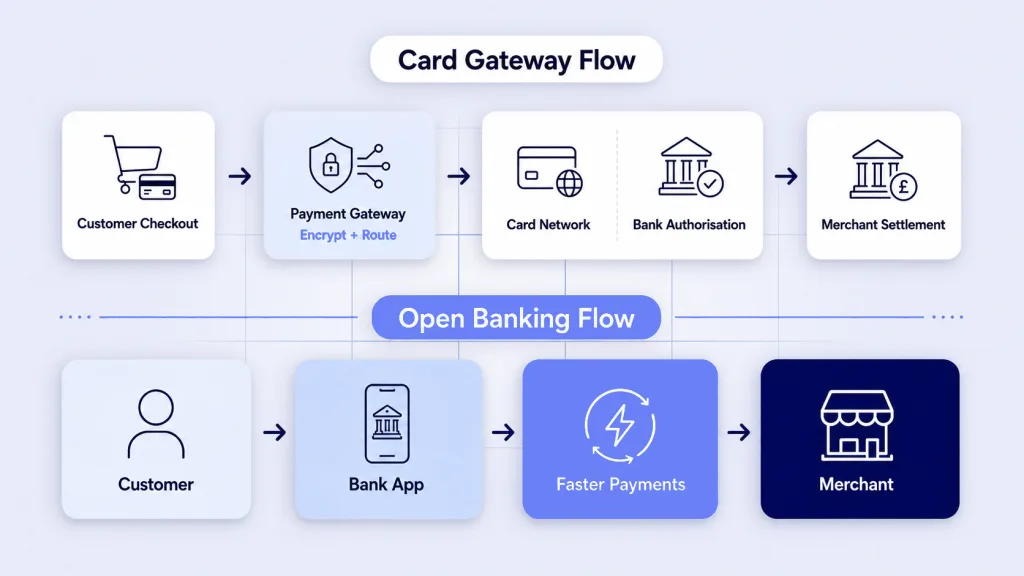
Payment gateways are the infrastructure layer between your customer’s card and your bank account.
When a customer pays online, the payment gateway captures their card data, encrypts it, sends it to the card network for authorisation, and returns an approval or decline in seconds. The actual funds settle later – typically the next day for most UK providers – via the card network and your payment processor.
The cost layers in a typical UK payment gateway:
- Interchange fee – paid to the card-issuing bank (capped in the UK at 0.2% debit, 0.3% credit under PSD2)
- Scheme fee – paid to Visa or Mastercard
- Gateway/processor margin – the provider’s fee on top
- Chargeback fee – £15-£20 per dispute raised
What most providers quote as their “transaction fee” bundles all three. At 1.5% + £0.20, Stripe’s blended rate includes interchange, scheme fees, and their own margin.
Open Banking Pay by Bank routes around the card network entirely. No interchange. No scheme fee. Settlement via Faster Payments, typically near-instant.
| Provider | UK transaction fee | Monthly fee | Payout speed | Best for |
|---|---|---|---|---|
| Stripe | 1.5% + £0.20 | None | Same day – 3 days | SaaS, subscriptions, developer platforms |
| Finexer Pay by Bank | Usage-based (no interchange) | None | Near-instant (Faster Payments) | Zero card fees via Open Banking |
| Square | 1.75% POS / 1.4% + £0.25 online | None | 1-2 business days | Small business, in-person + online |
| Checkout.com | Custom (volume-based) | None (custom) | Same day | High-volume ecommerce, enterprise |
| Adyen | £0.11 + method fee | None (settlement fee) | 1-2 business days | Enterprise, marketplaces, unified commerce |
| PayPal Braintree | From 1.2% + fixed fee | None | 1-3 business days | Global reach, wallets, B2C trust |
| Revolut Business | From 1% + £0.20 | None (plan-dependent) | Same/next day | UK SMEs with FX and international payments |
| Shopify Payments | ~1.7% + £0.25 | Shopify plan required | ~3 business days | Shopify stores only |
Verify current pricing with each provider before committing. Fees correct at time of writing - May 2026.How Much Does a Payment Gateway Cost in the UK?
The headline transaction rate isn’t the full story.
A business taking £100,000 per month in card payments on Stripe’s standard 1.5% + £0.20 pays approximately £1,500 in percentage fees plus £200 in fixed fees – £1,700 per month before chargebacks, international card surcharges, or currency conversion.
The real cost breakdown:
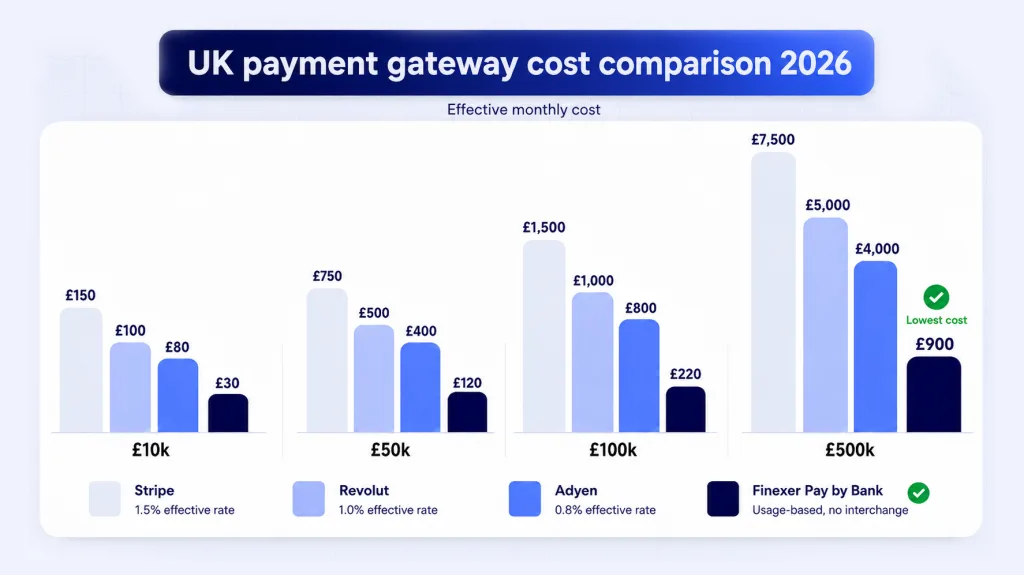
- Transaction fee – 1.4% to 2.9% depending on provider, card type (debit vs credit), and card origin (UK vs EU vs non-EU)
- Chargeback fee – £15 to £20 per dispute regardless of outcome
- Currency conversion – typically 1-2% on top of the transaction fee for non-GBP transactions
- PCI DSS compliance – self-assessment questionnaire or third-party audit costs for merchants running their own checkout pages
- Monthly minimums – some providers charge if you fall below a minimum monthly volume
| Cost element | Typical range | Who it applies to |
|---|---|---|
| Transaction fee (UK debit) | 1.4% – 1.75% | All merchants |
| Transaction fee (UK credit) | 1.5% – 2.9% | All merchants |
| International card surcharge | +0.5% to +1.5% | Merchants with international customers |
| Chargeback fee | £15 – £20 per dispute | Card gateways only |
| Currency conversion | 1% – 2% | Non-GBP transactions |
| Pay by Bank (Open Banking) | Usage-based, no interchange | A2A payment flows only |
“Most businesses I work with underestimate gateway costs by 30-40% because they only model the headline rate. Once you add international card surcharges, chargebacks, and currency conversion, the effective rate is often closer to 2.5-3% for businesses with mixed UK and international customers.” – Ravi, Finexer
1. Stripe: Best Payment Gateway for SaaS and Developer Platforms
Is Stripe the right payment gateway for UK businesses in 2026?
Among payment gateway providers UK SaaS teams evaluate, Stripe is the default choice for developer-led businesses and digital platforms. It isn’t the cheapest payment gateway UK businesses can find – but it offers the broadest feature set and the cleanest integration experience.
Updated 2026 pricing:
- UK standard cards: 1.5% + £0.20 per transaction (updated from previous 1.4%)
- EU cards: 2.5% + £0.20
- Non-EU international cards: 3.25% + £0.20
- Chargebacks: £20 per dispute
- Recurring billing: +0.5%
What Stripe does well:
- API-first architecture – developers can customise every element of the payment flow
- 135+ currencies with local payment method support
- Built-in subscriptions, invoicing, and recurring billing
- Direct integration with Shopify, WooCommerce, Magento, and custom stacks
- Strong fraud protection via Stripe Radar
The honest trade-off: The 1.5% rate is competitive for UK domestic transactions but becomes expensive when your customer base is international. A business with 30% non-EU customers effectively pays a blended rate closer to 2.5%. For high-volume merchants, Stripe’s custom pricing is worth negotiating.
Stripe increased its UK standard rate from 1.4% to 1.5% + £0.20 in 2024. Most businesses missed it. At £50,000/month that is £500 extra per year – buried in a product changelog.
For platforms evaluating how payment API integration sits within their stack, card gateways return tokenised card data while Open Banking returns bank-confirmed transaction data – fundamentally different for reconciliation.
2. Finexer Pay by Bank: The Open Banking Alternative
Where does Finexer fit among UK payment gateway providers?
Finexer isn’t a card payment gateway. It’s an FCA-authorised Open Banking payment infrastructure that routes transactions directly bank-to-bank, without touching the card network.
The customer pays from their mobile banking app via a QR code or payment link. No card details. No card network. No interchange fee. Settlement via Faster Payments, typically near-instant.
This changes the cost model significantly for high-volume merchants.
At £50,000/month in card payments on a 1.5% blended rate, the transaction cost is £750. Open Banking Pay by Bank removes the interchange and scheme fee from that calculation – the savings compound as volume grows.
| Feature | Finexer Pay by Bank | Card Payment Gateway |
|---|---|---|
| Interchange fee | None | 0.2-0.3% of transaction |
| Scheme fee | None | Included in gateway rate |
| Chargebacks | None – bank-authorised and final | £15-£20 per dispute |
| Settlement speed | Near-instant via Faster Payments | 1-3 business days |
| Hardware required | None – QR code or payment link | Card terminal or hosted checkout |
| UK bank coverage | Almost all major UK banks | All card-issuing banks |
37.46 million Open Banking payments were made in March 2026 (Open Banking Limited). Pay by Bank is no longer experimental – it is operational infrastructure used by UK platforms across billing, EPOS, and online checkout.
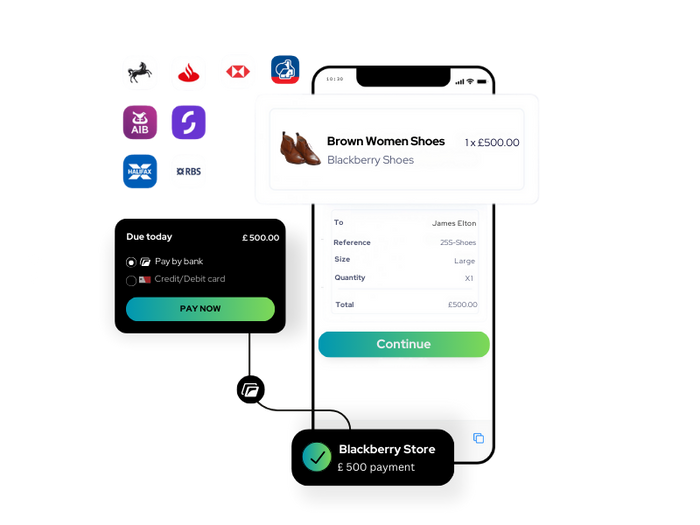
For platforms evaluating alternative payment methods beyond card gateways, Pay by Bank sits alongside – not instead of – card acceptance for most businesses.
Where Pay by Bank works best:
- Invoice payments – B2B invoices above £500 where card fees compound
- EPOS high-volume – retailers processing £20k+/month in card payments
- Payroll and marketplace disbursements – per-recipient confirmation via webhook
- Subscription billing alongside a card gateway – route high-value renewals via bank transfer
- FCA-authorised (FRN 925695)
- Usage-based pricing, no setup fees, deployment measured in weeks
How Does Pay by Bank Actually Work?
Understanding where it fits changes how you think about your checkout options.
Step-by-step: customer to merchant
- Customer selects Pay by Bank at checkout
- Platform initiates payment via Open Banking PIS (Payment Initiation Service)
- Customer is redirected to their own banking app
- Strong Customer Authentication (SCA) happens inside the bank app – biometrics or PIN
- Customer confirms the payment amount and recipient
- Bank executes the transfer via Faster Payments
- Platform receives webhook confirmation – initiated, confirmed, or failed
- Funds arrive near-instantly in the merchant’s account
Where SCA happens matters. With card payments, SCA is a friction point in the checkout flow – the 3DS redirect that causes drop-offs. With Pay by Bank, SCA happens inside the customer’s own banking app, which they already use daily. The experience is familiar. The friction is lower.
Faster Payments settlement. Pay by Bank routes through the UK Faster Payments Service – the same infrastructure behind bank transfers since 2008. Settlement is near-instant, 24/7, 365 days a year. There is no T+1 clearing window. No next-day batch. The merchant receives confirmation at the point of payment.
| Feature | Card Payment Gateway | Pay by Bank (Open Banking PIS) |
|---|---|---|
| Payment route | Customer → card network → acquirer → merchant | Customer → bank app → Faster Payments → merchant |
| SCA friction | 3DS redirect mid-checkout (drop-off risk) | Inside customer’s own bank app (familiar flow) |
| Interchange fee | 0.2-0.3% (capped under PSD2) | None |
| Chargebacks | £15-£20 per dispute | None – payment is bank-authorised and final |
| Settlement speed | T+1 to T+3 | Near-instant via Faster Payments (24/7) |
| Reconciliation | Reference may be lost at card network | Payment reference embedded at initiation |
AIS vs PIS – a quick distinction. PIS (Payment Initiation Service) is what Pay by Bank uses – it initiates the actual payment. AIS (Account Information Service) is different – it reads bank transaction data and balances without moving money. Finexer provides both. For payment acceptance, PIS is the relevant product.
3. Square: Best Payment Gateway for Small Business and Hybrid Retail
When does Square make the most sense as a UK payment gateway?
Among best payment gateways UK small businesses consider, Square works best for those needing in-person and online payments on one platform.
Verified 2026 pricing:
- In-person POS: 1.75% per transaction
- Online/keyed-in: 1.4% + £0.25 per transaction
- Reader hardware: £19 + VAT
Square combines a point-of-sale app, online checkout builder, invoicing, and inventory management into one platform. It is not the cheapest payment gateway UK providers offer for high volume – but for businesses under £15,000 per month, the simplicity and zero monthly fee make it a practical starting point.
Where it gets expensive: The 1.75% flat rate on in-person payments adds up at scale. A business taking £20,000/month in card payments pays £350 per month in fees. SumUp at 1.69% saves around £1.20 per £100 versus Square. Revolut at 0.8% saves around £9.50 per £100 at equivalent volume – but requires a Revolut Business account.
4. Checkout.com: Best Payment Gateway for Scaling Ecommerce
Which UK businesses benefit most from Checkout.com?
Among payment gateway providers for scaling ecommerce, Checkout.com suits mid-sized to enterprise businesses that need custom pricing, direct card scheme access, and deep visibility into payment data.
Unlike Stripe’s published rates, Checkout.com negotiates pricing based on volume – typically achieving lower effective rates for businesses processing £500,000+ per month. The platform offers modular APIs, direct access to 150+ local and global payment methods, and a fraud detection engine with real-time routing optimisation.
What makes it different from Stripe: Checkout.com’s direct acquiring relationships can produce lower interchange costs at volume. For high-volume merchants, the effective rate through Checkout.com can be lower than Stripe’s standard 1.5%.
The catch: Checkout.com isn’t designed for early-stage businesses. The onboarding process is longer and the custom pricing model requires negotiation. Under £100,000/month, Stripe or Square are more practical.
5. Adyen: Best Payment Gateway for Enterprise and Marketplaces
Is Adyen worth the complexity for UK businesses?
Adyen is the right choice among best payment gateways UK enterprises and large marketplaces should evaluate when they need a single platform across in-store, online, and mobile with a unified view of reconciliation and risk.
Pricing model:
- Processing fee: £0.11 per transaction (fixed)
- Method fee: charged on top (varies by card type, region, payment method)
- Settlement fee: small fee on each settlement cycle
The interchange++ pricing model means Adyen passes through actual interchange costs rather than blending them into a flat rate. For large volumes of low-interchange debit transactions, this can be significantly cheaper than Stripe’s blended 1.5%.
Worth knowing: Adyen requires a minimum monthly processing volume (typically £100,000+) to be viable. Below that, setup complexity and minimum fees make Stripe or Square more practical.
6. PayPal Braintree: Best Payment Gateway for Global Reach and Consumer Trust
Does PayPal Braintree still make sense for UK businesses in 2026?
Among payment gateway providers with global wallet support, Braintree’s main advantage is the PayPal brand at checkout – which still drives meaningful conversion for B2C businesses where consumer trust affects purchase completion.
Pricing:
- From 1.2% + fixed fee per transaction (card)
- PayPal transactions: separate rate
- No setup or monthly fee
- 3D Secure 2.0 included
Braintree combines cards, PayPal, Apple Pay, Google Pay, and recurring billing through one integration. For B2C businesses, the PayPal trust signal still moves conversion – particularly for first-time buyers on unfamiliar brands.
The real risk: PayPal account freezes and holds are well-documented in UK business forums. For businesses where payment timing is critical, the risk of account review disrupting cash flow is real. Mitigated – but not eliminated – by PayPal’s dispute process.
7. Revolut Business: Best Payment Gateway for UK SMEs With FX Needs
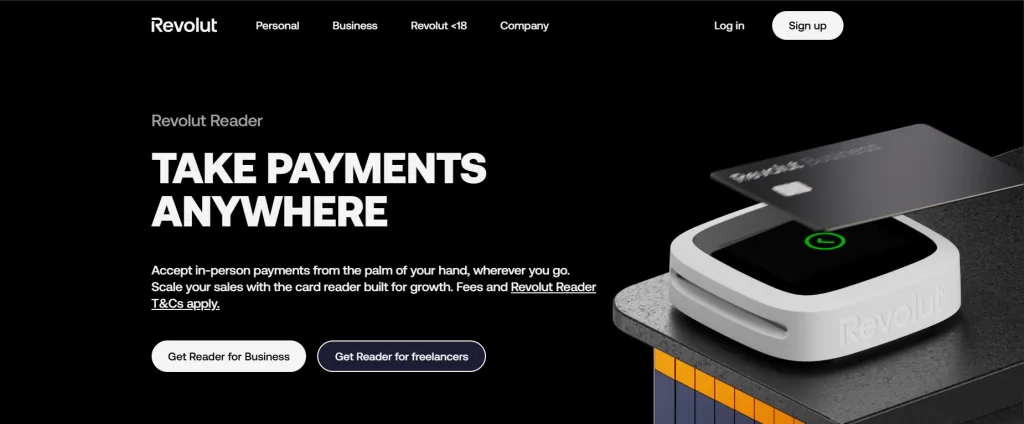
Who benefits most from Revolut Business as a payment gateway?
For best payment gateways to UK SMEs with FX needs, Revolut Business suits those already banking with Revolut and need competitive FX rates alongside card acceptance – without the cost of a separate payment gateway and FX account.
Pricing:
- Online transactions: from 1% + £0.20
- In-person (Revolut Reader): 0.8% + £0.02 (up to £2,000/month)
- No setup fee
- Monthly plan may apply for premium features
The combination of same-day or next-day payouts, competitive FX rates, and low transaction fees makes Revolut Business one of the better payment gateway options for UK businesses that invoice internationally or pay suppliers in foreign currency.
The limitation: Requires a Revolut Business account. If you bank elsewhere, the payout and FX advantages disappear. Not suitable as a standalone payment gateway for businesses that need multi-currency settlement outside the Revolut ecosystem.
8.(additional) Shopify Payments: Best Payment Gateway for Shopify Stores
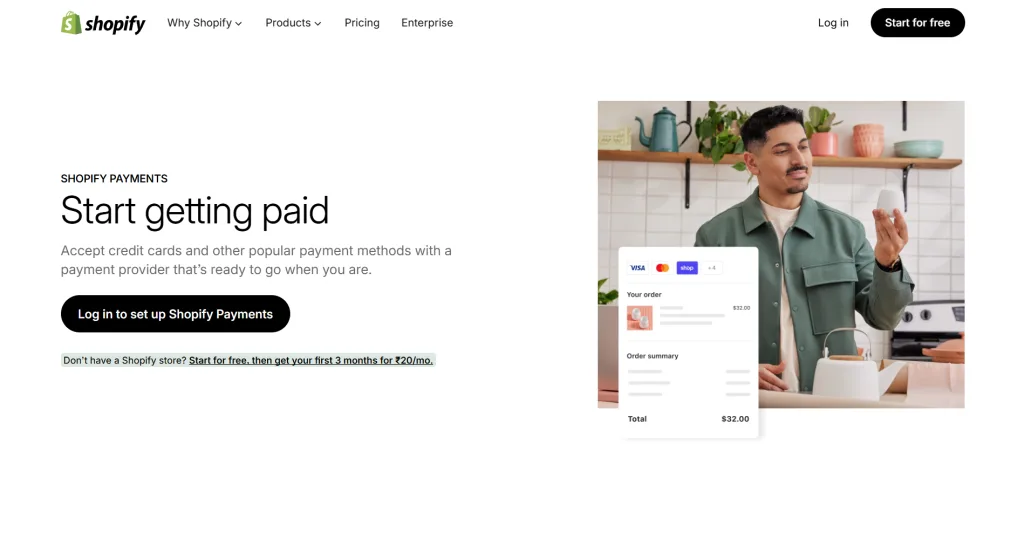
Is Shopify Payments the right gateway for all Shopify stores?
Among best payment gateways UK Shopify merchants consider, Shopify Payments eliminates the third-party transaction fee (0.5-2% that Shopify charges when you use an external gateway) and integrates natively with Shopify’s inventory, fraud tools, and checkout.
Pricing:
- Basic plan: ~1.7% + £0.25 per online transaction
- Shopify plan: ~1.6% + £0.25
- Advanced plan: ~1.5% + £0.25
- No additional transaction fee for Shopify Payments (vs 0.5-2% for external gateways)
For any Shopify store with meaningful volume, using an external gateway adds the Shopify platform transaction fee on top of the gateway’s own fee – making Shopify Payments the default rational choice for Shopify merchants.
Platform lock-in: Shopify Payments only works within Shopify. If you migrate platforms, you migrate payment gateways. And payout at ~3 business days is slower than Stripe or Revolut.
How to Choose the Right Payment Gateway for Your UK Business
After working with payment platforms across EPOS, SaaS, and B2B invoicing, the same mistake comes up repeatedly: businesses choose a gateway based on the brand name or a founder recommendation – not their actual volume and customer mix.
Four variables determine the right payment gateway. Brand preference comes fifth.
Transaction volume. Under £10,000/month: Stripe or Square – simple, easy setup. £10,000-£100,000/month: model the effective rate across your transaction mix (UK vs international, debit vs credit). Over £100,000/month: negotiate custom pricing with Checkout.com or Adyen, or model Open Banking Pay by Bank for high-frequency flows.
Customer location. UK-domestic transactions attract lower interchange under PSD2 regulation. Significant international customer base means international card surcharges (0.5-1.5%) compound into meaningful costs. Factor this into the comparison.
Business model. Subscription billing: Stripe. Physical retail: Square or Revolut. Marketplace payouts: Adyen. Shopify store: Shopify Payments. High-volume B2B invoicing: Open Banking Pay by Bank.
Payout speed. Cash-flow-sensitive businesses should factor settlement timing into the comparison. Revolut same-day, Stripe same-day to 3 days, Shopify 3 days. Open Banking near-instant.
“The businesses I see getting payment costs right in 2026 have done one thing differently: they modelled their actual effective rate, not the headline rate. That means running the numbers on their real transaction mix – domestic vs international, debit vs credit, average order value vs chargeback frequency.” – Ravi, Finexer
For businesses comparing best contactless payment systems alongside payment gateway options, hardware and software costs should be modelled together – not separately.
What is PIS and how does it differ from a payment gateway?
PIS (Payment Initiation Service) is the Open Banking mechanism that initiates bank-to-bank payments directly. A traditional gateway routes card transactions through Visa or Mastercard. PIS removes the card network – payment goes directly bank-to-bank via Faster Payments. No interchange, no scheme fee, no chargeback risk.
Is Pay by Bank secure?
Yes. Pay by Bank operates under FCA regulation via authorised Payment Initiation Service Providers. The customer authenticates directly inside their own banking app using biometrics or PIN – the merchant never sees bank credentials. Strong Customer Authentication (SCA) is built into the flow, meeting the same regulatory standard required for card payments.
How fast are Faster Payments settlements?
Faster Payments typically complete in seconds, 24 hours a day, 365 days a year. There is no T+1 batch window. Merchants receive webhook confirmation at the point of payment. Settlement lands near-instantly in the receiving account – significantly faster than the 1-3 business day window for most card gateway payouts.
How long do UK payment gateway payouts take?
Revolut Business: same day. Stripe: same day to 3 business days. Square: 1-2 business days. Checkout.com: same day. Adyen: 1-2 business days. Shopify Payments: approximately 3 business days. Finexer Pay by Bank: near-instant via Faster Payments.
Still Comparing Payment Gateways? See how Finexer stacks up as an affordable, card-free alternative for UK businesses
About the Author

Ravi Ranjan
Ravi Ranjan is Co founder & CEO of Finexer