
Your conveyancing client needs a source of wealth verification before matter opening. You request bank statements and employment proofs. Three days later, you’re still chasing incomplete documents. The client sends outdated statements with missing pages. Your fee-earner spends billable hours reviewing partial evidence whilst the matter sits unopened.
Automated source of wealth checks solve this by connecting directly to client bank accounts through regulated open banking. Client consents via banking app, system retrieves transaction history showing income sources, verification completes within minutes. No document requests. No delays. No incomplete evidence creating compliance gaps.
Why Manual Verification Creates Operational Problems

Most law firms request clients to provide bank statements, payslips, and investment proofs manually. Clients delay gathering documents. Evidence arrives incomplete or outdated. Fee-earners waste billable time chasing and reviewing submissions.
What this creates:
- Delayed case opening – Conveyancing completions miss target dates whilst waiting for verification
- Lost billable hours – Fee-earners spend time on admin instead of client work
- Compliance risk – Incomplete files create AML audit vulnerabilities
- Poor client experience – High-net-worth clients question firms using manual processes
The fundamental issue: document-based verification depends on client responsiveness whilst consuming fee-earner capacity that should focus on legal work.
How Automated Verification Works
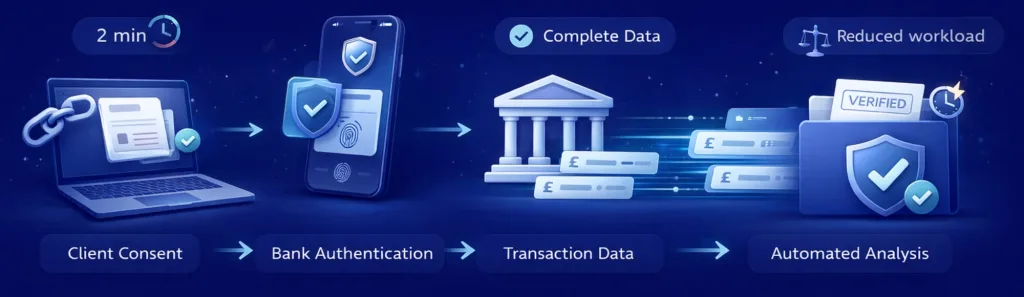
Open banking enables direct access to client bank transaction data with consent. The process:
- Client receives secure verification link during onboarding
- Authenticates through familiar banking app (not new passwords)
- System retrieves historical transactions (up to 7 years available)
- Income sources categorised automatically – salary, investments, property, business
- Verification report generates for compliance files
Completion time: minutes instead of days waiting for client document submission.
What I’ve Seen Work in Practice
Working with law firms implementing automated verification reveals consistent patterns:
Manual collection creates bottlenecks clients control. Traditional requests depend on busy clients finding documents. Automated consent takes 2 minutes through banking apps they already use.
Evidence quality varies dramatically with submissions. Clients provide cropped statements or outdated documents. Direct bank data ensures complete, current information without client-introduced gaps.
Fee-earner review compounds across caseload. Each manual file requires reviewing submissions, identifying gaps, requesting more evidence. Automation flags income sources automatically-human review only for complex patterns.
Source of Funds vs Source of Wealth: Understanding the Difference
Law firms need both but they serve different purposes:
| Verification Type | What It Proves | Typical Use |
| Source of wealth | How client accumulated total assets over time | Initial client onboarding |
| Source of funds | Where specific transaction money originated | Property deposit verification |
Law firms typically verify source of wealth during onboarding, then source of funds for specific deposit payments. Automated systems address both through transaction analysis.
What to Evaluate in Verification Solutions
When selecting systems for law firm clients:
UK bank coverage – 99% coverage minimises manual fallbacks for unsupported banks
Historical access – Several years of data demonstrates long-term wealth accumulation patterns
Evidence export – Compliance audits require documentation integrating with client files
Simple integration – API connections to existing onboarding workflows without infrastructure rebuilds
Usage-based pricing – Pay per verification rather than fixed contracts for uncertain caseloads
How Finexer Enables Automated Verification
Finexer provides open banking connectivity for automated source of wealth checks on law firm clients. The platform connects to 99% of UK banks through FCA-regulated infrastructure.
Historical data extends up to 7 years for supported banks, enabling thorough verification. Simple API and dashboard interfaces integrate with existing client onboarding systems.
Pricing works on actual verifications performed rather than fixed fees. Law firms with variable caseloads pay for checks conducted without minimum commitments.
The platform provides 3-5 weeks of dedicated onboarding support helping verification workflows align with your compliance requirements and matter management systems.
What is source of wealth verification for law firms?
Confirming how clients accumulated assets over time through employment, investments, or business activities rather than just verifying identity or specific transaction funds.
How does this differ from standard ID checks?
ID verification confirms identity, source of wealth explains asset accumulation history, and source of funds traces specific money-law firms typically need all three.
Can automated systems handle complex client accounts?
Systems identify standard income patterns whilst flagging unusual transactions for manual review rather than attempting full automation of edge cases.
What historical data do clients need?
Typically several years demonstrating consistent income and wealth patterns, with duration depending on client circumstances and regulatory guidance.
How does open banking affect client privacy?
Clients grant temporary consent for specific verification, not ongoing monitoring-access expires after completion.
Ready to Automate Client Verification?
See how Finexer enables source of wealth checks in minutes instead of days
Book Demo NowAbout the Author

Ravi Ranjan
Ravi Ranjan is Co founder & CEO of Finexer