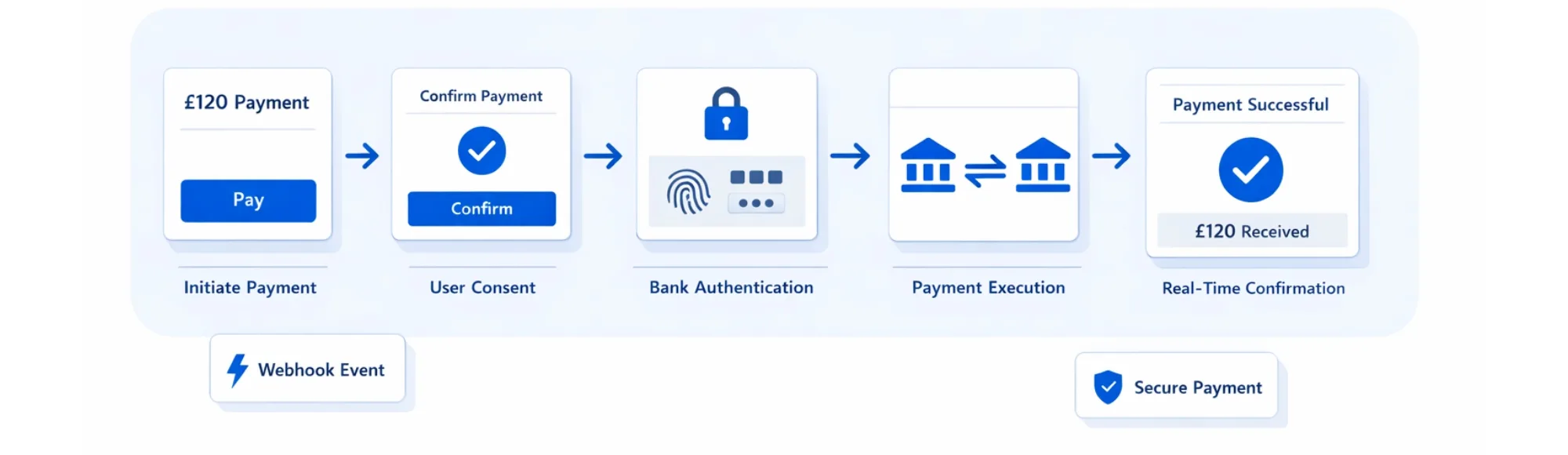
Building Pay by Bank into your platform?
Finexer gives UK platforms FCA-authorised PIS infrastructure – payment initiation, real-time confirmation, API-ready.
When product and engineering teams ask me about open banking payment flow, they are rarely asking what Open Banking payments are. They already know. What they want to understand is how the flow actually works inside their product – what each step involves, what the system receives at each stage, and where the failure points are.
That is what this blog covers.
At Finexer, I work with EPOS platforms, SaaS billing tools, payroll infrastructure, and fintech teams building embedded payment journeys. The open banking flow question comes up consistently during architecture discussions – not as a general concept question but as a system design question. How do we build this reliably?
This blog explains the open banking payment flow step by step from a platform architecture perspective – what happens at each stage, what the platform receives, and how Finexer’s PIS infrastructure powers the flow.
TL;DR
An open banking payment flow is the sequence of steps that moves a payment from user selection to confirmed settlement via PIS – without card networks. The open banking flow involves payment initiation, user consent, bank authentication via SCA, payment execution, and real-time confirmation via webhook. Finexer provides FCA-authorised PIS infrastructure enabling platforms to build this flow across 99% of UK banks.
Key Takeaways
What is an open banking payment flow?
An open banking payment flow is the structured sequence of steps that allows a user to pay directly from their bank account through a platform – covering payment initiation, consent, bank authentication, execution, and confirmation. It is powered by Payment Initiation Services (PIS) infrastructure.
What is the open banking flow from a platform architecture perspective?
The open banking flow involves five stages: payment request creation, user consent, SCA authentication at the bank, payment execution via PIS, and real-time webhook confirmation back to the platform. Each stage has a defined system interaction that platform architecture must handle.
Why does payment flow design matter for platform conversion and reliability?
A poorly designed open banking flow creates friction at the authentication step, produces unclear payment status signals, and breaks reconciliation workflows. A well-designed flow reduces drop-off, delivers instant confirmation, and feeds downstream platform logic automatically.
How does Pay by Bank differ from card payment flow at a system level?
Card payment flows pass through processor networks with variable settlement timing. Open banking payment flow initiates directly from the user’s bank account – settlement confirmation arrives via webhook at point of transaction, not in an end-of-day batch.
What does Finexer provide for open banking payment flow infrastructure?
Finexer provides FCA-authorised PIS infrastructure covering 99% of UK banks – handling payment request creation, consent flow management, SCA authentication redirect, payment execution, and real-time webhook confirmation within a single platform integration.
What Is an Open Banking Payment Flow?
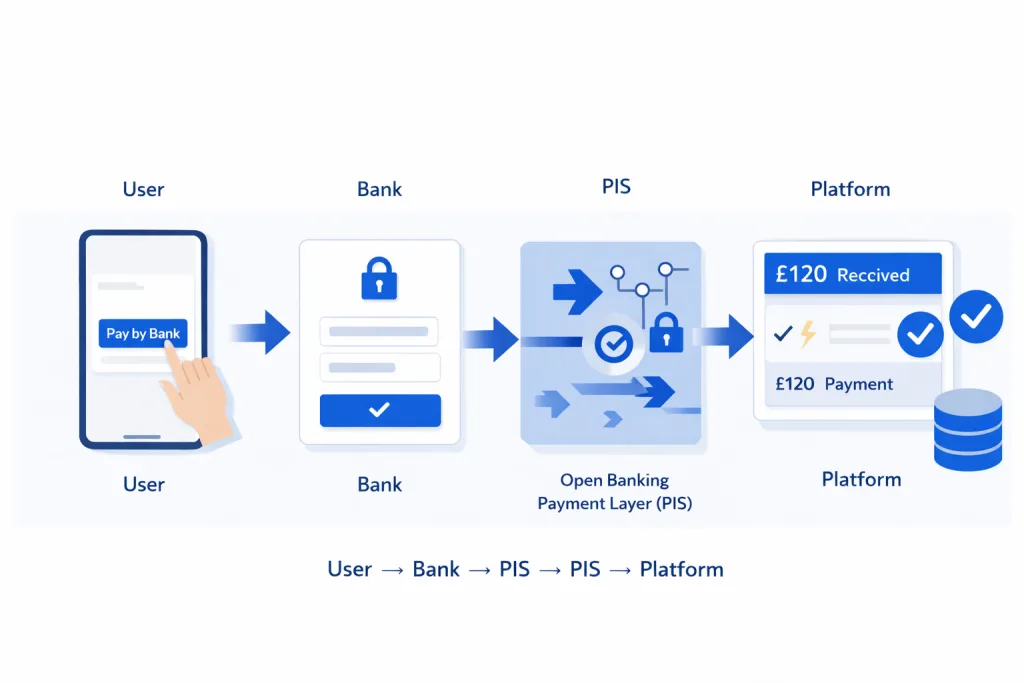
An open banking payment flow is the end-to-end sequence that moves a payment from the moment a user selects Pay by Bank to the point the platform receives confirmed settlement.
Unlike card payments, which route through processor networks and settle in batches, open banking payment flow initiates directly from the user’s bank account via PIS. There is no card network in the middle. Settlement confirmation arrives in real time.
For platforms, understanding the open banking flow at a system level is what determines whether the payment journey is reliable, conversion-optimised, and correctly integrated with downstream workflows.
“Open banking payment flow is not a single API call. It is a multi-stage consent and execution sequence – each stage produces a system event the platform must handle correctly.” – Yuri, Finexer
The complete guide to Open Banking payment covers the broader payment landscape context for platforms evaluating Open Banking payments.
How Does the Open Banking Payment Flow Work Step by Step?
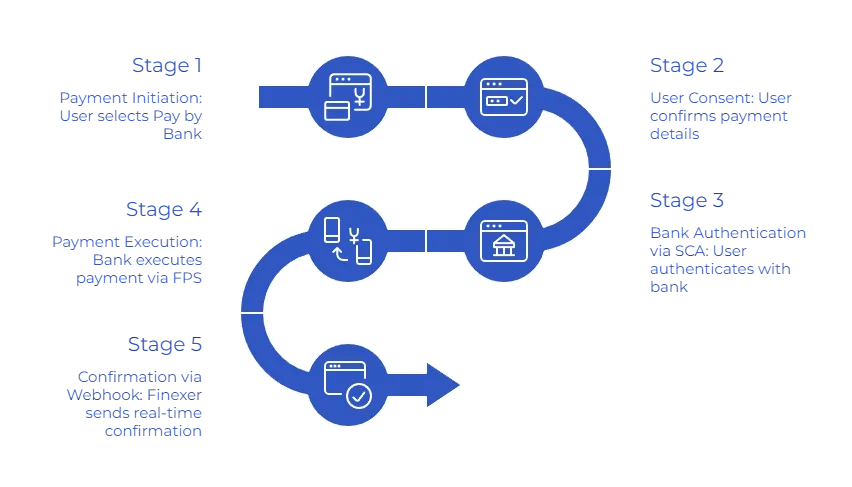
Here is the open banking flow from initiation to confirmation – what happens at each stage and what the platform receives.
Stage 1 – Payment Initiation
The user selects Pay by Bank at checkout or invoice. The platform creates a payment request via Finexer’s PIS API – specifying amount, payee details, and payment reference.
The platform receives a payment ID and a redirect URL at this stage. The redirect URL is where the user will authenticate with their bank.
Stage 2 – User Consent
The user is presented with the payment details for confirmation before authentication. This is the consent step – the user explicitly approves the payment amount and payee before proceeding to their bank.
Consent in the open banking flow is payment-specific. Unlike AIS consent which covers data access over a period, PIS consent is tied to a single payment instruction with a specific amount and recipient.
Stage 3 – Bank Authentication via SCA
The user is redirected to their bank’s authentication screen. Strong Customer Authentication is completed – typically via banking app biometric or mobile OTP.
The platform does not see or handle authentication credentials at this stage. Authentication happens entirely between the user and their bank. The platform receives a callback signal once authentication is complete.
Stage 4 – Payment Execution
Once authenticated, the bank executes the payment instruction via the UK Faster Payments Service. The payment moves directly from the user’s bank account to the payee account – no card network, no processor intermediary.
Payment execution timing is typically near-instant via FPS for supported UK banks.
Stage 5 – Confirmation via Webhook
Finexer’s PIS infrastructure sends a real-time webhook to the platform confirming payment status – completed, pending, or failed. The platform’s system updates order status, triggers fulfilment workflows, or surfaces confirmation to the user based on the webhook event.
This is the critical stage for platform reliability. Platforms that poll for payment status rather than consuming webhooks introduce latency and missed confirmation events.
How Should Platforms Evaluate Open Banking Payment Flow Infrastructure?
| Criteria | Why It Matters | What to Look For |
|---|---|---|
| UK Bank Coverage | Open banking flow gaps mean some users cannot complete Pay by Bank | 99% UK bank coverage; CMA9 and challenger banks; consistent flow across institutions |
| Real-Time Webhooks | Platform workflows depend on instant payment status signals – not polling | Webhook-driven confirmation; failed payment events; payment status callbacks |
| White-Label Consent Flow | Branded payment journeys maintain user trust at the authentication step | White-label PIS consent UI; customisable redirect flow; branded confirmation screens |
| Failed Payment Handling | EPOS and billing platforms need instant visibility into payment failures | Failure webhook events; retry capability; clear payment status codes |
| Payout Capability | Platforms needing both collections and disbursements need PIS for both directions | Instant payout; bulk payout; account-to-account transfers via PIS |
| FCA Authorisation | UK platforms must use regulated PIS providers for compliant payment initiation | FCA-authorised PIS; GDPR-compliant; SCA-enforced authentication |
How Does Finexer Power Open Banking Payment Flow?
Finexer provides FCA-authorised PIS infrastructure that powers the complete open banking payment flow for UK platforms – from payment request creation to real-time webhook confirmation.
What Finexer’s PIS infrastructure provides:
- Payment initiation covering 99% of UK bank accounts
- Real-time webhooks for instant payment confirmation and failure detection
- White-label consent flows for branded Pay by Bank journeys
- Instant payout and bulk payout for platforms managing disbursements
- SCA-enforced bank authentication within the payment flow
- FCA-compliant payment initiation under UK Open Banking regulation
- Usage-based pricing
For platforms also needing bank transaction data alongside payments, Finexer’s AIS provides settlement verification – confirming bank transaction records match payment confirmations within the same infrastructure layer.
Finexer’s payment infrastructure covers the full PIS product capabilities in detail.
Finexer utility billing use case and Finexer accounting and ERP use case show how the open banking flow applies across platform verticals.
What I Feel
The open banking payment flow question I get from engineering teams is almost always framed around the webhook stage – specifically, what happens when the webhook does not arrive.
That is the right question to ask during architecture design. The flow itself is well-defined. The failure modes are where platforms need to invest in defensive design – timeout handling, retry logic, and status reconciliation against AIS transaction data when webhook delivery is delayed.
Platforms that design for the failure cases from the start build more reliable open banking flows than those that handle it as an afterthought. The happy path is straightforward. The edge cases are where payment infrastructure quality becomes visible.
Common Use Cases

EPOS & Payment Platforms
EPOS platforms embed Finexer’s open banking payment flow to accept Pay by Bank at point of sale. The flow initiates from the payment terminal, redirects the customer to their banking app for SCA authentication, and delivers real-time confirmation via webhook – updating transaction status instantly without waiting for card processor batch reports.
SaaS Billing & Invoicing Platforms
SaaS billing platforms use Finexer’s PIS to embed Pay by Bank invoice payment within the platform workflow. The open banking flow triggers at invoice approval – the client authenticates via their bank, payment executes via FPS, and the platform receives webhook confirmation that updates invoice status automatically.
Payroll & Contractor Platforms
Payroll platforms use Finexer’s bulk payout capability to initiate contractor and employee disbursements via open banking flow. Multiple payment instructions execute in a single operation – each generating individual webhook confirmation events that feed payroll settlement records without manual payment tracking.
Utility Billing Platforms
Utility platforms use Finexer’s PIS to implement Request-to-Pay billing via open banking payment flow. Customers authenticate and approve bill payments directly from their banking app. Real-time confirmation feeds billing system records – replacing manual payment matching with webhook-driven settlement confirmation per billing cycle.
Accounting & ERP Platforms
Accounting platforms integrate open banking flow to enable Pay by Bank supplier payments within ERP workflows. Payment initiation triggers at approval stage. Webhook confirmation updates payment records automatically – removing the external banking portal step from supplier payment workflows entirely.
What is an open banking payment flow?
An open banking payment flow is the structured sequence of steps that moves a payment from user initiation to confirmed settlement via PIS – covering payment request creation, user consent, SCA bank authentication, payment execution via Faster Payments, and real-time webhook confirmation back to the platform.
What is the open banking flow from a technical platform perspective?
The open banking flow from a platform perspective involves five system interactions – payment request via PIS API, consent presentation, SCA authentication redirect, payment execution confirmation, and webhook delivery. Each stage produces a system event the platform must handle to maintain payment status accuracy and trigger downstream workflows.
Is Finexer suitable for platforms building open banking payment flow infrastructure?
Yes. Finexer is FCA-authorised and provides PIS infrastructure covering 99% of UK banks – with real-time webhooks, white-label consent flows, bulk payout capability, and SCA-enforced authentication. Platforms integrate once through Finexer’s PIS API and access the com.
Build reliable open banking payment flow with FCA-authorised PIS infrastructure.
About the Author

Yuri
Yuriy Yakushko is a fintech founder and software engineer with over 20 years of experience building financial technology. He’s passionate about creating scalable, secure infrastructure that helps businesses modernise how they access financial data and manage payments.