Tenant referencing infrastructure for lettings platforms.
Bank-verified financial data for affordability and fraud workflows.
Tenant referencing passed perfectly on paper. Payslip looked right. Bank statements matched. Three months later the rent stopped.
The income had been fabricated. The PDF payslip was edited. The bank statement was doctored to match.
This is the systematic risk in tenant referencing: every platform running on document uploads carries it. Most platforms absorb it silently until a tenancy fails – at which point the fraud has already cost more than the referencing workflow ever saved.
Platforms built on manual document review are absorbing that risk. The ones that have integrated bank-verified income data are not.
“The landlords and platforms that get hurt by tenancy fraud are not the ones that skipped referencing. They are the ones that ran referencing documents that could be – and were – fabricated. The document is not the verification. Bank-verified data is.” – Ravi, Finexer
TL;DR
54% of fraudulent UK tenancy applications involve fake or doctored payslips (Goodlord, 300,000+ applications, 2022). Open Banking AIS replaces the document upload step – income verified directly from the bank account. For tenant referencing companies UK evaluating an upgrade, the core decision is: build FCA-authorised Open Banking access or integrate an existing authorised AIS provider.
Where the Document Fraud Risk Actually Sits
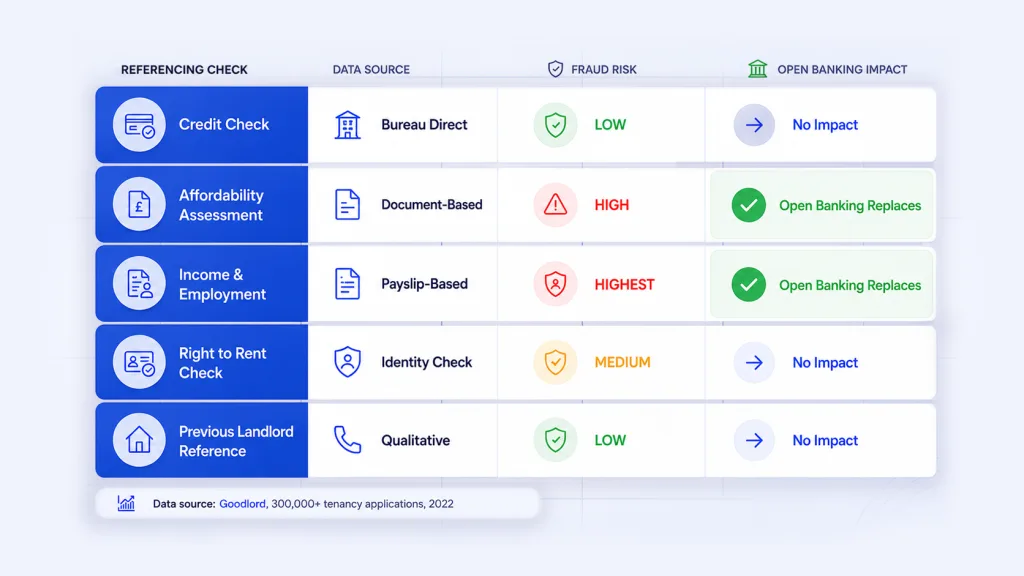
Why does income verification carry the highest fraud exposure in tenant referencing?
The credit check pulls data from credit bureaus directly. The applicant cannot edit it. The Right to Rent check uses identity documents verified digitally. The previous landlord reference is contacted directly.
The problem is affordability and income verification – the two checks that depend entirely on documents the tenant supplies.
UK standard: rent should not exceed 30-40% of gross monthly income. Most referencing providers require income at 2.5-3x the monthly rent. A tenant applying for a £1,500/month property needs verifiable gross income of at least £3,750-£4,500. That verification currently relies on payslips and bank statements that can be edited in minutes.
Payslip fraud accounts for 54% of proven fraudulent tenancy applications – the single biggest source of tenant referencing fraud risk – based on Goodlord’s analysis of over 300,000 applications. The fraud rate itself is around 1 in 1,000 – but the cost of a single fraudulent tenancy concentrates all of that risk in the income verification step.
| Referencing check | Data source | Fraud exposure | Open Banking impact |
|---|---|---|---|
| Credit check | Bureau (Experian, Equifax, TransUnion) | Low – pulled from source, not tenant-supplied | None – runs separately |
| Affordability assessment | Tenant-supplied documents | High – documents can be edited before submission | Replaces documents with bank-verified income data |
| Income and employment | Payslips and employer letters | High – 54% of tenancy fraud targets this step | Salary deposits confirmed directly from bank feed |
| Right to Rent | Identity documents | Medium – digital checks now standard | None – separate identity check |
| Previous landlord reference | Direct contact | Low – contacted directly | None – qualitative check |
Two checks carry the highest fraud exposure: affordability and income verification in tenant referencing. Both rely on tenant-supplied documents. Both are replaceable with bank-verified data. The other three checks are unaffected.
What Changes for Your Platform When You Integrate Open Banking
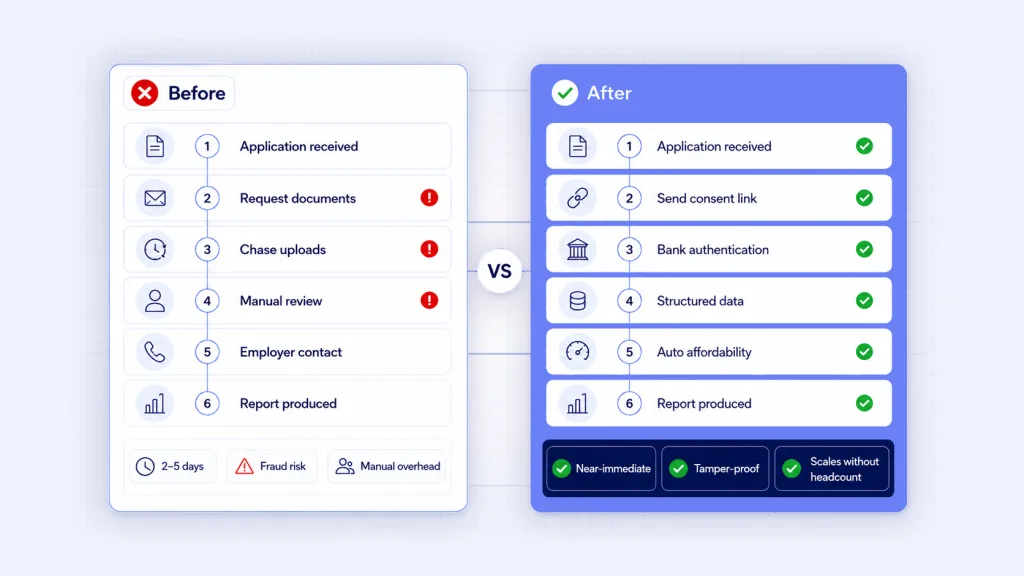
What does the operational shift look like for tenant referencing workflows?
The document-based tenant referencing model adds time at every step where a document can be missing, wrong, or delayed. The income check alone – payslips, bank statements, employer contact – typically takes two to five working days for standard employment cases. Self-employed tenants take longer.
Open Banking changes the income verification step specifically. The credit check, Right to Rent, and landlord reference remain as they are.
What your platform workflow looks like after integration:
The tenant receives a consent link. They authenticate with their own bank – no credentials shared with your platform. Your platform receives structured read-only transaction data: income deposits, outgoing patterns, payment history. The affordability calculation runs against bank-verified data, not uploaded documents.
No chasing. No re-formatting. No manual cross-check.
| Workflow element | Document-based | Open Banking-based |
|---|---|---|
| Income verification | Tenant uploads payslips and statements. Manual review required. | Tenant consents via bank. Structured data retrieved directly. |
| Fraud surface | Edited PDFs and fabricated payslips pass visual inspection. | Bank data is tamper-proof. Income must exist as actual deposits. |
| Self-employed applicants | Two years of accounts. Slow, document-heavy, often incomplete. | Irregular income patterns visible directly from transaction history. |
| Timeline | Two to five working days. Longer with employer delays. | Income data available near-immediately. References complete faster. |
| Audit trail | Document scans, manual notes, inconsistent formats. | Timestamped consent log. Structured transaction data per application. |
| Scalability | Volume growth = headcount growth for document review. | Volume handled by infrastructure. Manual review becomes exception handling. |
Platforms that have integrated Open Banking into income verification report completing references faster. Vorensys, a UK referencing platform, reported Open Banking references completing on average 1.5 days faster than employer reference-only checks (Vorensys, February 2026 internal data).
What to Evaluate Before Integrating Open Banking into Your Referencing Stack
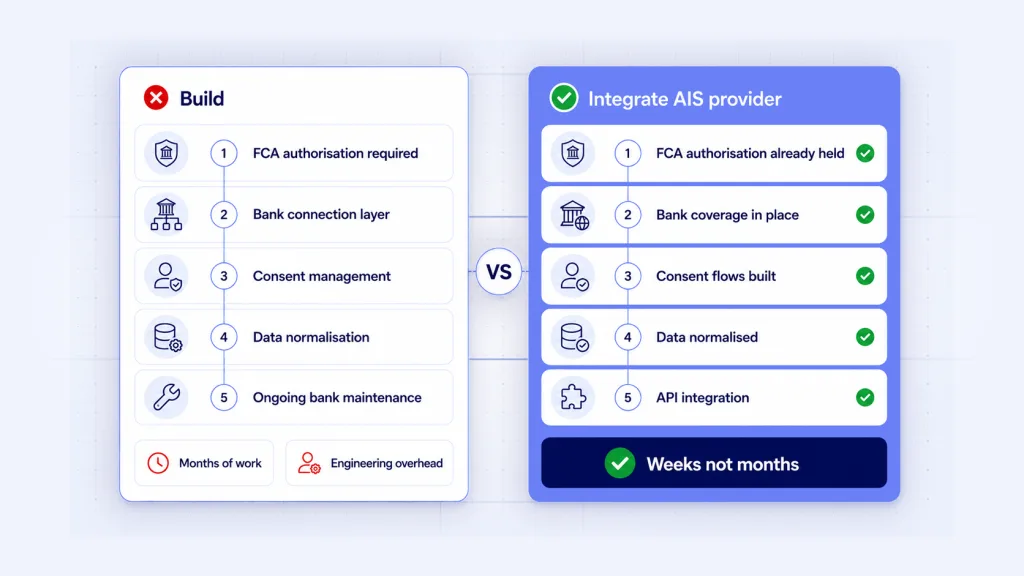
What are the four infrastructure decisions that determine whether this works at scale?
Tenant referencing companies UK moving to bank-verified workflows face one architecture decision before anything else: build FCA-authorised Open Banking infrastructure themselves or integrate an existing authorised AIS provider.
Building means: FCA authorisation, bank connection layer, consent management, data normalisation, webhook delivery, and ongoing bank maintenance. Months of work. Regulatory overhead. Internal engineering resource.
Integrating an FCA-authorised AIS provider into tenant referencing means: bank coverage already in place, consent flows built, data normalised, webhooks handled. Your team integrates against an API and focuses on the referencing logic.
Beyond the build-vs-integrate decision, four factors determine whether Open Banking referencing holds up in production.
Bank coverage. Your platform needs coverage across almost all major UK banks – Barclays, HSBC, Lloyds, NatWest, Santander, Halifax, Monzo, Starling. Gaps force a parallel document workflow for unsupported banks. That erodes most of the operational benefit.
Consent flow completion rate. The consent experience determines how many tenants complete the Open Banking step. A friction-heavy flow routes tenants back to document uploads. Consent flow design directly affects your referencing throughput.
Transaction data quality. Raw Open Banking data varies significantly across banks. Merchant identification and income categorisation need to be applied consistently before reaching your referencing logic. A data layer that normalises transaction data across supported banks is the difference between a workflow that holds across all applicants and one that breaks on edge cases.
Integration timeline. If your platform needs to be live within weeks rather than months, building from scratch is not viable. An FCA-authorised AIS provider with existing bank coverage and consent infrastructure compresses that timeline significantly.
For tenant referencing companies UK evaluating how the AIS integration sits within an existing workflow, the key point is that the platform’s own referencing logic – affordability calculation, decision rules, report format – does not change. The data feeding it does.
How Does Finexer Support Tenant Referencing Workflows?
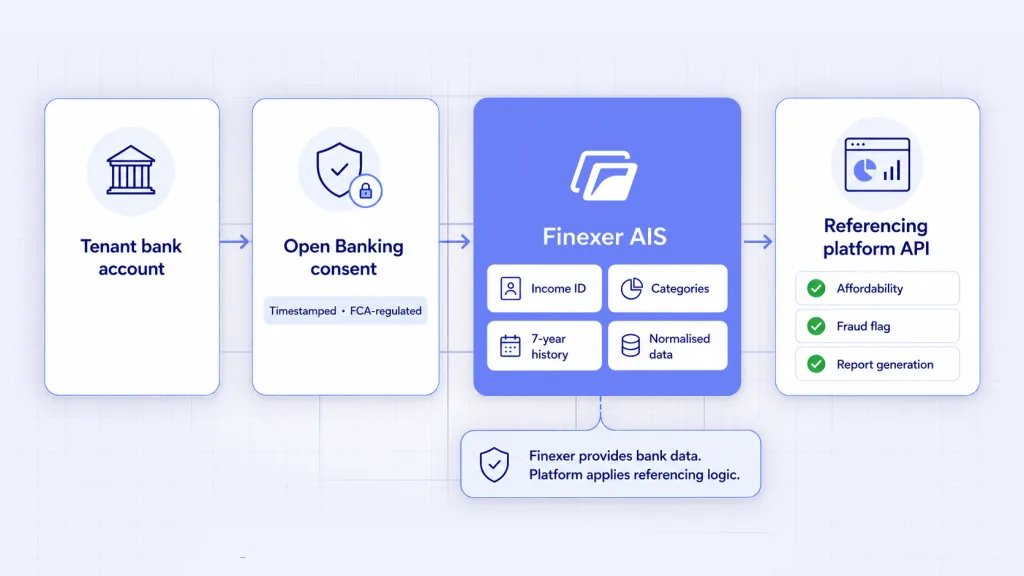
Finexer does not perform referencing. It does not make tenancy approval decisions, calculate affordability ratios, or produce referencing reports.
Finexer provides FCA-authorised Open Banking AIS – the bank transaction data infrastructure that let software providers, PropTech teams, and referencing platforms integrate as the financial data layer in their verification workflows.
What Finexer’s AIS provides for tenant referencing:
- Consent-based bank transaction data – tenant authenticates directly with their own bank
- Income deposit identification – salary credits, freelance payments, and regular deposits visible from transaction feed
- Outgoing payment patterns – rent, loan repayments, and recurring commitments identifiable across transaction history
- Transaction data across almost all major UK banks via single integration
- Up to 7 years of transaction history for income and payment pattern review
- Merchant identification and categorisation applied through the data layer
- Timestamped consent log and audit-ready transaction records per application
- Webhook delivery with retry logic designed to reduce missed-event gaps
What Finexer does not replace:
- Credit bureau checks (run separately by the referencing platform)
- Right to Rent verification (separate identity check)
- Previous landlord reference (qualitative, contacted directly)
- The platform’s own affordability calculation logic and referencing rules
The bank data layer feeds your tenant referencing platform workflow. Your platform builds the decision logic on top of it.
37.46 million Open Banking payments were processed in March 2026 (Open Banking Limited ). The infrastructure is production-ready. The question for tenant referencing platforms is whether to integrate it or continue absorbing the document fraud risk that manual workflows carry.
- FCA-authorised (FRN 925695)
- 3 to 5 weeks of hands-on onboarding support
- Usage-based pricing, commercial terms agreed based on use case
“The referencing platforms building on bank-verified income data have a structural advantage that document-based platforms do not. The fraud surface is smaller. The audit trail is cleaner. And for tenants with non-standard income – freelancers, contractors, portfolio workers – bank transaction data shows what a payslip cannot.” – Ravi, Finexer
Platform Use Cases
Which platform types benefit most from integrating Open Banking AIS into tenant referencing workflows?
Lettings and property management platforms. Platforms processing applications at volume need income verification that scales without adding document review headcount. Open Banking AIS delivers structured financial data per application automatically – manual review becomes exception handling, not standard process. For Open Banking for renting integrations, the AIS layer sits between the bank account and your referencing logic. Your platform handles neither bank connectivity nor consent infrastructure.
Referencing SaaS providers. Tenant referencing companies UK adding Open Banking as an alternative to document upload workflows means your product offers bank-verified income verification without building FCA-authorised infrastructure. The integration adds a consent link step to your existing referencing flow. The rest of your product – scoring, reporting, client portal – stays as is.
Rental onboarding and PropTech tools. Property platforms building end-to-end rental workflows need bank-verified financial data at the application stage. Documents that arrive late, incomplete, or in the wrong format delay every step downstream. Open Banking removes that dependency. The same AIS connection that supports income referencing supports ongoing payment visibility via client bank statements for compliance workflows.
Conveyancing and compliance tools. Tenant referencing companies UK and compliance platforms also handling deposit verification and source of funds checks under AML requirements can use the same AIS connection for both income referencing and source of funds verification. Consent granted once. Bank data retrieved. Structured records produced for both workflows.
What makes a tenant fail referencing when platforms use bank-verified data?
Income below 2.5-3x monthly rent, adverse credit history including CCJs or IVAs, and income patterns that do not match uploaded payslip figures. Bank-verified workflows surface this last category – a discrepancy that manual document review does not reliably catch because the payslip and the statement can both be fabricated consistently.
How long does Open Banking-based tenant referencing take versus document-based?
Document-based income verification typically takes two to five working days for employed applicants, longer for self-employed. Open Banking income data is available near-immediately after the tenant completes the consent flow. The credit check, Right to Rent, and landlord reference timelines remain unchanged regardless of which income verification method is used.
Can a tenant referencing platform integrate Open Banking AIS without becoming FCA-authorised itself?
Yes. Integrating an FCA-authorised AIS provider means the regulatory authorisation, bank connections, and consent infrastructure are already in place. The referencing platform integrates against an API and uses the bank data within its own workflow. The AIS provider – not the referencing platform – holds the FCA authorisation for bank data access.
Does Open Banking replace the full tenant referencing process?
No. Open Banking AIS replaces the income verification and affordability document steps specifically. Credit bureau checks, Right to Rent verification, and previous landlord references remain separate and unchanged. The referencing platform’s own decision logic and affordability calculation rules are not affected – only the data feeding them changes.
Still running affordability checks on uploaded PDFs?
About the Author

Ravi Ranjan
Ravi Ranjan is Co founder & CEO of Finexer