The best rental property accounting software does more than produce accurate accounts; it helps you see rental income sooner and reconcile it with less manual work. As landlords and lettings platforms automate more financial processes, bank connectivity has become as important as bookkeeping features.
This guide compares five leading UK rental property accounting software platforms: Hammock, LandlordStudio, Xero, FreeAgent and QuickBooks—across accounting features, HMRC Making Tax Digital readiness, pricing, integrations and bank connectivity.
It also explains how open banking reference workflows and Open Banking Account Information Service (AIS) provide regulated, customer-consented bank transaction data that supports faster reconciliation, rental income verification and more timely payment visibility.
By Ravi, Business at Finexer
“Accounting software tells you what has happened. Open Banking tells you what has just happened. For modern lettings platforms, that difference can determine how quickly rent is reconciled, arrears are identified and finance teams can act.”
Build Live Rental Accounting Into Your Platform
Accounting software records transactions after they happen.
Finexer’s FCA-authorised Open Banking AIS API lets your platform access real-time bank transaction data, automate rental income reconciliation and eliminate CSV imports.
The Best Rental Property Accounting Software Doesn’t Just Keep the Books Accurate. It Keeps You Up to Date.
Imagine a tenant paying rent at 9:15 am. The money reaches the bank almost immediately, but many platforms continue showing the payment as outstanding until the next scheduled bank feed or CSV import. During that delay, arrears dashboards remain out of date, finance teams investigate payments that have already arrived, and property managers make decisions using yesterday’s information.
That is why choosing rental property accounting software is no longer just about bookkeeping, tax reporting or HMRC compliance. It is also about how quickly the software receives verified bank data, how easily it integrates with modern Open Banking infrastructure, and whether it can support workflows such as open banking reference alongside day-to-day rental accounting.
Why You Can Trust This Comparison
Two rental accounting platforms can produce identical financial reports yet give you very different views of today’s rent payments. The difference often lies in how they connect to bank data, reconcile transactions and support open banking reference workflows for verification and affordability assessments.
At Finexer, we work with UK property technology companies and financial platforms integrating FCA-authorised Open Banking infrastructure into rent collection, reconciliation and verification journeys. That experience has shown us that the biggest operational bottleneck is rarely the accounting itself; it is the delay between a tenant making a payment and the platform reflecting verified bank activity.
This comparison evaluates five established rental property accounting software platforms using publicly available product information, documentation and real-world implementation considerations. Our assessment focuses on the capabilities that matter most to landlords, property managers and lettings platform builders: accounting functionality, bank connectivity, HMRC Making Tax Digital readiness, API support and integration with modern Open Banking infrastructure.
What to Look for in Rental Property Accounting Software?
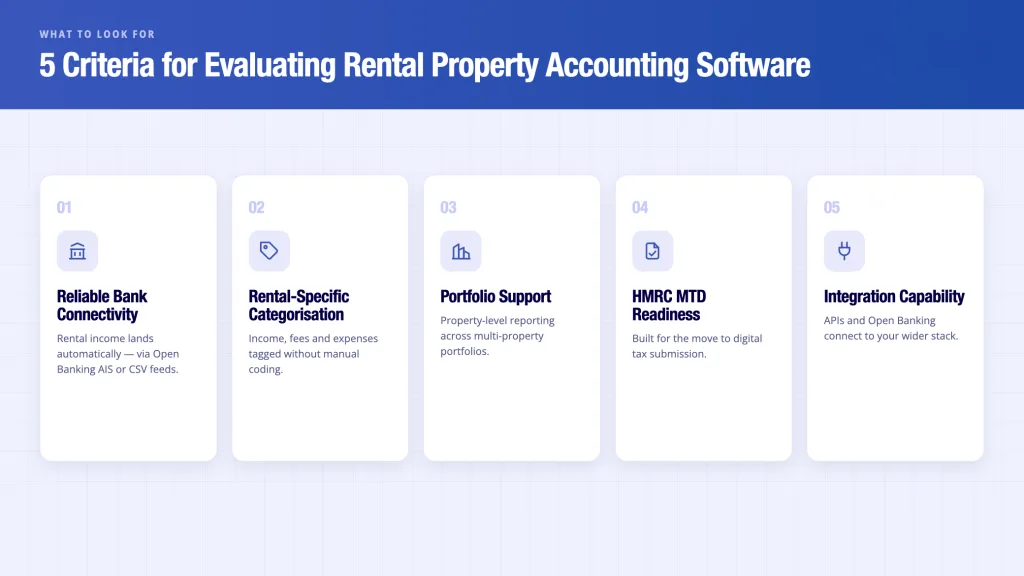
Before comparing products, it helps to define the capabilities a modern lettings platform should expect.
- Reliable bank connectivity: Rental income should arrive with minimal manual intervention, whether it be Open Banking AIS or CSV imports.
- Rental-specific categorisation: Income, maintenance costs, agency fees and property expenses should be identifiable without extensive manual coding.
- Portfolio support: Multi-property portfolios require property-level reporting rather than treating every transaction as part of one business.
- HMRC Making Tax Digital readiness: UK reporting requirements continue moving towards digital submission, making MTD support increasingly important.
- Integration capability: APIs and Open Banking infrastructure matter when platforms need accounting features to work alongside tenant onboarding, rent collection and reconciliation.
Which Rental Property Accounting Software Tools Lead the UK Market?
No single rental property accounting software platform is the best fit for every landlord or lettings business. Some products are purpose-built for property portfolios, while others are general accounting platforms that can be adapted through integrations and automation.
The five products below are compared on the factors that matter most in the UK market: accounting functionality, HMRC Making Tax Digital readiness, bank connectivity, API capabilities and support for open banking reference workflows. Together, these criteria provide a practical view of which platform is best suited to different operational and technical requirements.
Is Hammock the Right Choice for UK Lettings Platforms?

Hammock is purpose-built for UK landlords and buy-to-let portfolios, making it one of the few accounting platforms designed around rental property finances rather than general business bookkeeping. It combines rental income tracking, expense management, property-level reporting, and tax preparation in a workflow tailored to landlords instead of requiring extensive customisation.
A key differentiator is its Open Banking-connected bank feed, which supports automatic rental income categorisation from connected UK bank accounts. Rather than relying solely on imported CSV statements, Hammock synchronises bank transactions through Open Banking and automatically associates income and expenses with properties. The platform also supports HMRC Making Tax Digital (MTD) requirements, making it suitable for landlords preparing for digital tax reporting.
For software teams building lettings platforms, Hammock’s landlord-specific data model reduces the amount of custom development needed to represent properties, tenants, and rental income separately from standard business accounting.
- Key Features: Rental income and expense tracking, property-level financial reporting, Open Banking-connected bank feeds, automatic transaction categorisation, HMRC MTD support, and portfolio management for multiple properties.
- Open Banking & Integrations: Connects live bank feeds via TrueLayer (supporting over 50 UK banks and credit cards). It features a dedicated integration with QuickBooks to support landlords with hybrid or self-employment income alongside property portfolios. Its developer API is accessible primarily through structured enterprise partnerships rather than a completely open public portal.
- Pricing: Pricing scales based on portfolio size rather than tenancies, making it highly suitable for Houses in Multiple Occupation (HMOs). Plans start at £8 + VAT per month for 1–3 properties and scale up to £15 for 4–10 properties, or £25 for 11–20 properties. An annual subscription saves 20%, and the platform offers a 30-day free trial.
Pros
- Designed specifically for UK landlords (charges per property, not per tenancy)
- Native Open Banking connectivity via TrueLayer
- Property-focused reporting and automated tax statements
- MTD-ready (first landlord platform officially recognised by HMRC)
Cons
- Less suitable for non-property businesses or sole-trader income filing
- Enterprise finance capabilities are more limited than ERP-focused platforms
- Developer API access requires formal partnership onboarding
Best for: UK landlords and scaling lettings platforms wanting landlord-specific accounting with integrated Open Banking bank feeds.
Does LandlordStudio Cover Multi-Portfolio Management?
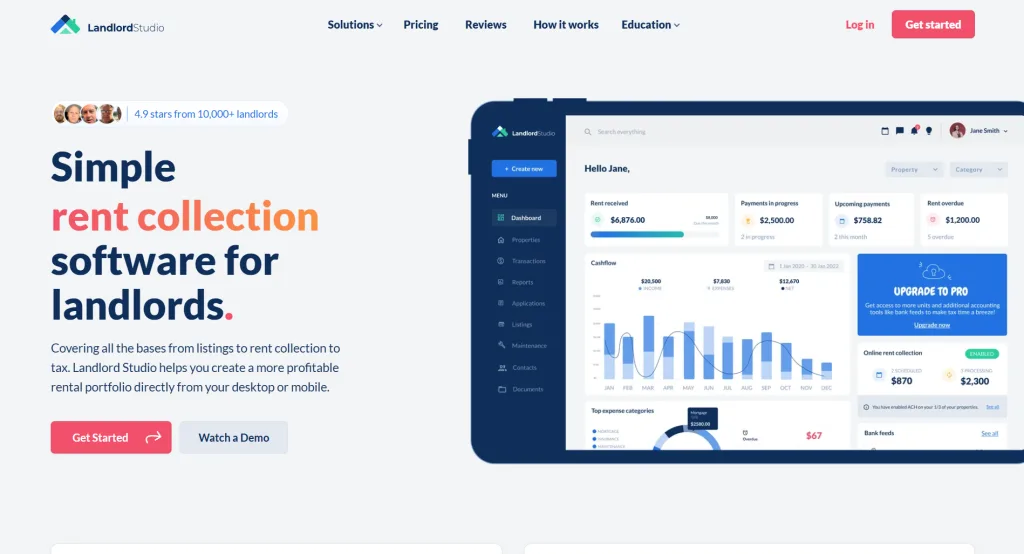
LandlordStudio combines property management and accounting into a single platform for landlords managing anything from individual buy-to-let properties to larger portfolios. Alongside rental income and expense tracking, it includes tenancy management, maintenance records, document storage, and reporting, allowing landlords to manage operational and financial information in one place.
Its broad functionality makes it attractive for landlords who prefer a single application rather than separate accounting and property management tools. However, bank reconciliation follows the platform’s standard synchronisation schedule rather than triggering real-time Open Banking Account Information Service (AIS) event hooks.
- Key Features: Rent collection tracking, maintenance management, document storage, portfolio reporting, expense tracking, and HMRC MTD support.
- Open Banking & Integrations: Uses Plaid to provide secure, read-only UK bank feeds. It features a native integration with Xero to sync transactional and property data directly into a wider ledger. Developer API access is available but primarily optimised for data syncing rather than white-label application embedding.
- Pricing: Features a basic tier where your first 3 properties can be logged for free via the mobile app. Upgrading to the PRO plan provides automated bank feeds and smart tracking, costing approximately £30 per property annually or accessible via standard tiered monthly pricing.
Pros
- Seamlessly combines accounting and day-to-day property management
- Highly accessible mobile experience for on-the-go updates
- Strong tenancy, document, and maintenance tracking
Cons
- Bank feeds sync on a schedule rather than instant, real-time AIS webhooks
- General accounting deep-dives are less specialised than dedicated ledger platforms
Best for: Landlords and property managers wanting one platform for tenancy management, maintenance, and accounting.
Is Xero Suitable for Landlord Accounting at Scale?
Xero is one of the UK’s most widely adopted cloud accounting platforms and is frequently used by landlords who already operate businesses using Xero. Although it is not designed specifically for rental property management, it provides reliable accounting functionality including expense categorisation, invoicing, bank reconciliation, and financial reporting.
Its extensive ecosystem of third-party integrations and well-documented API make it attractive for developers building lettings platforms that need to synchronise accounting data. Rental portfolios typically require additional account structures or integrations because Xero’s core data model is designed for general business accounting rather than properties and tenancies.
- Key Features: Cloud accounting, bank reconciliation, expense management, financial reporting, HMRC MTD compatibility, and a massive integration ecosystem.
- Open Banking & Integrations: Direct bank feeds to all major UK clearing banks. It offers a premier, fully open, well-documented developer API with a mature marketplace of real estate add-ons.
- Pricing: Offers a specialised Simple plan at £7/month designed for small landlords and sole traders needing basic MTD-ready bookkeeping. Core small business tiers scale from Ignite (£16/month) for basic needs, up to Grow (£37/month) and Comprehensive (£50/month) for unlimited volume and payroll. A 30-day free trial is standard.
Pros
- Exceptionally mature cloud accounting architecture
- World-class developer API and extensive software marketplace
- Scalable enough to support large corporate property portfolios
Cons
- Not purpose-built for landlords; tracking portfolios requires manual tracking-category tweaks
- Bank data updates run on a standard batch refresh cycle
Best for: Lettings platforms integrating with existing Xero users or landlords already operating within the Xero ecosystem.
Does FreeAgent Handle Buy-to-Let Tax Reporting?
FreeAgent is designed primarily for sole traders, freelancers, and small businesses, but many UK landlords use it to manage rental income alongside other sources of income. The platform includes expense tracking, bank reconciliation, and HMRC Making Tax Digital support, making it particularly useful for landlords with relatively straightforward property portfolios.
Unlike landlord-specific accounting software, FreeAgent focuses on business accounting rather than portfolio management. Multi-property reporting, tenancy tracking, and rental scheduling are therefore more limited than in dedicated landlord platforms.
- Key Features: Expense tracking, bank reconciliation, HMRC MTD support, Self Assessment preparation, and financial reporting.
- Open Banking & Integrations: Built-in Open Banking feeds that automatically pull real-time transactions. It provides a robust public developer API allowing platforms to push invoices, expenses, and contact data seamlessly.
- Pricing: Standard subscriptions range from £14.50 to £32 per month depending on your business structure. Crucially, FreeAgent is 100% free for any landlord or business owner who maintains an active business current account with NatWest, Royal Bank of Scotland (RBS), Mettle, or Ulster Bank.
Pros
- Unbeatable value (completely free) for NatWest/RBS/Mettle business banking clients
- Outstanding automated end-to-end Self Assessment tax preparation
- Clean, simple user interface
Cons
- Lacks native property management metrics (like rental yields or tenancy timelines)
- Not optimal for highly complex, multi-entity corporate landlord operations
Best for: Individual landlords with smaller portfolios who also manage freelance or business income alongside their properties.
Is QuickBooks Right for Multi-Property Landlord Portfolios?
QuickBooks provides comprehensive cloud accounting for businesses and can be adapted for rental property accounting through chart of accounts configuration, classes, and custom reporting. It supports rental income, expense tracking, invoicing, and HMRC Making Tax Digital compliance, making it a practical option for landlords already using QuickBooks for wider business activities.
For software developers, QuickBooks offers API access that supports accounting integrations and transaction synchronisation. However, landlord-specific workflows such as tenancy management and property-level reporting generally require additional application logic because the platform is built for general business accounting rather than property management.
- Key Features: Cloud accounting, expense management, bank feeds, HMRC MTD support, API integrations, and financial reporting.
- Open Banking & Integrations: Seamless Open Banking feeds across all major UK institutions, powered by built-in Intuit AI auto-categorisation. Integrates directly with specialised landlord tools like Hammock and features a massive app ecosystem via the Intuit Developer portal.
- Pricing: UK tiers start with the Sole Trader Plus / Simple Start plans (normally £19–£38/month), scaling up to Essentials (£75/month) for 3 users, and Plus (£115/month) which unlocks the class and location tracking essential for isolating individual property costs. New users frequently get a 50% discount for the first 3 months.
Pros
- Highly reliable financial core with heavy AI automation for categorisation
- Class-tracking features make it highly customisable for multi-property books
- Highly accessible and well-supported developer ecosystem
Cons
- Requires manual configuration to cleanly separate properties and tenancies
- Higher subscription tiers are required to unlock necessary property tracking fields
Best for: Landlords already using QuickBooks for broader business accounting and software ecosystems looking for an established, highly stable ledger integration.
Comparison Table
| Software | Bank Feed | Rental Categorisation | Expense Tracking | HMRC MTD | Open Banking Integration | Pricing |
|---|---|---|---|---|---|---|
| Hammock | Open Banking AIS | Yes | Yes | Yes | Native | Subscription |
| LandlordStudio | Open Banking / bank feed | Yes | Yes | Yes | Available | Subscription |
| Xero | Bank feed / CSV | General accounting | Yes | Yes | Via integrations | Subscription |
| FreeAgent | Bank feed | Limited | Yes | Yes | Available | Subscription |
| QuickBooks | Bank feed / CSV | Limited | Yes | Yes | Available | Subscription |
The Gap: Why Accounting Software Alone Isn’t Enough for Lettings Platforms?
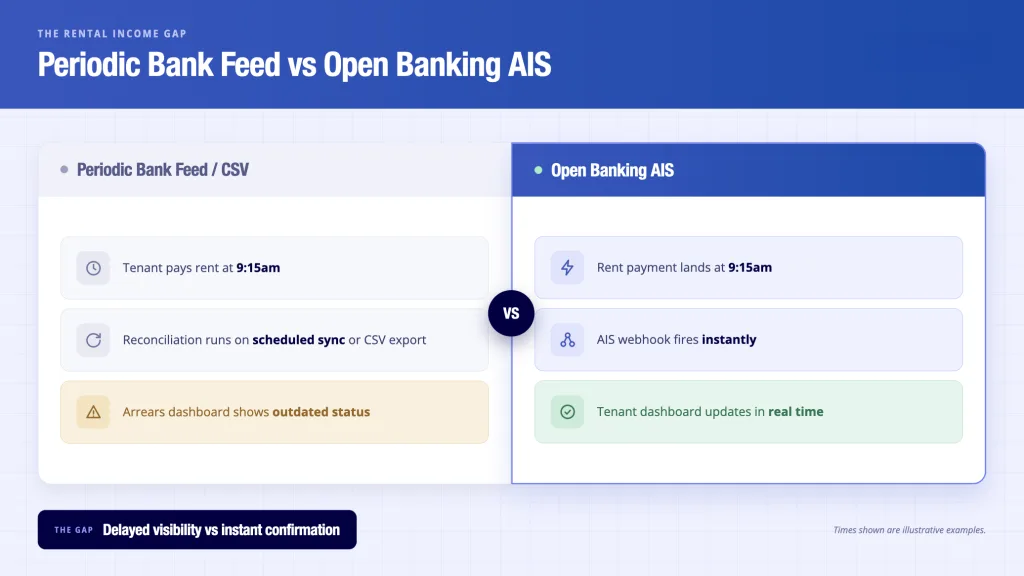
Every product above performs accounting well. The common limitation appears when platforms need current bank activity rather than historical accounting records.
Consider a tenant paying rent at 9:15 am. If reconciliation depends on a later CSV export or scheduled synchronisation, downstream workflows, including arrears monitoring, tenant dashboards and operational reporting, may not reflect that payment immediately.
For lettings platforms, the missing layer is live bank data delivered directly from regulated Open Banking APIs.
This is where Open Banking for proptech becomes relevant. Rather than replacing accounting software, Open Banking connects platforms to verified banking information that accounting systems can consume.
Finexer AIS: Live Rental Income Data for Platform Builders
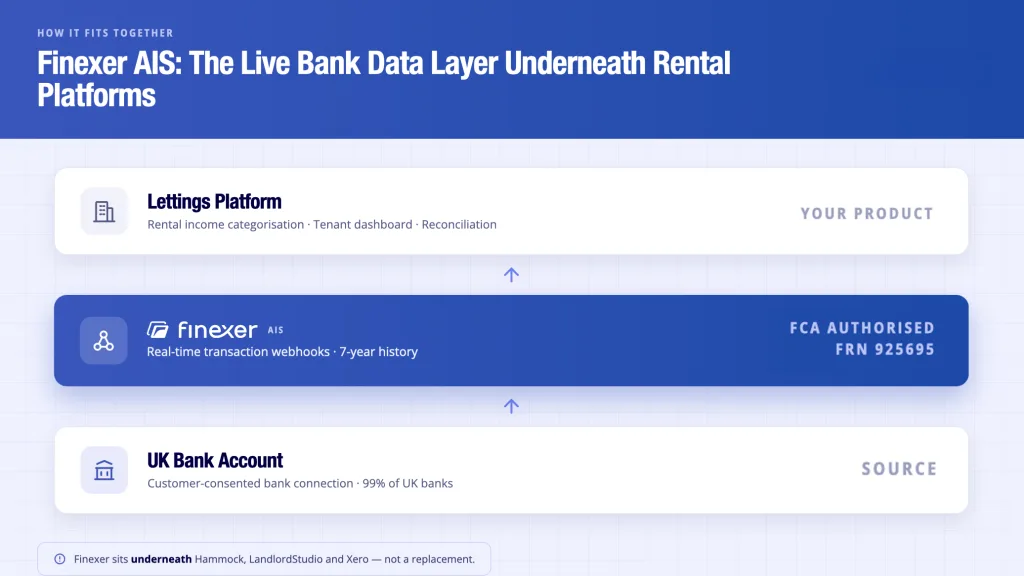
Property platforms increasingly need more than accounting records; they need verified bank transaction data that applications can use immediately.
Finexer’s Account Information Service (AIS) provides that regulated data layer.
With customer consent, AIS retrieves structured bank transaction data directly from UK banks through Open Banking APIs. Lettings platforms can automatically identify rental income, categorise transactions and reconcile property payments without relying solely on CSV imports.
Relevant capabilities include:
- Automatic rental income transaction categorisation
- Real-time transaction webhooks for connected bank accounts
- Up to seven years of transaction history with customer consent
- White-label infrastructure for platform integration
- FCA-authorised AISP and PISP (FRN 925695)
- Usage-based pricing
- 3–5 weeks onboarding support
- 99% UK bank coverage
Rather than competing with Hammock, LandlordStudio or Xero, Finexer supplies the regulated banking infrastructure that property technology providers integrate underneath their own accounting and property workflows.
What Is Open Banking Reference?
Open Banking reference describes the use of regulated bank data during customer verification and financial assessment workflows.
Within the lettings sector, Open Banking references are increasingly used during tenant applications for verification of rental affordability using current bank transaction data rather than uploaded bank statements.
Using customer consent, AIS retrieves verified transaction history directly from the tenant’s bank. Platforms can then analyse salary credits, recurring income and existing financial commitments to support referencing decisions.
For developers building tenant onboarding journeys, Open Banking references reduce dependence on manually supplied PDF statements while giving users a more current financial picture.
Platforms looking to extend these workflows often combine income verification software with rent affordability check capabilities built on Open Banking AIS.
Similarly, estate agency platforms performing financial verification before property transactions increasingly use confirm buyer funds open banking workflows that rely on the same regulated banking infrastructure.
Developers building accounting platforms can also explore Open Banking bank feeds UK to understand how AIS differs from traditional CSV-based reconciliation.
What is the best rental property accounting software in the UK?
The answer depends on the use case. Hammock and LandlordStudio focus specifically on property management, while Xero, FreeAgent and QuickBooks provide broader accounting capabilities that many property businesses extend through integrations.
Does rental property accounting software use Open Banking?
Many products now support Open Banking bank feeds to varying degrees. Some use native AIS connections, while others continue supporting CSV imports alongside bank integrations.
What is Open Banking reference?
Open Banking reference uses customer-consented bank transaction data during verification or affordability assessments. In the lettings sector, it supports tenant referencing and income verification workflows.
Is Open Banking better than CSV bank imports?
Open Banking AIS provides regulated access to current bank transaction data with customer consent. CSV imports remain useful but typically require manual export and upload before reconciliation begins.
Can accounting software verify rental income automatically?
Accounting software records rental income once transactions reach the ledger. Platforms needing verified live bank transaction data generally complement accounting software with Open Banking AIS infrastructure.
See how Finexer’s Account Information Service helps lettings platforms integrate live rental income data and Open Banking verification into their own products.
Explore with AI
About the Author

Ravi Ranjan
Ravi Ranjan is Co founder & CEO of Finexer