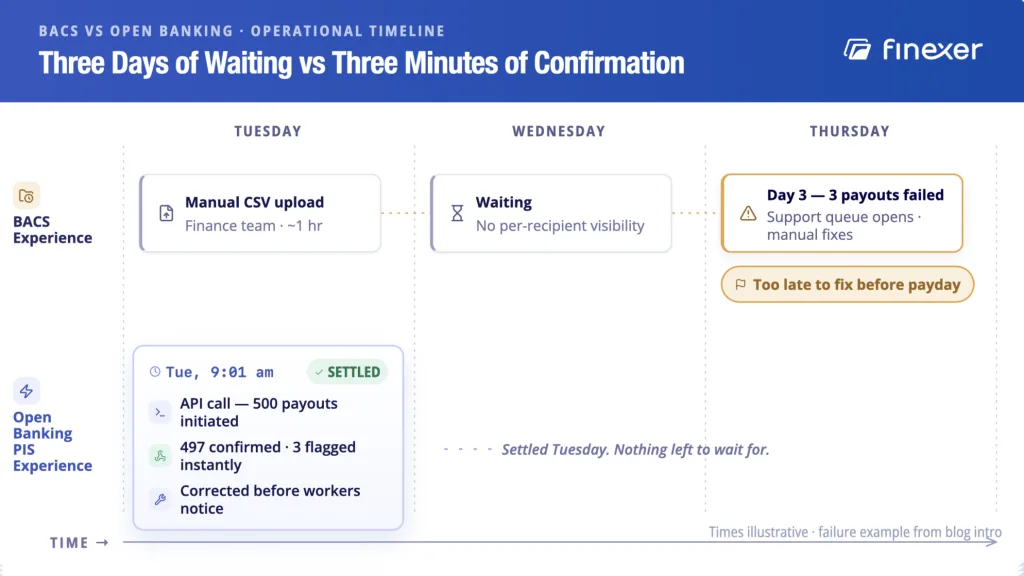
You run a delivery or gig marketplace platform. Every Tuesday, your finance team uploads a CSV file to their bank portal with 500 worker payouts. By Thursday (Day 3), they check for failures. One rider’s sort code is outdated- failed on Day 3. Now you are managing angry worker complaints and manual corrections. This is the operational friction that mass payouts create at scale.
According to a recent report by Statista, the UK workforce includes approximately 4.57 million freelancers and gig workers. University of Cambridge research found that 75% of riders and drivers report significant anxiety over income consistency. For platform builders managing large-scale payouts to hundreds of recipients on irregular schedules, this is a critical challenge.
This guide explains how multi-recipient payouts work, why BACS breaks at volume, and how Open Banking API infrastructure delivers real-time per-recipient visibility for modern platforms.
Exploring automated payout solutions for your platform? Let’s discuss your disbursement volume and settlement requirements.
What Are Mass Payouts in Platform Context?
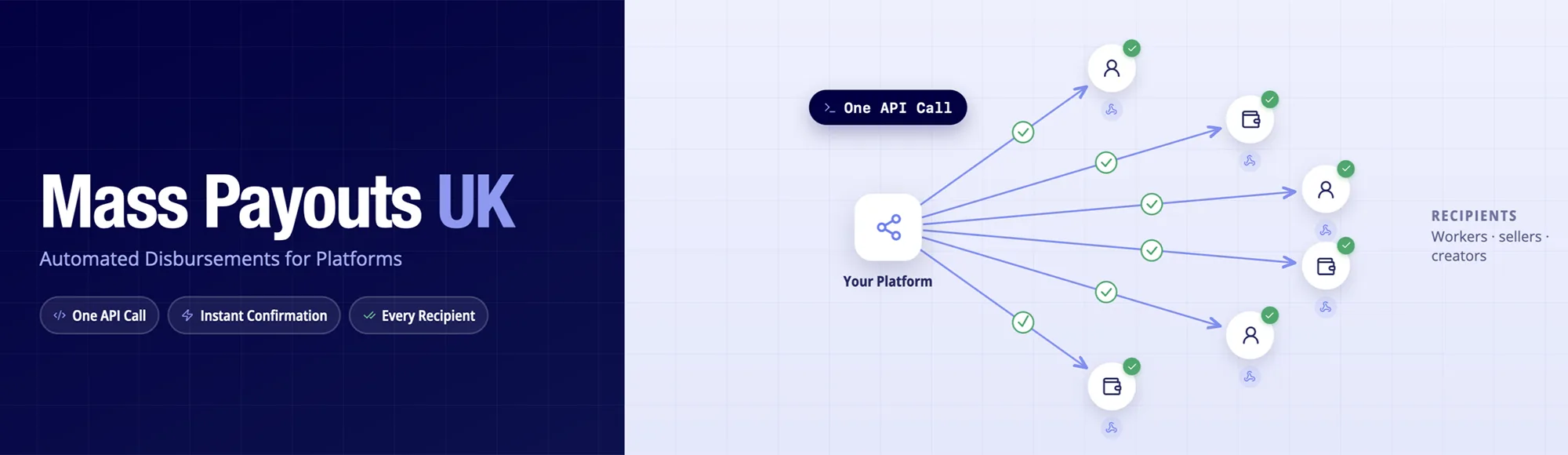
Mass payouts are automated, simultaneous disbursements from a platform to multiple recipients, like gig workers, marketplace sellers, affiliates, or content creators- via a single API call.
Unlike traditional payroll (scheduled, predictable), multi-recipient payouts serve variable, high-frequency disbursement patterns.
Key distinction:
Mass payouts = Automated API-driven disbursement at scale
Bulk payouts = Volume des
Global mass payouts UK = Cross-border
For a deeper look at how API-driven bulk disbursements work in practice, explore our guide on Finexer bulk payment services.
Why BACS Fail for Mass Payouts?
BACS (Bankers’ Automated Clearing Services) was designed for scheduled, bulk file uploads with inherent 3-day settlement. This architecture creates operational friction at scale:
| Factor | BACS Batch | Open Banking PIS |
|---|---|---|
| Submission Model | Manual CSV file upload | API call (fully automated) |
| Settlement Speed | 3 working days | Instant via Faster Payments |
| Per-Recipient Status | No visibility until Day 3 | Real-time webhooks per recipient |
| Error Detection | Day 3 — too late to fix before payday | Immediate — time to correct before impact |
| Operational Overhead | High — manual tracking and reconciliation | Low — fully automated, webhook-driven |
| File Dependency | Required — daily manual upload | Not required — API-driven |
| Recipient Experience | Wait 3 days — no confirmation | Instant confirmation — real-time status |
For platforms processing 500+ monthly disbursements, manual BACS uploads create bottlenecks. Finance teams spend significant time on file validation, error tracking, and post-settlement corrections. At Cambridge’s gig economy study scale (75% of workers anxious about income), slow settlement directly damages user retention.
Open Banking PIS for Large-Scale payouts
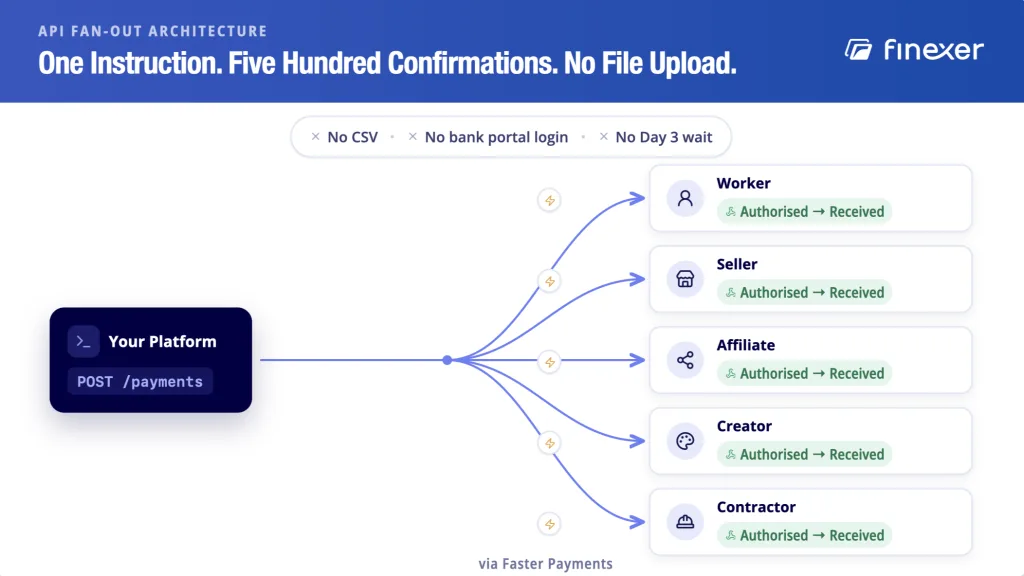
Open Banking Payment Initiation Service (PIS) solves large-scale payouts via API-driven infrastructure with per-recipient webhook status.
How it works
Your platform triggers a single Open Banking payment flow API call containing multiple disbursement instructions (recipient, amount, sort code). The system validates each recipient’s bank details and initiates payments directly from your UK business account via Faster Payments. Real-time webhooks fire at each stage for every recipient: “Payment Authorised,” “Sent,” “Received.”
Result: Instant settlement, per-recipient visibility, zero manual file uploads.
For large-scale payouts at scale, this architectural shift eliminates manual reconciliation overhead and provides gig workers with immediate confirmation, directly addressing the 75% anxiety metric cited in Cambridge’s research.
Mass Payouts Use Cases by Vertical
Here are the platforms requiring large-scale payment systems:
Gig Economy Platforms: Per-shift payouts to drivers. Real-time webhook status lets workers see earnings confirmation within minutes. Reduces payment-related support significantly.
Marketplace Seller Settlements: Weekly settlements to sellers. Per-payout webhook visibility prevents settlement delays and builds trust.
Affiliate Networks: Monthly commission payouts. High-volume payouts automation scales affiliate recruitment by removing payment friction.
Content Creator Platforms: Marketplace payouts UK for creators. Real-time settlement improves creator satisfaction and platform retention.
Finexer: FCA-Authorised Mass Payout Infrastructure
Finexer delivers mass payouts via FCA-authorised Open Banking PIS, built for UK platforms at scale.
Core capabilities:
- All UK banks: 99% UK bank coverage; recipient accounts (Barclays, HSBC, NatWest, Monzo) pre-connected.
- Per-payout webhook status: Every disbursement fires webhooks at each status. Real-time visibility.
- API-native: Single REST API call initiates bulk payouts requiring no CSV uploads or bank portal logins. You can check bulk payouts explained in the UK guide for a better understanding of the role of the open banking API in this regard.
- Usage-based pricing: Pay per transaction.
- FCA-authorised: Compliance handled; focus on product.
- Sandbox: Full webhook simulation for testing.
Finexer vs building direct bank connections: Building direct integrations with each UK bank requires months of negotiation and technical work. Finexer’s pre-built infrastructure reduces time-to-market from a large number of days to 3–5 weeks with onboarding support.
Comparison: BACS Batch vs Open Banking PIS
| Factor | BACS Batch | Open Banking PIS |
|---|---|---|
| Submission Model | Manual CSV file upload | API call (fully automated) |
| Settlement Speed | 3 working days | Instant via Faster Payments |
| Per-Recipient Status | No visibility until Day 3 | Real-time webhooks per recipient |
| Error Detection | Day 3 — too late to fix before payday | Immediate — time to correct before impact |
| Operational Overhead | High — manual tracking and reconciliation | Low — fully automated, webhook-driven |
| File Dependency | Required — daily manual upload | Not required — API-driven |
| Recipient Experience | Wait 3 days — no confirmation | Instant confirmation — real-time status |
What volume of large-scale payouts justifies moving from BACS?
At 50+ monthly disbursements, manual BACS uploads create operational friction. Beyond 500, large-scale payouts API infrastructure becomes operationally critical, resulting in savings in finance team time alone justify integration.
Do bulk payouts and mass payouts mean the same thing?
No. Bulk payouts = volume descriptor (applies to any system processing many payments). Mass payouts = automated, API-driven disbursement to multiple recipients via a single submission. Bulk payouts can be BACS or API-based
Can my recipients use any UK bank account?
Yes. High-volume payouts via Open Banking reach any UK bank account held with major clearing banks. Recipients don’t need special accounts or wallet sign-ups; just their standard bank account works.
How long does integration take?
Why not use BACS for cost efficiency?
BACS costs are low per transaction, but hidden costs are high: manual file management, finance team time on reconciliation, error correction overhead, and operational friction (workers waiting 3 days). At scale, mass payouts automation pays for itself.
Ready to Automate Mass Payouts for Your Platform?
If you’re processing 100+ monthly disbursements to gig workers, sellers, or creators, manual BACS uploads create operational bottlenecks and erode user trust. Real-time high-volume payouts infrastructure removes this friction.
See how Finexer’s FCA-authorised PIS delivers mass payouts to any UK bank- one API call, per-payout webhook, no BACS files.
To discuss your specific disbursement volume and settlement timeline.
Explore with AI
About the Author

Ravi Ranjan
Ravi Ranjan is Co founder & CEO of Finexer