
Match the Name, Every Time.
Bank-record name verification with clear match outcomes.
Search “how to check bank account holder name” and you’ll find plenty of pages promising an answer. Here’s the one they should give you: you can’t, not by yourself, not from a sort code and account number alone. The name only exists on the bank’s own record, and the only way to check it is to ask the bank.
TL;DR: An account holder name check compares the name you expect against the name the bank actually holds for that account. It returns one of a small number of outcomes: full match, close match, or no match. Covered here are questions as to why that check matters, how close matches work in practice, where individuals and businesses should place bank account verification and how the main verification providers compare.
This guide draws on Finexer’s work as an FCA-authorised (FRN 925695) Open Banking infrastructure provider performing bank-based account holder name checks for UK platforms. It includes input from Paul, Compliance Lead, Finexer.
Paul says, “Most people assume a name mismatch means fraud. Usually it just means a trading name, an initial, or a joint account. The value of a proper check is telling those two situations apart before a payment goes out.”
You Cannot Look Up an Account Holder Name Yourself
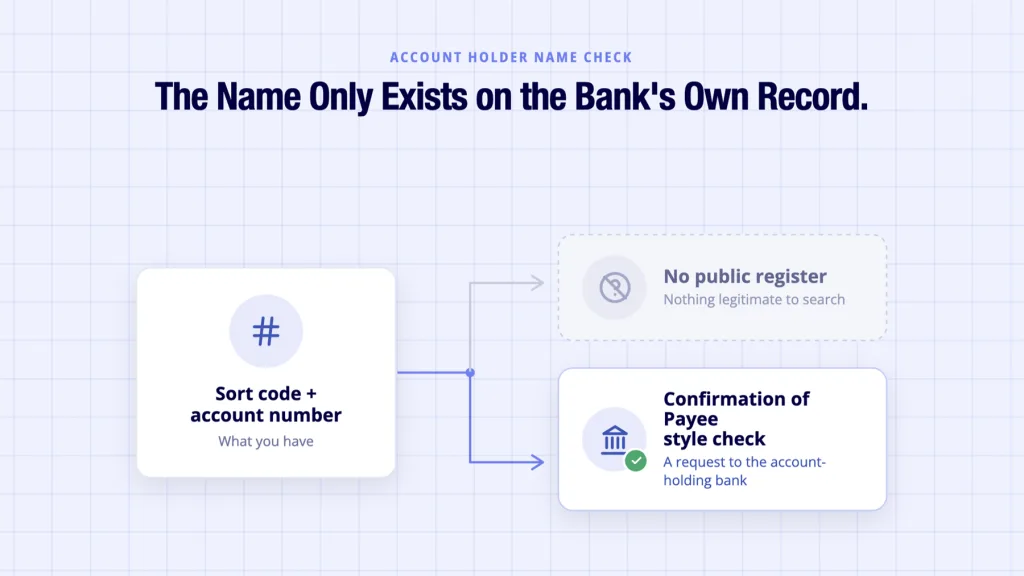
There’s no public register mapping sort codes and account numbers to names, and there shouldn’t be. The only legitimate way to check whose name sits on an account is a request to the account-holding bank itself, made through a Confirmation of Payee style check or a bank account verification API built on the same principle.
Anyone offering a shortcut around that isn’t offering a real account holder name check. A business building one into a product shouldn’t imply otherwise to its own users either.
Why This Matters
Two things go wrong without a name check: money sent to the wrong account by ordinary human error, and invoice redirection fraud, where the bank details on an otherwise genuine invoice bank details have been quietly changed.
A name check doesn’t stop every mistake or every scam. It stops the specific failure where the account details look plausible but belong to someone other than the intended recipient.
How an Account Holder Name Check Works
The payer submits the name they expect, alongside the sort code and account number. The receiving bank checks its own record and returns one of three outcomes:
| Outcome | What it means | What it should trigger |
|---|---|---|
| Full match | The name matches the bank record exactly | Proceed with payment |
| Close match | The name is similar but not identical | Review before proceeding |
| No match | The name doesn’t match the bank record | Stop and verify with the payee directly |
A fourth outcome, unavailable, appears when the receiving bank doesn’t support the check or the account can’t be found. It isn’t a red flag on its own, just a gap in coverage.
This is worth understanding before choosing an approach, because “account holder name check” and “bank account verification” get used almost interchangeably in the market. The term that matters is the specific outcome a provider returns, not the label on the product page.
Close Matches: Where Most of the Difficulty Sits
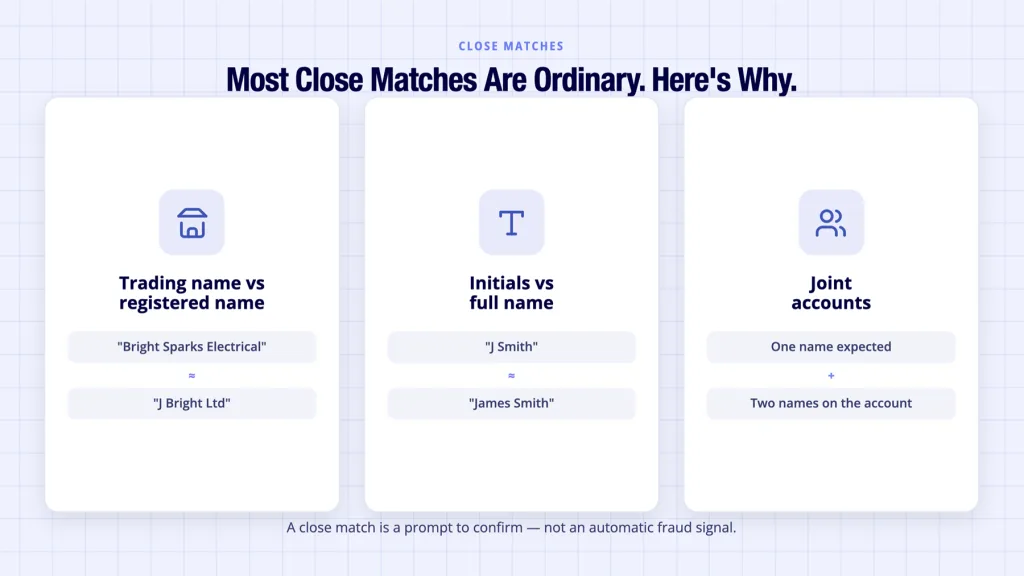
Close matches carry most of the operational weight, because they’re common, and because treating everyone as suspicious creates unnecessary friction. Three patterns account for most of them:
- Trading names against registered names. A supplier invoices as “Bright Sparks Electrical” but the account is registered to “J Bright Ltd.”
- Initials against full names. “J Smith” on file against “James Smith” submitted at payment.
- Joint accounts. A payment expects one name, but the account is held jointly, so only a partial match is possible.
None of these are fraud signals by default. A sound process treats a close match as a prompt to confirm, not an automatic block, since blocking every close match just pushes finance teams toward ignoring the warnings altogether.
Getting this wrong in either direction is costly. Too strict, and legitimate suppliers get delayed or rejected at onboarding. Too loose, and the close match warning becomes background noise nobody reads before approving a payment.
Not the Same as Identity Verification
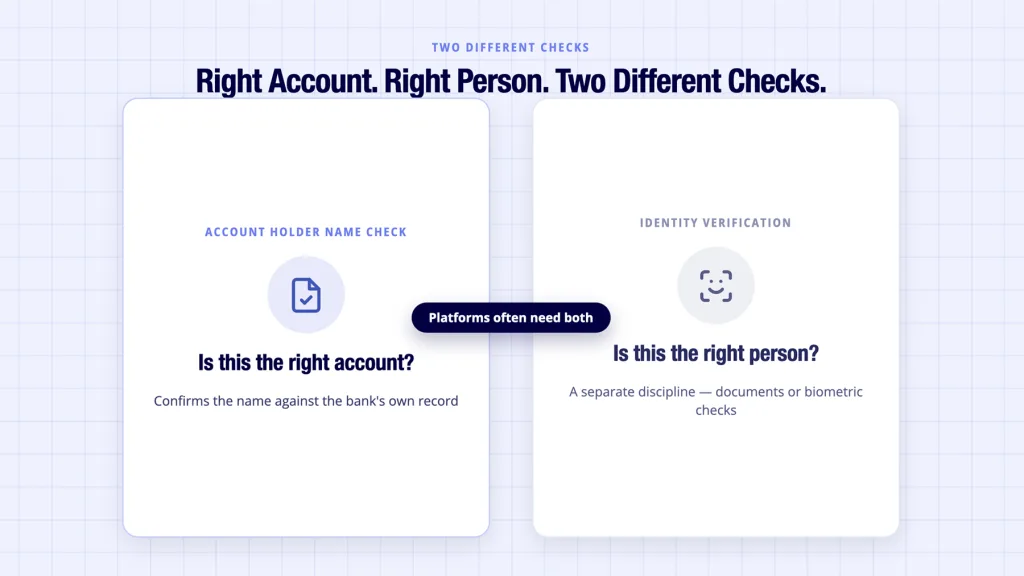
An account holder name check confirms a name against a bank record. It doesn’t confirm who’s sitting behind the screen, check a document, or verify a face. That’s a separate discipline handled by identity verification providers such as those compared on our page covering onfido pricing. Platforms often need both, but they solve different problems and shouldn’t be treated as interchangeable.
For Individuals: When Your Banking App Flags a Mismatch
Adding a new payee and getting a close match or no match warning doesn’t mean you’ve been scammed. It usually means the name on the account differs slightly from what you typed, or the recipient uses a trading name. Before proceeding, contact the person or business directly, using a number or email you already trust, not one supplied in the payment request itself.
For Businesses: Where to Place the Check
A single check at onboarding isn’t enough on its own. Bank account verification earns its keep at four points in a payment relationship:
| Stage | Why it matters |
|---|---|
| Onboarding | Confirms the account belongs to the customer or supplier being onboarded |
| Payee creation | Catches errors before a new payee is saved to the system |
| Bank detail changes | Catches invoice redirection fraud at the exact moment it happens |
| Before first payment | A final check before money actually moves |
Skipping any one of these leaves a gap, particularly the bank-detail-change stage, which is where most redirection fraud actually lands. Treating the check as a one-off onboarding step, rather than something repeated at each of these points, is one of the more common gaps in an otherwise solid payment process.
Choosing a Provider for Account Verification
Coverage tells you which banks a provider reaches. It doesn’t tell you what the check actually returns, and that’s what determines whether a platform can act on the result.
| Provider | Coverage | Verification maturity |
|---|---|---|
| TrueLayer | Verification API: UK, Germany and Spain (additional countries on request) | Public beta |
| Yapily | UK and Europe | Validate product in private beta |
| Plaid | UK, US, Canada | Identity match scores, established product |
| Finexer | UK-focused | Platform with account verification features |
Beta status isn’t disqualifying on its own. A platform relying on account holder name checks for live payment decisions should know whether the product it’s building on is still maturing.
Where Finexer Fits\
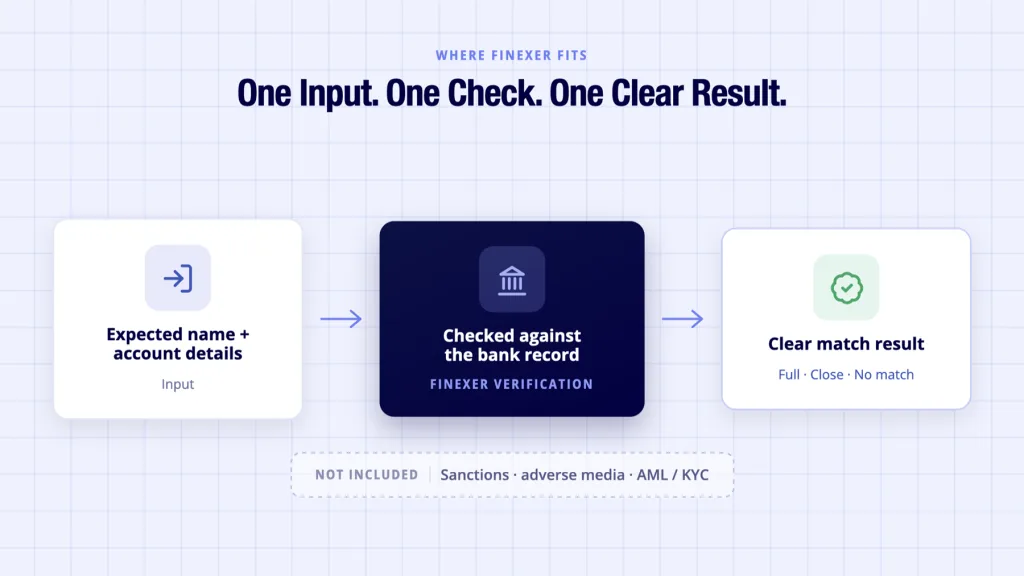
Finexer’s Verification product performs the account holder name check directly: the expected name and account details go in, the bank record is checked, and a clear match result comes back for the platform to act on through Finexer Verification.
Verification confirms a name against a bank record. It doesn’t screen for sanctions, check adverse media, or replace a business’s own AML and KYC processes, and it doesn’t guarantee that no payment will ever go astray.
This matters most for Payroll and Invoicing platforms verifying contractor and supplier accounts before payment runs, Accounting and ERP platforms confirming customer bank details during onboarding, and Proptech platforms checking landlord and tenant payment details before deposits and rent move.
Can I find an account holder’s name from just their sort code and account number?
No. Names aren’t published anywhere. The only way to confirm one is a name check against the bank’s own record, run through your bank or a verification provider.
What should I do if I get a close match warning?
Don’t ignore it, but don’t assume fraud either. Contact the payee through a number or email you already trust and confirm the account details before paying.
Does a name check stop all payment fraud?
No. It catches the specific case where account details look genuine but belong to the wrong person. Other fraud types need separate checks and internal controls.
Is an account holder name check the same as KYC?
No. A name check confirms a name against a bank record. KYC and identity verification confirm who the customer actually is, typically using documents or biometric checks, and address a different risk entirely.
See how Finexer’s Verification product checks an account holder name against the bank record and returns a clear match result your platform can act on
Explore with AI
About the Author

Ravi Ranjan
Ravi Ranjan is Co founder & CEO of Finexer