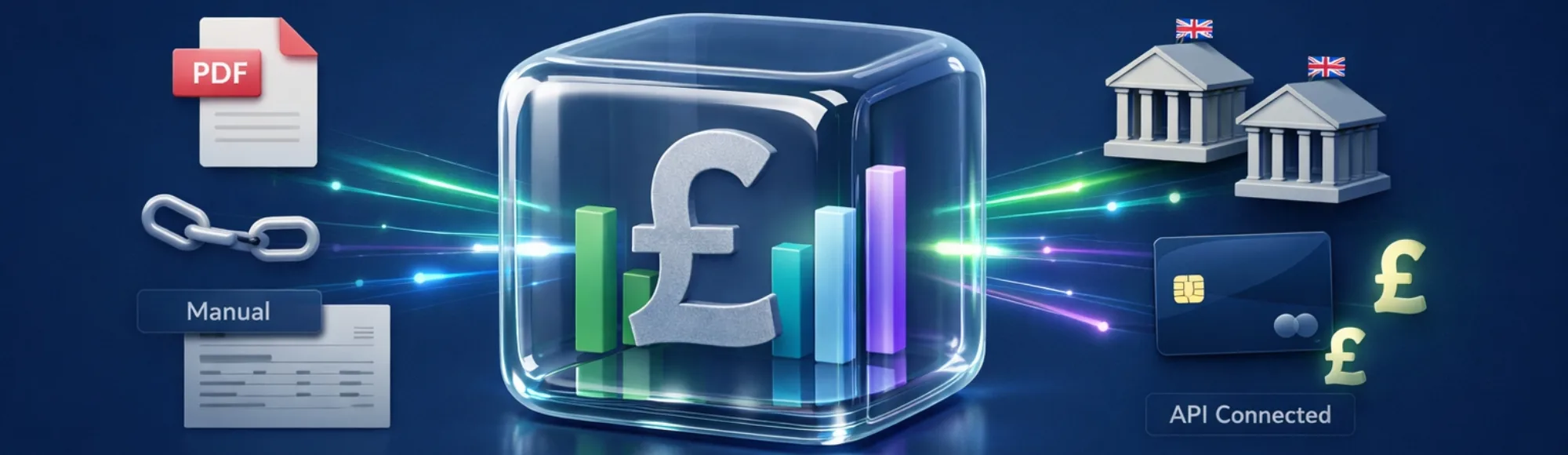
Bank account aggregation APIs solve the operational drag of collecting and verifying bank data manually. Your platform needs transaction history for onboarding, affordability checks, or reconciliation. Users currently screenshot statements or upload PDFs. Those workflows break.
This article explains what matters at the infrastructure level when choosing a bank account aggregation API. Real problems platforms face. Common implementation mistakes. And what good aggregation infrastructure actually unlocks.
The Real Problem Platforms Are Solving

Manual statements create bottlenecks: Users download PDFs, upload wrong files. Finance teams verify authenticity manually. Onboarding takes days instead of minutes.
Broken feeds damage trust: Screen-scraping breaks when banks update websites. Support tickets pile up.
Reconciliation becomes a full-time job: Transaction descriptions vary across banks. Manual matching required every month.
Compliance evidence takes forever: Teams chase users for updated statements. Reviews stall waiting for documents.
Bank account aggregation APIs remove these bottlenecks when implemented properly.
What Actually Matters in Bank Account Aggregation (At Infrastructure Level)
Consent lifecycle management: Open Banking consent expires. The API needs to handle re-consent flows without breaking your product.
Data freshness: Some APIs poll daily. Others use webhooks for real-time updates. Delayed data means delayed decisions.
Historical coverage: Affordability checks need 3-6 months minimum. Some banks provide up to 7 years via Open Banking.
Transaction normalisation: Raw bank data arrives inconsistent. Production-grade APIs deliver normalised, enriched data.
Bank coverage: Supporting only major banks covers 40% of UK users. Incomplete coverage creates operational gaps.
This is what account aggregation via Open Banking requires to work reliably.
What We See in Practice

From working with UK platforms, these patterns appear repeatedly.
Scrapers break silently: Screen-scraping looks cheaper initially. Then bank websites change. Feeds break. Support handles user complaints.
Re-consent friction: Open Banking consent expires after 90 days. Platforms without automated re-consent lose bank data access unexpectedly.
Inconsistent categorisation: Logic built for one bank’s format breaks when adding other banks. Transaction descriptions don’t match.
These operational realities affect platforms without proper bank account aggregation infrastructure.
Common Mistakes When Choosing Aggregation Infrastructure
| Mistake | Why It Matters | What to Look For Instead |
|---|---|---|
| Choosing cheapest provider | Screen-scraping or limited coverage creates operational costs | FCA-authorised Open Banking with 99% UK bank coverage |
| No consent audit trail | Regulators expect consent records for compliance | Timestamped consent logs with full lifecycle management |
| Limited historical data | Verification needs 3–6 months minimum | Up to 7 years available (bank-dependent) |
Low-cost APIs often use screen-scraping or limited bank coverage. The operational cost of handling broken feeds exceeds initial savings.
What Good Bank Account Aggregation Unlocks
Reliable bank account aggregation APIs enable specific business outcomes:
- Faster onboarding: Income verification happens in minutes instead of days
- Automated affordability: Assess affordability using real transaction history
- Real-time risk monitoring: Financial health changes trigger alerts before defaults
- Cleaner reconciliation: Match bank transactions to invoices automatically
- Embedded payments: Aggregate bank accounts and initiate payments via one API
Platforms across fintech, WealthTech, PropTech, and accounting use bank account aggregation for these workflows.
Where Finexer Fits
Finexer provides Open Banking connectivity using FCA-authorised infrastructure for UK platforms.
We handle bank connections across 99% of UK banks, transaction data retrieval with enrichment, historical access (up to 7 years bank-dependent), webhooks, and consent management.
Your platform handles verification logic, product features, and business rules.
Integration typically takes 3-5 weeks with hands-on support.
How We’d Evaluate an Aggregation Provider Today

If choosing a bank account aggregation API for production:
- Coverage: 99% UK bank support including challengers
- Historical depth: Maximum available per bank (up to 7 years)
- Webhooks: Real-time notifications, not polling
- Data quality: Enrichment and normalisation included
- Pricing: Usage-based without hard caps
- Support: Hands-on integration assistance
APIs that work in demos often break in production. Operational reliability matters more than technical capability.
What I Feel About Bank Account Aggregation APIs
Bank account aggregation has become table stakes for financial platforms. But most APIs are built for consumer apps, not platform infrastructure.
I’ve watched platforms integrate providers that worked in demos, then consent re-authorisation broke the user experience. Or transaction categorisation only worked for one bank. Or historical data limits prevented the verification workflows they needed.
The gap isn’t technical capability. It’s understanding that platforms need reliable infrastructure to build on top of, not consumer-facing software that competes with their product.
What is a bank account aggregation API?
A bank account aggregation API provides programmatic access to multiple bank accounts via Open Banking, delivering transaction data and balances in a standardised format.
How does bank account aggregation work?
Users authorise read-only bank access via Open Banking. The API retrieves transaction data, normalises formats, and delivers structured data via REST endpoints.
What’s the difference between screen-scraping and Open Banking for bank account aggregation?
Screen-scraping simulates user logins and breaks frequently. Open Banking uses regulated APIs with user consent, providing reliable access to aggregate bank accounts.
Can platforms use bank account aggregation APIs for affordability checks?
Yes. Transaction history from aggregated bank accounts provides verified income and spending data for affordability assessments without manual document review.
Ready to Aggregate Bank Accounts Reliably?
See how Finexer’s Open Banking API provides bank account aggregation infrastructure for UK platforms.
Book Demo NowAbout the Author

Ravi Ranjan
Ravi Ranjan is Co-founder and CEO of Finexer, a UK-based Open Banking infrastructure provider that gives fintech and SaaS platforms direct access to bank data and payment APIs. A two-time founder, Ravi previously built Voilo, an Open Banking payments startup that reached a £2 million valuation within its first year. His work sits at the intersection of financial infrastructure and developer tooling, with a focus on making regulated payment systems more accessible to builders. Ravi holds an MBA from Aston Business School and a background in Computer Science Engineering.