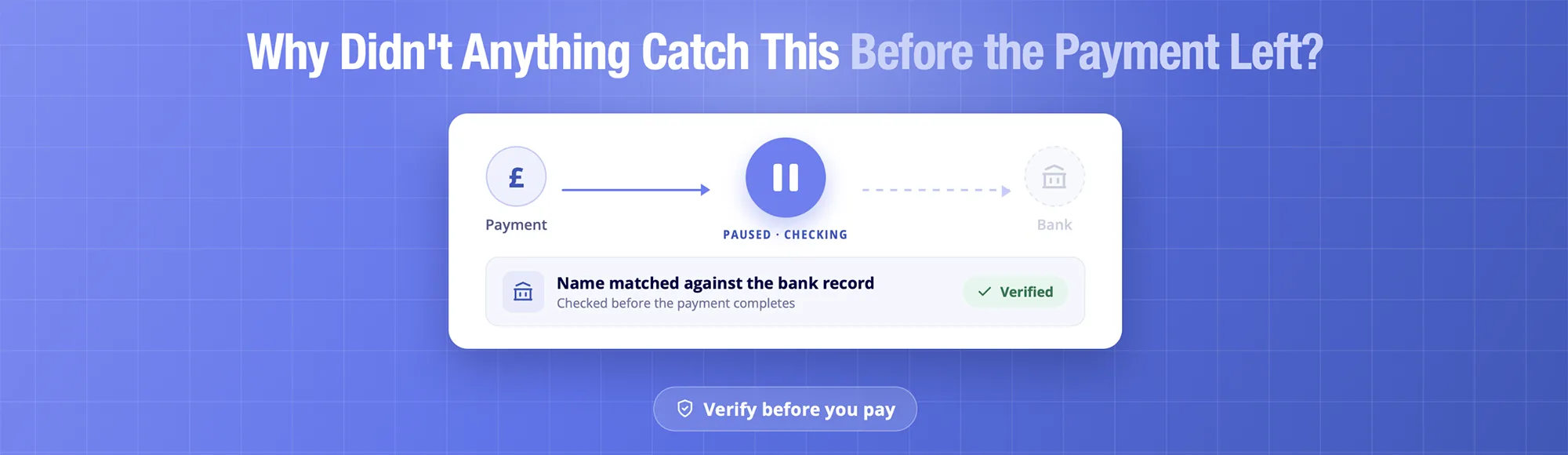
Verify Before You Pay.
Account name matched against the bank record via API.
A payment fails, or worse, lands in the wrong account, and the first question is always the same: why didn’t anything catch this before the payment left. A bank account verification api exists to catch exactly that, before the money moves.
TL;DR: A bank account verification api checks that an account exists and that the name on it matches whom the platform expects to pay. It returns a structured match result, not a guess, so the decision of what happens next stays with the platform.
This guide draws on Finexer’s work as an FCA-authorised Open Banking infrastructure provider (AISP and PISP, FRN 925695), supplying bank-based verification to UK platforms handling payroll, supplier payments and tenant transactions.
“Every platform I talk to has the same failure mode,” says Yuri, who works on Finexer’s data architecture. “A payment goes out, the sort code and account number are technically valid, and the money still ends up with the wrong person because nobody checked the name against the bank record first.”
What Gets Verified
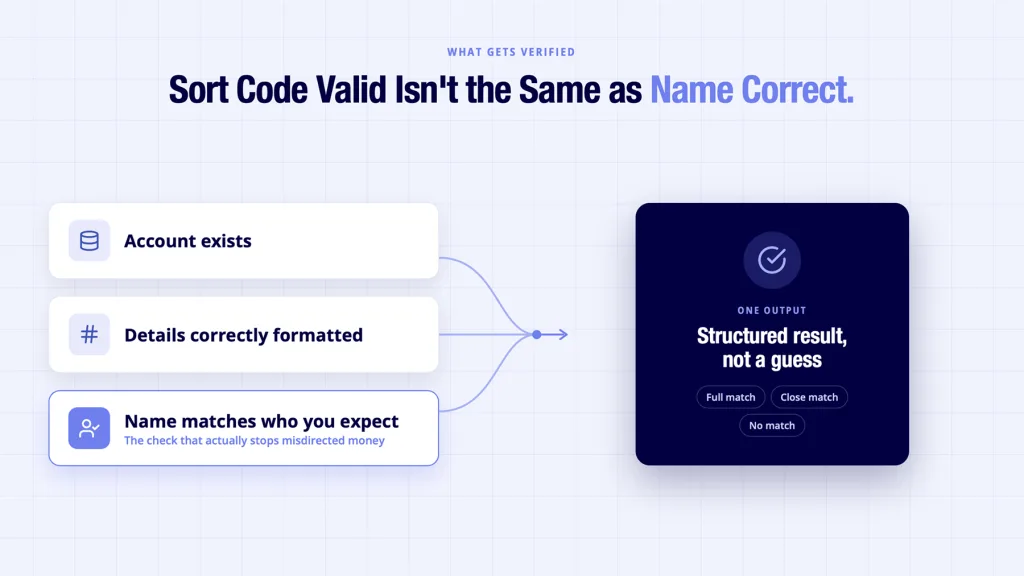
A bank account verification api checks three things: that the account exists, that the account details are correctly formatted, and that the name on the account matches whom you expect.
That last check, the account holder name check, is the part that actually prevents money going astray. Sort code and account number validity alone won’t catch a typo in a surname or an outdated supplier record.
The platform submits the expected name and account details. The API checks them against the bank record and returns a structured result rather than a plain pass or fail.
How the Match Actually Works
| Match outcome | What it means | What the platform should do |
|---|---|---|
| Full match | Name matches the bank record exactly | Proceed with the payment |
| Close match | Name is similar but not identical (e.g. a shortened first name, a missing middle initial) | Apply a decision rule: flag for manual review, or accept within a defined tolerance |
| No match | Name does not match the account on record | Block or hold the payment pending confirmation |
A close match is the outcome that trips platforms up most. Treating it the same as a full match defeats the point of checking at all, and treating it the same as no match blocks legitimate payments over a shortened name or a maiden name still on file. Every UK bank account verification implementation needs a defined rule for this middle case, and it’s worth reviewing that rule with your compliance team before go-live.
Where It Fits in Your Payment Flow
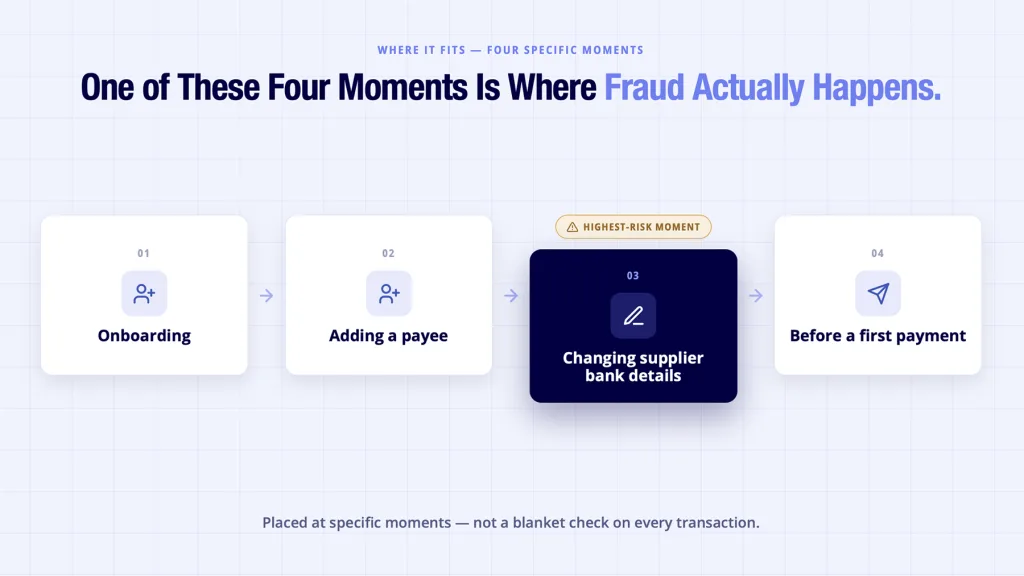
UK bank account verification works best placed at a small number of specific moments, not as a blanket check on every transaction:
- Onboarding: confirming a new customer or supplier’s account before the first payment
- Adding a payee: at the point a new bank account is added to a platform, not after
- Changing supplier bank details: the single highest-risk moment for invoice redirection fraud
- Before a first payment: a final check immediately ahead of funds leaving the account
This lines up with where bank account verification already sits in most onboarding flows, extended here to cover payee changes and supplier updates specifically.
What It Prevents (and What It Doesn’t)
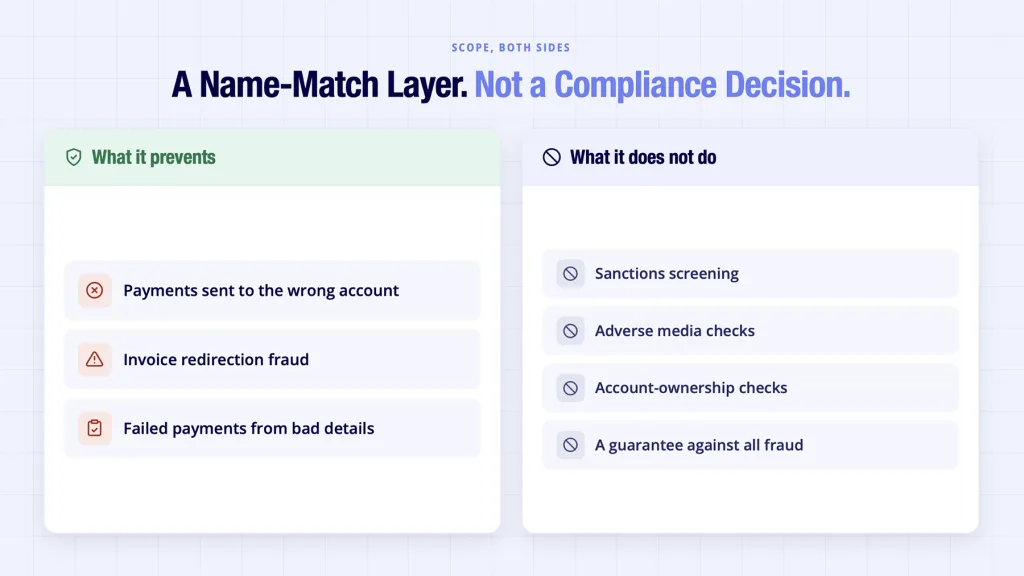
Done properly, a bank account verification api reduces three specific problems: payments sent to the wrong account, invoice redirection fraud where a supplier’s bank details are quietly changed and failed payments caused by incorrect account details entered at source.
A verified name match against invoice bank details catches the moment fraud typically happens: not the invoice itself, but a follow-up email changing where the payment should land.
It’s worth being precise about scope here. Verification does not screen for sanctions, check adverse media or assess who owns an account, and it does not guarantee that no fraud will get through. “It’s a name-match layer, not a compliance decision,” says Paul, Compliance Lead at Finexer. “Platforms that need sanctions screening or PEP checks still need a dedicated AML provider for that.”
What to Evaluate Before Choosing a Provider
| Criteria | Why it matters |
|---|---|
| UK bank coverage | A provider that misses major banks creates gaps at the exact moment you need certainty |
| Response time | A check that holds up onboarding defeats the purpose |
| Match granularity | Full match, close match, no match, not just a binary pass or fail |
| FCA authorisation | Confirms the provider has the legal right to access bank data in the UK |
| How close matches are surfaced | The provider should return enough detail to build a decision rule, not just a score |
Finexer’s Verification API
Platforms adding or changing payee details run into the same gap: account number and sort code validity say nothing about whether the name on the account is correct.
Finexer’s Verification product closes that gap with bank-based name verification through an API, alongside document data extraction and verification reports for identity checks.
For this specific problem, three things matter:
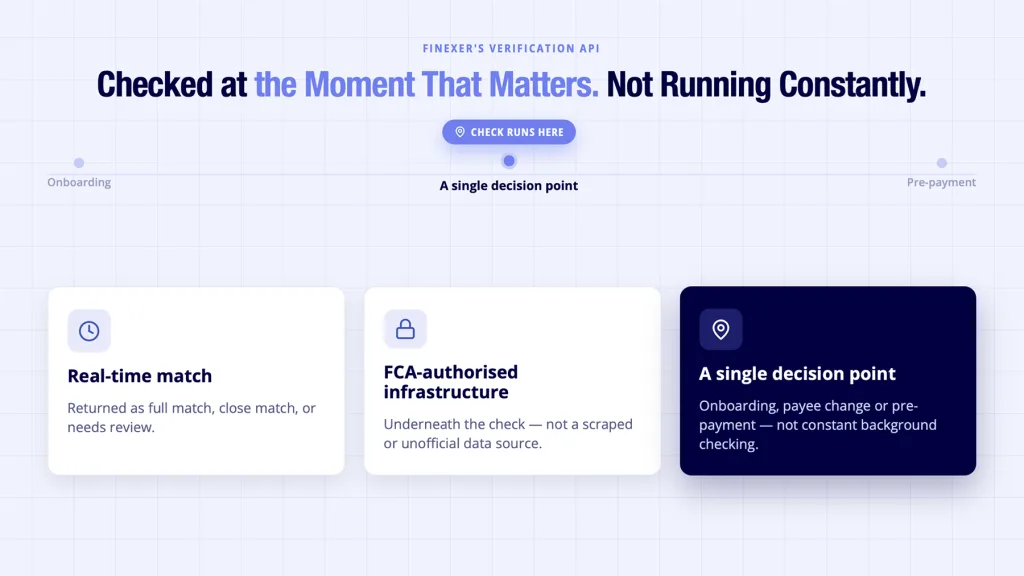
- Real-time match against the bank record, returned as full match, close match, or needs review
- FCA-authorised infrastructure underneath the check, not a scraped or unofficial data source
- Built to sit at a single decision point (onboarding, payee change or pre-payment) rather than as a constant background check
Who’s Already Using This
Payroll and invoicing platforms verify supplier and contractor accounts before a batch payment run. Accounting and ERP tools check payee details at the point a new supplier is added. Proptech platforms verify landlord and tenant accounts before rent collection begins.
Does a bank account verification api slow down onboarding?
A well-built check runs in the background at the point a bank account is added, not as a separate step the user has to wait through, so it shouldn’t add meaningful friction to onboarding itself.
What happens if a business account is verified instead of a personal one?
The same three checks apply, existence, format validity and name match, matched against the registered business name rather than an individual’s name on the account.
Can a close match be accepted automatically?
Yes, within a tolerance the platform defines, such as a shortened first name or a missing middle initial. The decision rule sits with the platform, not the API.
Does this replace a full KYC process?
No. Name verification against a bank record is one input into onboarding, not a substitute for identity verification, sanctions screening or the platform’s own KYC checks.
See how Finexer’s Verification API confirms account name and existence against the bank record before payment, cutting failed payments and misdirected funds
About the Author

Ravi Ranjan
Ravi Ranjan is Co founder & CEO of Finexer