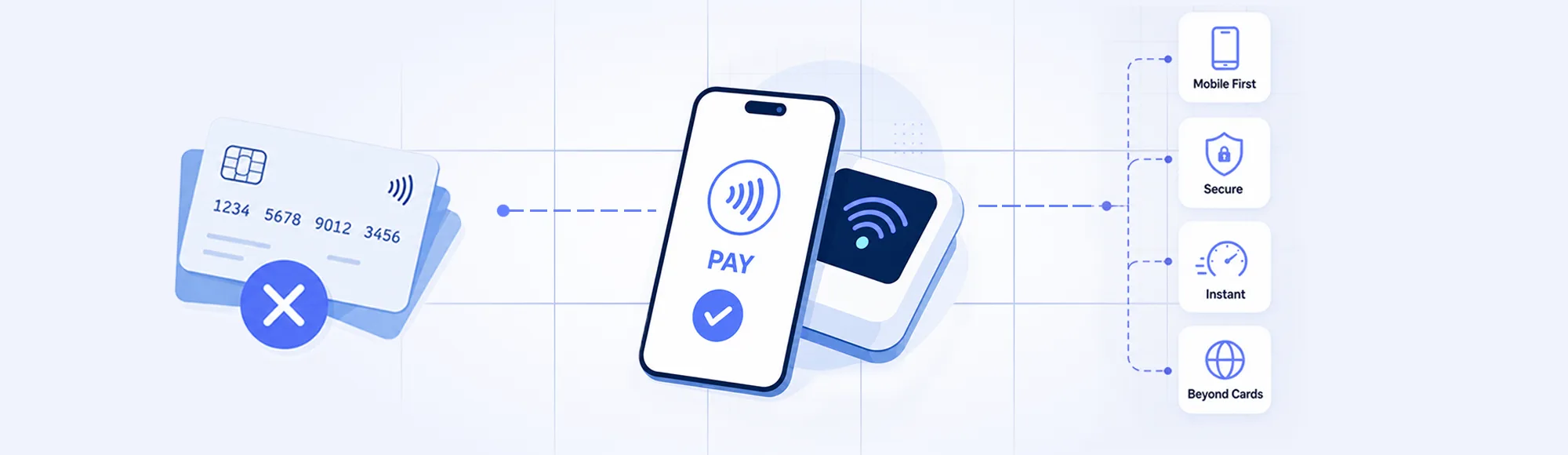
QR payments. Pay by Bank. No card network. No hardware required.
Touchless payment infrastructure for EPOS, utility billing, and payment SaaS platforms.
Contactless mobile payment solutions have defined the checkout experience for the past decade. 83% of UK adults now use contactless payments regularly. The tap-to-pay habit is embedded.
But for platforms – not consumers – the cost structure behind that tap is the problem.
Every contactless card payment runs through NFC hardware, a card network, a PSP, an acquiring bank, and an issuing bank before settling. That infrastructure charges 1.5–3% per transaction. At checkout volumes typical of EPOS and utility billing platforms, that fee compounds into a material operational cost.
UK Open Banking payments reached 37.46 million in March 2026 – up 14.1% month on month. The platforms leading that growth are the ones replacing card-network-dependent contactless with software-driven, bank-based touchless payment flows.
TL;DR
A contactless mobile payment solution includes NFC card tap, mobile wallets (Apple Pay, Google Pay), QR code payments, and Pay by Bank via Open Banking. NFC and mobile wallets depend on card network infrastructure and carry 1.5–3% transaction fees. QR-based and Pay by Bank touchless payment options initiate account-to-account transfers directly – no card network, instant settlement, zero chargebacks. For EPOS, utility billing, and payment SaaS platforms processing volume, the infrastructure choice determines the fee structure and settlement speed.
Key Takeaways
What are the main contactless mobile payment solutions available in the UK?
Four categories:
- NFC card tap – contactless debit/credit card, £100 limit per transaction, runs on card network rails
- Mobile wallets – Apple Pay, Google Pay, Samsung Pay via NFC. No £100 limit with biometric authentication. Still card-network dependent.
- QR-based payments – customer scans a code, initiates bank-authenticated payment via smartphone. No tap hardware required.
- Pay by Bank (Open Banking) – account-to-account payment initiated via banking app or Payment Link. Direct bank-to-bank transfer via Faster Payments.
What is the difference between NFC and QR touchless payment options?
NFC requires hardware at the point of sale – a card reader or terminal – and routes the payment through card networks. QR requires no hardware. The QR code appears on a screen, a printed receipt, or an invoice. The customer scans it with their phone and authenticates in their banking app. The payment initiates as an account-to-account transfer. No card network involved.
Why are platforms shifting away from card-based contactless mobile payment solutions?
Three reasons:
- Cost – card fees of 1.5–3% scale with transaction value. A £500 utility bill payment via card costs £7.50–£15 in fees alone. Via Open Banking QR, the cost is a fixed API call.
- Settlement speed – card payments settle T+1 to T+3. Open Banking Faster Payments settles instantly.
- Chargebacks – card payments carry chargeback exposure. Open Banking A2A payments do not.
What Does the Contactless Payment Landscape Look Like for Platforms?
How Do the Three Types of Touchless Payment Options Compare?
UK-specific context: The standard contactless card limit in the UK is £100 per transaction. Mobile wallets (Apple Pay, Google Pay) have no limit when biometric authentication is used. Open Banking QR and Pay by Bank have no transaction limit and connect directly to virtually every major UK bank.
| Payment Type | Hardware Required | Fee Structure | Settlement | Chargeback Risk |
|---|---|---|---|---|
| NFC card tap | Yes – card reader | 1.5–3% per transaction | T+1 to T+3 | Yes |
| Mobile wallet (Apple/Google Pay) | Yes – NFC terminal | 1.5–3% per transaction | T+1 to T+3 | Yes |
| QR code (Open Banking) | No | Usage-based API cost | Instant (Faster Payments) | None |
| Pay by Bank (Payment Link) | No | Usage-based API cost | Instant (Faster Payments) | None |
“The contactless mobile payment solution question for platforms is not about tap vs scan. It is about what infrastructure sits behind the tap. Card networks charge a percentage. Open Banking charges a flat API cost. At volume, that distinction determines platform unit economics.” – Ravi, Finexer
Best contactless payment systems for EPOS platforms covers how contactless payment hardware and software options compare for retail and EPOS platform deployments.
Why Are Platforms Moving Beyond Card-Based Contactless Mobile Payment Solutions?
What Makes QR and Pay by Bank Touchless Payment Options More Scalable?
The shift is economic, not experiential. Customers do not care whether the touchless payment runs on NFC or QR – they care that it is fast and works first time.
The platform cares about the infrastructure behind it.
- No hardware dependency: QR codes appear on any screen, printed receipt, or digital invoice. No card reader. No terminal lease. No hardware maintenance. A utility billing platform collecting from 50,000 customers needs a Payment Link – not 50,000 NFC readers.
- Fee structure that does not scale with transaction value: A 2% card fee on a £1,000 invoice is £20. On a £10,000 corporate payment, it is £200. Open Banking payment initiation costs the same per API call regardless of transaction value. For high-value B2B payments, utility bills, and supplier invoices, the fee structure difference is substantial.
- Instant settlement changes cash flow: Card settlement takes 1-3 business days. Open Banking Faster Payments settles instantly. For platforms managing cash positions across thousands of transactions, the gap between authorisation and settlement is the gap between accurate and approximate cash flow reporting.
- Zero chargebacks: An Open Banking payment is an authenticated bank-to-bank transfer. The customer initiates it directly in their banking app. There is no card-network dispute mechanism. No chargeback exposure. No dispute management overhead.
Pay by Bank for EPOS and payment platforms covers how Pay by Bank works as a touchless payment option for in-person and digital payment flows.
Where Does Each Touchless Payment Option Work Best?
Which Contactless Mobile Payment Solution Fits Which Platform Type?
- EPOS platforms: NFC remains the dominant contactless method for high-frequency, low-value retail transactions – coffee, groceries, transport. It is fast, familiar, and the customer habit is established.
- For higher-value EPOS transactions: equipment purchases, trade services, hospitality bills – QR-based Open Banking payments reduce fee exposure significantly and remove the chargeback risk that card payments carry at those values.
- Utility billing platforms: Utility bills are high-value, recurring, and typically collected remotely. NFC is irrelevant. A Payment Link embedded in a digital bill notification initiates an Open Banking payment that settles instantly. The customer authenticates in their banking app. No card details entered. No NFC hardware required.
- In-person service businesses: Tradespeople, mobile service providers, and field operations cannot always rely on NFC connectivity. QR codes on paper invoices or displayed on a phone screen work offline and in environments where terminal connectivity is unstable.
- Payment SaaS: Platforms embedding payment capability into their product need infrastructure that does not require the end client to install hardware. QR and Payment Links deploy as software. No hardware rollout. No merchant account per client.
Payment methods for retailers and billing platforms covers how different touchless payment options perform across retail, billing, and service payment workflows.
How Does Finexer Support Touchless Payment Options?
What Does Finexer Provide for QR and Pay by Bank Payment Flows?
Finexer does not provide NFC hardware, card readers, or mobile wallet infrastructure. Finexer provides Open Banking payment initiation (PIS) – the software layer that powers QR and Pay by Bank as a contactless mobile payment solution for platforms.
It complements existing card and NFC infrastructure – not replaces it.
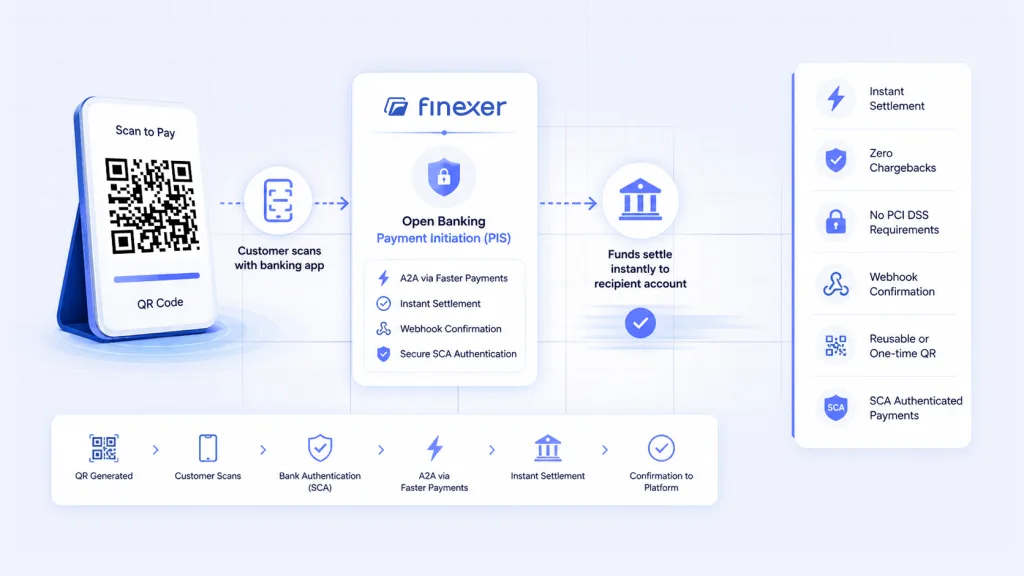
QR code payments:
- QR code generated per transaction or reusable per merchant
- Customer scans with smartphone, authenticates in banking app via SCA
- Payment initiates as A2A transfer via Faster Payments
- Instant settlement to recipient account
- Webhook confirmation returned to platform immediately
- Zero chargebacks on initiated payments
- No PCI DSS requirements on payment flows
Payment Links:
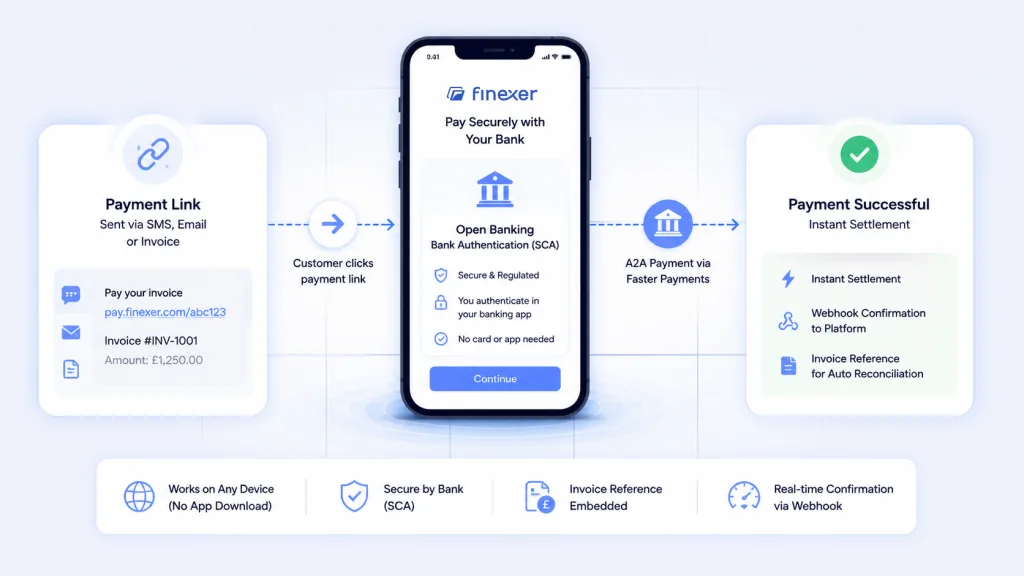
- Shareable link sent via SMS, email, or embedded in invoice
- Initiates the same Open Banking bank-authenticated flow
- Invoice reference embedded at initiation – automated reconciliation
- Works on any device with a browser – no app download required
What this looks like in a platform:
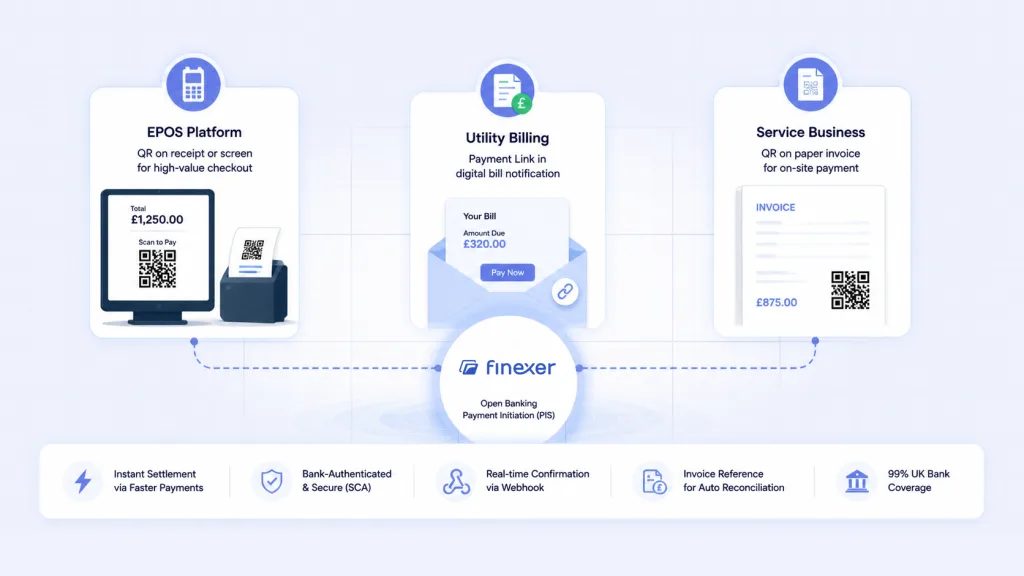
- EPOS platform: QR on receipt or screen for high-value checkout
- Utility billing: Payment Link in digital bill notification
- Service business: QR on paper invoice for on-site payment
Usage-based pricing, no setup fees, no minimum commitments. 3-5 weeks to production. 99% UK bank coverage – high street, challenger, and business accounts. UK-only infrastructure built for the UK Open Banking standard.
“QR and Payment Link touchless options work because they move the payment initiation to the payer’s banking app – the most authenticated, most trusted environment the payer already uses every day. No card details. No NFC hardware. Just a scan and a biometric confirmation.” – Ravi, Finexer
Finexer payments product covers the full PIS capability set including QR code payments, Payment Links, Pay by Bank, and VRP for platform integration.
What I Feel
“Contactless” became synonymous with NFC because tap-to-pay was the first hardware solution that worked at scale.
Hardware shaped the habit.
But hardware is not the definition. Contactless means without physical contact. QR is contactless. A Payment Link is contactless. Biometric bank authentication is more secure than a card tap and does not require the merchant to own a terminal.
The platforms that recognise this now – and add QR and Pay by Bank as a contactless mobile payment solution alongside NFC – are the ones whose unit economics improve as transaction volume grows.
Common Use Cases
EPOS Platforms
QR code as contactless mobile payment solution at checkout for high-value transactions. Customer scans, authenticates in banking app, payment settles instantly. No card reader required. No chargeback exposure. Webhook confirms settlement to EPOS system immediately.
Utility Billing Platforms
Payment Link as a contactless mobile payment solution in digital bill notifications. Customer clicks, authenticates in banking app, payment settles. Invoice reference embedded at initiation. No manual reconciliation. No card processing fees on bill collection.
In-Person Service Businesses
QR code as a contactless mobile payment solution on paper invoice or phone screen. Works in any location, with or without stable connectivity. Instant settlement means the tradesperson does not wait for card batch processing.
Payment SaaS Builders
A contactless mobile payment solution via Payment Links and QR deploys as API calls – no hardware rollout required per client. Platform embeds touchless payment capability into its product without managing card reader infrastructure.
What is a contactless mobile payment solution?
A contactless mobile payment solution allows payments without physical contact between payer and payment hardware. Common methods include NFC card tap, mobile wallets (Apple Pay, Google Pay), QR code payments, and Pay by Bank via Open Banking. NFC and mobile wallets use card networks. QR and Pay by Bank use direct bank-to-bank transfers via Faster Payments – no card network needed.
Why do EPOS and billing platforms prefer QR over NFC for high-value payments?
NFC routes payments through card networks and charges 1.5–3% per transaction. For a £500 utility bill, that is £7.50–£15 in fees. QR-based Open Banking payments initiate as A2A transfers, costing a fixed API fee regardless of transaction value. Combined with instant settlement and zero chargebacks, QR becomes more cost-efficient than NFC at higher transaction values.
How do Open Banking touchless payment options compare to card-based contactless?
Open Banking QR and Pay by Bank settle instantly via Faster Payments, carry no chargeback risk, and cost a fixed API fee per transaction rather than a percentage. Card-based contactless settles T+1 to T+3, carries chargeback exposure, and costs 1.5–3% per transaction. For high-value or high-volume platform payments, the difference in cost and settlement speed is material.
Extend your contactless payment options beyond NFC with QR and Pay by Bank infrastructure.
About the Author

Ravi Ranjan
Ravi Ranjan is Co founder & CEO of Finexer