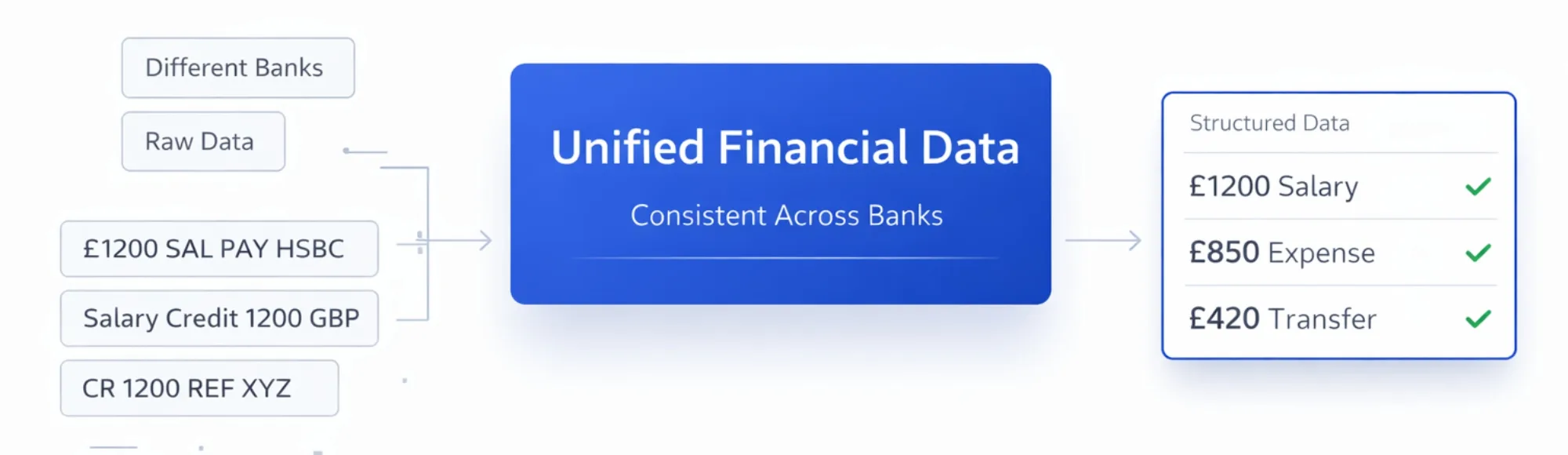
Connectivity is not the problem. Usable data is.
FCA-authorised financial data connectivity for UK fintech platforms.
Financial data connectivity across institutions allows fintech platforms to access, standardise, and use transaction data from multiple banks through a single API integration.
That is the definition. The reality is harder.
Bank connections are achievable. But financial data connectivity that produces workflow-ready, enriched, consistently structured data across every connected institution – that is where most platforms hit production problems.
At Finexer, I work with UK fintech founders and product heads building on multi-bank data. The connectivity challenge they face is not connecting to banks. It is receiving data that is immediately usable once connected.
TL;DR
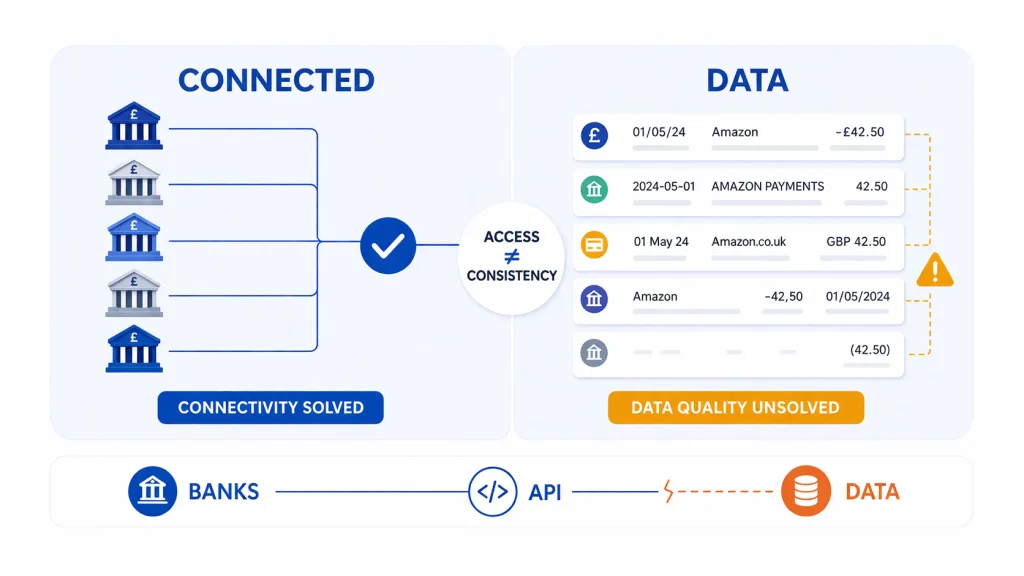
Financial data connectivity across institutions in the UK is delivered through FCA-regulated Open Banking APIs – the UK’s primary open banking data network for secure, consented access to bank transaction data. Over 13 million UK users now access financial services through Open Banking infrastructure (Open Banking Limited, 2025), with 14 billion API calls processed annually. The challenge is not achieving connectivity – it is ensuring the data that arrives is structured, enriched, and consistent across all connected banks. Most financial data providers solve connectivity. Fewer solve data quality.
Key Takeaways
What is financial data connectivity across institutions?
Financial data connectivity across institutions is the technical capability to access account data and transaction history from multiple banks through a single integration. In the UK, it is delivered via FCA-authorised AIS under Open Banking standards – giving platforms consented access to bank data without direct bank integrations.
Why does financial data connectivity break after go-live?
Connectivity breaks post-launch because raw bank data is inconsistent across institutions. The same transaction type arrives with different description formats, merchant identification varies by bank, and schema structures differ. Financial data providers that solve connectivity without solving normalisation leave platforms with usable connections and unusable data.
What separates financial data providers on data quality?
The gap between financial data providers is in what arrives at the platform after the bank connection is made. Providers that apply merchant IDs, category codes, and a normalised schema before delivery give platforms workflow-ready data. Providers that pass through raw bank output require platforms to build normalisation themselves.
What Does Financial Data Connectivity Across Institutions Actually Require?
What Makes Multi-Bank Data Connectivity Production-Ready?
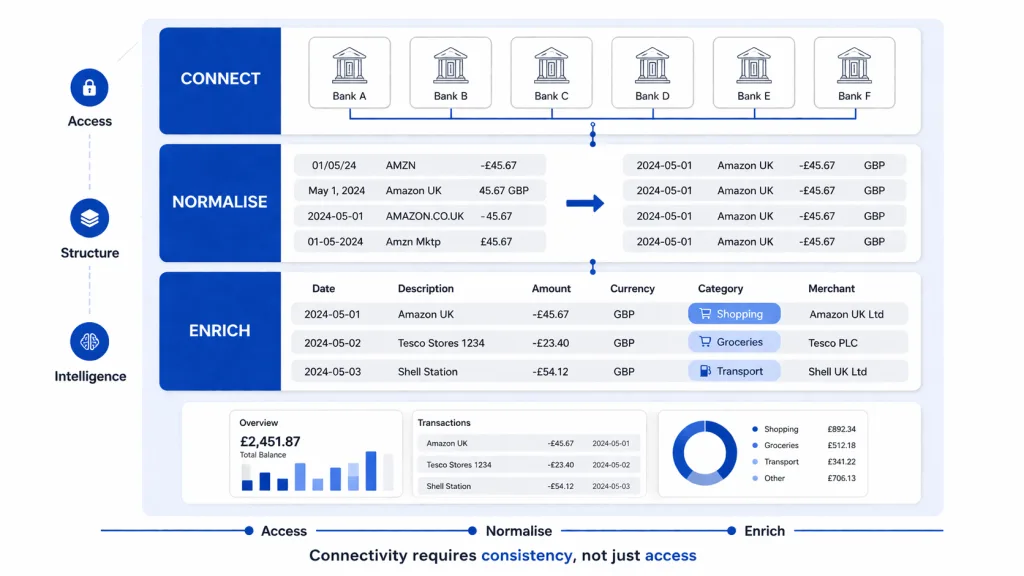
Financial data connectivity across institutions requires three layers to work together:
- Bank connectivity – FCA-authorised access to UK bank APIs covering high street, challenger, and business accounts
- Data normalisation – consistent transaction schema regardless of which bank or payment method originated the transaction
- Enrichment at source – merchant IDs and category codes applied before data reaches the platform, not as a post-processing step
For fintech startups and scale-ups, sharing financial data across institutions through a single provider removes the complexity of managing multiple bank connections and data formats simultaneously.
Data connectivity for UK financial platforms covers how multi-bank connectivity architecture determines whether data arrives usable or requires additional normalisation overhead.
“The financial data connectivity problem in the UK is not access. Open Banking solved access. The unsolved problem is consistency – getting the same data quality from bank 12 as from bank 1, with the same schema, the same enrichment, and the same latency.” – Ravi, Finexer
Where Do Financial Data Providers Fall Short?
What Are the Real Gaps in Financial Data Connectivity Platforms?
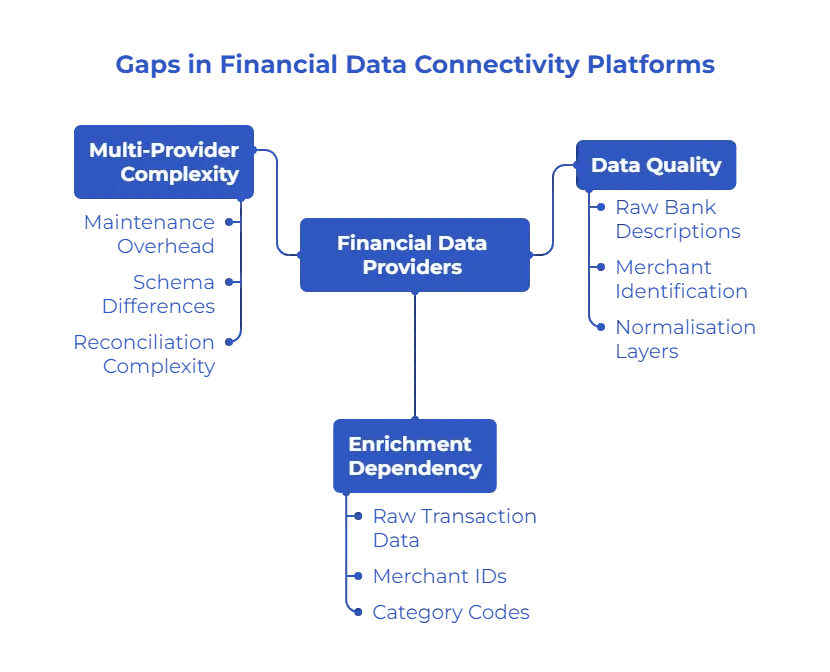
Most financial data providers in the UK solve bank connectivity well. The production gaps appear in three areas:
Data quality after connection:
- Raw bank descriptions are inconsistent across payment methods
- Merchant identification varies by institution and payment rail
- Platforms build normalisation layers that break when bank API formats change
Enrichment dependency:
- Many providers pass raw transaction data without merchant IDs or category codes
- Platforms must source enrichment separately or build it in-house
- This creates a two-provider dependency: one for connectivity, one for enrichment
Multi-provider complexity:
- Platforms often stitch together 2-3 financial data providers to cover connectivity, enrichment, and payments
- Each integration adds maintenance overhead, schema differences, and reconciliation complexity
- No single provider owns the end-to-end data quality
Bank integration API for financial data access covers how integration architecture decisions at the infrastructure layer determine long-term data quality reliability.
Leading bank data providers for UK financial platforms covers how UK financial data providers compare on connectivity depth, data quality, and production readiness.
How Should Platforms Evaluate Financial Data Providers?
What Criteria Actually Predict Production Data Quality?
Evaluating financial data providers on documentation and sandbox cleanliness predicts demo quality. These criteria predict production quality:
| Evaluation Criteria | What Providers Claim | What to Actually Test |
|---|---|---|
| UK bank coverage | Headline bank count or percentage | Consistency across challenger banks, business accounts, and joint accounts |
| Data quality | Structured transaction data | Merchant ID normalisation across all payment methods before delivery |
| Enrichment | Data enrichment available | Category codes applied at source – not as a separate post-processing step |
| Time to production | Quick setup / fast integration | Realistic timeline from API access to first live transaction with active support |
| Unified capability | Full financial data connectivity | Data and payment initiation in a single integration – no second provider required |
Financial data extraction API for UK financial services covers how extraction method and enrichment architecture interact to determine production data quality for financial platforms.
Where Finexer Fits in Financial Data Connectivity
What Does Finexer Provide for Multi-Institution Data Connectivity?
Platforms that need both financial data connectivity and usable data quality – without managing multiple financial data providers – look for infrastructure that combines aggregation, enrichment, and payments in a single layer. For fintech startups evaluating open banking data network providers, the decision comes down to which provider delivers workflow-ready data, not just raw bank access.
Finexer’s FCA-authorised AIS provides:
- Real-time webhook delivery – each transaction delivered at occurrence, no polling gaps
- Merchant IDs per transaction – consistent identification across all payment methods and banks
- Category codes at source – expense classification before data reaches the platform
- Structured JSON – consistent schema across 99% of UK banks
- Up to 7 years of transaction history – full historical depth for onboarding and analytics
- Consent logs per retrieval – audit trail for FCA and MLR 2017 compliance
- PIS alongside AIS – Pay by Bank, Payment Links, VRP, and Bulk Payout in the same integration
- Usage-based pricing, 3-5 weeks to production with active onboarding support
Best financial data aggregators for UK platforms covers how Finexer’s unified AIS and PIS approach compares to aggregator-only financial data providers.
“Financial data connectivity across institutions is a solved problem in the UK. What is not solved – for most platforms – is receiving that data in a format that accounting, ERP, and compliance workflows can use without additional processing. That is the gap Finexer closes.” – Ravi, Finexer
What I Feel
The financial data connectivity conversation in the UK almost always starts with bank count.
It should start with data quality after connection.
Any FCA-authorised provider can connect to UK banks. The decision that matters is which provider delivers data that the platform can actually use – enriched, structured, and consistent – from the first connection to the hundredth.
Common Use Cases
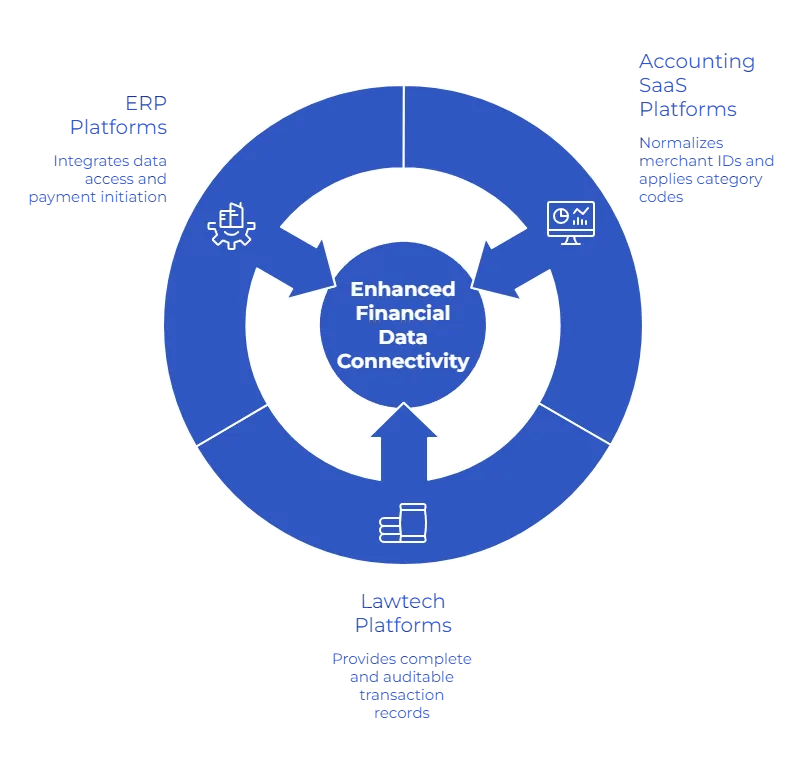
Accounting SaaS Platforms
Multi-bank client data arrives with inconsistent merchant descriptions that break categorisation workflows. Finexer’s financial data connectivity delivers:
- Merchant IDs normalised across all payment methods
- Category codes applied before data reaches the accounting system
- Real-time webhooks per transaction – no CSV imports, no polling gaps
Lawtech Platforms
Source of funds checks and financial history analysis require complete, auditable transaction records across all client accounts. Finexer’s cross-institution connectivity provides:
- Up to 7 years of transaction history per connected account
- Consent logs and access timestamps per retrieval
- Multi-account access in a single consent flow
ERP Platforms
Multi-bank financial data connectivity for high-volume supplier and payroll workflows requires both data access and payment initiation. Finexer delivers:
- Single integration covering both data and payments
- AIS for transaction data and account verification
- Bulk Payout and Pay by Bank for outbound disbursements
Which fintech platforms provide the best financial data connectivity in the UK?
The best financial data connectivity platforms for UK fintechs combine FCA-authorised bank access with data normalisation and enrichment at source. Key criteria are UK bank coverage depth, merchant ID consistency across payment methods, structured JSON output, and whether data and payment initiation are available through a single integration.
What should platforms look for in financial data providers?
Platforms should prioritise data quality over bank count, enrichment at source over post-processing, and unified connectivity plus payments over separate integrations. The difference between financial data providers is not which banks they connect to – it is what the data looks like when it arrives at the platform.
How does Open Banking enable financial data connectivity in the UK?
FCA-authorised AIS providers access UK bank data under Open Banking standards using consented API access. Each retrieval delivers account details and transaction history with consent logging. Over 13 million UK users now access financial services through this infrastructure, making it the primary mechanism for financial data connectivity across UK institutions.
Build reliable financial data connectivity on FCA-authorised bank data infrastructure
About the Author

Ravi Ranjan
Ravi Ranjan is Co founder & CEO of Finexer