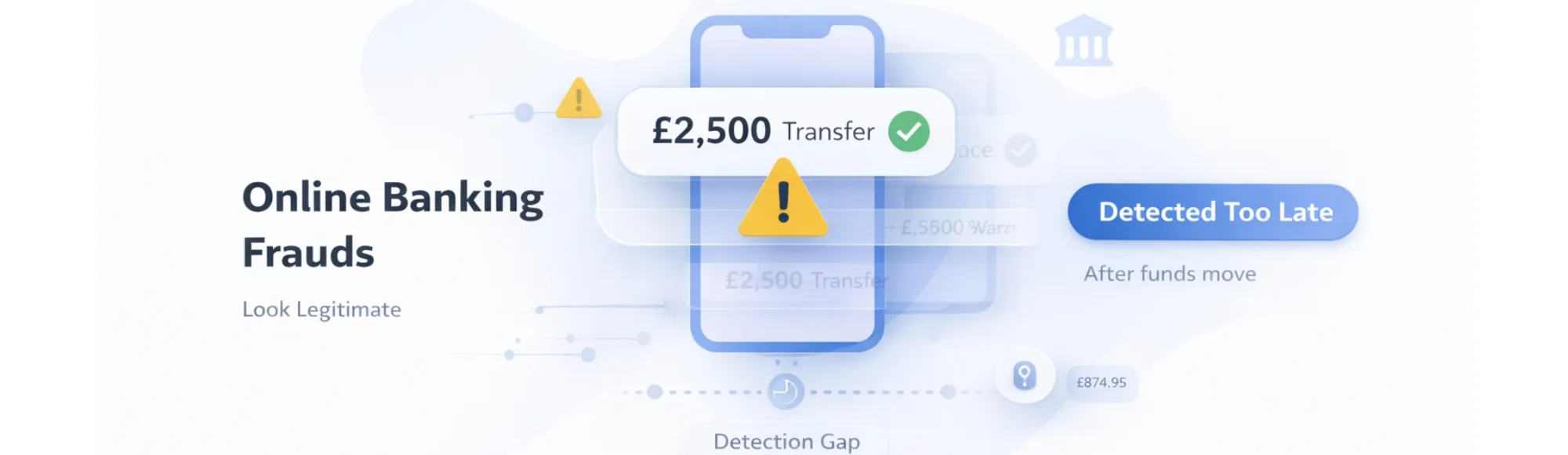
Fraud does not announce itself.
See how platforms use bank transaction data to improve fraud detection and monitoring.
Online banking frauds rarely look like fraud when they happen.
A payment is authorised. The bank processes it. The funds move. To every system watching the transaction, it looks legitimate – because at the point of authorisation, the user approved it.
The fraud is not in the payment. It is in the circumstances that led to the payment. And by the time those circumstances are understood, the money is gone.
At Finexer, I work with Lawtech platforms, EPOS systems, and accounting SaaS that encounter this problem in their workflows. Fraud detection that happens after the payment is not detected. It is documentation.
TL;DR
Online banking frauds in the UK – particularly Authorised Push Payment (APP) fraud – cost over £600 million in H1 2025 alone. Open Banking itself has a fraud rate of just 0.013% by volume, significantly lower than the industry average of 0.045%. The problem is not the payment rails. It is the visibility gap that allows fraud to complete before platforms identify it. Real-time bank transaction data is what closes that gap – giving platforms the financial activity visibility they need to detect anomalies before funds clear.
Key Takeaways
What are the most common types of online banking frauds?
The main types of online banking frauds in the UK are Authorised Push Payment (APP) fraud, phishing and credential theft, account takeover, and impersonation fraud. APP fraud is the most damaging – victims are manipulated into approving genuine payments to fraudulent accounts, making the transaction appear legitimate.
Why do online banking frauds go undetected until after the payment?
Most platform monitoring looks at transaction format and authorisation status – not financial context. A fraudulently-obtained authorised payment looks identical to a legitimate one. Without real-time visibility into the account’s financial history and behaviour patterns, the anomaly is invisible at the point of payment.
How to prevent online banking frauds at the platform level?
Preventing online banking frauds at scale requires real-time transaction monitoring, continuous access to account transaction history, and bank-verified identity confirmation at onboarding. Platforms that rely on point-in-time checks miss the patterns that reveal fraud across multiple transactions over time.
What is the visibility gap in online banking fraud detection?
The visibility gap is the window between when fraud occurs and when it is detected. For platforms without real-time bank data access, this window can span hours or days – long enough for funds to move beyond recovery. Closing it requires continuous, not periodic, transaction visibility.
What Types of Online Banking Frauds Are Platforms Seeing in 2025?
What Is Authorised Push Payment Fraud and Why Is It So Hard to Detect?
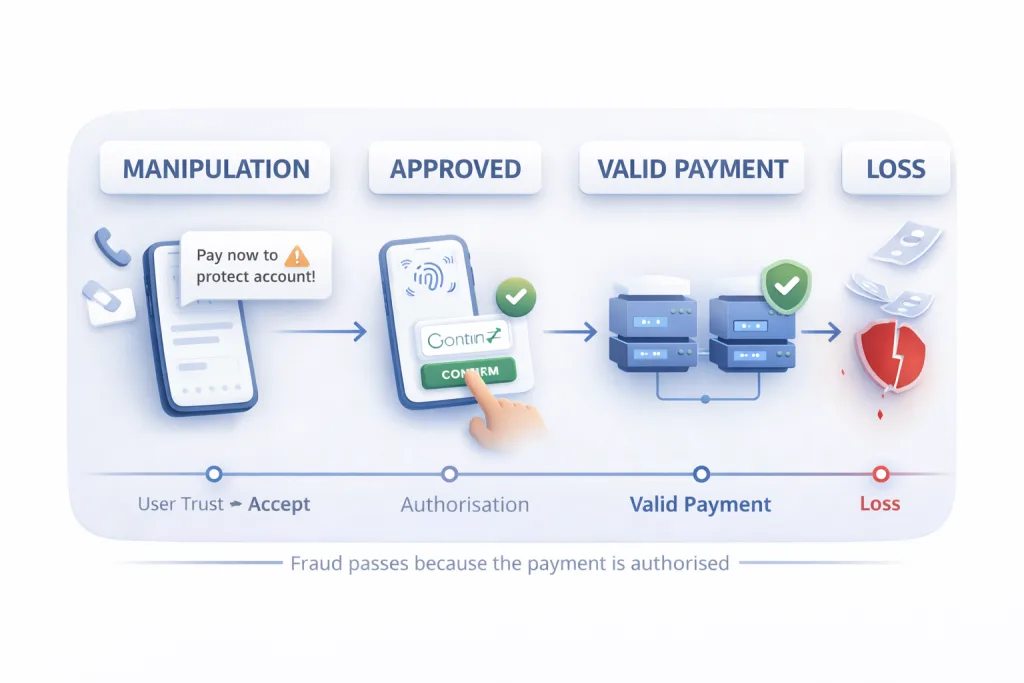
Authorised Push Payment fraud is the dominant form of online banking fraud in the UK.
The victim is manipulated – by phone, email, or social media – into believing a payment is legitimate. They approve it themselves, through their own banking app, with their own credentials. The bank processes a valid authorised payment. Every fraud control passes.
According to Open Banking Limited’s 2025 financial crime update, UK consumers lost over £600 million to APP fraud in H1 2025. Open Banking transactions themselves show a fraud rate of just 0.013% by volume – significantly below the industry average of 0.045%. The fraud problem is social engineering, not technical vulnerability.
“At Finexer, the platform teams I speak to are not losing to technical exploits. They are losing to authorised payments that look clean at every system checkpoint. The fraud happened before the payment – in the conversation that convinced the user to approve it.” – Ravi, Finexer
What Other Online Banking Frauds Affect Platform Workflows?
Beyond APP fraud, platforms face three other common fraud types:
Account takeover – credentials are stolen via phishing or data breach, giving fraudsters direct access to a legitimate account. Payments initiated from a compromised account pass authentication controls because the credentials are real.
Onboarding fraud – fraudulent identities or mule accounts pass verification at the point of onboarding. The fraud does not surface until financial activity from the account reveals anomalous patterns.
Invoice and payment redirection – a vendor or client account is compromised, bank details are changed, and payments are redirected to fraudulent accounts before anyone notices. The payment is legitimate. The destination is not.
The truth about Open Banking security for UK platforms covers how Open Banking infrastructure handles security at the technical layer – and where the remaining fraud exposure sits.
What Is the Business Impact of Late Fraud Detection?
Why Does the Detection Gap Cost Platforms More Than the Fraud Itself?
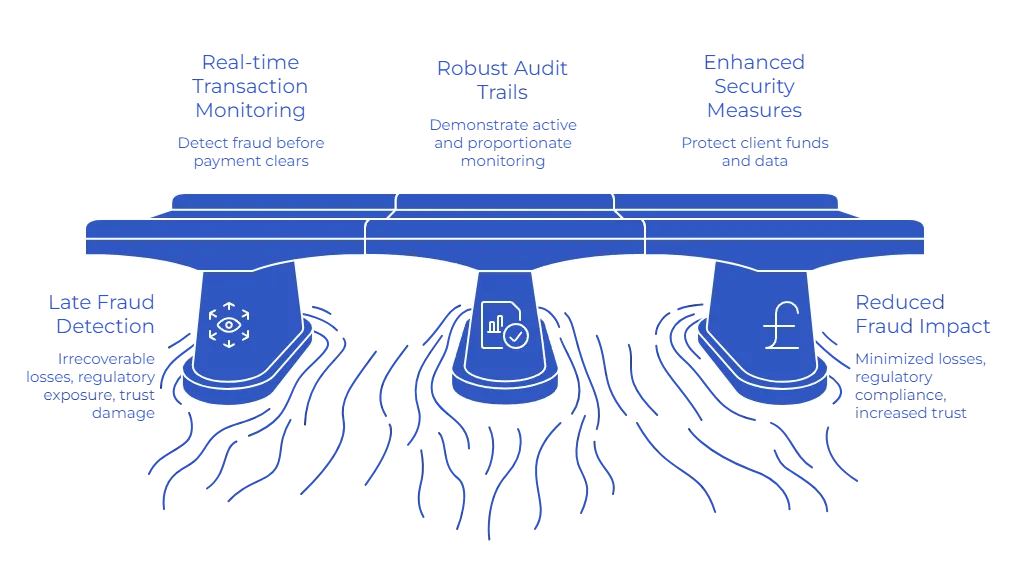
Online banking frauds that are detected after payment have already cleared create three compounding problems for platforms:
Irrecoverable losses – Faster Payments settle in seconds. By the time fraud is confirmed, funds have often moved through multiple accounts and cannot be recalled. The PSR’s APP reimbursement rules cover consumers – platform-level exposure varies.
Regulatory exposure – platforms with MLR 2017 obligations must demonstrate that transaction monitoring was active and proportionate. Late detection without an audit trail creates compliance gaps that regulators scrutinise.
Trust damage – for Lawtech platforms handling client funds, EPOS platforms processing payments, and accounting SaaS managing client financial data, a single undetected fraud event damages client confidence in a way that takes months to recover.
| Fraud Type | How It Gets Through | Why Detection Is Late | What Visibility Closes It |
|---|---|---|---|
| APP fraud | User approves a legitimate-looking payment | Authorisation controls see a valid payment | Behavioural patterns across account history |
| Account takeover | Stolen credentials pass authentication | Login is valid – fraud is in the context | Real-time transaction monitoring post-login |
| Onboarding fraud | Fraudulent identity passes verification | Document checks do not see financial history | Bank-verified account and transaction history at onboarding |
| Payment redirection | Bank details changed before payment processes | Payment goes to wrong account before mismatch is spotted | Payee account verification before payment initiation |
How to Prevent Online Banking Frauds – What Platforms Need to Do Differently?
Why Point-in-Time Checks Miss the Patterns That Reveal Fraud?
The instinct is to add more checks at the point of payment. Better authentication. Stronger verification. More friction.
This helps. But it does not close the visibility gap.
APP fraud bypasses authentication entirely – the user is the authenticator. Account takeover uses real credentials. Onboarding fraud presents clean documents. The fraud is not in the data at the moment of the check. It is in the pattern of activity before and after.
Delayed bank transfers and payment visibility for UK platforms covers how payment confirmation gaps create the windows fraudsters exploit in platform workflows.
To prevent online banking frauds at the platform level, teams need continuous financial visibility – not just point-in-time transaction checks. That means:
- Real-time transaction feeds that surface activity as it happens
- Transaction history that provides behavioural context per account
- Bank-verified account ownership confirmation at onboarding
- Payee account confirmation before payment initiation
Open Banking authentication explained for UK platforms covers how bank-level authentication compares to credential-based methods for fraud prevention at the onboarding stage.
How Does Bank Transaction Data Help Platforms Detect Fraud Earlier?
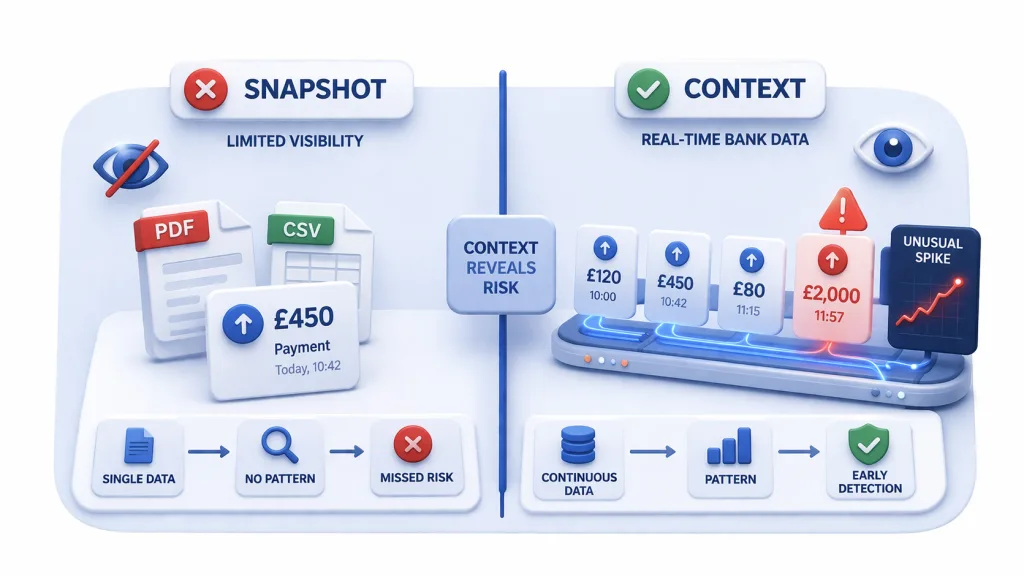
Real-time bank data via FCA-authorised AIS gives platforms financial activity visibility that document-based and periodic-import approaches cannot provide. Each data retrieval is logged with consent timestamps – providing an audit trail that demonstrates active monitoring for MLR 2017 compliance.
When a platform can see a client’s actual transaction history – incoming patterns, outgoing behaviour, account activity timing – anomalies become visible before they become confirmed fraud events.
Signing in using your bank account for secure platform access covers how bank-level identity confirmation at login reduces account takeover exposure for platforms.
A payment that looks normal in isolation looks very different in the context of five unusual transactions that preceded it. That context is only available if the platform has real-time, continuous access to bank transaction data.
“The platforms that catch online banking frauds early are not the ones with the most sophisticated rules engines. They are the ones with the most complete view of what is happening in the account. Continuous bank data access is what gives them that view.” – Ravi, Finexer
What I Feel
Most fraud conversations focus on the fraud itself – the scam type, the attack vector, the social engineering technique.
The more useful question for platforms is: at what point in the workflow was there an opportunity to see this coming?
For most online banking frauds, that opportunity existed. The pattern was there. The anomaly was detectable.
What was missing was the financial visibility to see it in time.
Common Use Cases
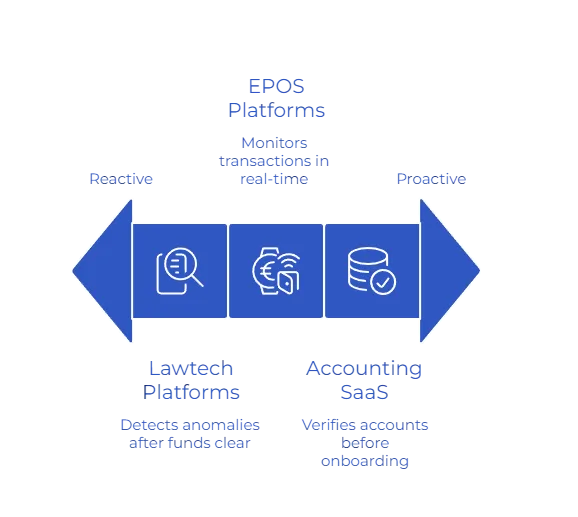
Lawtech Platforms
Client funds handled by Lawtech platforms are high-value targets for payment redirection and APP fraud. Real-time bank transaction visibility across client accounts allows anomalous payment patterns to surface before funds clear – rather than after.
EPOS & Payment Platforms
Payment platforms face account takeover and fraudulent payment initiation as primary risks. Bank-verified account confirmation before payment processing and real-time transaction monitoring reduce the window between fraud attempt and detection.
Accounting SaaS Platforms
Accounting platforms handling client financial data are exposed to onboarding fraud and mule account risk. Bank-verified account history at onboarding surfaces financial behaviour patterns that document-based verification cannot reveal.
What are the most common online banking frauds in the UK?
Authorised Push Payment fraud is the most prevalent – costing over £600 million in H1 2025. Other common types include account takeover, phishing credential theft, invoice redirection, and onboarding fraud using fraudulent or mule accounts. APP fraud is particularly damaging because the payment is approved by the victim.
What are frauds in online banking and how do they get through controls?
Online banking frauds exploit the gap between what controls check and what fraud actually looks like. APP fraud uses real credentials and genuine authorisation. Account takeover uses stolen but valid credentials. Controls check format and authentication status – not financial context or behavioural anomalies across account history.
What should platforms look for in bank transaction data to detect online banking frauds?
Platforms should look for unusual payment patterns, rapid account activity changes, first-time high-value transactions, and activity inconsistent with a client’s typical financial behaviour. Real-time AIS bank feeds provide this context continuously – giving platforms the account-level visibility that periodic imports and document-based checks cannot produce.
Learn how platforms use bank transaction data to improve fraud detection and monitoring.
About the Author

Ravi Ranjan
Ravi Ranjan is Co founder & CEO of Finexer