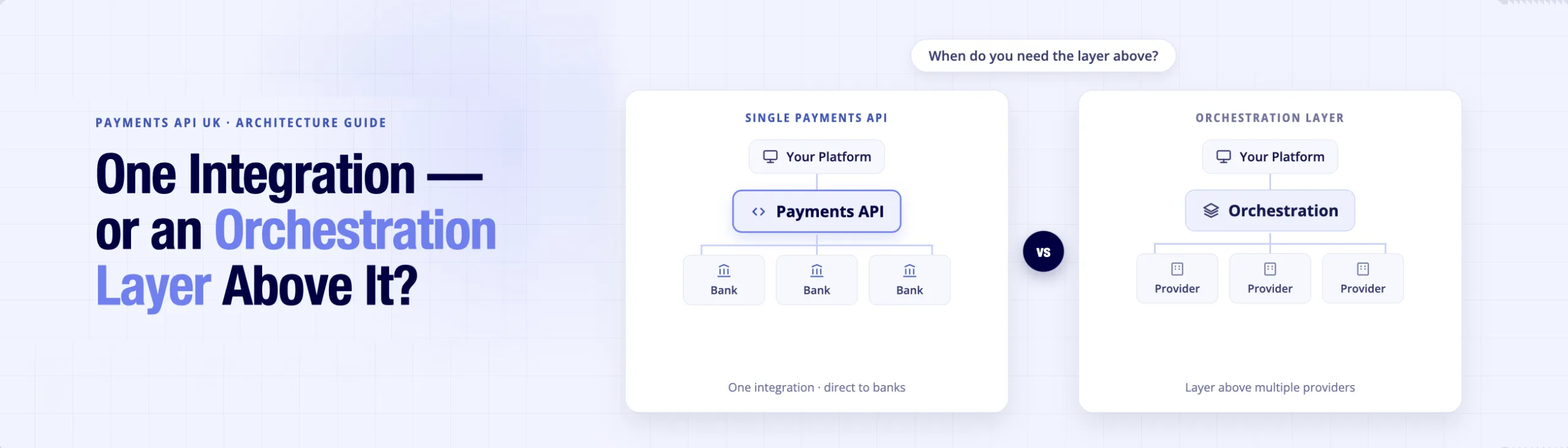
When a platform processes hundreds of transactions daily, a single payment provider’s network issue can result in failed payments, reconciliation gaps, and customer churn. This is why many UK businesses now evaluate not just which payments API to choose, but whether they need it at all, or if a broader orchestration layer sits above it.
The distinction matters. Most platforms start with a single payments API. Some eventually add orchestration. Understanding the difference determines your architecture, cost, and operational resilience.
If you’re evaluating payment infrastructure for your platform, this guide will help you assess which approach fits your scale, volume, and complexity.
What Is a Payments API, Actually?
A payments API is a programmable interface that allows platforms to initiate and manage multiple payment types- bank transfers, instant payments, direct debits, and international payouts through one integration point, rather than building separate connections to each bank or payment network.
Instead of your platform independently connecting to Barclays, NatWest, HSBC, Lloyds, and Monzo, you call a payments API. The provider handles the connectivity to each bank’s clearing network. You send payment instructions; the provider routes them.
This saves months of engineering effort and eliminates the compliance overhead of managing bank relationships directly.
How a Payments API Works in Practice?
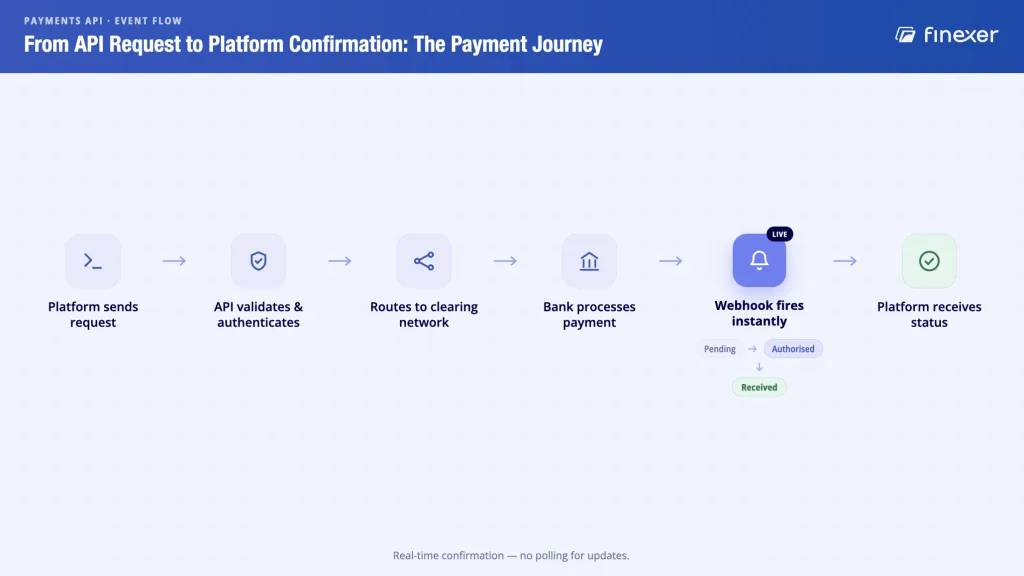
The flow is simple:
- Your platform sends a payment request to the payments API (amount, payer, payee, payment method).
- The provider validates the request and authenticates the payer.
- The payments API routes the transaction to the appropriate clearing network (Faster Payments, BACS, card networks).
- The bank processes the payment.
- The provider fires a webhook instantly with the status change (Pending → Authorised → Received).
- Your platform receives real-time confirmation instead of polling for updates.
This is why payment API integration matters. Without it, you would have to manage webhooks, retry logic, and compliance documentation yourself. With it, you inherit production-ready infrastructure. Most platforms go live within weeks, not months.
The UK Payments API Landscape: Three Payment Routes
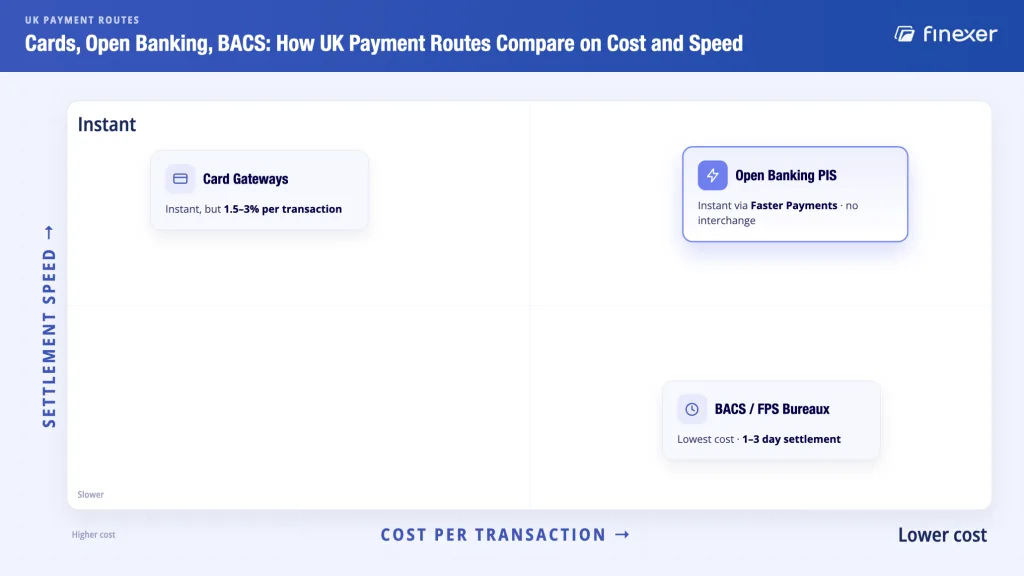
UK platforms typically integrate one or more of these:
Card gateways (Stripe, Checkout.com): Card transactions via Visa/Mastercard networks. Industry standard 1.5–3% per-transaction fees. Reliable but costly at scale.
Open Banking PIS providers (TrueLayer, Yapily, Finexer): Bank-to-bank payments via Faster Payments. FCA-authorised. No card interchange fees. Instant settlement. Growing UK adoption. For a breakdown, see UK Open Banking providers.
BACS/FPS bureaux (Modulr, Ecommpay): Batch file uploads. Slower settlement (1–3 days). Lower per-transaction cost. Suitable for bulk payouts.
Most platforms combine these. Cards for consumer e-commerce, Open Banking for B2B payouts, and BACS for recurring bulk transactions. The choice depends on your user’s geography and payment preference.
What is Payments Orchestration?
Payments orchestration is not a payments API. It’s a control layer above multiple providers that dynamically routes transactions based on success rates, cost, and geography.
Example: You sell across the UK and the EU? UK transactions route via Open Banking (cheaper, instant), EU via card networks. Failed payments automatically reroute to backups. This requires a separate payment orchestration platform (Primer.io, Gr4vy, Spreedly) abstracting multiple APIs beneath one integration.
A Quick Comparison Between Single Payments API vs Payments Orchestration
This insightful comparison between Payments Orchestration and Single Payments API will provide you with better clarity:
| Factor | Single Payments API | Payments Orchestration |
|---|---|---|
| Integration Complexity | Lower – one API to build against | Higher – orchestration platform plus underlying APIs |
| Routing Flexibility | Limited – all transactions route to one provider | High – dynamic routing based on custom rules |
| Failover | Manual – provider outage affects your platform | Automatic – failed transactions route to backup |
| Implementation Speed | Faster – weeks, not months | Slower – multiple integrations to configure |
| Cost Structure | Predictable – single provider fees | Complex – optimisation across multiple providers |
| Best Suited For | Single-market businesses, modest volumes, simple payment needs | Multi-market enterprises, high volumes, resilience critical |
When to Choose a Single Payments API vs Payment Orchestration?
For businesses operating within a single market and processing modest transaction volumes, a single payments API provides sufficient functionality with lower implementation complexity. As transaction volumes grow and operational resilience becomes a business imperative, payment orchestration begins to make financial sense.
What Makes Finexer Different from a Payment Orchestration Platform?
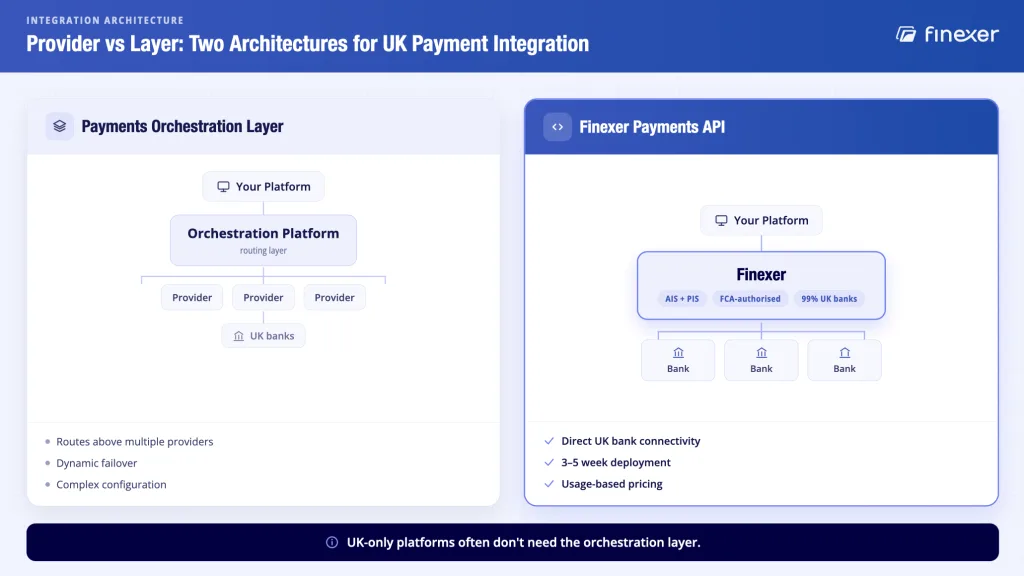
Here’s where Finexer differs from orchestration platforms, and why it matters for your decision.
Finexer is an FCA-authorised payments API, a specialist UK Open Banking provider. We don’t sit above multiple providers or require orchestration configuration. We are the provider. One payment API integration. Two unified capabilities: AIS (read bank data) and PIS (initiate payments).
For Payroll SaaS: Contractor payouts via Finexer’s PIS eliminate BACS three-day settlement and card processing fees (typically 1.5–3% per transaction). Instead: real-time Faster Payments, per-payment webhook status, and automated retry on failure. Based on industry-standard card processing fees of 1.5 to 3% per transaction, a platform processing 50,000 monthly transactions at an average of £200 per payout saves £150,000 to £300,000 annually by switching from card processing. Open Banking payment initiation fires a webhook instantly when each payment settles; no polling, no manual tracking.
For Accounting SaaS: Finexer’s AIS pulls real-time bank transactions for automated reconciliation; PIS handles bulk accountant payouts. Combined, this eliminates CSV imports and BACS file uploads. Integration takes 3 to 5 weeks with Finexer’s onboarding support versus 16+ weeks building direct bank connections in-house.
Pay by bank UK is the consumer experience: The payer authenticates with their bank, the payment moves instantly, and the receipt is confirmed immediately. No card network. No payment delay.
Why Finexer over competitors like TrueLayer or Yapily?
Usage-based pricing means you pay per transaction, not flat enterprise fees-a critical advantage for growing platforms. 99% UK bank coverage. FCA-authorised. 2–3x faster deployment than building direct integrations. UK Open Banking providers vary widely on speed and cost; Finexer’s niche is speed and usage-based fairness.
Finexer’s honest boundaries: UK-focused. Bank-to-bank payments. FCA-authorised. Not a multi-provider orchestration layer. Solves the payout API need without orchestration overhead.
When a Single Payments API Works
- Accounting & ERP: AIS bank feeds + PIS bulk payouts = real-time reconciliation, no BACS 3-day lag
- Payroll SaaS: Per-payment webhook status, instant confirmation, lower failure rates
- Proptech: Instant rent collection via Pay by Bank, lower costs than cards
- Utility billing: Direct debit alternative with instant settlement, lower bounce rates
How long does it take to integrate Finexer?
3–5 weeks from integration start to go-live with Finexer’s onboarding support. This includes API documentation review, webhook setup, testing, and production deployment. Platforms typically deploy Finexer 2–3x faster than building direct bank connections, which typically require 16+ weeks of engineering effort.
How much does a payments API cost versus card processing or BACS?
Finexer charges per transaction (usage-based), not flat fees. For payroll platforms, eliminating 1.5–3% card fees directly improves margins. Typical annual savings depend on transaction volume, but the ROI is immediate. Finexer’s typical per-transaction cost is a fixed amount per payment, meaning you pay only for what you process. For most platforms, the annual cost is 60–70% lower than card processing.
What happens if a payment fails?
Faster Payments has a high settlement success rate. When a payment succeeds or fails, Finexer fires a webhook instantly, letting you know immediately about the transaction status, which, in the case of BACS, you need to wait for three days. Your platform can automatically retry failed transactions or notify the payer, rather than discovering failures post-settlement.
Does payments orchestration make sense for my platform?
If you operate only in the UK and your current payments API provider is reliable, orchestration adds cost and complexity you don’t need. Orchestration makes sense when you cross multiple countries, require automatic failover, or use multiple payment methods (cards, BACS, Open Banking). For single-market UK operations, a specialist payments API is more cost-effective.
To explore which approach fits your platform.
Explore with AI
About the Author

Yuri
Yuriy Yakushko is a fintech founder and software engineer with over 20 years of experience building financial technology. He’s passionate about creating scalable, secure infrastructure that helps businesses modernise how they access financial data and manage payments.