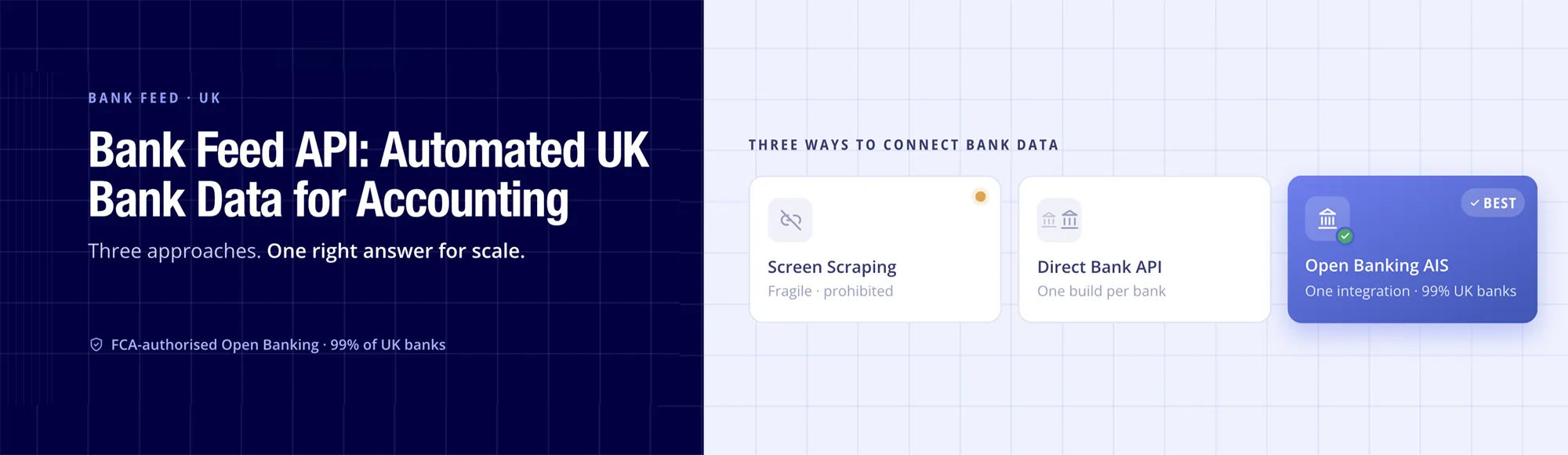
Your accounting SaaS platform has 500 active users. Every morning, your support team receives emails: “My transactions didn’t sync,” “I’m missing bank data from yesterday,” “The feed broke again.” Finance teams are re-uploading CSV files manually because your bank feed isn’t reliable. You’re drowning in support tickets about broken feeds, failed authentications, and missing transaction data.
This is the operational friction that poor bank transactional data infrastructure creates for accounting platforms. According to Statista’s 2025 cloud accounting adoption report, 67% of UK accounting SaaS platforms cite transaction data synchronisation as their top integration challenge.
For platforms making the build-vs-buy decision on bank account data infrastructure, understanding the landscape of screen-scraping vs Open Banking, real-time vs daily refresh, direct APIs vs aggregators is critical.
This guide compares approaches to bank feed infrastructure, helping accounting platforms evaluate what works for their users and business model.
Building or evaluating bank feed infrastructure for your platform? Let’s discuss your data integration requirements and user base size.
What Is a Bank Feed?
A bank feed is an automated connection between an accounting platform and a user’s bank account. Instead of manually downloading bank statements or uploading CSV files, an account synchronises transaction data in real-time or on a scheduled basis- automatically populating ledgers, reconciling accounts, and flagging variances.
For accounting SaaS users, a reliable bank transaction feed transforms reconciliation from a manual, error-prone process into an automated workflow. Finance teams approve transactions rather than hunt for them.
Why does this matter at the platform level?
Users expect bank feed connectivity as a baseline feature. Even recent research found that 48% of accounting practices considered transaction sync friction as a result of the fragmented platforms, which further resulted in investing 5 hours manually in manual reconciliation.
The same study also showed that 78% of the UK emerging accounting leaders view cloud synchronisation as something obvious, and it is driven by the MTD mandate as well.
How Bank Feeds Work?
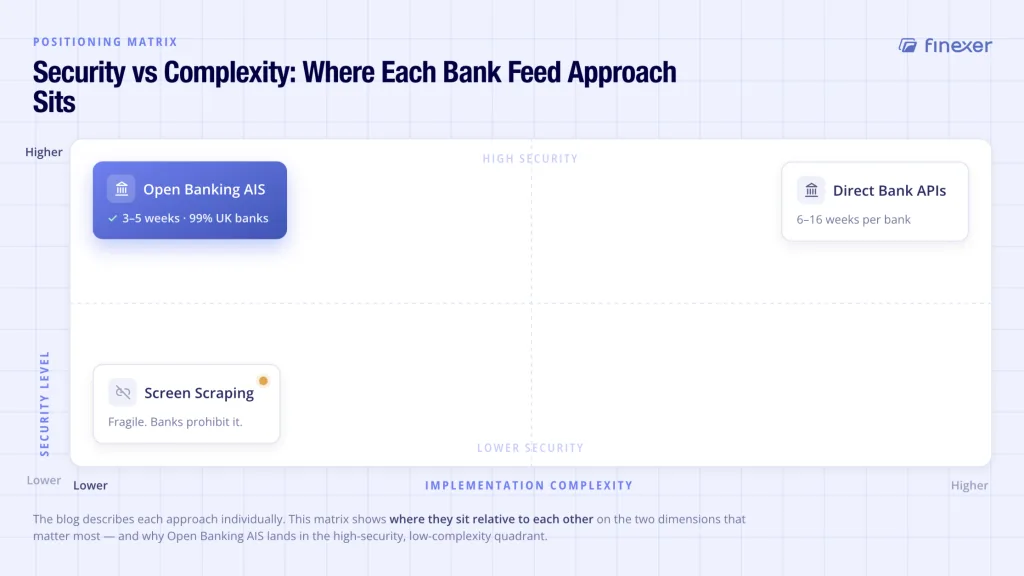
Here are three approaches on how bank account feeds work:
Approach 1: Screen-Scraping
The oldest method. Your platform logs into the user’s bank portal (using their credentials), scrapes the HTML, and extracts transaction data.
How it works: User provides username/password to your platform → Your platform logs in → Extracts transaction data → Stores locally.
Pros: No bank approval needed; works with any bank.
Cons: Fragile (bank portal redesigns break feeds); banks explicitly prohibit this in terms of service; security risk (storing user credentials); 90% failure rate in some studies due to bank security changes; labour-intensive support.
Best for: Legacy systems with no alternative; not recommended for new platforms.
Approach 2: Direct Bank APIs
Your platform connects directly to individual banks’ APIs (Barclays, HSBC, NatWest, etc.).
How it works: Your platform integrates with each bank’s developer portal → Direct API connection → Transaction data feeds in real-time.
Pros: Direct relationship with the bank; real-time data; secure.
Cons: Integration effort for each bank (months per integration); relationship management overhead; banks frequently change APIs; limited to banks with published APIs; only major banks have robust APIs.
Best for: Enterprise platforms handling specific high-value banks.
Approach 3: Open Banking APIs (PIS/AIS)
Your platform integrates with an FCA-authorised Open Banking provider. The provider handles connectivity to all UK banks via a unified API.
How it works: Your platform → Open Banking provider (e.g., Finexer) → Unified connection to 99% of UK banks → Real-time transaction data via webhooks.
Pros: One integration covers 99% of UK banks; secure (no credential storage); real-time data; compliant; low maintenance.
Cons: Depends on third-party provider reliability; different architecture from direct APIs.
Best for: Accounting SaaS platforms targeting UK users; fastest time-to-market.
To understand the underlying architecture in more detail, explore how a bank feed API connects accounting platforms with UK banks through secure Open Banking integrations.
Bank Feed Data: Real-Time vs Daily Refresh
Real-time feeds deliver transactions as they clear the bank (typically minutes to hours). Your users see data immediately. Daily refresh feeds batch-sync once per day, usually overnight or at a set time.
For accounting SaaS, real-time is superior. As Open Banking adoption grows across the UK, accounting platforms are increasingly expected to provide secure, real-time access to bank transaction data. By 2025, nearly 12 million people were using Open Banking-powered products, reflecting the rapid shift towards API-based financial connectivity.
Real-time bank feed infrastructure demands:
- Webhook-based architecture (not polling)
- Sub-second latency
- Reliable notification delivery
- Per-transaction status tracking
Daily refresh is simpler operationally but less competitive.
The 90-Day Re-Authentication Challenge
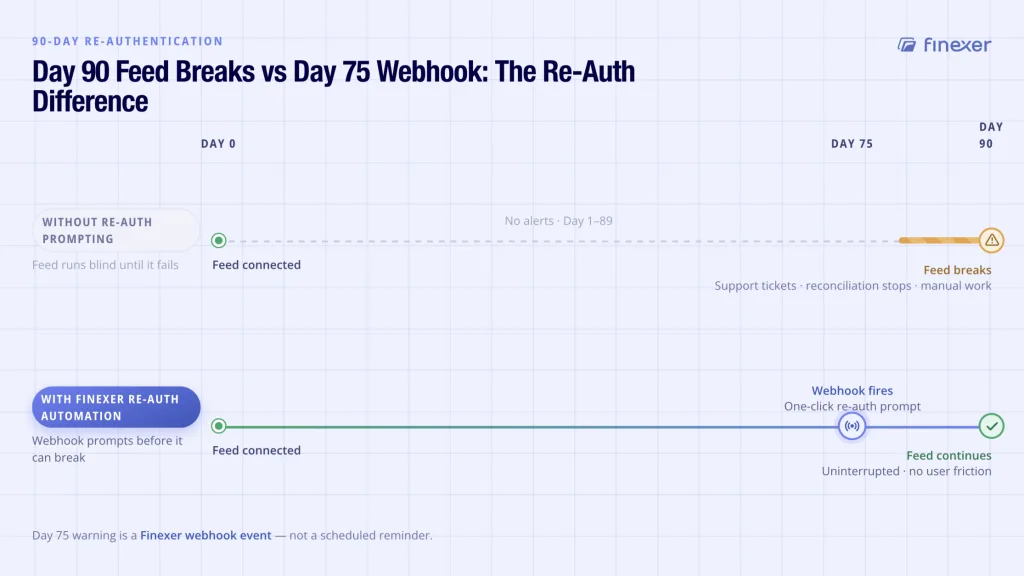
Open Banking regulations require users to re-authenticate every 90 days. This means every 3 months, users must re-consent to transaction access.
How does this impact platforms?
The UK’s Open Banking Standards found that one major third-party provider loses around 13% of active users every 90 days due to the mandatory re-authentication process, while nearly 30% of customer connections break compared with screen-scraping. When users don’t reconnect their accounts, bank feeds stop updating, creating support tickets and reconciliation delays for accounting platforms.
Platforms mitigating this:
- Gives in-app reminders at day 75.
- Provides one-click re-authentication flows.
- Generates webhook notifications when re-auth is required.
Bank transaction data infrastructure providers like Finexer handle re-auth automation via webhook notifications and streamlined UX.
Bank Feed Aggregator vs Direct Integration: Build Considerations
A quick comparison between bank feed aggregator and direct integration can provide insights into operational and time effectiveness that the former has over the latter.
| Factor | Direct Integration | Bank Feed Aggregator |
|---|---|---|
| Time to market | 6–16 weeks per bank | 3–5 weeks (single integration) |
| Bank coverage | Limited to connected banks | 99% of UK banks via one API |
| Operational overhead | High -maintain each integration | Low -aggregator maintains connections |
| Real-time capability | Depends on individual bank API | Aggregator SLA dependent |
| Data freshness | Bank SLA dependent | Aggregator SLA dependent |
| Cost structure | Fixed (engineering resource) | Per-transaction or flat fee |
When to Build vs Buy?
The decision to build or buy depends on your platform’s engineering resources, implementation timeline, compliance obligations, and the level of control you need over bank data integrations.
Build in-house if:
- You have 6+ months of engineering time
- You’re targeting a single specific bank
- You have a budget for ongoing maintenance
Buy (aggregator) if:
- You need UK coverage in weeks
- You’re serving SMB accounting users
- You need maximum uptime reliability
- Your support team capacity is limited
According to a recent report, financial institutions report, over 70% of financial institutions are adopting SaaS or modular platforms rather than building infrastructure in-house, reflecting the economic reality that engineering resources are better spent on product differentiation than infrastructure maintenance.
Use Cases: Where Bank Feeds Matter
Bank feed information delivers the greatest value in platforms where accurate, up-to-date financial data is essential for automation, reconciliation, and informed decisions. Businesses looking to reduce manual reconciliation can also explore how automated bank feeds help accounting platforms keep financial records up to date with minimal manual intervention.
Accounting SaaS: Automated bank feeds eliminate manual CSV uploads, reduce reconciliation time by 70%, and improve user retention through zero-friction onboarding.
Law Firms & Conveyancing: Client bank statements for escrow account monitoring, source-of-funds verification, and audit trails (critical for SRA compliance). The same infrastructure also supports regulated industries, where secure access to client bank statements helps automate financial verification and document collection.
Bookkeeping Platforms: Transaction categorisation via bank transaction feeds enables automated invoicing, expense tracking, and profit-and-loss statements without user effort.
Bank Feed Infrastructure: Finexer’s Approach
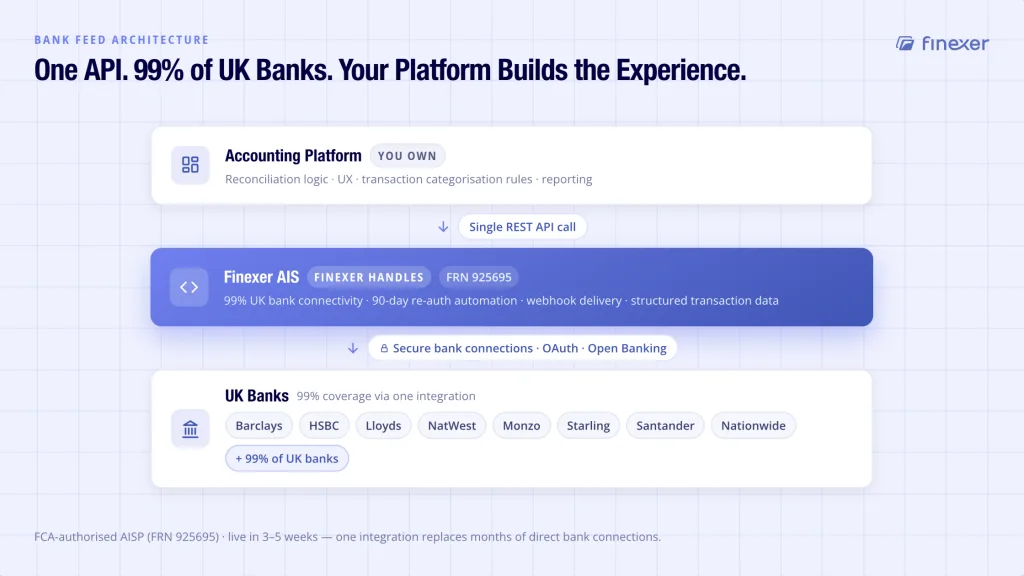
Finexer provides bank feed connectivity via Finexer’s Transaction Enrichment API– an FCA-authorised Account Information Service Provider (AISP) for UK accounting platforms.
What it delivers:
- Real-time transaction synchronisation from most of the UK banks
- Webhook-based architecture (not polling)
- Structured transaction data (amount, date, merchant, category-ready format)
- 90-day re-auth automation
- Sandbox environment for testing
Where does Finexer fit in your architecture?
Finexer is the bank connectivity layer. Your platform owns the user experience- reconciliation workflows, transaction categorisation rules, approval logic, and reporting. Finexer provides the reliable, compliant transaction data stream that powers those workflows.
By abstracting most of the UK bank variations into a single API, Finexer eliminates the operational burden of maintaining direct integrations while freeing your engineering team to focus on reconciliation logic and user experience that differentiates your product.
Why does this architecture matter?
Unlike building or maintaining direct bank connections (months of engineering per bank), Finexer’s unified bank feed API gets you live in 3–5 weeks. Your finance team spends engineering time on features users see and value, not on managing bank API changes and 90-day re-auth workflows.
Evaluating Bank Feed Infrastructure for Your Platform
If you’re an accounting SaaS platform deciding whether to build direct bank integrations or integrate third-party bank feed infrastructure, the decision hinges on: engineering capacity, time-to-market, uptime requirements, and support burden tolerance.
Real-time, reliable bank feed infrastructure is no longer a differentiator- it’s table-stakes. Users expect it. The question is: build or buy?
What is a bank transaction feed and how does it differ from manual CSV upload?
A bank transaction feed automatically synchronises transaction data from your bank account into accounting software in real-time or on a schedule. Manual CSV upload requires finance teams to download statements, save files, and import them, introducing errors, delays, and manual labour. For accounting platforms, real-time bank feeds are now table-stakes.
How often should bank feeds refresh?
Real-time feeds deliver transactions within minutes to hours of bank posting. Daily refresh feeds batch-sync once per day, usually overnight. For accounting platforms, real-time refresh is increasingly expected, and Industry Week’s 2025 SaaS Benchmark shows real-time feeds correlate with 15% higher user engagement.
Are bank feeds secure?
Open Banking bank feeds (like those via Finexer’s Data API) are more secure than screen-scraping. Users authenticate directly with their bank, not with your platform. No passwords are stored in your system. Bank feeds use encrypted API connections and FCA regulation. Screen-scraping, by contrast, requires storing user credentials which is a significant security liability.
What happens when a bank feed breaks?
Breaks occur when: bank portal redesigns (screen-scraping), authentication tokens expire (90-day re-auth), network issues, or bank API changes. Robust platforms have fallback flows: in-app alerts, support escalation, manual upload options, and re-auth prompts. Finexer’s webhook architecture detects failures instantly and alerts platforms.
What’s the difference between bank accounts feed and bank feed API?
A “bank accounts feed” is the end-user feature- automatic transaction sync. A “bank feed API” is the technical infrastructure enabling it. Accounting platforms integrate a bank feed API (like Finexer’s Data API) to deliver bank feed functionality to their users.
If you’re deciding between building direct bank integrations or integrating third-party infrastructure, we’re happy to discuss how different approaches align with your platform architecture.
Get in touch if you’d like to explore this further.
Explore with AI
About the Author

Yuri
Yuriy Yakushko is a fintech founder and software engineer with over 20 years of experience building financial technology. He’s passionate about creating scalable, secure infrastructure that helps businesses modernise how they access financial data and manage payments.