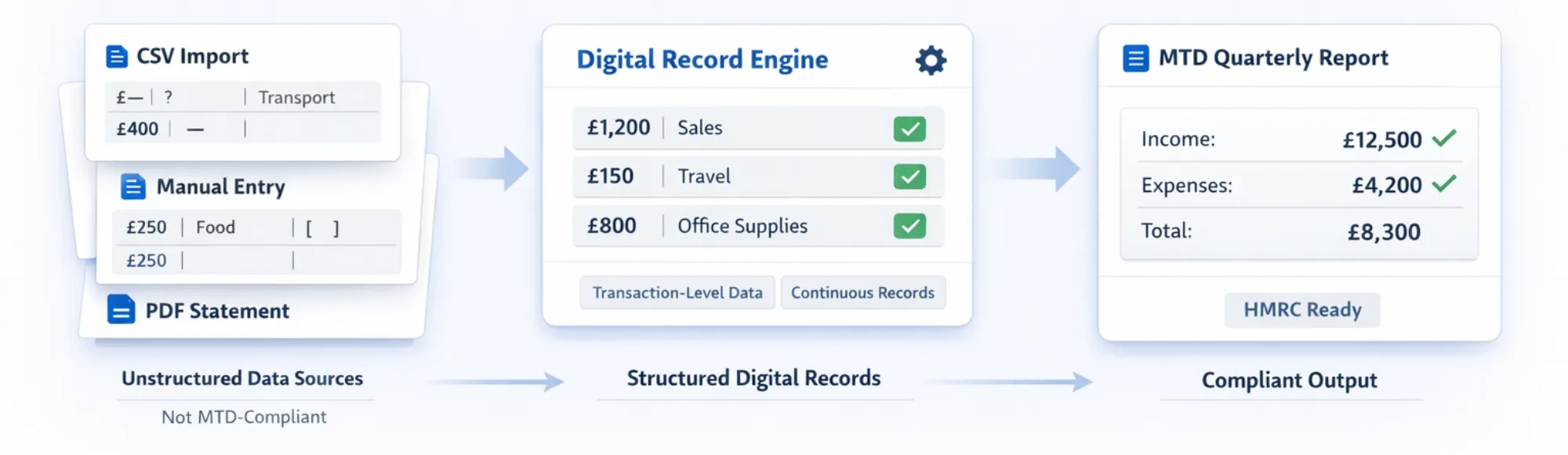
Building MTD-compliant workflows for your clients?
Finexer gives accounting platforms FCA-authorised AIS access to verified bank transaction data
MTD quarterly reporting is widely understood as a compliance obligation. What is less understood is that it is fundamentally a data problem.
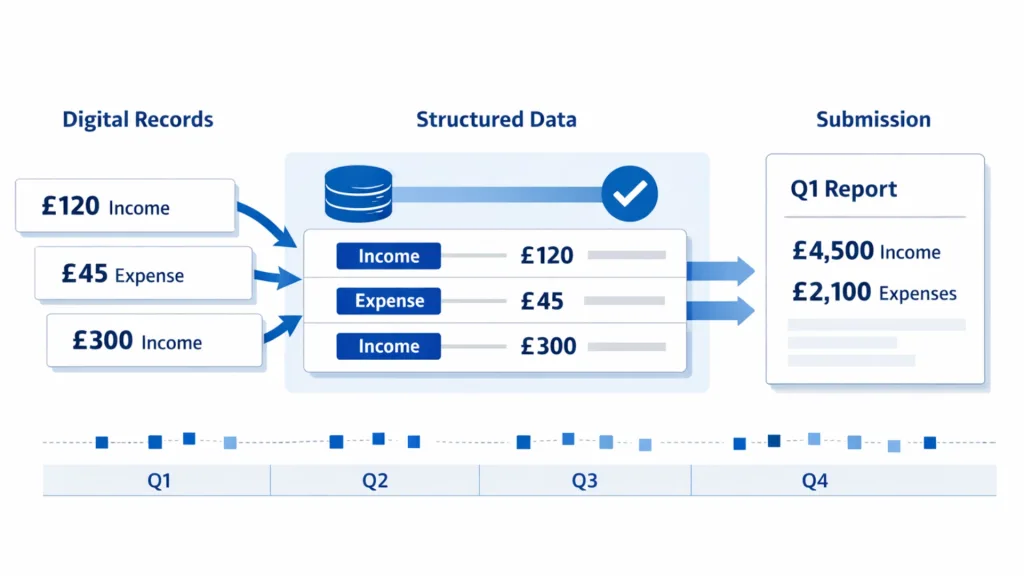
HMRC does not just want a quarterly filing. It requires that filing to be built from digitally maintained, transaction-level financial records that meet specific structural requirements. For accounting platforms and tax SaaS tools, that means the data pipeline sitting beneath the submission is as important as the submission itself.
Under UK regulation, I see the same challenge consistently across accounting platforms preparing for MTD for Income Tax. Teams understand the reporting deadlines. What they underestimate is what it takes to collect, structure, and maintain the financial data that makes those reports accurate and compliant.
This blog explains what MTD quarterly reporting actually requires at the data layer, where platform workflows break down, and how verified bank transaction data supports the digital records that MTD depends on.
TL;DR
MTD quarterly reporting requires platforms to collect and maintain structured, transaction-level financial data – not just file quarterly summaries. MTD digital records must include categorised income and expense data maintained continuously, not assembled at deadline. For accounting platforms and tax SaaS tools, the data pipeline is the compliance challenge. Finexer provides FCA-authorised AIS access to verified bank transaction data, giving platforms the structured financial inputs that MTD digital records require.
Key Takeaways
What is MTD quarterly reporting?
MTD quarterly reporting requires sole traders and landlords to submit income and expense summaries to HMRC every quarter using digitally maintained financial records – replacing the annual Self Assessment return with four quarterly updates and a final declaration.
What are MTD digital records?
MTD digital records are structured, transaction-level financial records maintained digitally – covering income, expenses, and financial activity categorised per transaction. They must be maintained continuously, not reconstructed at quarter-end from manually assembled data.
What does MTD quarterly reporting require from platforms?
Platforms must collect transaction-level financial data, categorise income and expenses accurately, maintain continuous digital records, and generate structured quarterly summaries – all from a data source that meets HMRC’s digital record requirements.
Where do platform MTD workflows typically break down?
The most common failure points are incomplete transaction data from manual entry or CSV imports, inconsistent categorisation across client accounts, and data gaps that only surface at submission time – creating compliance risk that tools alone cannot resolve.
Where does Finexer fit in MTD quarterly reporting workflows?
Finexer provides verified bank transaction data that accounting platforms use to maintain MTD digital records. Finexer does not handle tax filing or MTD submissions – it provides the structured financial data layer that platforms use to build compliant reporting workflows.
What Does MTD Quarterly Reporting Actually Require?
The Regulatory Framework
MTD for Income Tax applies to sole traders and landlords with income over £50,000 from April 2026, dropping to £30,000 from April 2027. Instead of one annual Self Assessment return, affected individuals must submit:
- Four quarterly income and expense updates per tax year
- One final end-of-period statement confirming the annual position
- All submissions made through HMRC-compatible software using digitally maintained records
Submissions are due within one month and seven days of each quarter end. Late or incorrect filings trigger automatic penalties under HMRC’s points-based system.
Making Tax Digital covers the full MTD regulatory framework and timeline for UK platforms.
What HMRC Actually Requires at the Data Level
This is where most platforms underestimate the scope.
MTD quarterly reporting is not a filing task that sits at quarter-end. It is a continuous data maintenance requirement. HMRC requires that:
- Every income and expense transaction is recorded digitally as it occurs
- Records include date, amount, and category per transaction
- Data is maintained using HMRC-compatible software with digital links between systems
- Records are retained for a minimum of five years from the relevant submission deadline
The quarterly submission is the output of that process – not the process itself. Platforms that treat MTD as a filing problem rather than a data maintenance problem will consistently produce inaccurate submissions.
“MTD compliance is not about what gets submitted. It is about whether the data maintaining the submission was structured correctly from the start. By the time a platform reaches quarter-end, it is too late to fix categorisation errors or fill transaction gaps.” – Clare, Finexer
MTD for Income Tax Software covers what HMRC-compatible software must support for compliant MTD workflows.
Where Do Platform MTD Digital Record Workflows Break Down?
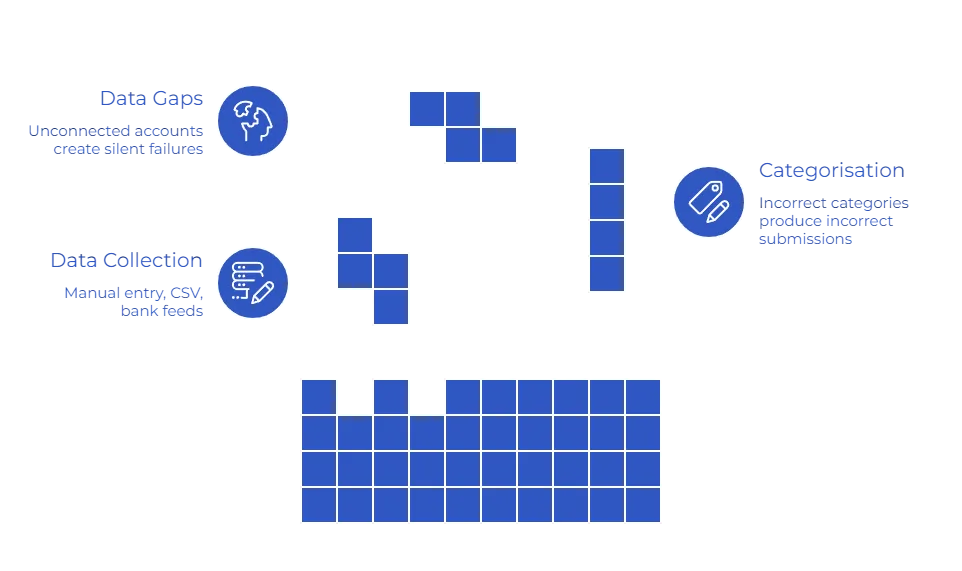
The Data Collection Problem
Most accounting platforms collect client financial data through one of three methods:
- Manual entry by the client or bookkeeper
- CSV or bank statement imports
- Third-party bank feed integrations
Each carries specific risks for MTD digital records.
Manual entry introduces human error at the transaction level – miscategorised expenses, missed income entries, and duplicated records that only surface when the quarterly summary does not match the client’s bank position.
CSV imports create a timing problem. Data is collected in batches – weekly, monthly, or at quarter-end – rather than continuously. Transactions that occurred between import cycles create gaps. The MTD digital record that results is incomplete by the time it is submitted.
Bank feed integrations are closer to what MTD requires – but only if the feed is reliable, covers all relevant accounts, and produces structured data consistently across every bank the client uses.
“The gap I see most often is platforms that have a data collection method – but not a data completeness method. They can import transactions. They cannot verify that all transactions are there.” – Clare, Finexer
HMRC MTD ITSA Software for Accounting Platforms covers what accounting platforms need to support for HMRC MTD ITSA compliance.
The Categorisation Problem
MTD quarterly reporting requires income and expenses to be categorised correctly per HMRC’s specified categories. A transaction categorised incorrectly in the digital record produces an incorrect quarterly submission – and an incorrect final declaration.
The categorisation challenge is particularly acute for platforms managing multiple clients across different business types. A sole trader in construction categorises expenses differently from a landlord or a freelance consultant. Generic categorisation rules applied across a mixed client base produce systematic errors that accumulate across quarters.
The Data Gap Problem
Data gaps are the most dangerous MTD digital records failure because they are silent. The platform’s system shows records for the period. The quarterly submission is generated. But transactions from accounts not connected to the platform – a business savings account, a secondary current account, a client money account – were never captured.
The client’s HMRC submission reflects incomplete financial activity. Under MTD’s digital records requirements, that is a compliance failure – even if the platform’s software produced the submission correctly from the data it had.
MTD Self Assessment Tools covers the tool requirements for accurate MTD Self Assessment reporting workflows.
How Should Platforms Evaluate Financial Data Infrastructure for MTD?
| MTD Data Requirement | Why It Matters | What to Look For |
|---|---|---|
| Continuous Transaction Feed | MTD requires records maintained as transactions occur – not batch imports | Real-time webhooks; automated ongoing feeds; no manual upload dependency |
| Transaction-Level Detail | HMRC requires date, amount, and category per transaction in digital records | Structured JSON output; merchant IDs; categorised transaction data |
| Multi-Account Coverage | All relevant accounts must be captured – not just primary current accounts | Multi-account AIS access; 99% UK bank coverage; cross-bank aggregation |
| Bank-Verified Source | Digital records are only defensible when data is bank-authenticated | FCA-authorised AIS; consent-based access; bank-authenticated transaction records |
| Historical Data Depth | Platforms need lookback access for corrections and prior period review | Up to 7 years transaction history; multi-period access |
| Consistent Data Format | Categorisation accuracy depends on consistent data structure across banks | Standardised output across all connected banks; no per-bank post-processing |
How Does Finexer Support MTD Quarterly Reporting Workflows?
Finexer provides FCA-authorised AIS infrastructure delivering verified bank transaction data to accounting platforms that need a reliable financial data layer for MTD digital records. Finexer does not handle tax filing or MTD submissions – it provides the bank-authenticated, structured transaction data that platforms use to maintain compliant digital records and generate accurate quarterly reporting.
What Finexer’s AIS Provides for MTD Workflows
- Verified bank transaction data from 99% of UK bank accounts
- Real-time webhooks delivering transaction events continuously
- Transaction history up to 7 years for prior period access
- Structured, categorised data output across all connected banks
- Multi-account access from a single consent-based API connection
- Balance and income data for financial record completeness
- Usage-based pricing with 3-5 weeks onboarding support
“Platforms that get MTD right do not wait for clients to submit data. They connect to verified bank transaction feeds and maintain digital records continuously – so that when the quarter ends, the submission is a natural output of the data they already have.” – Clare, Finexer
Making Tax Digital for ITSA covers the specific ITSA data requirements that platforms must support for compliant quarterly reporting.
What I Feel
The MTD implementations I see working are the ones built on continuous data – not the ones built around quarterly filing deadlines.
Platforms that chase the deadline are always behind. They are assembling records from incomplete sources, filling gaps manually, and correcting categorisation errors under time pressure. The submission gets filed. But the digital record it was built from does not meet what HMRC actually requires.
MTD digital records are a continuous compliance requirement. The platforms that understand this build data pipelines – not filing workflows. That distinction determines whether MTD compliance holds up under scrutiny or just looks like it does.
Common Use Cases
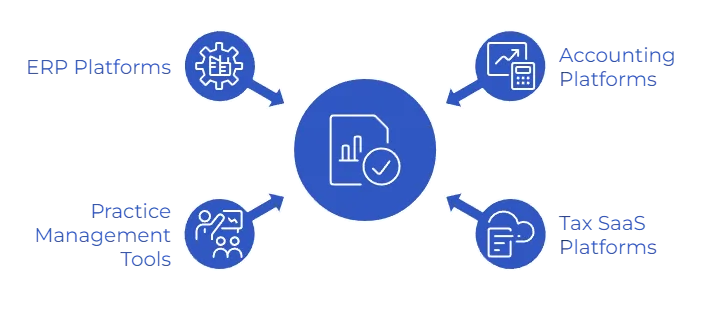
Accounting & Bookkeeping Platforms
Accounting platforms use Finexer’s AIS to access verified client bank transaction data continuously – maintaining MTD digital records from bank-authenticated sources rather than client-submitted statements or manual entry. Structured transaction feeds with categorised income and expense data give accounting tools the financial inputs needed to generate accurate MTD quarterly reporting without manual reconciliation at quarter-end.
Tax SaaS Platforms
Tax SaaS tools embed Finexer’s AIS as the verified data layer beneath their MTD reporting workflows. Continuous bank transaction feeds mean digital records are maintained as transactions occur – not assembled retrospectively from batch imports that create gaps and categorisation inconsistencies across client accounts.
Practice Management Tools
Practice management platforms handling multiple client MTD obligations use Finexer’s AIS to maintain consistent financial data quality across their entire client base. Multi-account AIS access covering 99% of UK banks ensures that all relevant client accounts are captured – eliminating the silent data gaps that produce incorrect quarterly submissions.
ERP Platforms
ERP platforms with MTD obligations for their users use Finexer’s AIS to integrate verified bank transaction data directly into financial record workflows. Standardised data output across all UK banks removes per-bank post-processing – ensuring categorisation rules apply consistently across every client account regardless of which bank holds the account.
What are digital records for MTD?
MTD digital records are transaction-level financial records maintained digitally – covering income, expenses, and financial activity with date, amount, and category per transaction. They must be maintained continuously using HMRC-compatible software and retained for a minimum of five years from the relevant submission deadline.
What is MTD quarterly reporting in the UK?
MTD quarterly reporting requires sole traders and landlords above the income threshold to submit income and expense summaries to HMRC four times per year using digitally maintained financial records – replacing the annual Self Assessment return with four quarterly updates and a final end-of-period declaration.
Can Finexer support MTD digital record workflows?
Yes. Finexer is FCA-authorised and provides AIS infrastructure covering 99% of UK banks – delivering verified bank transaction data with structured categorisation, multi-account access, and up to 7 years of transaction history. Accounting platforms use Finexer’s data feeds to maintain MTD-compliant digital records and support accurate quarterly reporting workflows.
Build accurate MTD quarterly reporting on verified bank transaction data your clients can rely on.
About the Author

Clare Pearson
Clare Pearson is a senior payments professional with extensive experience across the global financial services and payments industry. She specialises in Open Banking, payment infrastructure, and financial technology transformation, with expertise spanning product delivery, operational strategy, regulatory compliance, and large-scale payments programmes. Clare currently serves as a Non-Executive Director at Finexer and a panel member for the Payment Systems Regulator (PSR), advising on the development of payment systems policy and innovation