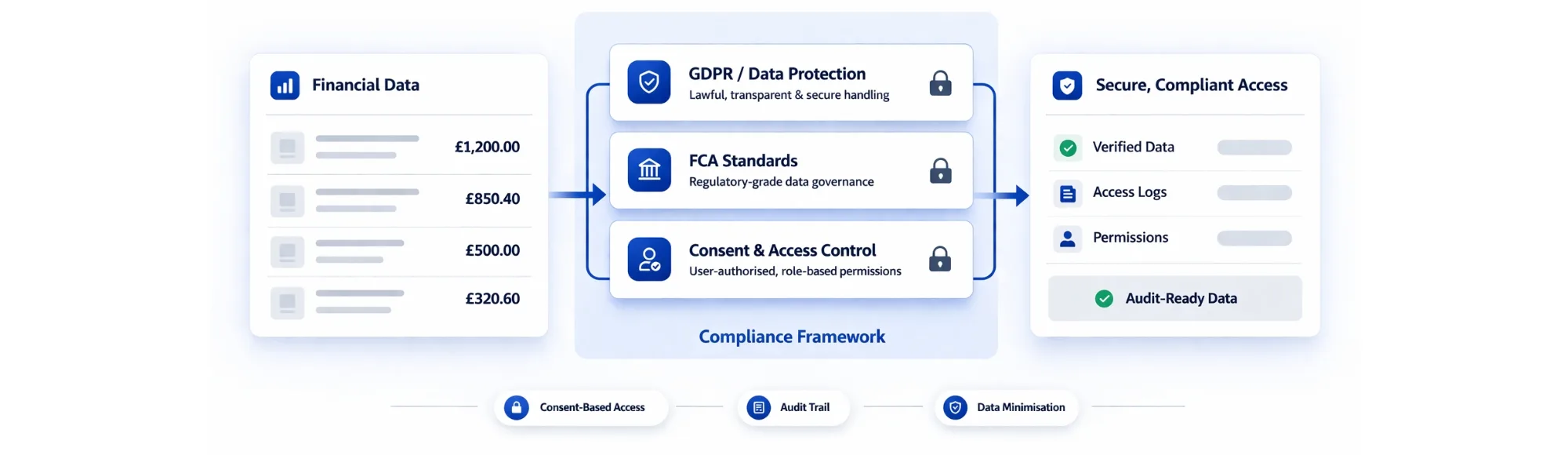
Client financial data obligations go further than GDPR alone.
Finexer gives UK platforms FCA-authorised, consent-based AIS access – audit-ready from day one.
Financial data protection in the UK is not a single regulation. It is a layered set of obligations that regulated platforms must navigate simultaneously – and getting any layer wrong carries regulatory, operational, and reputational consequences.
UK GDPR and the Data Protection Act 2018 set the baseline for how personal financial data must be handled. The FCA adds sector-specific requirements for firms operating in financial services. Open Banking introduces consent and access standards that go beyond general data protection law. For platforms operating across these frameworks, understanding where each obligation applies – and to what – is the starting point for building compliant data workflows.
Under UK regulation, I work with accounting platforms, LawTech firms, and fintech SaaS tools that handle client financial data as part of their core product. The compliance gap I see most consistently is not ignorance of GDPR. It is underestimating how financial data protection obligations interact with product design decisions – data collection methods, consent flows, storage practices, and third-party data access.
This blog explains what financial data protection requires for UK regulated platforms, how compliance manual financial services obligations apply in practice, and where Open Banking infrastructure fits into compliant data handling.
TL;DR
Financial data protection for UK platforms requires compliance across UK GDPR, the Data Protection Act 2018, FCA data security standards, and Open Banking consent requirements. These are not separate checklists – they interact. Compliance manual financial services obligations apply to how platforms collect, store, access, and share client financial data. Finexer provides FCA-authorised AIS access to verified bank transaction data through consent-based Open Banking flows that align with these layered data protection requirements.
Key Takeaways
What is financial data protection in the UK?
Financial data protection in the UK is governed by UK GDPR, the Data Protection Act 2018, and FCA sector-specific standards. Together they require that personal financial data is collected lawfully, processed transparently, stored securely, and accessed only with appropriate consent and authorisation.
What does a compliance manual financial services obligation cover?
A compliance manual financial services obligation covers how a regulated firm manages data security, consent, access controls, AML procedures, and regulatory reporting. For platforms handling client financial data, it extends to how data is collected, stored, transmitted, and accessed by third parties.
What financial data protection obligations apply to accounting platforms?
Accounting platforms handling client bank data must comply with UK GDPR lawful basis requirements, FCA data security expectations where regulated, and Open Banking consent standards when accessing client bank accounts through third-party providers.
What is the biggest financial data protection risk for regulated platforms?
The most significant risk is collecting or accessing client financial data without a clearly documented lawful basis and explicit consent – particularly when using third-party data aggregation tools that access bank accounts on behalf of clients.
How does Open Banking infrastructure support financial data protection compliance?
FCA-authorised Open Banking infrastructure provides consent-based bank data access with granular permissions, time-limited consent, instant revocation capability, and full audit trails – aligning data access with UK GDPR and FCA data security requirements.
What Does Financial Data Protection Actually Require for UK Platforms?
The Regulatory Framework
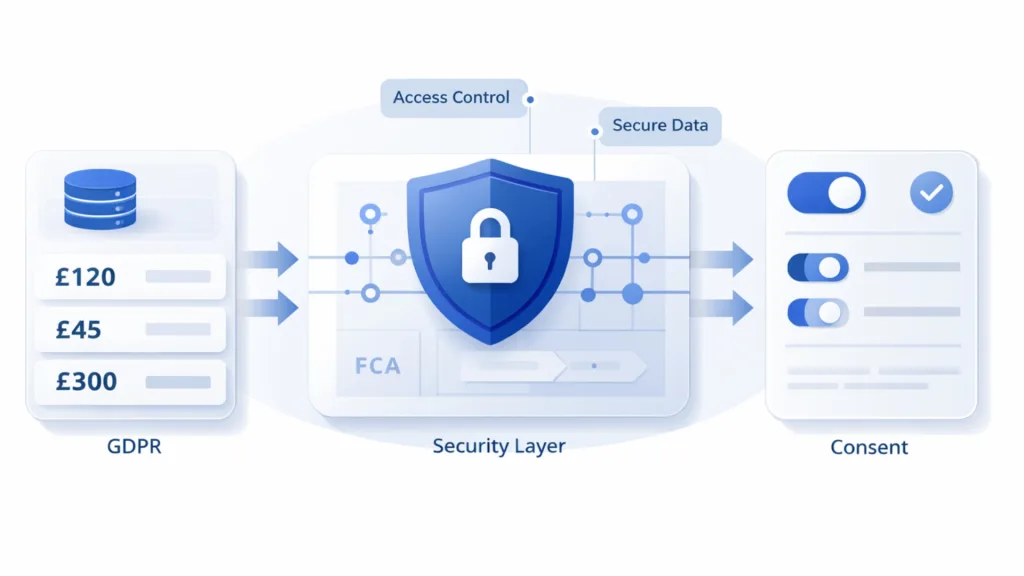
Financial data protection in the UK sits across three overlapping frameworks that regulated platforms must address simultaneously.
UK GDPR and Data Protection Act 2018 – The baseline. Personal financial data carries high sensitivity even where it does not meet the strict special category definition. Platforms must establish a lawful basis for processing, maintain records of processing activities, implement data minimisation, and enforce storage limitations.
FCA Data Security Standards – The FCA’s data security guidance requires regulated firms to implement robust security controls, maintain data integrity, and demonstrate that client data is protected from unauthorised access. These obligations extend to third-party systems and data processors that regulated firms use.
Open Banking Consent Standards – When platforms access client bank data through Open Banking, they operate within a consent framework requiring explicit, granular, time-limited permission. Users must be able to revoke access at any time. The scope of data access must match the consent given.
“The mistake I see most often is platforms treating these as three separate compliance exercises. They are not. A data access decision that satisfies GDPR may still create an FCA data security issue if third-party access controls are not documented. They have to be read together.” – Clare, Finexer
What This Means for Platform Product Decisions
Financial data protection is not just a legal obligation – it shapes product architecture decisions that compliance teams and product managers must make together.
Platforms handling client financial data must address:
- Lawful basis for data collection – Is the platform collecting client bank data under consent, legitimate interests, or contractual necessity? Each carries different obligations for how that data can be used, stored, and shared.
- Data minimisation – Is the platform collecting only the financial data it actually needs for its stated purpose? Collecting full transaction history when only balance data is required creates unnecessary exposure.
- Third-party access controls – When a platform uses a data aggregator or Open Banking provider to access client bank accounts, the platform remains responsible for how that access is governed. The third party’s FCA authorisation status matters.
- Retention and deletion – Client financial data must be retained only as long as necessary for the stated purpose and deleted in line with documented retention schedules.
What Does a Compliance Manual Financial Services Framework Require?
Core Components for Financial Data
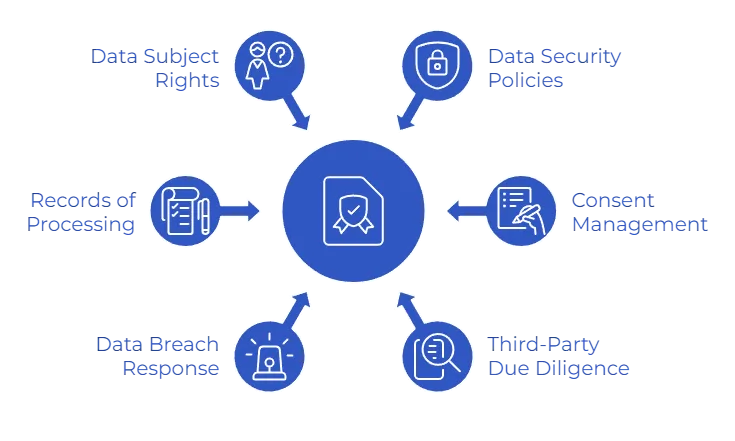
For regulated platforms in financial services, a compliance manual financial services framework covering data protection must address:
- Data security policies aligned with FCA expectations
- Consent management procedures for client data access
- Third-party processor due diligence and contractual controls
- Data breach response and ICO notification procedures
- Records of processing activities per UK GDPR Article 30
- Data subject rights procedures – access, erasure, portability
Where Platforms Typically Have Gaps
The gaps I see consistently across accounting and LawTech platforms are not in the documented policies – they are in the operational implementation.
Platforms have a privacy policy. They have a data processing agreement with their cloud provider. But when a product team integrates a consent-driven financial data aggregation tool to access client accounts, the data protection impact assessment was not completed. The consent flow does not clearly explain what bank data is being accessed or for how long. The client cannot easily revoke access.
These are not policy failures. They are product integration failures that create compliance exposure.
“A compliance manual financial services team can write the right policies. But if the product integration does not implement them – if the consent flow is vague, access is not scoped correctly, or there is no revocation mechanism – the policy provides no protection.” – Clare, Finexer
How Should Platforms Evaluate Financial Data Access Infrastructure?
| Compliance Requirement | Why It Matters | What to Look For |
|---|---|---|
| FCA Authorisation | Platforms remain responsible for the regulatory status of third-party data providers | FCA-authorised AISP status; verifiable on FCA register |
| Consent-Based Access | UK GDPR and Open Banking standards require explicit, granular consent for bank data access | Granular consent flows; time-limited permissions; instant revocation capability |
| Data Minimisation | GDPR requires collecting only data necessary for the stated purpose | Configurable data scope; account-level access controls; no over-collection |
| Audit Trail | FCA and GDPR both require documented evidence of data access and consent | Consent logs; access timestamps; data provenance records per retrieval |
| Data Security Standards | FCA expects robust security controls for all financial data access | Bank-grade API security; encrypted data transmission; access controls per user |
| Third-Party Accountability | Platforms must document due diligence on data processors per GDPR Article 28 | Data processing agreements; sub-processor transparency; compliance documentation |
How Does Finexer Support Financial Data Protection Compliance?
Finexer is an FCA-authorised Open Banking infrastructure provider – authorised as both an AISP and PISP. For platforms that need to access client bank transaction data as part of their product, Finexer provides the consent-based data access infrastructure that aligns with UK financial data protection requirements.
What Finexer’s Infrastructure Provides
- FCA-authorised AIS access – verifiable on the FCA register
- Explicit, granular consent flows with time-limited permissions
- Instant consent revocation capability for end users
- Full consent logs and access timestamps per data retrieval
- Bank-authenticated transaction data – not client-submitted documents
- Structured data output with data minimisation controls
- Usage-based pricing with 3-5 weeks onboarding support
“The question I get from compliance teams is always: who is responsible if something goes wrong with the bank data access? With FCA-authorised infrastructure, the regulatory layer is managed at the infrastructure level. The platform still owns its product obligations – but the data access itself operates within a documented, regulated framework.” – Clare, Finexer
What I Feel
The platforms that handle financial data protection well are not the ones with the longest privacy policies. They are the ones where compliance decisions and product decisions happen in the same conversation.
Data protection in financial services is not a legal team problem handed to product after the fact. The consent flow, the data scope, the access controls, the revocation mechanism – these are product decisions that carry compliance weight. Getting them right from the start is significantly easier than retrofitting compliance into a data workflow built without it.
Compliance manual financial services frameworks exist to structure that conversation. The platforms that use them well treat them as operational guidance – not documentation exercises.
Common Use Cases
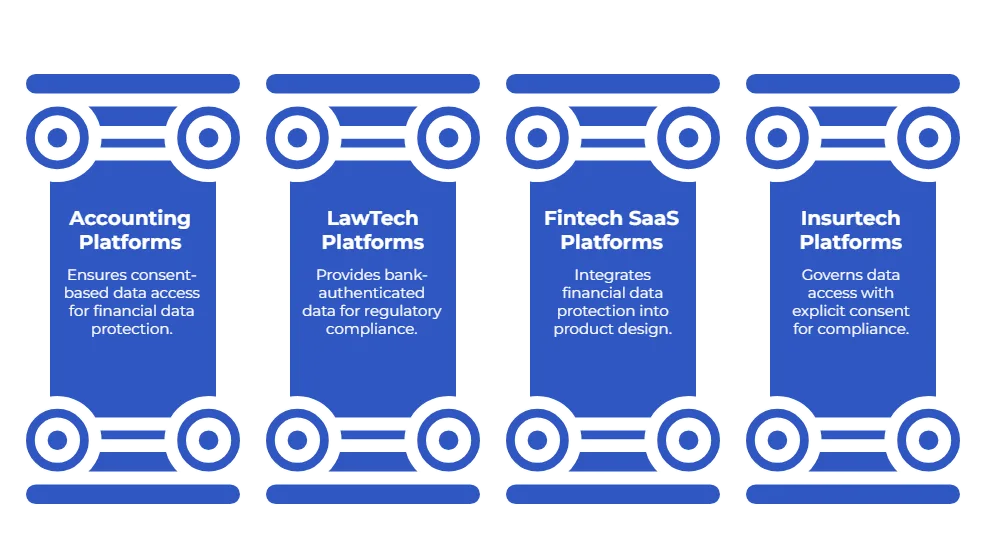
Accounting & Bookkeeping Platforms
Accounting platforms accessing client bank data through Open Banking must ensure that data access is consent-based, scoped correctly, and governed by a documented lawful basis. Finexer’s FCA-authorised AIS provides granular consent flows – ensuring that financial data protection obligations are met at the data access layer, not retrofitted through policy documents after integration.
LawTech Platforms
LawTech platforms handling client financial data for source-of-funds checks and AML reviews operate under both GDPR and FCA data security expectations. Finexer’s AIS provides bank-authenticated transaction data through consent-based access with full audit trails that support regulatory review and compliance documentation requirements.
Fintech SaaS Platforms
Fintech SaaS platforms building financial data features must navigate financial data protection obligations at the product design stage. Finexer’s infrastructure provides FCA-authorised data access with documented consent logs, access timestamps, and data minimisation controls – reducing the compliance design burden for product teams building on Open Banking data.
Insurtech Platforms
Insurtech platforms accessing client financial data for underwriting or claims processing use Finexer’s AIS to ensure data access is governed by explicit consent and documented correctly. Bank-authenticated transaction data accessed through FCA-authorised infrastructure provides the audit trail that compliance manual financial services frameworks require for third-party data processor oversight.
What is financial data protection in the UK?
Financial data protection in the UK is governed by UK GDPR, the Data Protection Act 2018, and FCA sector-specific data security standards. Together they require that personal financial data is collected with a lawful basis, processed transparently, stored securely, and accessed only with documented consent and appropriate authorisation.
What does a compliance manual financial services framework cover for data protection?
A compliance manual financial services data protection framework covers lawful basis documentation, consent management, third-party processor controls, data breach procedures, retention policies, and records of processing activities. For platforms accessing client bank data, it extends to how Open Banking data access is governed and documented.
How does Finexer support financial data protection compliance?
Finexer is FCA-authorised and provides AIS infrastructure with explicit consent flows, granular permissions, instant revocation capability, and full audit trails. Platforms use Finexer’s infrastructure to access client bank transaction data in a way that aligns with UK GDPR, FCA data security expectations, and Open Banking consent standards.
Build financial data workflows that meet UK regulatory requirements from the ground up.
About the Author

Clare Pearson
Clare Pearson is a senior payments professional with extensive experience across the global financial services and payments industry. She specialises in Open Banking, payment infrastructure, and financial technology transformation, with expertise spanning product delivery, operational strategy, regulatory compliance, and large-scale payments programmes. Clare currently serves as a Non-Executive Director at Finexer and a panel member for the Payment Systems Regulator (PSR), advising on the development of payment systems policy and innovation