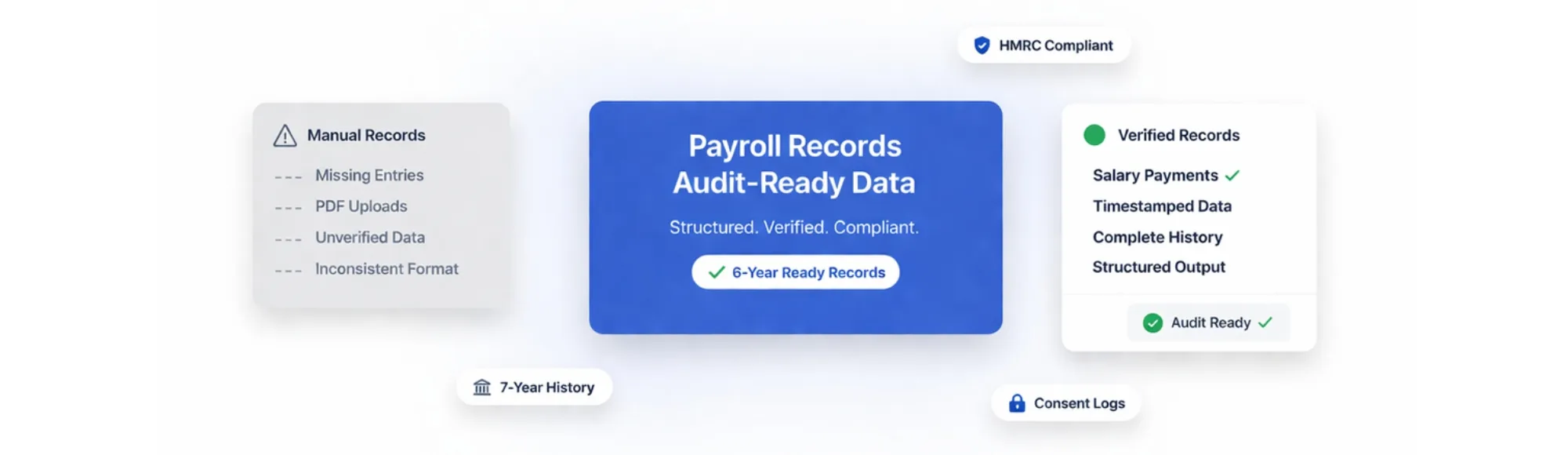
Payroll records have defined retention periods – and audit exposure when those records cannot be produced.
Build audit-ready financial data infrastructure on verified bank transaction records.
How long to keep payroll records uk is a question with a clear regulatory answer – but the compliance challenge for platforms goes well beyond knowing the retention period. The harder operational problem is whether the records being retained are complete, accurate, verifiable, and accessible when a regulatory query or audit demand requires them.
For payroll SaaS platforms and accounting tools managing financial records on behalf of clients, data retention is not a filing exercise. It is an auditability problem – and the quality of the underlying financial data determines whether retained records can withstand scrutiny.
This blog sets out the retention requirements for payroll and accounting records in the UK, explains where manual recordkeeping creates audit exposure, and demonstrates how automated bank transaction data supports compliant, audit-ready financial data storage.
TL;DR
How long to keep payroll records uk: HMRC requires a minimum of three years from the end of the tax year they relate to. Best practice and legal claim protection under the Limitation Act 1980 requires six years. How long to keep accounting records uk follows the same six-year standard for most regulated platforms. The compliance challenge is not knowing the duration – it is ensuring retained records are complete, verifiable, and accessible. Finexer’s AIS provides bank-authenticated transaction data that supports automated, audit-ready financial recordkeeping.
Key Takeaways
How long to keep payroll records uk under HMRC requirements?
HMRC requires payroll records to be retained for a minimum of three years from the end of the tax year to which they relate. Best practice is six years, providing protection against legal claims under the Limitation Act 1980 and aligning with standard audit requirements.
How long to keep accounting records uk for regulated platforms?
Most regulated platforms should retain accounting records for a minimum of six years. Companies Act requirements specify six years for private companies. HMRC’s guidance on business records similarly recommends six years for self-assessment and corporation tax purposes.
What payroll records must be retained under UK regulation?
Platforms must retain PAYE records including RTI submissions, P45s, P60s, tax code notifications, salary payment records, statutory payment details, pension contribution data, and payment confirmation records per pay period.
Why does manual payroll recordkeeping create audit exposure for platforms?
Manual records are prone to gaps, inconsistency, and format variation that make them difficult to produce accurately under audit. Records that cannot be independently verified against actual payment activity create compliance exposure regardless of how long they have been retained.
How does automated bank transaction data improve payroll recordkeeping?
Bank transaction data provides a verifiable, timestamped record of actual salary payments directly from the source. Automated access through Open Banking AIS ensures records are complete, consistent, and audit-ready without dependency on manual data entry or document uploads.
How Long to Keep Payroll Records UK – The Regulatory Requirements
HMRC Retention Obligations
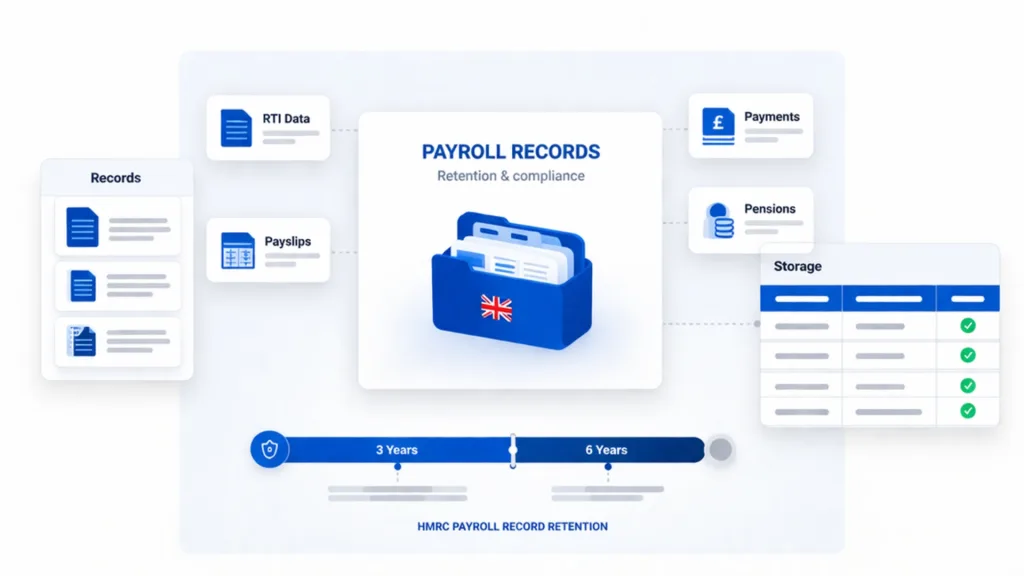
HMRC’s guidance on keeping PAYE records sets out the minimum retention periods for payroll data in the UK. The requirements apply to all employers operating PAYE schemes – and extend to platforms managing payroll data on behalf of employer clients.
Key retention periods:
- PAYE records – minimum three years from the end of the tax year they relate to
- Statutory payment records – three years from the end of the tax year
- Pension contribution records – six years for most records, four years for contribution records
- Payment confirmation records – six years, aligned with the Limitation Act 1980 and audit best practice
How long to keep accounting records uk follows a parallel framework. Companies Act 2006 requires private companies to retain accounting records for six years from the date they are made. HMRC guidance on business records recommends six years for self-assessment and corporation tax purposes.
What Records Must Be Retained
The payroll records that platforms are responsible for retaining cover the full payment and compliance documentation chain:
- RTI submissions and PAYE correspondence
- P45s, P60s, and tax code notifications per employee
- Salary payment records per pay period
- Statutory sick pay, maternity pay, and other statutory payment details
- Pension assessment dates, contribution records, and opt-out notices
- Payment confirmation records linking disbursements to employee accounts
“The retention requirement is the starting point. What creates compliance exposure is whether the records retained are complete, structured, and independently verifiable – not simply whether they exist in a filing system somewhere.” – Clare, Finexer
Why Does Manual Recordkeeping Create Audit Exposure?
The Data Quality Problem
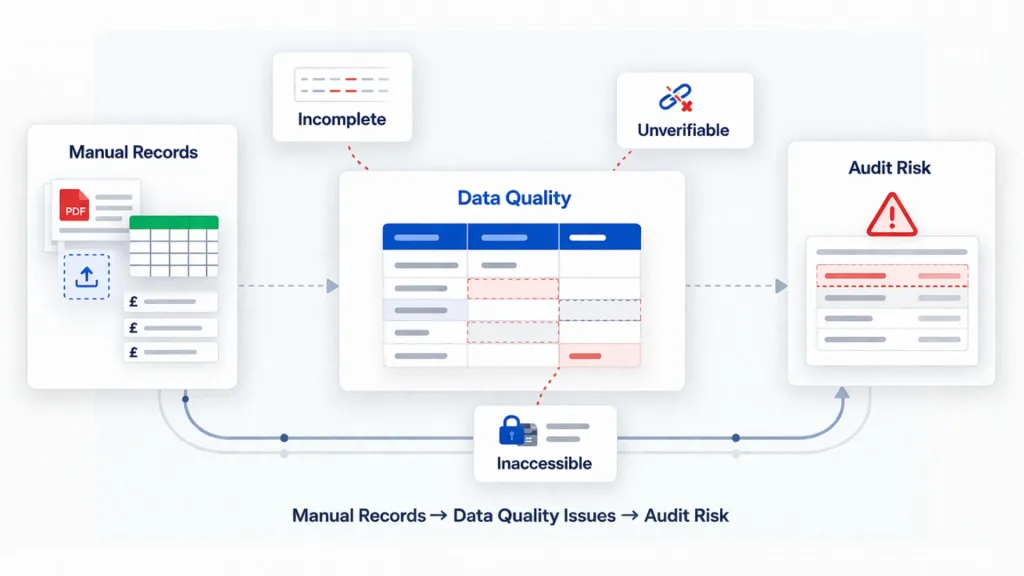
Knowing how long to keep payroll records uk does not resolve the underlying data quality challenge. Records retained across spreadsheets, PDF exports, and manual uploads may satisfy the duration requirement while failing the auditability test entirely.
Manual payroll records are subject to gaps at every stage of the record creation process. Salary payments entered manually may not reflect what was actually paid. PDF bank statements uploaded periodically may cover incomplete date ranges. Records compiled from multiple sources introduce format inconsistency that makes structured audit responses difficult to produce.
For payroll SaaS platforms and accounting tools managing records across multiple client payrolls, these gaps compound with client volume. A single missing pay period or unverifiable salary payment can create disproportionate compliance exposure under audit.
How platforms build audit trail infrastructure for financial data covers the structural requirements for audit-ready financial record systems in detail.
Where Platforms Are Most Exposed
The audit exposure for platforms managing payroll records typically falls into three categories:
- Incomplete records – gaps in pay period coverage where salary payments cannot be produced for specific dates
- Unverifiable records – records that cannot be cross-referenced against actual bank payment activity to confirm accuracy
- Inaccessible records – historical records stored in formats or systems that cannot produce structured outputs in response to audit requests
How long to keep accounting records uk answers the duration question. It does not address whether records retained over that period are complete, accurate, or producible under scrutiny.
How Should Platforms Approach Automated Payroll Recordkeeping?
The Shift to Bank-Sourced Financial Data
The structural solution to manual payroll recordkeeping limitations is access to verified bank transaction data at source. Bank transaction records provide a timestamped, amount-confirmed record of every salary payment made – directly from the account from which payments were disbursed or into which they were received.
| Recordkeeping Requirement | Manual Approach Limitation | Bank Transaction Data Approach |
|---|---|---|
| Salary payment verification | Manual entries may not reflect actual disbursements – no independent source verification | Bank-authenticated transaction records confirm exact amounts, dates, and recipient accounts |
| Complete pay period coverage | Periodic uploads create gaps – missing periods are difficult to identify and remediate | Continuous transaction feeds ensure complete coverage across all pay periods automatically |
| Audit-ready record format | Multi-source manual records produce inconsistent formats that require restructuring for audit response | Structured, categorised transaction data is consistently formatted and immediately producible |
| Retention period compliance | Manual archiving processes create version control and access issues over six-year retention periods | Automated data access with consent logs and timestamps supports structured long-term retention |
| GDPR data documentation | Manual records lack the consent and access audit trail required under GDPR for financial data processing | Consent-based bank data access provides time-stamped consent records per data retrieval |
How platforms verify salary records using bank transaction data covers the salary verification workflow that underpins audit-ready payroll recordkeeping.
How Does Finexer Support Audit-Ready Payroll Recordkeeping?
Finexer is an FCA-authorised Open Banking infrastructure provider. For payroll and accounting platforms that need to maintain compliant, audit-ready financial records, Finexer’s AIS provides bank-authenticated transaction data that supports automated payroll recordkeeping aligned with HMRC retention requirements.
What Finexer’s Infrastructure Provides
- FCA-authorised AIS access – verifiable on the FCA register
- Up to seven years of bank transaction history – covering the full six-year retention period required under best practice
- Consent-based access with full consent logs and timestamps per data retrieval
- Structured, categorised transaction data with payment references, amounts, and dates
- Continuous transaction feeds eliminating periodic upload gaps
- Instant revocation capability and GDPR-compliant consent architecture
- Usage-based pricing with 3-5 weeks onboarding support
“Platforms that use bank transaction data as the foundation for payroll recordkeeping start with a verified, timestamped source of truth. That is a fundamentally stronger basis for audit compliance than records reconstructed from manual entries or periodic document uploads.” – Clare, Finexer
What I Feel
How long to keep payroll records uk is a question most platforms can answer. Whether the records they are retaining can actually withstand an HMRC query or employment tribunal request is a different question entirely.
The platforms that handle payroll recordkeeping well are not the ones with the longest retention policies. They are the ones whose records are complete, consistently formatted, independently verifiable, and immediately accessible when required.
How long to keep accounting records uk follows the same logic. Duration compliance without data quality is a documentation exercise, not a compliance programme.
Common Use Cases
Payroll SaaS Platforms
Payroll SaaS platforms retaining salary and PAYE records on behalf of employer clients need bank transaction data that confirms actual payment activity across all pay periods. Finexer’s AIS provides verified transaction records covering up to seven years of history – supporting HMRC retention requirements and audit-ready record production without manual data gaps.
Accounting and Bookkeeping Platforms
Accounting platforms managing client financial records for how long to keep accounting records uk compliance require structured, verifiable transaction data per client account. Finexer’s AIS provides categorised bank transaction data with timestamps and payment references – supporting six-year retention requirements with records that are immediately producible under audit.
How platforms handle source of funds verification and record retention covers the related source-of-funds recordkeeping obligations that apply alongside payroll retention requirements.
How long to keep payroll records uk under HMRC rules?
HMRC requires payroll records to be retained for a minimum of three years from the end of the tax year they relate to. Best practice is six years, providing protection under the Limitation Act 1980 and meeting standard audit requirements for PAYE, statutory payments, and pension records.
How long to keep accounting records uk for a private company?
Companies Act 2006 requires private companies to retain accounting records for six years from the date they are made. HMRC guidance on business records recommends six years for self-assessment and corporation tax purposes. Regulated platforms should apply the six-year standard as a minimum baseline.
How does Open Banking AIS support payroll recordkeeping compliance?
FCA-authorised AIS infrastructure provides consent-based access to bank transaction history covering up to seven years – supplying verified, timestamped salary payment records that support HMRC retention requirements, audit-ready record production, and GDPR-compliant data access documentation.
Maintain complete, verifiable payroll records built on bank-authenticated transaction data.
About the Author

Clare Pearson
Clare Pearson is a senior payments professional with extensive experience across the global financial services and payments industry. She specialises in Open Banking, payment infrastructure, and financial technology transformation, with expertise spanning product delivery, operational strategy, regulatory compliance, and large-scale payments programmes. Clare currently serves as a Non-Executive Director at Finexer and a panel member for the Payment Systems Regulator (PSR), advising on the development of payment systems policy and innovation