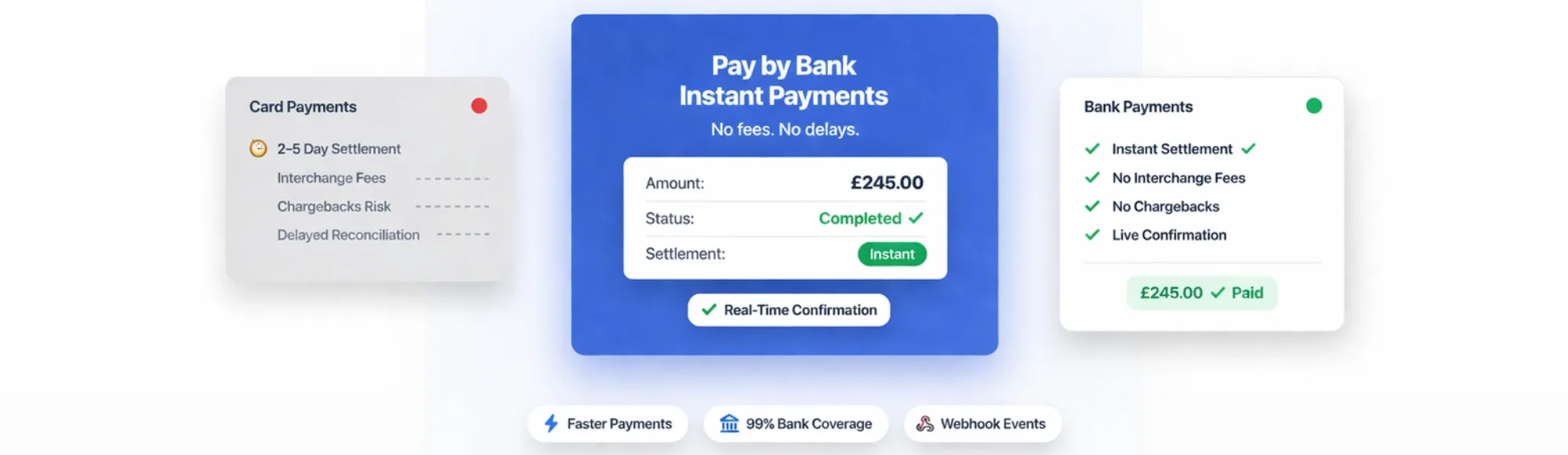
Still paying card interchange on every transaction?
Embed Pay by Bank with 99% UK bank coverage and instant settlement.
Alternative payment methods UK are shifting from a checkout preference question to a core infrastructure decision. For EPOS platforms, payment SaaS providers, and fintech product teams exploring alternative payment methods uk, the question is no longer whether to offer alternatives to cards – it is which payment rail delivers the operational and commercial outcomes their platform actually needs
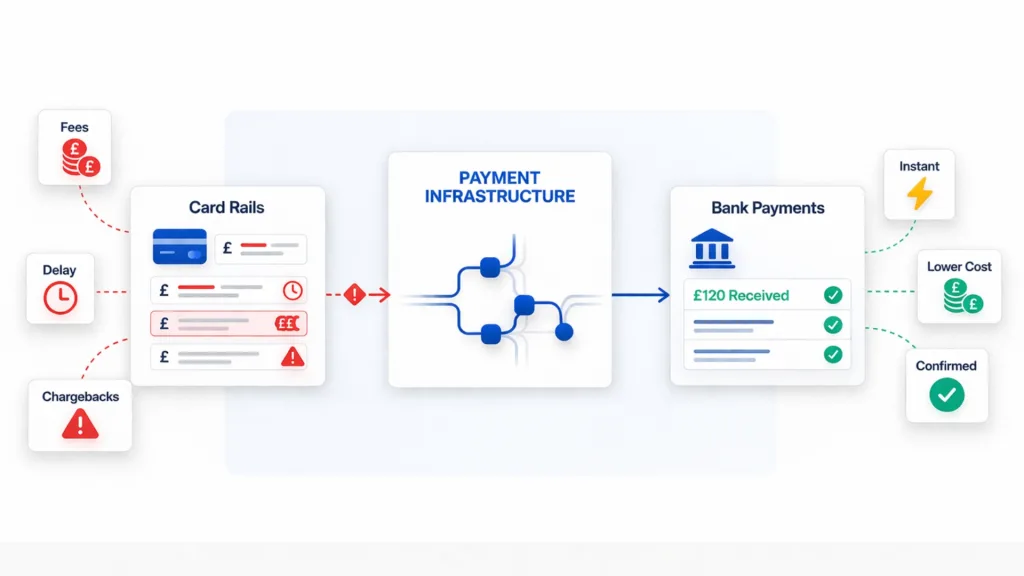
Card payments carry interchange fees, two-to-five day settlement windows, and chargeback exposure that compound at scale. For platforms processing thousands of transactions daily, these are not inconveniences – they are structural costs embedded into every payment flow.
This blog covers why UK platforms are moving payment infrastructure away from card rails, what Pay by Bank delivers operationally, and how FCA-authorised Open Banking infrastructure makes that transition practical for platforms building in the UK today.
TL;DR
Alternative payment methods UK have moved beyond consumer wallet preferences. For UK platforms, Pay by Bank via Open Banking provides instant account-to-account payments through the Faster Payments network, eliminating card interchange fees and settlement delays. Finexer’s FCA-authorised PIS infrastructure enables platforms to embed Pay by Bank with real-time payment confirmation, webhook-based reconciliation, and 99% UK bank coverage.
Key Takeaways
What makes Pay by Bank a scalable alternative payment option for UK platforms?
Pay by Bank uses the UK Faster Payments network to move money directly between bank accounts – making it the most practical alternative payment methods uk for platforms eliminating interchange fees and chargeback exposure.
Why are card rails a structural cost problem for high-volume platforms?
Every card transaction carries interchange fees charged by the card scheme. At volume, this cost compounds significantly, and card settlements take two to five days to reach the platform’s account.
What does real-time payment confirmation change for EPOS and payment platforms?
Real-time confirmation means a payment is verified at the point of transaction. EPOS platforms can close transactions and reconcile without waiting on card batch files or settlement reports.
How does Open Banking infrastructure make alternative payment options practical to embed?
FCA-authorised PIS infrastructure provides pre-built alternative payment options that platforms embed via API – the infrastructure provider manages bank connections, FCA compliance, and payment initiation on the platform’s behalf.
Which UK platforms benefit most from moving to alternative payment methods?
EPOS platforms, payment SaaS products, and fintech founders building payment-native products – particularly where transaction volume is high, margins are tight, or reconciliation accuracy is a product requirement.
Why Are UK Platforms Reconsidering Card Rails as Their Primary Payment Infrastructure?
The Cost Structure of Card Payments at Scale
Card payments are not cheap payment infrastructure. Every transaction on a card network carries interchange fees that flow to the card issuer, scheme fees charged by Visa or Mastercard, and acquirer margins on top. For platforms processing tens of thousands of transactions monthly, these costs accumulate into a significant operational drag.
Settlement timing compounds the problem. Card transactions typically take two to five business days to clear. For platforms that need to reconcile daily revenue or pay out to merchants, this delay creates working capital friction that bank-to-bank payments remove entirely.
Chargebacks add a further liability layer. Card schemes allow buyers to dispute transactions after the fact, reversing funds from the merchant regardless of whether goods or services were delivered. For EPOS platforms and payment SaaS providers, this is a direct margin risk with no equivalent in Open Banking payment flows.
“At Finexer, I work with UK platforms that have done the maths on card fees at volume. The conclusion is consistent – the case for moving primary payment flows to bank rails is a straightforward cost and speed calculation.” – Ravi, Finexer
Why Alternative Payment Options Are Now a Platform Architecture Question
The shift in alternative payment methods UK is not being driven by consumer preference research. It is being driven by platform product and finance teams reviewing what card payments actually cost at scale and what bank-to-bank alternatives now deliver in practical terms.
Best payment gateways UK covers the gateway comparison landscape for UK platforms evaluating their payment stack. The decision to move beyond card rails requires understanding what Pay by Bank infrastructure delivers at the integration level – not just the headline fee savings.
What Does Pay by Bank Actually Deliver for Platforms Operationally?
Instant Settlement via the UK Faster Payments Network
Pay by Bank payments in the UK route through the Faster Payments Service, which settles account-to-account transfers in seconds. Unlike card transactions that batch and settle over days, a Pay by Bank payment initiated at checkout confirms and clears into the payee’s account in near-real time.
For EPOS platforms, this means reconciliation against confirmed payments rather than pending authorisations. For payment SaaS providers managing client funds, it means real-time visibility of what has cleared versus what is still in transit.
| Payment Rail | Settlement Speed | Fee Structure | Chargeback Exposure | Reconciliation |
|---|---|---|---|---|
| Card (Visa / Mastercard) | 2-5 business days | Interchange + scheme + acquirer fees per transaction | Yes – buyer-initiated chargebacks reverse funds post-settlement | Batch settlement files, delayed visibility |
| Digital wallets (Apple Pay / Google Pay) | 2-5 business days (card-backed) | Card-equivalent fees apply as wallet sits on card rails | Yes – same card chargeback rules apply | Batch settlement, same delays as card |
| Pay by Bank via Open Banking (PIS) | Near-instant via Faster Payments | No interchange – usage-based API fee only | No chargebacks – irrevocable push payment | Real-time webhook confirmation per transaction |
Webhook-Based Confirmation and Reconciliation
Pay by Bank payments via FCA-authorised PIS infrastructure fire a webhook on payment confirmation. This gives platforms a real-time event trigger – the payment cleared, the transaction reference, the amount, and the timestamp – at the point it happens.
For EPOS platforms running multi-location operations, per-transaction reconciliation happens automatically as payments clear. For fintech founders building payment-native products, webhook confirmation is the foundation of any reliable payment event system.
Best digital payments solution UK covers the broader digital payment solution landscape for platforms evaluating infrastructure options beyond card-based processing.
Why Do Alternative Payment Options Fail Without the Right UK Infrastructure?
The Coverage Problem
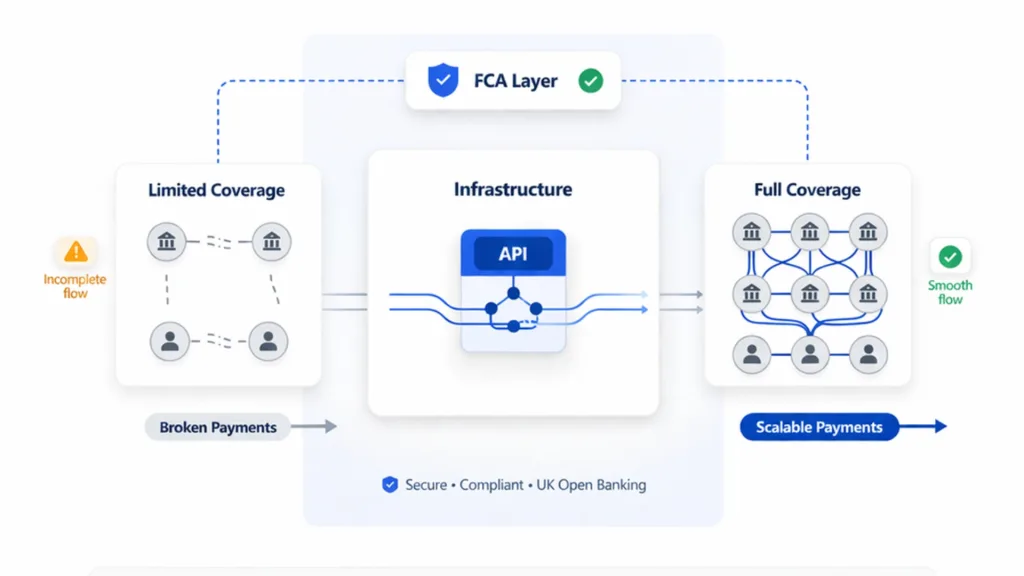
Pay by Bank only works as a primary alternative payment option if coverage is comprehensive. A platform that reaches only a portion of UK bank customers cannot position Pay by Bank as a default checkout rail – it becomes a niche option rather than a primary payment method.
UK-specific Open Banking infrastructure that covers the major retail banks – Barclays, HSBC, Lloyds, NatWest, Santander, Monzo, Starling, and the broader UK banking population – is what determines whether Pay by Bank is deployable at scale.
The FCA Authorisation Layer
Payment initiation in the UK requires FCA authorisation as a Payment Initiation Service Provider. Platforms building on top of an FCA-authorised infrastructure provider inherit the compliance layer – they do not need their own PISP authorisation to offer Pay by Bank.
This removes a significant regulatory barrier. Maintaining PISP authorisation independently requires compliance resources, ongoing FCA reporting, and internal payment expertise. Using FCA-authorised infrastructure means the platform focuses on the product while the infrastructure provider manages the regulatory obligations.
How Does Finexer Support Alternative Payment Methods for UK Platforms?
Finexer is an FCA-authorised Open Banking infrastructure provider. For EPOS platforms, payment SaaS providers, and fintech founders building alternative payment options into their products, Finexer’s PIS infrastructure provides the payment initiation layer that makes Pay by Bank practical to embed and operate at scale.
What Finexer’s Infrastructure Provides
- FCA-authorised PIS – verifiable on the FCA register
- 99% UK bank coverage across retail and challenger banks
- Real-time payment confirmation via webhooks per transaction
- White-label payment flows embeddable under the platform’s own brand
- Payment Links and QR code payment initiation for EPOS and in-person use cases
- Bulk Payout and Payout capabilities for platforms managing merchant disbursements
- Usage-based pricing – costs scale with transaction volume
- 3-5 weeks onboarding support to reach production deployment
- Saves platforms up to 90% on transaction costs versus card-based processing
“The platforms that make Pay by Bank work operationally are those that treat it as an infrastructure decision from day one – coverage, confirmation speed, and reconciliation reliability need to be locked in before product launch, not retrofitted.” – Ravi, Finexer
What I Feel
The conversation around alternative payment methods UK has been dominated by consumer-facing comparisons for too long. The real shift in alternative payment options is happening at the platform infrastructure level, where product and finance teams are doing the actual cost analysis on card rails and finding the numbers do not justify the default.
Pay by Bank is not a niche checkout option. For platforms operating at volume in the UK, with 99% bank coverage and Faster Payments settlement, it is the most economically rational primary payment rail available. The question for UK platforms is not whether to explore Pay by Bank. It is how long card fees remain acceptable while the alternative is already live.
Common Use Cases

EPOS Platforms
EPOS platforms running multi-location payment flows carry daily reconciliation overhead from card batch settlements. Finexer’s PIS enables Pay by Bank via QR code or Payment Link at point of sale, with real-time webhook confirmation and near-instant settlement – removing card fees and batch reconciliation delays from the payment flow.
Accounting & ERP Platforms
Accounting platforms handling client payment collection face card fees reducing invoice yield and delayed settlements creating cash flow reporting gaps. Finexer’s Pay by Bank infrastructure embeds direct bank-to-bank collection into invoicing workflows, with confirmed payment events firing in real time for immediate ledger reconciliation.
Payroll & Invoicing Platforms
Payroll and invoicing platforms initiating outbound disbursements need payment rails that are fast, traceable, and cost-efficient at volume. Finexer’s Payout and Bulk Payout capabilities deliver account-to-account disbursements via Faster Payments, with per-transaction confirmation webhooks for real-time payment status updates.
Proptech & Real Estate Platforms
Proptech platforms collecting rental payments or deposit transfers require irrevocable, traceable payment confirmation. Pay by Bank via Finexer’s PIS removes chargeback exposure from high-value property transactions and provides bank-authenticated payment records with timestamps for reconciliation and audit.
Utility Billing Platforms
Utility billing platforms managing recurring payment collection need confirmation at the billing cycle level. Finexer’s PIS supports Pay by Bank initiation with structured payment references per billing record, enabling automatic reconciliation against billing data without waiting on card settlement files.
Lawtech Platforms
Lawtech platforms collecting client funds for conveyancing or settlement disbursements need clear audit trails and no chargeback exposure. Finexer’s FCA-authorised PIS provides bank-authenticated payment confirmation with consent logs and timestamps for regulated legal payment workflows.
What are alternative payment methods in the UK for platforms?
In the UK platform context, they primarily refer to Pay by Bank via Open Banking PIS – account-to-account payments via Faster Payments that replace card transactions for checkout, invoicing, and disbursement flows.
How does Pay by Bank compare to card payments for UK platforms on cost?
Pay by Bank removes interchange and scheme fees entirely, replacing them with a usage-based API fee – reducing per-transaction costs significantly for high-volume platforms.
Do platforms need FCA authorisation to offer Pay by Bank as an alternative payment option?
Platforms building on FCA-authorised Open Banking infrastructure inherit the PISP compliance layer and do not need independent FCA authorisation to offer Pay by Bank.
Replace card rails with instant, FCA-authorised Pay by Bank infrastructure.
About the Author

Ravi Ranjan
Ravi Ranjan is Co founder & CEO of Finexer