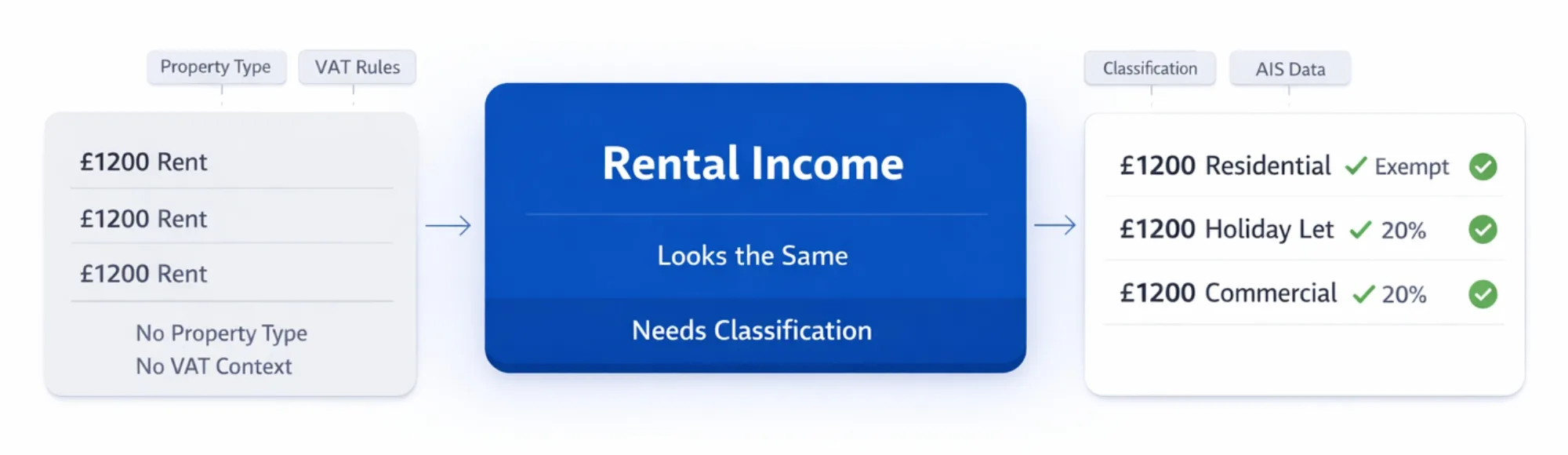
VAT on rental income misclassification is a data problem before it is a compliance problem.
Finexer provides structured bank transaction data for accurate rental income tracking workflows.
VAT on rental income UK treatment depends entirely on correct classification. But classification requires knowing what type of property generated each payment – and that is exactly what most platforms cannot reliably determine from raw bank transaction data.
A property portfolio generates rent. The payments arrive. They look identical in the bank feed – reference numbers, round amounts, monthly timing. Nothing in the transaction distinguishes a long-term residential let (VAT exempt) from a furnished holiday let (VAT applicable at 20%) or a commercial unit with an option to tax.
In my work with accounting SaaS and PropTech platforms at Finexer, this is where VAT on rental income HMRC compliance breaks down. Not in misunderstanding the rules. In applying them to data that does not carry enough context to classify correctly.
TL;DR
VAT on rental income UK rules: residential letting is exempt, furnished holiday lets (FHLs) are VAT-applicable at 20% above the £90,000 threshold (from 1 April 2024), and commercial property is exempt by default unless the landlord opts to tax. VAT on rental income HMRC enforcement depends on correct income classification per property type. For accounting and PropTech platforms, the classification problem is a data input problem – bank transactions do not arrive labelled by property type, and manual classification at volume creates compliance exposure.
Key Takeaways
What is the VAT treatment of rental income in the UK?
Residential letting is VAT exempt. Furnished holiday lets are VAT-applicable at 20% if taxable turnover exceeds £90,000. Commercial property is VAT exempt by default but landlords can opt to tax, enabling VAT recovery on expenses. Each property type carries a different classification under VAT on rental income HMRC guidance.
Why do platforms struggle to classify rental income correctly for VAT?
Bank transactions from rental portfolios arrive without property type labels. A payment from a residential tenant and a payment from a holiday look identical in the feed. Manual classification is error-prone at volume and creates inconsistency across a landlord’s portfolio.
How does structured bank data improve VAT classification for platforms?
FCA-authorised AIS retrieves transaction data with merchant identifiers and category codes per payment. When combined with property type metadata, platforms can classify each rental receipt by income category – separating exempt residential from taxable FHL and commercial income automatically.
What Are the VAT Rules for Rental Income in the UK?
How Does HMRC Classify Rental Income for VAT?
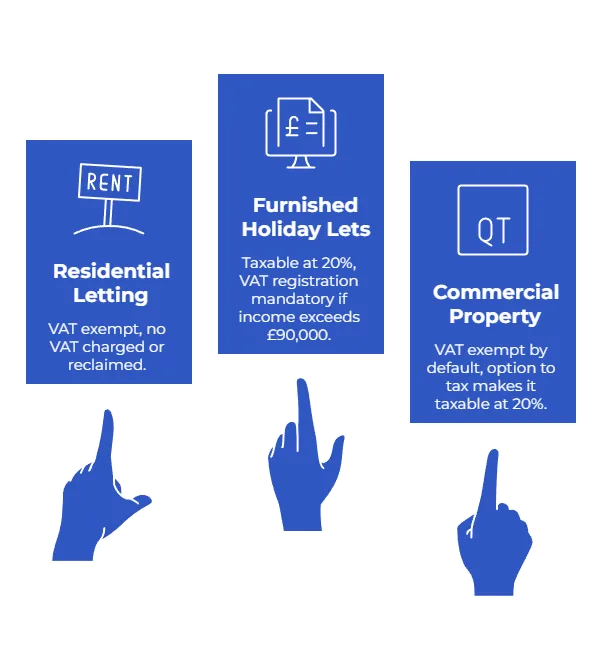
VAT on rental income UK classification follows three distinct rules under HMRC Notice 742 and VAT Act 1994:
Residential letting – long-term rental of houses and flats – is VAT exempt. Landlords cannot charge VAT and cannot reclaim VAT on associated expenses.
Furnished holiday lets – short-term holiday accommodation including Airbnb and holiday cottages – are treated as taxable supplies at the standard 20% rate. If income from FHLs (combined with other taxable sources) exceeds £90,000, VAT registration is mandatory.
Commercial property – offices, retail, industrial units – is VAT exempt by default. Landlords can exercise an option to tax, making rental income VAT-applicable at 20% and enabling recovery of input VAT on property expenses.
According to HMRC VAT on land and property Notice 742, each property type requires separate classification – mixed portfolios cannot apply a single VAT treatment across all rental income.
“The VAT on rental income UK rules are clear enough when you know the property type. The problem platforms face is that they often do not know the property type from the transaction data alone. That is where misclassification occurs.” – Clare, Finexer
Why Does Rental Income Misclassification Happen in Platforms?
Why Do Bank Transactions Fail to Identify VAT Treatment?
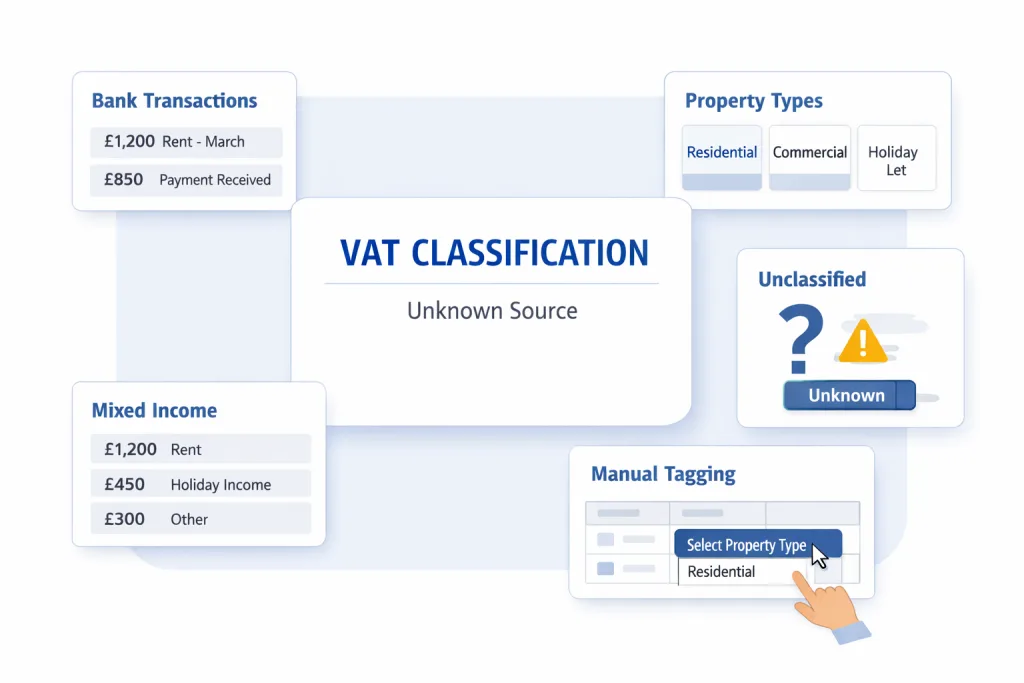
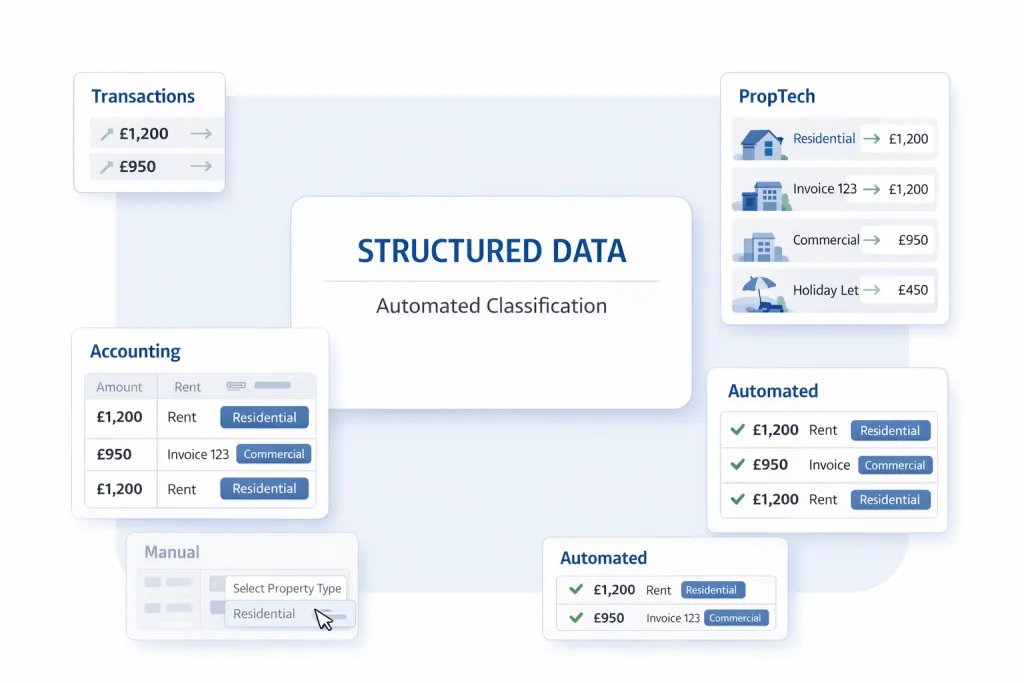
Rental payments arrive as credits in the bank feed. A £1,200 payment reference “Rent – March” could come from a residential tenant, a holiday let guest, or a commercial subtenant. The transaction carries no property type indicator.
For platforms handling large property portfolios, this creates a classification bottleneck. Every transaction must be manually reviewed and tagged against a property register before VAT treatment can be applied. At volume, this breaks.
VAT on rental income UK – what platforms must track covers the specific tracking obligations that accounting and PropTech platforms must maintain across mixed property portfolios.
The misclassification risk compounds when landlords hold mixed portfolios. Residential, FHL, and commercial income arrive in the same account. Without structured classification, platforms cannot reliably separate exempt from taxable receipts – which is exactly what VAT on rental income HMRC reporting requires.
| Property Type | VAT Treatment | Threshold | Platform Classification Problem |
|---|---|---|---|
| Residential letting | VAT exempt – cannot charge or reclaim | No threshold | Transactions look identical to other rental receipts |
| Furnished holiday let (FHL) | Standard rate 20% if above threshold | £90,000 from 1 April 2024 | Short-term lets mixed with residential in same feed |
| Commercial (no option) | VAT exempt by default | No threshold | Indistinguishable from residential in transaction data |
| Commercial (opted to tax) | Standard rate 20% | £90,000 combined taxable income | Option to tax status not visible in bank transaction |
How Does Finexer Support VAT Classification for Rental Income Platforms?
For accounting SaaS, PropTech platforms, and property accounting tools, Finexer’s FCA-authorised AIS provides structured transaction data that supports accurate rental income classification.
Making Tax Digital compliance for platforms covers how MTD requirements intersect with rental income VAT tracking and the digital record-keeping obligations from April 2026.
What Does Finexer’s AIS Provide?
- FCA-authorised AIS – read-only, consent-based bank data access
- Real-time transaction feeds with merchant identifiers and category codes
- Multi-account access – full portfolio in one consent flow
- Up to 7 years of transaction history per account
- Structured JSON output – consistent schema across almost all major UK banks
- Consent logs with access timestamps – audit trail per retrieval
- White-label consent flows, usage-based pricing, 3-5 weeks onboarding
Excel MTD bridging software and Open Banking for UK platforms covers how Open Banking data feeds replace manual spreadsheet imports for MTD-compliant VAT reporting.
“Platforms that receive structured, categorised transaction data can apply classification logic programmatically. VAT on rental income UK misclassification is a data input problem. Fix the input layer and classification becomes systematic.” – Clare, Finexer
What I Feel
Most VAT on rental income HMRC guidance focuses on the rules. What type of property. What threshold applies. When to register.
Platforms already know the rules. What they cannot do is apply them reliably to a bank feed that does not identify property types.
The classification problem is an infrastructure problem. And infrastructure problems are fixed at the data layer, not the analysis layer.
Common Use Cases
Accounting SaaS Platforms
Landlord clients hold mixed portfolios – residential, FHL, commercial. Transactions arrive in a single feed without classification. Finexer’s AIS delivers structured transaction data per account, enabling platforms to apply property-type rules programmatically rather than manually per client.
PropTech Platforms
Property management platforms tracking rent collection across large portfolios cannot manually classify every receipt for VAT treatment. Finexer’s AIS provides continuous transaction feeds with consistent categorisation – supporting automated VAT classification at portfolio scale.
Can I charge VAT on rental income in the UK?
Residential letting is VAT exempt – landlords cannot charge VAT. Furnished holiday lets are VAT-applicable at 20% above the £90,000 threshold. Commercial landlords can opt to tax, enabling them to charge VAT on rent and recover input VAT on expenses.
What is the VAT threshold for rental income HMRC?
From 1 April 2024, the VAT registration threshold is £90,000. This applies to combined taxable rental income – furnished holiday lets and commercial properties with an option to tax. Residential rental income is exempt and does not count toward the threshold.
How do platforms track VAT on mixed rental income portfolios?
Platforms need structured transaction data that can be classified by property type. Bank transaction feeds via FCA-authorised AIS provide categorised income data per account, enabling VAT treatment to be applied programmatically across residential, FHL, and commercial rental receipts.
Track rental income VAT correctly from source with Finexer.
About the Author

Clare Pearson
Clare Pearson is a senior payments professional with extensive experience across the global financial services and payments industry. She specialises in Open Banking, payment infrastructure, and financial technology transformation, with expertise spanning product delivery, operational strategy, regulatory compliance, and large-scale payments programmes. Clare currently serves as a Non-Executive Director at Finexer and a panel member for the Payment Systems Regulator (PSR), advising on the development of payment systems policy and innovation