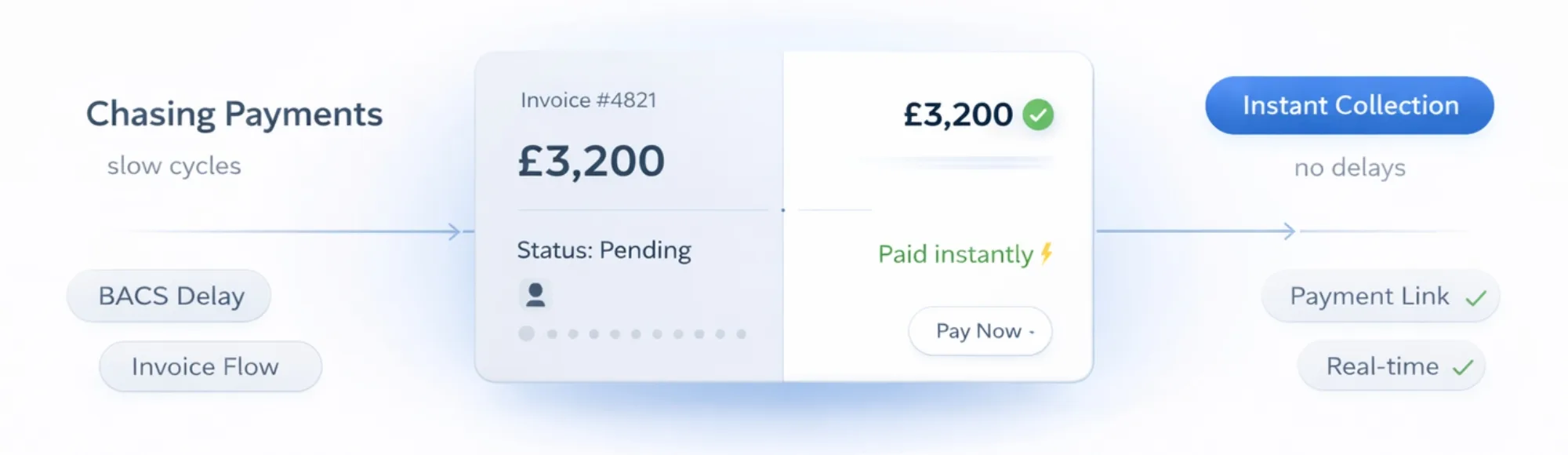
Late payment penalties exist. Late payments still happen.
FCA-authorised payment infrastructure to reduce payment delays and improve collection.
Late payment fees UK law is clear and has been since 1998.
Businesses can charge statutory interest at 8% above the Bank of England base rate. They can claim fixed compensation of £40, £70, or £100 per invoice depending on its value. Interest starts accruing the day after the invoice falls overdue.
The legal framework is there. And most businesses never use it. And they still get paid late.
The penalties are not the problem. The collection workflow is the problem. And no level of statutory interest fixes a payment process that makes it easy to delay and difficult to pay promptly.
In my work with invoicing and billing platforms at Finexer, late payment of commercial debts is almost never about unwillingness to pay. It is about friction, manual processes, and payment methods that let time pass without urgency.
TL;DR
Late payment fees UK law under the Late Payment of Commercial Debts Act 1998 entitles businesses to charge 8% above the Bank of England base rate plus fixed compensation (£40-£100 per invoice) on overdue B2B payments. Despite this, UK businesses wrote off £2.4 billion in bad debt in 2023 and the average B2B invoice is paid 18 days late. The legal right to charge fees exists. The real fix is removing the payment friction that allows delays to happen.
Key Takeaways
What are the late payment fees under UK law?
Under the Late Payment of Commercial Debts Act 1998, businesses can charge statutory interest at 8% above the Bank of England base rate from the day after an invoice falls overdue. Fixed compensation is also claimable: £40 for invoices under £1,000, £70 for £1,000-£9,999, and £100 for invoices of £10,000 or more.
Why do businesses still get paid late despite legal penalties?
Most businesses do not enforce late payment fees UK law allows. The administrative effort, client relationship risk, and lack of automated enforcement mean fees are rarely charged. Meanwhile, payment methods like BACS and cheque create natural delay windows that no fee structure changes.
What is the real cause of late payment of commercial debts?
Late payment of commercial debts persists because payment collection workflows create friction at every stage. Manual invoicing, multi-step bank transfer processes, and payment methods with 3-5 day settlement windows give debtors time to delay without consequence – regardless of what fees the law allows.
How does reducing payment friction reduce late payments?
Instant payment methods with real-time confirmation remove the delay windows that manual collection creates. When payment is as easy as approving a payment link or QR code, and the platform receives instant confirmation, the friction that enables late payment is eliminated at the point of collection.
What Are the Late Payment Fees UK Law Allows?
What Can Businesses Legally Charge on Overdue Invoices?
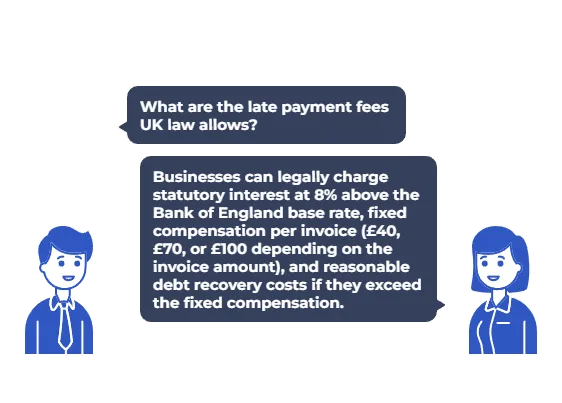
The Late Payment of Commercial Debts Act 1998 applies to B2B transactions and gives creditors the right to charge:
- Statutory interest at 8% above the Bank of England base rate, accruing daily from the day after the due date
- Fixed compensation per invoice: £40 for invoices under £1,000, £70 for £1,000 to £9,999, and £100 for invoices of £10,000 or above
- Reasonable debt recovery costs where they exceed the fixed compensation
According toHMRC and government guidance on charging interest on commercial debt, the statutory rate applies automatically – businesses do not need to specify it in the contract, though they may agree a different rate if it is substantial enough to compensate.
Late fee policy for UK invoicing and billing platforms covers how platforms structure late payment fee policies within these statutory boundaries.
“The legal framework for late payment fees UK businesses can charge is stronger than most realise. The problem is not the law. It is that enforcing fees requires a manual process that most businesses absorb rather than pursue – so the late payment cycle continues.” – Clare, Finexer
What Is the Business Impact of Late Payment of Commercial Debts?
Why Do Late Payments Persist Despite Legal Protections?
UK businesses wrote off an estimated £2.4 billion in bad debt in 2023, according to industry data. The average B2B invoice is paid approximately 18 days late. These figures exist alongside a legal framework that has entitled creditors to statutory interest for over 25 years.
The gap between the legal right and the business reality comes from three practical problems:

Fee enforcement is manual – calculating statutory interest, sending formal demands, and following up requires administrative overhead most small businesses and platform clients cannot sustain at scale.
Client relationship risk – businesses routinely choose not to enforce fees to preserve client relationships, particularly with high-value or repeat buyers. The legal right to charge exists; the commercial willingness to exercise it often does not.
Payment methods create delay windows – BACS transfers take 3 business days. Cheques take longer. Card payments have chargeback exposure. None of these methods creates urgency at the point of payment or confirmation at the point of receipt.
Payment processing fees and collection costs for UK platforms covers how payment method selection affects both collection speed and the total cost of late payment recovery for invoicing platforms.
| Payment Method | Settlement Time | Delay Window Created | Late Payment Risk |
|---|---|---|---|
| BACS / bank transfer | 3 business days | Natural 72-hour gap before funds arrive | High – no urgency, no confirmation until cleared |
| Cheque | 5-7 working days | Postal delay + clearing window | Very high – significant delay before any confirmation |
| Card payment | 2-5 business days | Authorisation vs settlement gap | Medium – chargeback exposure, settlement delay |
| Pay by Bank (Faster Payments) | Seconds | None – confirmation at point of payment | Low – instant settlement, webhook confirmation |
What Does Fixing Late Payment of Commercial Debts Actually Require?
Why Do Penalty Structures Do Not Change Payment Behaviour?
Late payment fees UK law provides are a remedy after the fact. They do not prevent the delay from occurring. A debtor who ignores an invoice due date will also ignore a statutory interest notice – until the situation escalates to formal debt recovery, which most businesses do not pursue.
The actual fix for persistent late payment of commercial debts is structural – at the point of collection, not after the due date.
Alternative payment methods for UK billing platforms covers how payment method selection directly affects collection timing and late payment rates for billing and invoicing platforms.
When payment is initiated at the point of invoice – via a payment link embedded in the invoice, a QR code at point of sale, or a VRP-enabled recurring collection – the delay window disappears. The debtor does not receive an invoice and decides when to pay. They receive an invoice with a payment mechanism that completes the collection in seconds.
Legacy payment systems and the cost of delayed collections for UK platforms covers how BACS-dependent collection workflows create the structural delay windows that late payment fees exist to compensate for.
How Does Finexer Reduce Late Payments for Billing and Invoicing Platforms?
What Does Finexer’s PIS Provide for Collection Workflows?
The problem: late payment of commercial debts persists because payment collection workflows create friction and delay windows that statutory fees cannot remove. Finexer’s FCA-authorised PIS removes payment friction at the point of collection – so payment happens at the moment of invoice, not days later.
- Payment Links – shareable links embedded in invoices that initiate instant Faster Payments at point of receipt
- QR code payments – point-of-sale and invoice payment initiation without redirect friction
- Pay by Bank via Faster Payments – zero chargebacks, instant settlement, no interchange fees
- VRP (Variable Recurring Payments) – merchant-controlled recurring collection within pre-agreed consent, no per-payment re-authentication
- Webhook confirmation per payment – real-time settlement confirmation, no manual bank login to verify receipt
- Covers almost all major UK banks – high street, challenger, and business banking providers
- Usage-based pricing, 3-5 weeks to production deployment
“Late payment fees UK law provides are a legal safety net. They should not be the primary collection strategy. When payment is as easy as clicking a link and approving on a bank app, the friction that enables delay is removed before the invoice has a chance to become overdue.” – Clare, Finexer
What I Feel
Late payment is talked about as a legal problem. It is actually a workflow problem.
The Late Payment of Commercial Debts Act 1998 is well-constructed legislation. The statutory rate is meaningful. The compensation amounts are clear.
But the businesses I work with do not have a late payment fee enforcement problem. They have a payment collection infrastructure problem. The law gives them a remedy. What they need is a mechanism that makes the delay less likely to occur in the first place.
Common Use Cases

Invoicing & Billing Platforms
Platforms issuing high volumes of B2B invoices accumulate late payment exposure across client portfolios. Finexer’s Payment Links and Pay by Bank enable payment at point of invoice delivery – reducing the window between invoice receipt and payment initiation from days to seconds.
Utility Billing Platforms
Recurring utility collection via BACS creates the 3-day delay window every billing cycle. Finexer’s VRP enables merchant-controlled collection on the billing date within pre-consented parameters – removing the re-authentication friction that allows payment cycles to slip.
Accounting SaaS Platforms
Accounting platforms managing client receivables need real-time visibility of which invoices have been paid. Finexer’s AIS provides real-time transaction feeds with webhook confirmation per payment – giving platforms instant confirmation when each invoice payment clears, without manual bank reconciliation.
Are late payment fees legal in the UK?
Yes. Under the Late Payment of Commercial Debts Act 1998, businesses can charge statutory interest at 8% above the Bank of England base rate on overdue B2B invoices. Fixed compensation of £40, £70, or £100 per invoice can also be claimed depending on the invoice value.
What is the late payment fee on a commercial invoice in the UK?
Statutory interest is 8% above the Bank of England base rate, accruing daily from the day after the due date. Fixed compensation is £40 for invoices under £1,000, £70 for £1,000-£9,999, and £100 for invoices of £10,000 or above. Reasonable debt recovery costs can also be claimed if they exceed the fixed sum.
How can invoicing and billing platforms reduce late payments beyond charging fees?
Embedding instant payment mechanisms in invoices – Payment Links, QR codes, or Pay by Bank – removes the delay window that BACS and manual bank transfers create. Real-time AIS transaction feeds confirm when each payment clears. VRP enables recurring collection on the billing date without per-payment user re-authentication.
Build payment collection workflows that prevent late payment before fees are needed.
About the Author

Clare Pearson
Clare Pearson is a senior payments professional with extensive experience across the global financial services and payments industry. She specialises in Open Banking, payment infrastructure, and financial technology transformation, with expertise spanning product delivery, operational strategy, regulatory compliance, and large-scale payments programmes. Clare currently serves as a Non-Executive Director at Finexer and a panel member for the Payment Systems Regulator (PSR), advising on the development of payment systems policy and innovation