Manual audit trails creating compliance gaps?
Learn how platforms design payment flows that work within Open Banking limits.
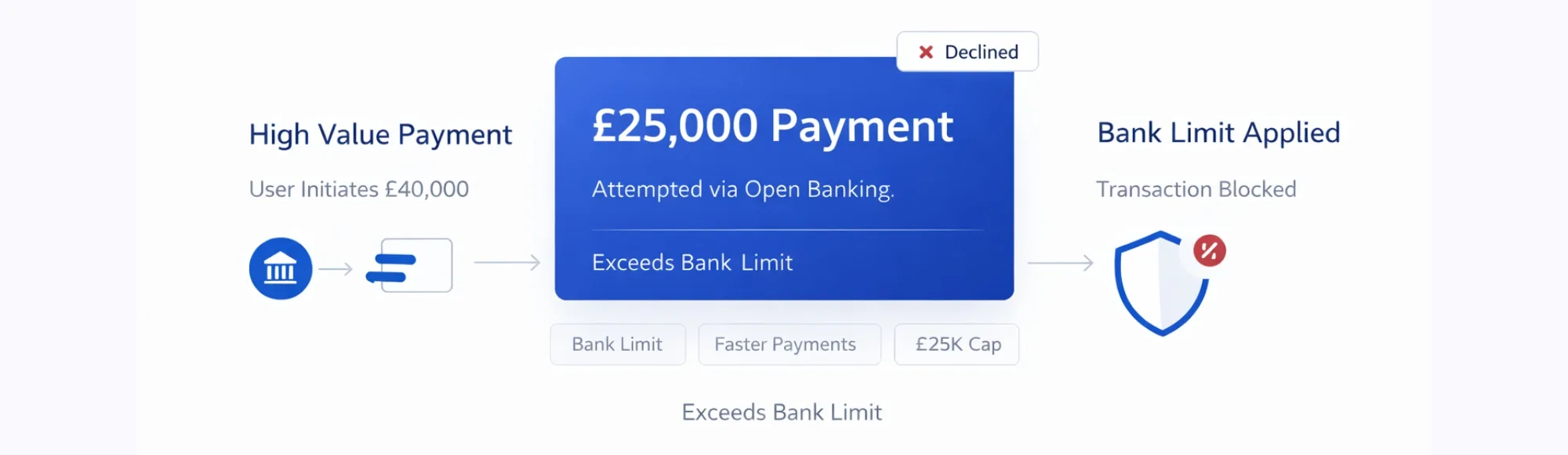
Open banking payment limits are one of the most overlooked causes of payment failure in UK product flows.
The limit is not set by Open Banking. It is set by the user’s bank. And it varies – significantly – across institutions.
For product and compliance teams, this creates an invisible ceiling that only surfaces when a transaction fails.
TL;DR
UK open banking payment limits are bank-specific and tied to each institution’s Faster Payments thresholds. Common online limits are £25,000 per day at major UK banks, though some allow higher amounts via branch or dedicated channels. There is no universal Open Banking cap. For platforms, the practical impact is silent transaction failures, user drop-off, and split payment overhead at the checkout or onboarding stage.
Key Takeaways
What are open banking payment limits in the UK?
Open banking payment limits in the UK are set by individual banks, not by a central Open Banking authority. Most UK banks apply their Faster Payments online limits – typically £25,000 per transaction or per day for standard online/app channels – to Open Banking initiated payments.
Why do open banking transactions fail despite correct setup?
Transactions fail when the payment amount exceeds the user’s bank-specific open banking payment limit. The payment initiation succeeds technically, but the bank declines the transaction at authorisation. The platform receives a failure response with no user-facing explanation of the actual cause.
What do platforms do when limits create friction?
Platforms implement split payment flows, fallback payment methods, and pre-payment user prompts that surface the limit issue before the user reaches authorisation. Each workaround adds UX complexity and development overhead that correct limit handling at the infrastructure layer would eliminate.
What Are the Open Banking Payment Limits by UK Banks?
How Do Bank-Specific Limits Affect Transaction Success?
There is no single answer. UK open banking payment limits depend entirely on the user’s bank and the channel through which the payment is authorised.
| Bank | Online / App Limit | Source |
|---|---|---|
| Lloyds Bank | £25,000 per day | Lloyds Bank payment limits page |
| Barclays | Varies by account type – check online banking settings | Barclays payment information page |
| Santander | Varies by account – third-party access via open banking | Santander third-party providers page |
| NatWest | Set per account – visible in online banking | NatWest open banking support page |
No universal UK open banking limit exists. Faster Payments itself supports transfers up to £1 million between banks – but individual bank online limits are typically far lower for standard digital channels.
“In my work with payment and EPOS platforms, open banking payment limits are one of the most common causes of unexplained transaction failure. The payment flow is correct. The initiation is correct. The bank declines – and the platform has no prompt in place to tell the user why.” – Ravi, Finexer
Open Banking examples and real-world UK payment flows cover how open banking payment limits appear in practice across different transaction types and use cases.
Where Do Open Banking Payment Limits Break Real Flows?
What Are the Real Friction Points for Product Teams?
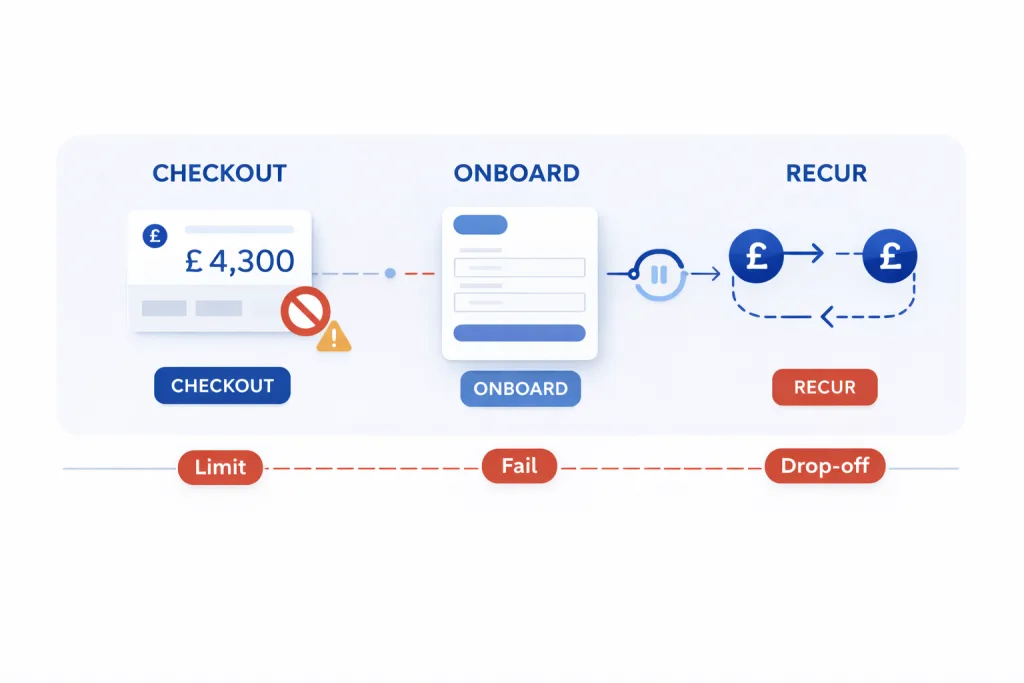
Open banking payment limits create friction at three specific points in a payment flow:
High-value checkout failure:
- User reaches authorisation with a valid payment
- Bank declines because amount exceeds the daily online limit
- User receives a generic failure message with no clear next step
- Platform loses the transaction with no recovery path built in
Onboarding payment failure:
- Platform requires a deposit or fee payment during onboarding
- User’s bank limit is below the required amount
- Onboarding stalls – no alternative payment method offered
- Support ticket raised, conversion lost
Recurring collection gaps:
- Variable payment amounts occasionally exceed a user’s current bank limit
- Collection fails silently
- Platform discovers the gap at reconciliation, not at point of failure
UK open banking governance and payment rules for platforms covers how UK Open Banking standards interact with bank-level payment limits and what platforms are responsible for handling.
What Do Platforms Do to Handle Open Banking Payment Limits?
How Should Product Teams Design Around Limit Constraints?

Platforms that handle open banking payment limits well build the solution into the flow before the user reaches authorisation:
- Pre-payment limit check prompt – surface the limit issue to the user before initiating payment, with a clear explanation and alternative
- Split payment option – allow users to complete high-value transactions across multiple authorisations within their bank’s daily limit
- Fallback payment method – offer an alternative (card, BACS) when the Open Banking payment amount is likely to exceed the user’s limit
- VRP for recurring collections – Variable Recurring Payments pre-authorise within agreed parameters, reducing per-collection failure exposure
How to use Open Banking API for UK payment platforms covers how payment initiation APIs surface limit-related failure codes and how platforms handle them in the payment flow.
Open Banking infrastructure for UK financial platforms covers how PIS infrastructure handles bank-specific limit variation across different payment scenarios.
How Does Finexer Support Payment Flows Within UK Open Banking Limits?
What Does Finexer’s PIS Provide for Limit-Aware Payment Flows?
Finexer’s FCA-authorised PIS works within UK open banking payment limits as defined by each bank. For platforms building limit-aware payment flows, Finexer provides:
- Pay by Bank via Faster Payments – standard open banking payment initiation within bank limits
- Payment Links – shareable payment initiation for controlled-amount flows
- VRP (Variable Recurring Payments) – pre-authorised recurring collection within consented parameters, reducing per-payment limit exposure
- Webhook confirmation per payment – real-time failure notification so platforms can trigger fallback flows immediately
- Payment failure codes – structured response data that platforms can use to surface limit-specific user prompts
Open Banking API guide for UK platforms covers how Finexer’s PIS returns payment status and failure codes that platforms use to build limit-aware user flows.
What I Feel
Open banking payment limits are treated as a compliance question. They are actually a product design question.
The limit is a bank constraint. How the platform responds to it – with a clear prompt, a fallback, or a silent failure – determines whether the user completes the payment or abandons it.
“The platforms that handle open banking payment limits well treat them as a UX problem, not a technical one. The limit is fixed. The user experience around it is not.” – Ravi, Finexer
The platforms that handle this well build the limit into the flow from the start. The ones that do not discover it in support tickets.
Common Use Cases
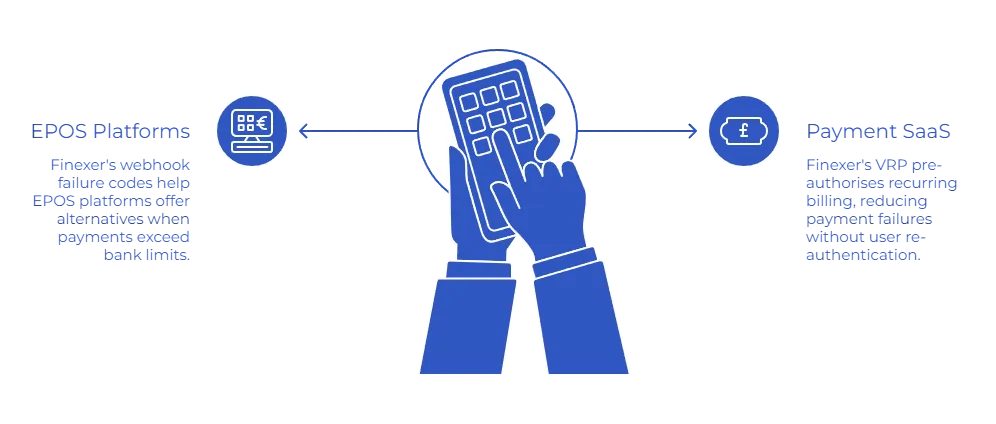
EPOS Platforms
High-value point-of-sale payments occasionally exceed the user’s bank online limit. Finexer’s webhook failure codes allow EPOS platforms to surface a clear prompt and offer an alternative – preventing silent abandonment at the point of payment.
Payment SaaS
Variable payment amounts in recurring billing may breach a user’s limit on specific cycles. Finexer’s VRP pre-authorises collection within agreed parameters, reducing per-cycle failure exposure without requiring per-payment user re-authentication.
What are UK open banking payment limits?
UK open banking payment limits are set by individual banks based on their Faster Payments online thresholds. There is no universal Open Banking cap. Common limits at major UK banks are around £25,000 per day for standard online and app channels, though limits vary by account type and institution.
Why do open banking payments fail even when correctly initiated?
Open banking payments fail when the transaction amount exceeds the user’s bank-specific daily or per-transaction limit. The payment initiation is technically correct, but the bank declines at authorisation. Platforms receive a failure response – but users often see only a generic error with no explanation of the actual cause.
How can platforms reduce open banking payment limit failures?
Platforms reduce failures by building limit-awareness into the payment flow before the user reaches authorisation. This includes surfacing a limit prompt before initiation, offering split payment options for high-value transactions, providing a fallback payment method, and using VRP for recurring collections where per-payment limits create cycle-by-cycle exposure.
Learn how platforms design payment flows that work within Open Banking limits.
About the Author

Ravi Ranjan
Ravi Ranjan is Co founder & CEO of Finexer