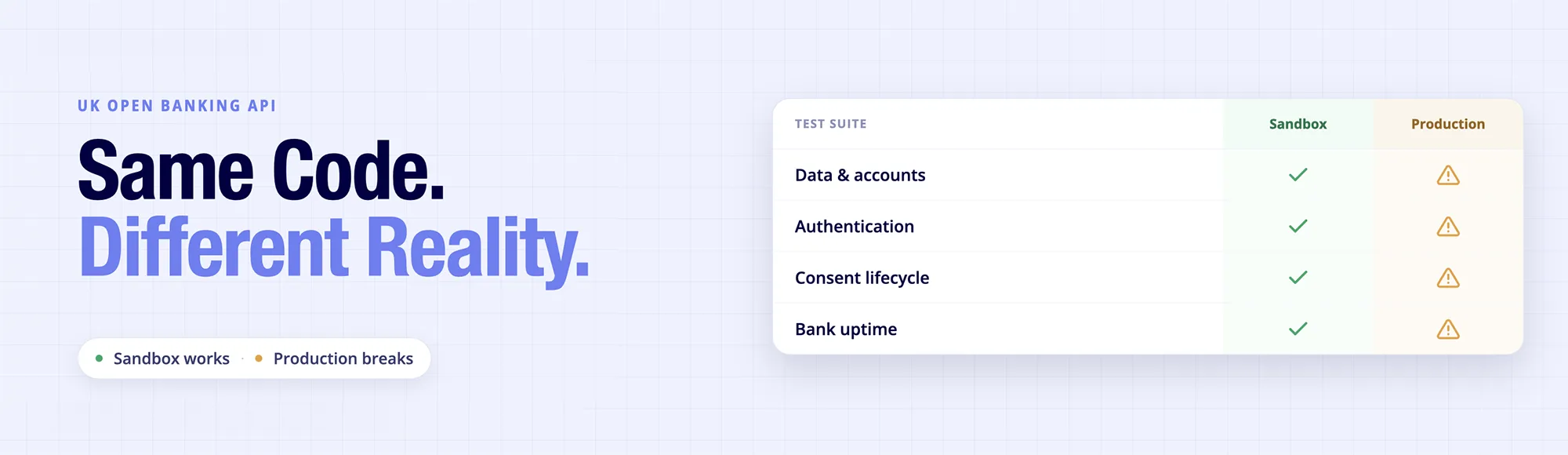
API works in a sandbox. Production is different.
Reliable UK open banking API infrastructure for product and engineering teams.
Brief: UK open banking API integrations rarely fail because your code is wrong. They fail because sandbox tests your code, while production tests the banks. The CMA9 standard covers only nine banking groups. Beyond them, field formats, error codes, and uptime vary bank by bank. This guide covers what actually differs, and the reliability checklist that closes the gap.
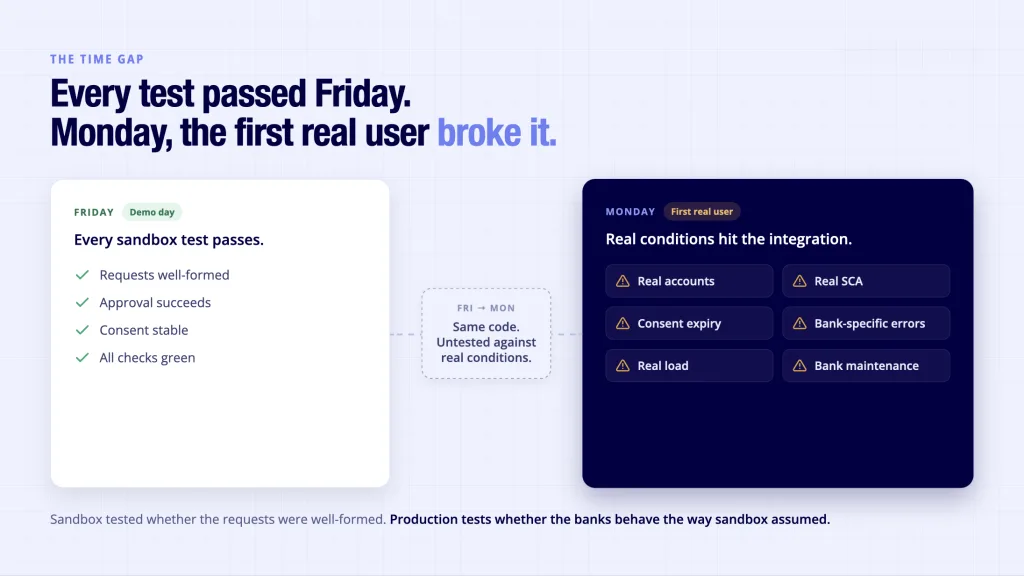
The demo went perfectly on Friday. Every test passed. On Monday, you launch, and the first real user connects a challenger bank account. The connection hangs on an error code your team has never seen.
Nothing about your code changed over the weekend. What changed is the bank on the other end. This is the most common story in UK open banking API integrations, and it has a specific, fixable cause. Sandbox proved your logic works. It never tested the thing that breaks: how differently each real bank behaves.
Why Do UK Open Banking API Integrations Break in Production?
Because the sandbox and production test different things. Sandbox tests whether your requests are well-formed. Production tests whether hundreds of separately built bank systems respond the way the standard says they should. Many banks don’t behave exactly as the standard expects.
If you need the basics of how Open Banking APIs work, start with our guide. This page assumes them and focuses on the gap between the specifications and the banks. That gap is where most UK open banking API projects lose their first month after launch.
The scale makes the gap matter. Open Banking Limited’s live performance data shows 17.94 million active UK connections and 37.46 million payments processed in March 2026. At that volume, a bank quirk that affects 1% of connections is not an edge case. It is your support queue.
Does the Open Banking Standard Cover Every UK Bank?
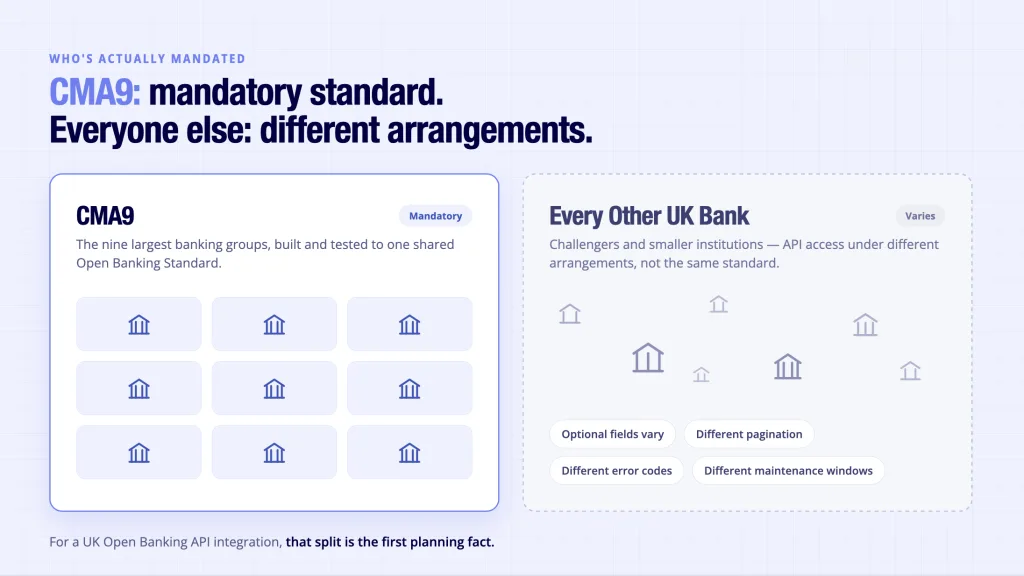
No. The Open Banking Standard was made mandatory only for the CMA9: the nine largest banking groups, under a Competition and Markets Authority order. Those nine were built to a shared specification and were tested against it.
Every other bank is different. Challenger banks and smaller institutions must offer API access under the Payment Services Regulations 2017, but the CMA order does not bind them to the same specification detail. In the open banking API UK ecosystem, that shows up as real differences:
- Optional fields that one bank fills and another leaves empty
- Different pagination rules for transaction history
- Error codes that mean one thing at Bank A and another at Bank B
- Different maintenance windows and downtime patterns
For a UK open banking API integration, that list is the first planning fact.
Reliability varies even among the big names. OBL publishes monthly availability and response-time data, and it shows performance differs bank to bank, month to month. Independent monitors, such as API metrics and OBL itself in its OBIE days, have flagged these gaps for years. The lesson is simple- Open banking APIs are standardised on paper, and in production, you integrate with banks, not with a standard.
Sandbox vs Production: What Actually Differs?
In any open banking API UK rollout, six things change between the two environments:
| What You Test | In Sandbox | In Production |
|---|---|---|
| Data | Clean, static test accounts | Real accounts: joint accounts, empty histories, odd characters |
| Authentication | Simulated approval always succeeds | Real SCA journeys that users abandon or fail |
| Consent | Never expires | Expires and needs reconfirmation, and users revoke it |
| Errors | The documented error codes | Bank-specific codes, timeouts and half-responses |
| Load | Your test volume | Real traffic, plus the bank’s own busy periods |
| Downtime | Effectively none | Scheduled and unscheduled bank maintenance |
Each row is a class of production incident for which your UK open banking API tests were never created in a sandbox. A consent that expires mid-month breaks a data sync; your tests never questioned. A real user abandoning the bank’s approval screen leaves a payment in a state your happy-path tests never saw.
This is expected behaviour in live Open Banking environments, not necessarily a fault in your integration. Our banking API integration guidecovers the build side in detail, and the practical flow is on how to use Open Banking API connections on a UK platform.
The Production Reliability Checklist
Six habits separate a UK open banking API integration that holds from one that pages the on-call engineer:
- Test per bank, not per standard: Passing against the spec proves little. Run real journeys against every bank your users actually hold accounts with.
- Plan for consent expiry: Build the reconfirmation journey before launch, not after the first wave of dropped connections.
- Map error codes bank by bank: Keep a translation layer so “temporarily unavailable” at one bank is not treated like “invalid request” at another.
- Handle downtime gracefully: Queue and retry around bank maintenance windows instead of failing the user.
- Prefer webhooks over polling: Event-driven updates survive timing problems that scheduled polling turns into missing data.
- Monitor the banks, not just your app: Your uptime dashboard is green while one of your connected open banking APIs degrades. Track bank-side health separately.
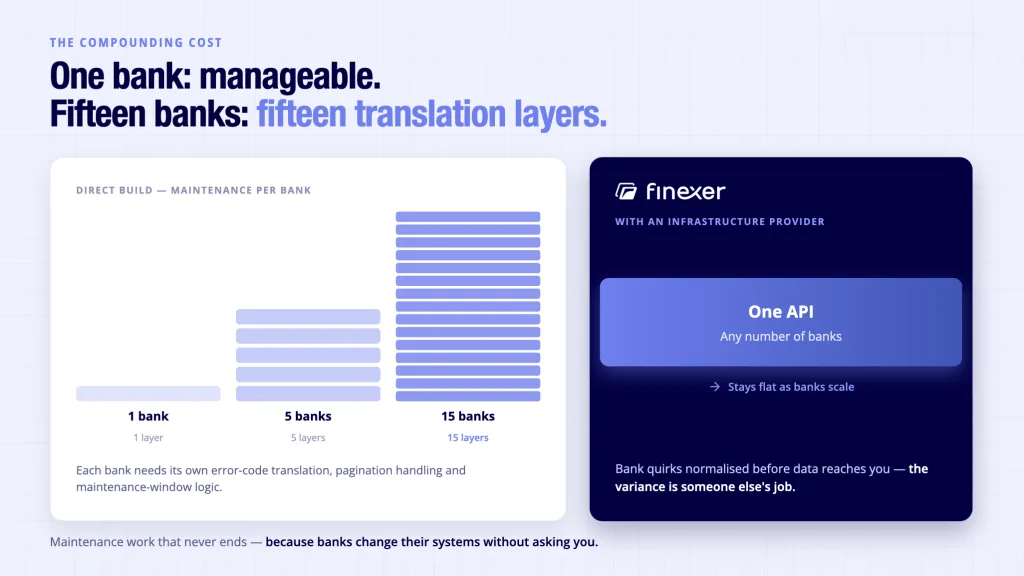
Building all six per bank is the real cost of a direct integration in the open banking API UK market. It is maintenance work that never ends, because banks change their systems without asking you. The fuller version of this build-or-buy decision sits in our Open Banking API integration guide.
Where Does Finexer Fit?
This per-bank variance is exactly what an infrastructure provider exists to absorb. Finexer maintains the bank connections so platforms integrate once, against one consistent API, instead of hundreds of slightly different ones. Through Finexer’s Data API, the differences between banks are handled below your integration:
- One API across 99% UK bank coverage, with bank quirks normalised before data reaches you
- Real-time webhooks on transactions and payment events, no polling
- Structured JSON (standardised transaction data) per transaction, consistent across banks
- Connection monitoring and maintenance handled by Finexer, not your team
- FCA-authorised (FRN925695) as both AISP and PISP
- Usage-based pricing, 3-5 weeks onboarding support
The trade is straightforward. A direct build gives you control of every UK open banking API connection and the permanent job of maintaining each one. Infrastructure gives you one integration and someone else on the hook when a bank changes its behaviour at 2am.
The Bottom Line
The failures are not mysterious. Sandbox validates your code. Production validates the banks, and the banks vary. That is the whole open banking API UK reliability problem in one line. Test per bank, plan for expiry and downtime, and monitor the other side of every connection. Or put an infrastructure layer under your UK open banking API integration and make the variance someone else’s job.
Why do Open Banking integrations fail in production?
Because production adds what sandbox removes: real user behaviour, real bank differences, and time. Consents expire. Users abandon authentication. Banks return undocumented errors and go down for maintenance. A UK open banking API integration that only passed sandbox tests has proven its logic, not its resilience.
Are UK bank APIs reliable?
Mostly, but unevenly. Open banking API UK performance data published by OBL shows availability and response times differ bank to bank. The CMA9 are held to a shared standard. Beyond them, implementation quality varies more. Treat every UK open banking API connection as a per-bank question, not a yes-or-no one.
What is the difference between sandbox and production in open banking?
Sandbox is a simulation: clean test data, authentication that always succeeds, consent that never expires. Production is the real thing: live accounts, real approval journeys, expiring consents and bank downtime. Open banking APIs behave predictably in the first and variably in the second, which is why per-bank testing matters.
If you’re planning a production rollout or troubleshooting inconsistent bank behaviour, Finexer’s team can show you how the same connections work through one normalised API.
See how a single integration can simplify bank-specific differences.
Explore with AI
About the Author

Ravi Ranjan
Ravi Ranjan is Co founder & CEO of Finexer