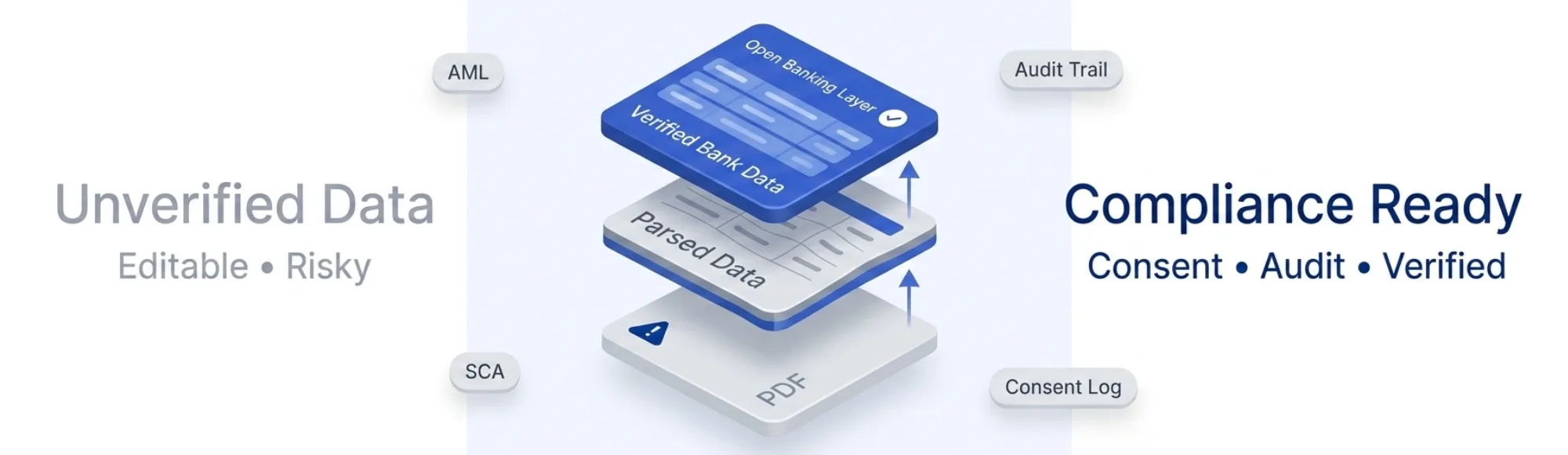
Verified bank data. No PDFs. Full audit trail.
Open banking data access for law firm AML and source of funds compliance.
The cheapest way to fetch client bank statements for solicitors is to use secure, consent-based financial data access instead of manual documents or third-party uploads.
But cheap upfront is not the same as cheap at scale. The methods that cost least to implement often carry the highest compliance overhead – and the highest regulatory risk under the Money Laundering Regulations 2017.
Under the MLRs 2017, solicitors must verify the source of funds used in a transaction and maintain adequate records to demonstrate that verification to the SRA. The method used to fetch client bank statements determines whether that evidence holds up in a regulatory review.
In my work with law firms and compliance teams at Finexer, the cost of manual document collection is almost never visible until a compliance audit surfaces it.
TL;DR
Solicitors must fetch client bank statements as part of source of funds checks under the Money Laundering Regulations 2017. Three methods are in common use: manual PDF collection, document scraping tools, and open banking data access. PDFs carry manipulation risk and create manual review overhead. Document scraping tools improve speed but rely on unverified source data. Open banking data access – via FCA-authorised AIS – delivers verified, direct-from-bank transaction history with consent logs and audit trails, at a usage-based cost that scales with transaction volume.
Key Takeaways
Why do solicitors need to fetch client bank statements?
Under the Money Laundering Regulations 2017 and the Proceeds of Crime Act 2002, solicitors must verify the source of funds used in a transaction. Fetching client bank statements – typically 6-12 months of transaction history – is the standard method for demonstrating that verification to the SRA.
What makes a bank statement collection method compliant?
A compliant method for fetching bank statements produces:
- Verified data confirmed as coming directly from the bank
- Complete transaction history with no redactions
- Consent record showing the client authorised the access
- Audit trail demonstrating when the data was retrieved and by whom
What are the risks of manual PDF bank statements in AML compliance?
PDF bank statements can be altered using basic software. The SRA cannot verify authenticity from the document alone. Solicitors relying on unverified PDFs carry compliance risk if the document is later found to have been manipulated – and may be unable to demonstrate adequate due diligence to the regulator.
The 3 Ways Solicitors Fetch Client Bank Statements
1. Manual PDF Collection

The most common method used to fetch client bank statements. The solicitor requests bank statements from the client, who downloads and sends them by email or upload portal.
Cost: Low upfront. No software required.
What it involves:
- Client downloads statements from their banking app
- Sends via email, portal upload, or in person
- Solicitor reviews and files manually
Compliance risk:
- PDF bank statements can be altered – transaction amounts, dates, and balances can be changed using standard tools
- No independent verification that the document came directly from the bank
- Manual review creates time overhead per matter
- SRA cannot confirm authenticity from a PDF alone
- Unredacted statements required – any blacked-out transactions may indicate risk
When it fails: In an SRA review, a solicitor using unverified PDFs who cannot demonstrate the bank statements are genuine may be unable to evidence adequate due diligence under MLR 2017 Regulation 28.
2. Document Scraping and Verification Tools
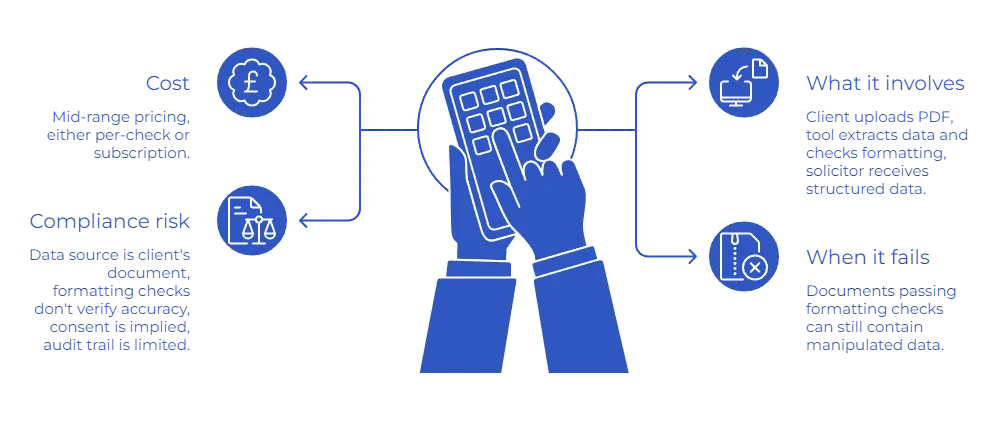
Third-party tools that extract data from uploaded bank statement PDFs and attempt to verify them using metadata or formatting checks.
Cost: Mid-range. Per-check or subscription pricing.
What it involves:
- Client uploads a PDF statement
- Tool extracts transaction data and checks document formatting
- Solicitor receives structured data output
Compliance risk:
- Data source is still the client’s document – not the bank directly
- Formatting checks do not verify that underlying transaction data is accurate
- Consent is implied through the upload, not explicitly logged per retrieval
- Audit trail is limited to the tool’s own records
When it fails: A document that passes automated formatting checks can still contain manipulated transaction data. The verification is of the document format, not the financial data itself.
3. Open Banking Data Access (Most Reliable Way to Fetch Client Bank Statements)
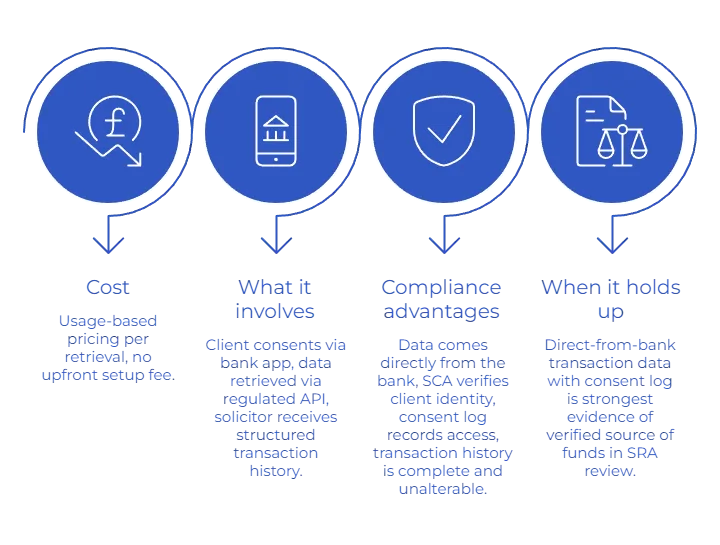
FCA-authorised Account Information Service Providers (AISPs) fetch bank statements directly from the bank with explicit client consent. No PDF involved.
Cost: Usage-based pricing per retrieval. No upfront setup fee with providers offering usage-based models.
What it involves:
- Client consents via their bank app using SCA (Strong Customer Authentication)
- Data is retrieved directly from the bank via regulated API
- Solicitor receives structured transaction history with consent log
Compliance advantages:
- Data comes directly from the bank – no document intermediary
- SCA at authentication means the bank verified the client’s identity
- Consent log records when access was granted, by whom, and for what scope
- Transaction history is complete and unalterable – not a client-prepared document
- Supports 6-12 months history (or up to 7 years with providers like Finexer)
When it holds up: In an SRA review, direct-from-bank transaction data with a consent log and access timestamp is the strongest available evidence of verified source of funds.
| Method | Data Source | Compliance Risk | Audit Trail | Cost Model |
|---|---|---|---|---|
| Manual PDF | Client-prepared document | High – manipulable | None (solicitor’s own records only) | No tool cost, high staff time |
| Scraping tools | Client-uploaded document | Medium – format verified, data not | Tool-level only | Per-check or subscription |
| Open Banking AIS | Direct from bank via API | Low – bank-verified, SCA-authenticated | Consent log + access timestamp per retrieval | Usage-based, no setup fee |
Bank statement automation for UK legal and compliance platforms covers how automated bank statement retrieval compares to manual document collection for law firm workflows.
“The compliance risk in manual bank statement collection is not immediately visible. It surfaces when a statement is later found to have been altered, or when a firm cannot demonstrate to the SRA that the data was genuine and obtained with proper consent.” – Clare, Finexer
How Does Finexer Help Solicitors Fetch Client Bank Statements?
What Does Finexer’s AIS Provide for Source of Funds Compliance?
For law firms that need to fetch client bank statements with verified data, consent logs, and an auditable access record, Finexer’s FCA-authorised AIS provides direct-from-bank transaction history in a single integration.
- Direct bank access – data retrieved from the bank, not from a client-prepared document
- SCA at bank level – client authenticates directly in their banking app
- Consent logs per retrieval – timestamp, client identity, and data scope recorded per access event
- Up to 7 years of transaction history – covers the full depth required for source of funds checks
- Unalterable transaction data – no PDF intermediary, no manual upload risk
- Structured JSON – consistent format across almost all major UK banks
- Usage-based pricing, 3-5 weeks to production with active onboarding support
Bank statement extraction software for UK financial platforms covers how Finexer’s AIS compares to document extraction tools for bank statement retrieval.
Historical financial data access for UK platforms covers how AIS transaction history depth supports source of funds and AML workflows.
Real-time bank feeds for accounting and compliance platforms covers how real-time bank data access replaces manual statement collection across compliance workflows.
Finexer Data product – AIS for UK platforms covers the full AIS capability set and compliance documentation for law firm vendor assessment.
“For law firms handling AML and source of funds checks, infrastructure like Finexer enables direct bank data access with client consent – providing verified transaction history and audit-ready records without relying on documents.” – Clare, Finexer
What I Feel
PDF bank statements are the most common way solicitors fetch client bank statements data.
They are also the least verifiable.
A client who wants to obscure a transaction can do so in a PDF before sending it. A consent-based open banking retrieval cannot be manipulated after the fact – the data comes directly from the bank at the moment of access.
For a £500,000 property transaction, the cost difference between open banking access and manual review is negligible. The compliance difference is not.
Common Use Cases
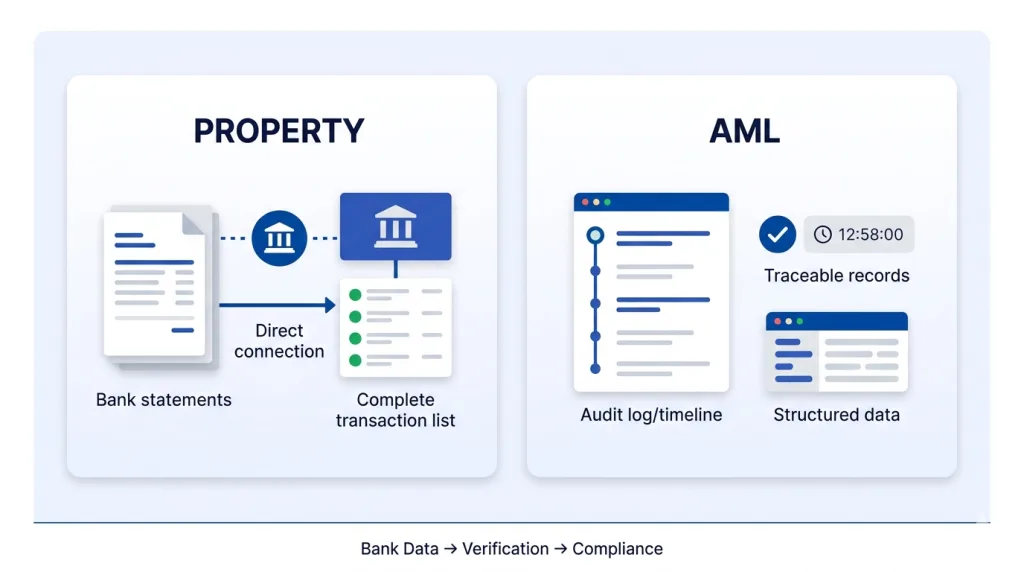
Conveyancing and Property Solicitors
Source of funds checks for property transactions require 6-12 months of unredacted bank statements. Finexer’s AIS enables solicitors to fetch client bank statements directly from the bank:
- Retrieves with client consent via SCA
- Delivers complete, unalterable transaction history
- Records consent log and access timestamp for SRA audit purposes
AML and Compliance Teams
Compliance teams reviewing source of funds across multiple client matters need verified data with traceable consent per retrieval. Finexer’s per-retrieval consent logs and structured transaction data support both the review workflow and the regulatory evidence trail.
What is the cheapest way to fetch client bank statements for solicitors?
Open banking data access via an FCA-authorised AIS is the most cost-effective compliant method. Usage-based pricing means solicitors pay per retrieval with no setup fee. Manual PDFs appear cheaper upfront but carry compliance risk and staff review overhead. Document scraping tools add cost without eliminating the verification gap.
How long does it take to fetch client bank statements via open banking?
Open banking AIS retrieves client bank statements directly from the bank in seconds once consent is granted. The client authenticates via SCA in their banking app – no document upload, no waiting for statements to arrive by email. Solicitors receive structured transaction data immediately with a consent log per retrieval.
How does open banking help solicitors fetch bank statements compliantly?
Open banking allows FCA-authorised providers to fetch bank statements directly from a client’s bank with explicit consent via SCA. The data is unalterable, comes directly from the bank, and is accompanied by a consent log and access timestamp – providing an auditable record that satisfies MLR 2017 and SRA requirements for source of funds documentation.
Fetch client bank statements directly with verified data from the bank – no PDFs, full audit trail.
About the Author

Clare Pearson
Clare Pearson is a senior payments professional with extensive experience across the global financial services and payments industry. She specialises in Open Banking, payment infrastructure, and financial technology transformation, with expertise spanning product delivery, operational strategy, regulatory compliance, and large-scale payments programmes. Clare currently serves as a Non-Executive Director at Finexer and a panel member for the Payment Systems Regulator (PSR), advising on the development of payment systems policy and innovation