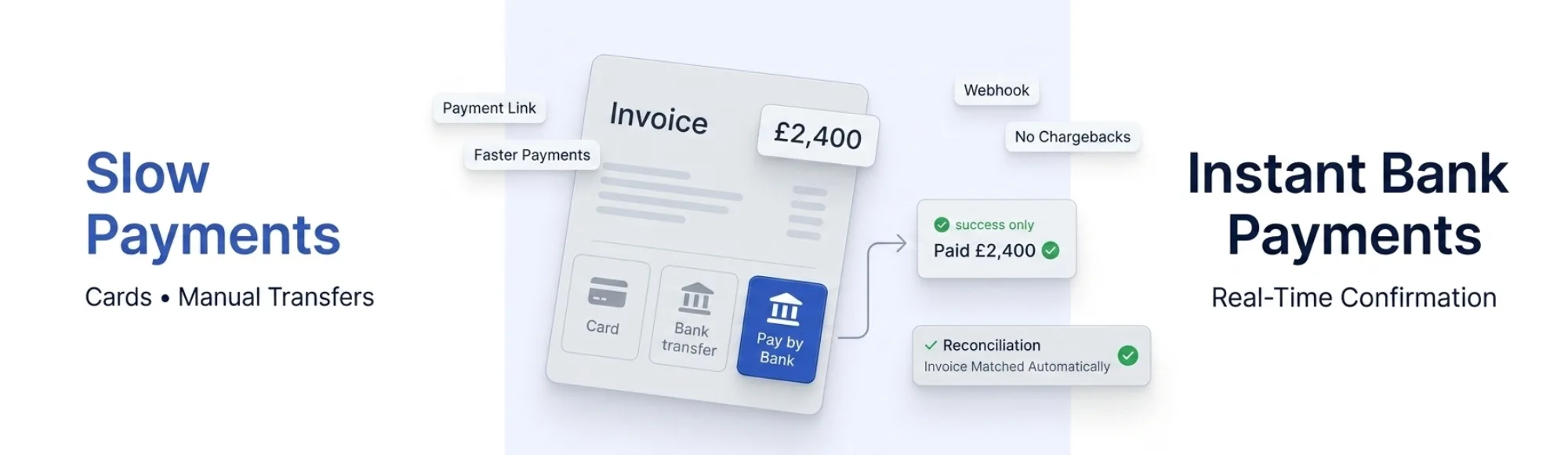
Bank-based invoice payments. Instant confirmation. Zero chargebacks.
Open Banking payment initiation and bank data for invoice workflows.
Invoice payment methods include bank transfers, card payments, and account-to-account payments via Open Banking. The invoice payment process involves issuing an invoice, selecting a payment method, and confirming receipt – with modern methods enabling faster settlement and cleaner reconciliation.
The method used to collect invoice payments determines more than transaction cost. It determines how quickly funds arrive, how reliably payment is confirmed, and how much manual work the reconciliation step requires.
At Finexer, I work with billing platforms, accounting SaaS, and ERP teams who build invoice payment workflows. The shift from manual bank transfers to bank-based payment initiation consistently reduces collection time and reconciliation overhead.
TL;DR
Invoice payment methods in the UK include bank transfers (BACS, Faster Payments), card payments, Direct Debit, and Open Banking-based account-to-account payments. The invoice payment process improves when payment methods deliver instant confirmation and reconciliation-ready transaction data. Pay by Bank via Open Banking – with Payment Links, QR codes, and VRP – combines instant settlement, zero chargebacks, and structured data, making it the most reconciliation-efficient option for billing and accounting platforms.
Key Takeaways
What are the main invoice payment methods in the UK?
- Bank transfer (Faster Payments) – direct account-to-account, instant or near-instant settlement
- BACS Direct Debit – automated recurring collection, 3 working day settlement
- Card payments – widely accepted, 2-5 day settlement, chargeback exposure
- Pay by Bank (Open Banking) – bank-authenticated A2A, instant settlement, zero chargebacks
- Payment Links / QR – shareable payment initiation embedded directly in the invoice
What makes an invoice payment method good for billing platforms?
Speed of settlement, confirmation reliability, and reconciliation-readiness. The ideal invoice payment method delivers funds quickly, confirms payment in real time via webhook, and provides structured transaction data that maps directly to the invoice without manual matching.
How does the invoice payment process improve with Open Banking?
The invoice payment process improves at two points. First, collection: the client pays directly from their bank via an authenticated flow – no card details, no chargeback risk, instant Faster Payments settlement. Second, reconciliation: structured transaction data with payment references arrives alongside confirmation, reducing manual matching work.
What Are the Common Invoice Payment Methods?
Which Invoice Payment Methods Do UK Businesses Use?
| Invoice Payment Method | Settlement | Confirmation | Chargeback Risk | Reconciliation |
|---|---|---|---|---|
| Manual bank transfer | Instant (Faster Payments) | Delayed – manual check | None | Manual matching required |
| BACS Direct Debit | 3 working days | Batch notification | Low – guarantee applies | Automated for recurring |
| Card payment | 2-5 days | Near instant | High | Moderate – fee deducted |
| Pay by Bank (Open Banking) | Instant (Faster Payments) | Real-time webhook | None | Structured data, low overhead |
| Payment Link (Open Banking) | Instant (Faster Payments) | Real-time webhook | None | Invoice reference in transaction |
Open Banking for payroll and invoicing platforms covers how Open Banking payment methods compare to card and BACS alternatives for billing and invoicing workflows.
How Does the Invoice Payment Process Work With Traditional vs Modern Methods?
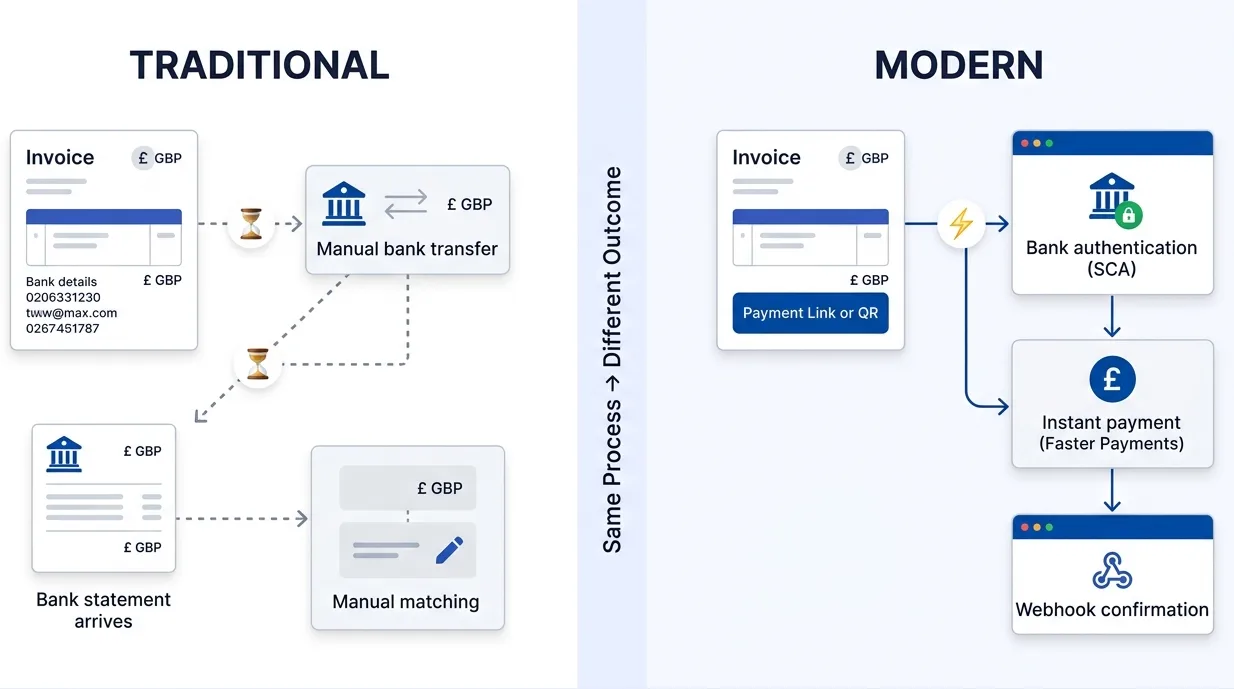
What Is the Difference Between Traditional and Modern Invoice Payment Workflows?
Traditional invoice payment process:
- Invoice sent with bank sort code and account number
- Client initiates a manual bank transfer
- Payment arrives – confirmation comes via bank statement review
- Accounts team manually matches payment to invoice reference
- Settlement: instant via Faster Payments, but confirmation is delayed
Modern invoice payment process (Open Banking):
- Invoice includes a Payment Link or QR code
- Client clicks link, authenticates via their bank app using SCA
- Faster Payments settles instantly
- Platform receives webhook confirmation with payment reference
- Transaction data maps directly to the invoice – no manual matching
The invoice payment process is the same number of steps. The difference is in confirmation speed and reconciliation readiness.
“The invoicing platforms that shift to payment links and Pay by Bank are not just reducing collection time. They are eliminating the reconciliation overhead that comes with manual bank reference matching – which is where most of the staff cost sits.” – Ravi, Finexer
Request to Pay and Payment Links for invoice workflows covers how embedded payment initiation in invoices changes the collection and confirmation workflow.
What Invoice Payment Methods Work Best for Each Platform Type?
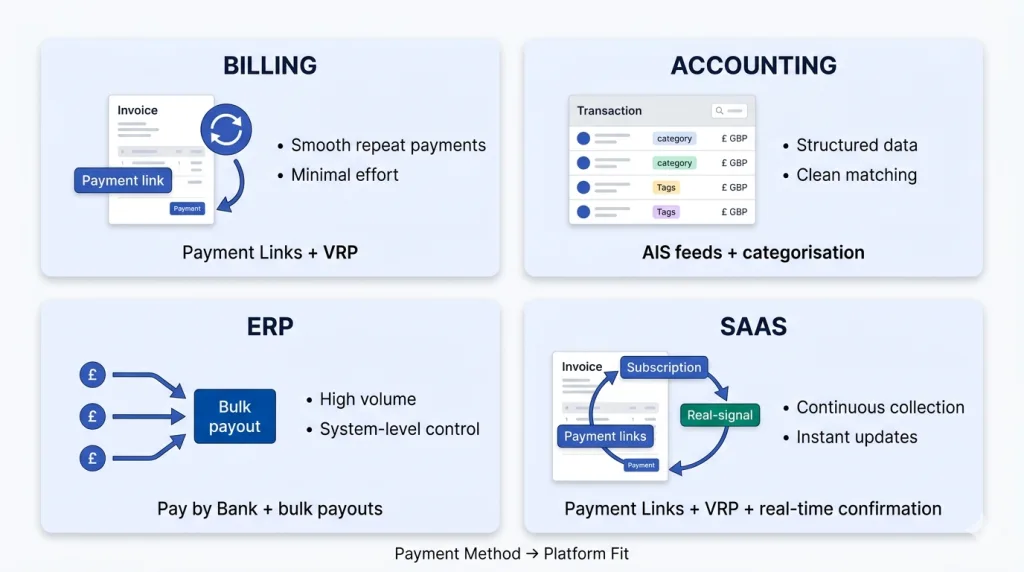
Which Invoice Payment Methods Should Billing and Accounting Platforms Prioritise?
Billing platforms:
- Payment Links embedded in digital invoices reduce client effort and improve collection rates
- VRP for recurring invoices – pre-authorised within agreed parameters, no per-cycle re-authentication
- Webhook confirmation per payment eliminates manual payment chasing
Accounting SaaS:
- Structured transaction data with invoice references reduces manual reconciliation
- Real-time AIS bank feeds eliminate import timing gaps in the accounting record
- Category codes at source reduce mis-categorisation before month-end close
ERP systems:
- Pay by Bank for supplier and client invoice settlement in a single flow
- Bulk Payout for high-volume outbound invoice payments
- Consistent JSON schema across UK banks reduces data normalisation overhead
SaaS platforms handling collections:
- Payment Links replace manual bank details in invoices – removing manual transfer instruction risk
- VRP enables flexible recurring collection without per-cycle client action
- Real-time confirmation improves cash flow visibility and reduces days-sales-outstanding
Payment methods for retailers and billing platforms covers how invoice payment method selection affects collection rates and reconciliation across different platform types.
How Does Finexer Support Invoice Payment Workflows?
What Does Finexer Provide for Invoice Payment Initiation and Reconciliation?
Finexer’s FCA-authorised PIS and AIS enables billing and accounting platforms to build invoice payment flows that collect faster and reconcile with less manual overhead.
Finexer does not replace invoicing tools. It provides the payment initiation and bank data infrastructure that powers the payment step within the invoice payment process.
Payment initiation (PIS):
- Payment Links – shareable links embedded in invoices, initiate bank-authenticated payment
- Pay by Bank – direct A2A via Faster Payments, instant settlement, zero chargebacks
- QR code payments – scan-to-pay initiation for point-of-invoice or printed invoices
- VRP (Variable Recurring Payments) – pre-authorised recurring invoice collection
- Bulk Payout – outbound invoice payments to multiple recipients in a single API call
- Webhook confirmation per payment – real-time settlement status for reconciliation workflows
Bank data (AIS):
- Real-time transaction data with invoice payment references
- Merchant IDs and category codes for structured reconciliation
- Up to 7 years of transaction history for audit and reporting
Usage-based pricing, 3-5 weeks to production with active onboarding support. Deploys 2-3x faster than market alternatives. Saves up to 90% on transactional costs versus card-based invoice payment methods.
Finexer payroll and invoicing use case covers how Finexer’s PIS and AIS supports invoice payment initiation and reconciliation workflows for billing platforms.
“The combination of Payment Links and real-time webhooks changes the invoice payment process from a two-step workflow – collect, then reconcile – into a single event. Payment arrives, reference is captured, invoice is matched. The manual step is gone.” – Ravi, Finexer
What I Feel
Invoice payment methods are still evaluated mainly on transaction cost.
The bigger cost is invisible: the reconciliation overhead, the manual matching, the chasing of payments with no confirmation.
Pay by Bank and Payment Links address both. Instant settlement reduces the collection gap. Webhook confirmation with structured transaction data removes the reconciliation step.
The invoice payment process improves when the payment method is built for the platform’s workflow, not just for the payer’s convenience.
Common Use Cases
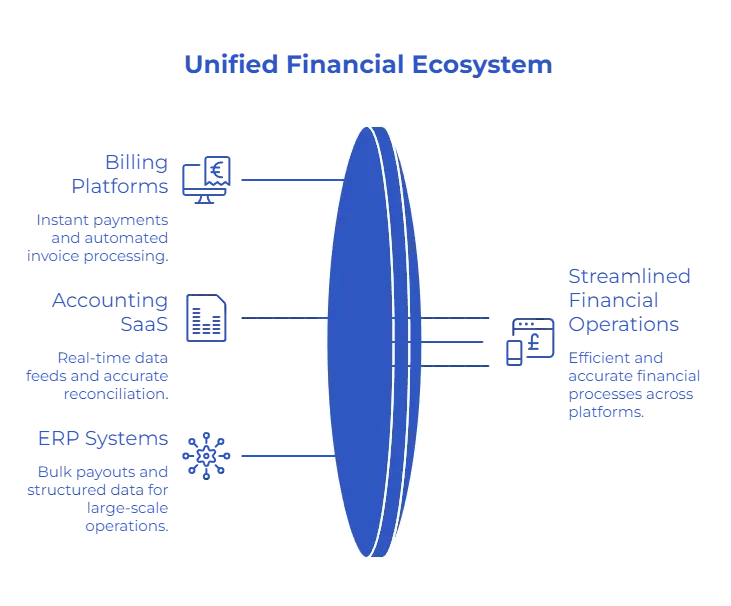
Billing Platforms
Payment Links embedded in invoices reduce manual bank detail entry for clients. Finexer’s PIS delivers instant settlement with webhook confirmation – the platform knows payment is complete without a manual bank statement check.
Accounting SaaS
Reconciliation accuracy improves when transaction data arrives with invoice references and category codes applied. Finexer’s AIS real-time bank feeds deliver structured data that maps directly to accounting records without import gaps.
ERP Systems
High-volume invoice settlement across suppliers requires consistent data and bulk initiation. Finexer’s Bulk Payout and structured JSON schema reduce the data normalisation overhead that creates reconciliation errors at scale.
What are the best invoice payment methods for UK businesses?
The best invoice payment methods for UK businesses combine fast settlement with low reconciliation overhead. Pay by Bank via Open Banking settles instantly via Faster Payments, delivers zero chargebacks, and provides webhook confirmation per payment – making it the most reconciliation-efficient option for billing and accounting platforms alongside traditional BACS for recurring collections.
Which invoice payment methods have the lowest transaction cost?
Pay by Bank via Open Banking typically carries the lowest per-transaction cost for business invoice payments – significantly less than card processing fees of 1.5-3%. BACS Direct Debit also has low per-transaction costs for recurring invoices. Card payments carry the highest fees but provide the broadest client acceptance across consumer-facing billing workflows.
What invoice payment method reduces reconciliation work most?
Pay by Bank and Payment Links via Open Banking reduce reconciliation work most. Webhook confirmation delivers real-time payment status with a structured transaction reference. Unlike manual bank transfers, payment references are captured automatically – removing the manual matching step that creates reconciliation overhead for billing and accounting teams.
Build invoice payment workflows on Open Banking payment initiation and real-time bank data
About the Author

Ravi Ranjan
Ravi Ranjan is Co founder & CEO of Finexer