Embed payments and bank data under your brand. No banking licence required.
White label Open Banking infrastructure for accounting SaaS, Lawtech, and billing platforms.
White label finance means embedding financial features – payments, bank data access, financial verification – into your platform under your own brand, without building regulated bank connectivity or payment infrastructure yourself.
For product teams at accounting SaaS, Lawtech, and billing platforms, the decision is not whether to add financial features. Many SaaS buyers now expect financial features to sit inside the product journey. The decision is which approach to use – and what that choice costs in time, complexity, and compliance overhead.
Many product teams evaluating white label finance solutions encounter the same problem: the full-stack options are built for banks and neobanks, not for SaaS platforms adding a financial layer to an existing product.
TL;DR
White label finance solutions range from full banking infrastructure (cards, IBANs, lending) to modular API-based approaches (payments, bank data, verification). For accounting SaaS, Lawtech, and billing platforms, modular Open Banking infrastructure delivers the financial features that matter – Pay by Bank, bank transaction data, financial verification – without the regulatory overhead, setup cost, or deployment timelines of full-stack Banking-as-a-Service. Finexer provides white label Open Banking AIS and PIS for platforms building financial workflows into their products.
Key Takeaways
What is white label finance?
White label finance allows platforms to offer financial features – payments, bank data access, and financial verification – under their own brand using third-party infrastructure. The platform controls the user experience. The infrastructure provider handles the regulated financial layer, including FCA authorisation, compliance, and bank connectivity.
What are the main white label finance solution approaches?
Two distinct approaches:
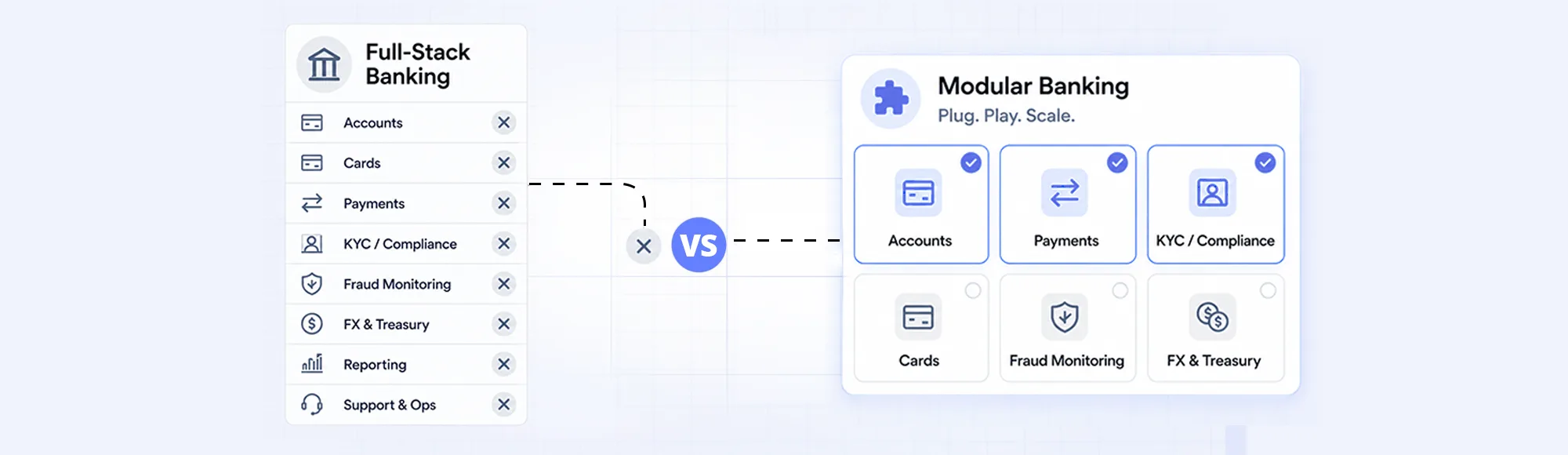
- Full-stack BaaS – Banking-as-a-Service providers offer cards, IBANs, accounts, lending, and FX. Setup takes months. Built for neobanks and fintechs launching new financial products from scratch.
- Modular Open Banking – API-based access to specific financial capabilities: bank data (AIS), payment initiation (PIS), and verification. Deploys in weeks. Built for SaaS platforms adding financial features to existing products.
Which white label finance approach suits SaaS and billing platforms?
Modular Open Banking. These platforms need bank data for reconciliation, payments for collections, and financial verification for compliance – not cards, IBANs, or lending products. Full-stack BaaS adds infrastructure complexity and deployment timelines that SaaS platforms building financial features do not need.
What Financial Features Do Platforms Actually Need?
The gap between what full-stack white label finance solutions offer and what SaaS platforms actually need is where most product decisions go wrong.
Full-stack BaaS provides:
- Issued cards and prepaid accounts
- Multi-currency IBANs and FX
- Lending and credit products
- Full banking licence under the provider’s authorisation
- Deployment: 2-6 months
Accounting SaaS, Lawtech, billing platforms need:
- Bank transaction data for reconciliation and reporting
- Payment initiation for collections, invoices, and payroll
- Financial verification for onboarding and compliance
- White-label consent flows matching the platform’s UX
- Deployment: weeks, not months
Platforms building on full-stack BaaS pay for and manage infrastructure they do not use. The compliance onboarding, card programme setup, and IBAN provisioning add months before a single feature goes live.
| Approach | What It Provides | Deployment | Best For |
|---|---|---|---|
| Full-stack BaaS | Cards, IBANs, accounts, lending, FX | 2-6 months | Neobanks launching new financial products |
| Modular Open Banking | Bank data (AIS), payments (PIS), verification | 3-5 weeks | SaaS platforms adding financial features to existing products |
“The platforms that get white label finance right are not the ones that choose the most comprehensive provider. They choose the provider whose capabilities match exactly what their product needs – and nothing more.” – Ravi, Finexer
White label payment API guide for PSPs and platforms covers how white label payment APIs differ by provider and what to evaluate when integrating payment initiation into an existing product.
Which Platforms Benefit Most from Open Banking White Label Finance?
Accounting SaaS platforms:
Bank transaction data is the core input for reconciliation, reporting, and MTD compliance. White label Open Banking AIS delivers real-time bank feeds under the platform’s brand – with consent flows that show the platform’s identity, not a third-party provider’s.
- Real-time bank feeds replacing CSV imports
- Merchant IDs and category codes at source
- White-label consent flows throughout the client journey
- Up to 7 years of transaction history for audit and reporting
Lawtech platforms:
Financial verification for AML, source of funds, and client onboarding requires verified bank data and identity checks – under the platform’s brand, with an audit trail the supports audit trails for SRA-related compliance reviews
- Bank-based identity verification branded to the platform
- Direct-from-bank transaction history for source of funds
- Consent logs per retrieval for audit purposes
- Verification reports under the platform’s identity
Billing and payment platforms:
Payment collection and invoice settlement require branded payment initiation with instant confirmation. White label PIS delivers Pay by Bank and Payment Links under the platform’s brand.
- Branded Pay by Bank – no Finexer identity visible to end users
- Payment Links in invoices under the platform’s branding
- VRP for pre-authorised recurring collections, where supported and within mandate limits
- Instant confirmation via webhook
“White label finance for SaaS is not BaaS. It is modular Open Banking – pick what your product needs, brand it as your own, go live in weeks.” – Ravi, Finexer
White label payments API for UK platforms covers how white label payment initiation works in practice for billing and collections platforms.
How Does Finexer Support White Label Finance?
What Does Finexer Provide as a White Label Finance Solution?
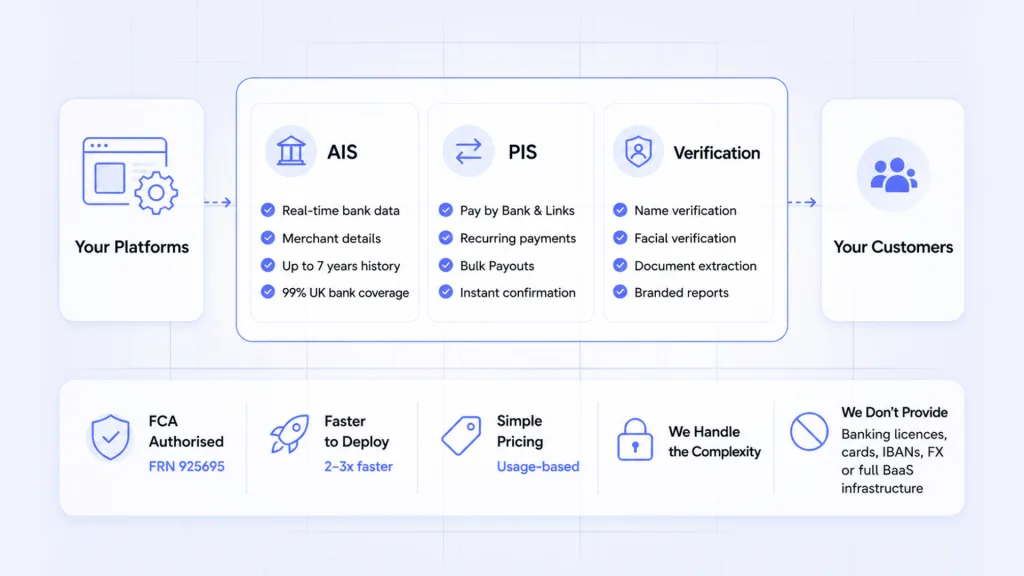
Finexer provides modular Open Banking infrastructure – AIS, PIS, and Verification – that platforms embed under their own brand. Finexer handles FCA authorisation, bank connectivity, and compliance. The platform controls the user experience throughout.
Finexer does not provide banking licences, card issuing, IBANs, FX, or full BaaS infrastructure.
We provides –
White label AIS (bank data):
- White-label consent flows – platform branding throughout
- Real-time bank transaction data with webhooks
- Merchant IDs and category codes at source
- Up to 7 years of transaction history
- Consent logs per retrieval for compliance
- 99% UK bank coverage
White label PIS (payments):
- Branded Pay by Bank and Payment Links
- VRP for pre-authorised recurring collections
- Bulk Payout for high-volume outbound payments
- Instant confirmation via webhook
- Zero chargebacks on initiated payments
- No PCI DSS scope for Pay by Bank flows that do not process card data
White label Verification:
- Bank-based name verification under the platform’s brand
- Facial recognition with similarity score
- Document data extraction
- Verification reports branded to the platform
Usage-based pricing, no setup fees. Deploys 2-3x faster than market alternatives. 3-5 weeks to production with active onboarding support. FCA-authorised FRN925695 – no separate authorisation required for platforms using Finexer’s infrastructure.
Finexer Connect – manage financial workflows on users’ behalf covers how Finexer’s Connect product enables platforms to manage accounts and payments on behalf of users within a white label financial workflow.
Finexer Data – white label bank data access covers the full AIS capability set for platforms embedding bank data under their own brand.
What This Means for Product Teams
Most product teams evaluating white label finance solutions start with the wrong question.
“Which platform is most complete?” leads to BaaS providers built for neobanks – months of setup, card issuing contracts, infrastructure the product does not use.
The right question is: “What are the three financial capabilities my product actually needs?”
For accounting SaaS, Lawtech, and billing platforms, the answer is almost always bank data, payments, and verification. That is a modular Open Banking problem – not a full banking infrastructure problem.
Build for what your product needs now.
Common Use Cases
Accounting SaaS
White label bank feeds replace CSV imports under the platform’s brand. Category codes at source reduce manual classification before month-end close. Clients see the platform’s identity throughout – no third-party branding in the consent flow.
Lawtech Platforms
White label financial verification combines bank-based identity checks with direct-from-bank transaction history in a single branded journey. Consent logs per retrieval provide the SRA audit trail built into the workflow.
Billing Platforms
White label Pay by Bank and Payment Links embed branded payment initiation directly in the invoice workflow. Confirmation via webhook. Invoice reference travels with the payment through Faster Payments.
Fintech SaaS Builders
Platforms building financial dashboards aggregate bank data across client accounts under their own brand – structured, enriched, real-time. No third-party provider visible in the product.
What types of platforms use white label finance solutions?
Accounting SaaS platforms use white label bank feeds and payment initiation for reconciliation and collections. Lawtech platforms use white label financial verification for AML and source of funds workflows. Billing platforms embed Pay by Bank and Payment Links under their brand. Fintech SaaS builders use white label bank data aggregation for financial dashboards and reporting tools.
What is the difference between white label finance and Banking-as-a-Service?
Banking-as-a-Service provides full banking infrastructure – cards, IBANs, FX, and lending – for fintechs building new financial products. White label finance via Open Banking APIs provides specific capabilities – bank data, payments, and verification – for platforms adding features to existing products. BaaS suits neobanks. Modular Open Banking suits SaaS platforms by adding a financial layer.
Build branded financial workflows with Finexer’s white label Open Banking APIs.
About the Author

Ravi Ranjan
Ravi Ranjan is Co founder & CEO of Finexer