
Reduce overdue invoices at the payment level, not the reminder level.
Open Banking payment infrastructure for billing platforms, accounting SaaS, and ERP systems.
Invoice payment overdue situations are almost always framed as a customer behaviour problem.
The customer forgot. The customer deprioritised it. The customer needs another reminder.
Sometimes that is true. More often, the payment method is the problem.
At Finexer, I work with billing platforms, accounting SaaS, and ERP teams managing invoice collections. The pattern is consistent: overdue rates improve most when the payment step becomes easier, not when the reminder sequence becomes more sophisticated.
A customer who receives an invoice with a bank sort code and account number has to open their banking app, find the payment screen, enter the details, and remember the reference. Every one of those steps is an opportunity to defer. And deferring becomes overdue.
UK businesses spent an average of 86 hours per year chasing late payments in 2025 (Office of the Small Business Commissioner, July 2025). 38 businesses closed every day because of overdue invoices.
The UK government announced sweeping late payment reforms on 24 March 2026 – including a proposed 60-day payment cap and mandatory statutory interest – as recognition that the overdue invoice problem is systemic, not individual.
Key Takeaways
What does invoice payment overdue mean in the UK?
An invoice payment is overdue when it has not been received by the agreed due date. Under UK law, if no date is agreed, payment becomes overdue 30 days after the customer receives the invoice or goods and services, whichever is later. For public sector clients, the standard is 30 days. For B2B contracts, payment terms can be up to 60 days (60-day cap proposed under March 2026 reforms).
What can UK businesses charge on an invoice payment overdue?
Under the Late Payment of Commercial Debts (Interest) Act 1998, UK businesses can charge:
- Statutory interest – 8% above the Bank of England base rate. At the current base rate of 4.5% (February 2026), the total rate is 12.5% per annum, accruing daily from the day after the due date
- Fixed compensation – £40 for invoices under £1,000; £70 for £1,000-£9,999; £100 for £10,000 or more. This applies per invoice and does not require prior notice.
- Reasonable debt recovery costs – where actual costs exceed the fixed compensation
These rights apply automatically to B2B transactions. They cannot be waived by contract under the March 2026 reform proposals (pending legislation).
Why do invoice payment overdue rates stay high even with reminders?
Because reminders address customer awareness, not payment friction. A customer who has received three reminder emails but still needs to manually initiate a bank transfer – enter sort code, account number, amount, and reference – faces exactly the same friction on the fourth reminder as on the first. The payment has not become easier. The customer has only become more aware they need to do a difficult task.
Why Is Invoice Payment Overdue a Payment Friction Problem?
What Actually Causes Customers to Pay Late?
Most overdue invoice analysis focuses on customer intent. Late payers are categorised as forgetful, cash-strapped, or disorganised. All three exist. But platforms that reduce overdue rates most effectively focus on a fourth category: customers who intended to pay but deferred because the payment process required too many steps.
The friction points in standard invoice payment:
- Invoice arrives by email with bank details
- Customer needs to log into their banking app separately
- Enter sort code, account number, and amount manually
- Add the correct payment reference (which must match the invoice for reconciliation)
- Confirm and submit
Each step is a decision point. Each decision point is a deferral opportunity.
What changes with a Payment Link:
- Invoice arrives with a single click-to-pay link
- Customer clicks, authenticates in their banking app with biometric
- Payment initiates directly from their bank account via Faster Payments
- Done
The customer has not become more responsible. The payment has become easier than deferring it.
| Payment Method | Steps to Complete | Deferral Risk |
|---|---|---|
| Manual bank transfer (sort code + account) | Open app → navigate → enter details → add reference → confirm | High – 5+ steps, easy to abandon |
| Card payment link | Click link → enter card details → confirm | Medium – card details entry is a barrier for some |
| Pay by Bank (Payment Link) | Click link → authenticate in banking app → confirm | Low – 2 steps, uses existing banking habit |
“Invoice payment overdue rates are not just a reflection of customer reliability. They are a reflection of how hard the payment process is. Every extra step between receiving the invoice and completing the payment is a chance to defer – and deferral becomes overdue.” – Ravi, Finexer
Request to Pay and Payment Links for invoice workflows covers how embedded payment initiation in invoices changes collection rates and invoice payment overdue frequency for billing platforms.
How Do You Request Payment for an Overdue Invoice Under UK Law?
What Are the Steps to Request Payment for an Overdue Invoice Under UK Law?
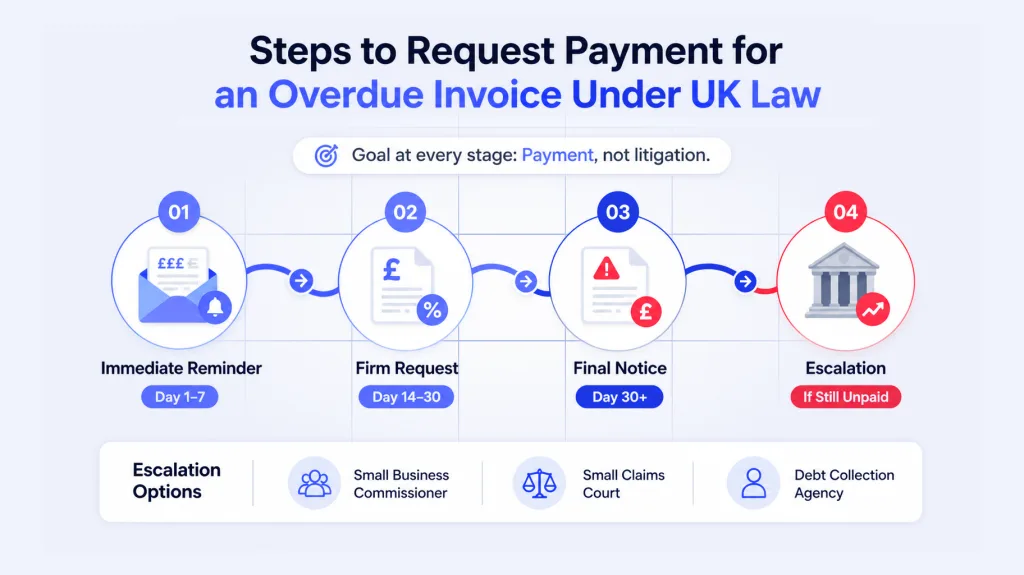
When invoice payment overdue has occurred, UK law provides a clear escalation framework. The goal at each stage is payment – not litigation.
Stage 1 – Day 1-7: Immediate reminder
Send a polite payment reminder the day after the due date. Attach the original invoice. Include your bank details, a Payment Link if available, and a clear statement of the due date and amount. Assume the invoice was overlooked – most first-stage reminders result in payment.
Stage 2 – Day 14-30: Firm request
Send a formal payment request stating the invoice is now overdue, the amount owed, and the original due date. State clearly that statutory interest is now accruing under the Late Payment of Commercial Debts (Interest) Act 1998. Calculate the daily interest (amount × 12.5% ÷ 365) and include it.
Stage 3 – Day 30+: Final notice before action
Send a formal letter before action. State the total amount including accrued statutory interest and fixed compensation (£40, £70, or £100 depending on invoice value). Set a final payment deadline – typically 7-14 days. State that you will pursue the debt through the Small Business Commissioner or Small Claims Court if payment is not received.
Stage 4 – Escalation
- Small Business Commissioner: free mediation service, can recover unpaid invoices without court proceedings. Recovered £8 million in unpaid invoices to date.
- Small Claims Court: for debts up to £10,000 via the UK government’s online Money Claim Service.
- Debt collection agency: appropriate for larger or older debts.
UK Government – Late commercial payments: interest and debt recovery covers the statutory rights to charge interest and compensation on overdue invoices and how to calculate them.
Finexer late fee policy and invoice collections covers how billing platforms can build late fee policy into invoice workflows to reduce invoice payment overdue frequency.
How Does Open Banking Reduce Invoice Payment Overdue Rates?
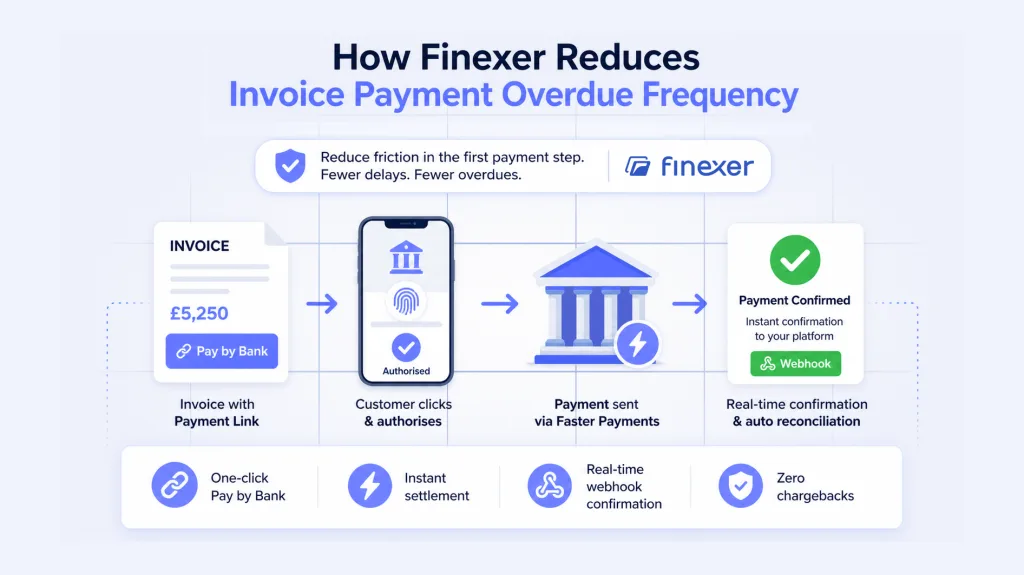
What Does Pay by Bank Do to the Invoice Payment Process?
Payment Links via Open Banking change the invoice payment process from a multi-step manual task to a two-step bank-authenticated action.
The customer receives the invoice. They click the Payment Link. They authenticate in their banking app using Face ID or fingerprint. Payment initiates directly from their bank account via Faster Payments. The invoice is settled.
No sort code entry. No account number. No reference field to get wrong. No separate banking portal session to open.
What this changes for billing and invoicing platforms:
- Customers who would have deferred because the payment was inconvenient now pay in the same session as opening the invoice
- Payment references are embedded at initiation – the platform’s reconciliation is automatic
- Confirmation arrives via webhook immediately – the platform knows payment is received without checking a bank statement
- No chargebacks on bank-authenticated A2A payments
Open Banking payment volumes in the UK grew to 37.46 million payments in March 2026, up 14.1% month on month – the adoption reflects platforms and customers finding bank-based payment flows genuinely easier than alternatives.
Open Banking for payroll and invoicing platforms covers how Open Banking payment initiation integrates with invoicing workflows to reduce manual payment steps and improve collection rates.
How Does Finexer Reduce Invoice Payment Overdue Frequency?
What Does Finexer Provide to Reduce Invoice Payment Overdue Frequency?
Finexer does not send payment reminders, chase overdue invoices, or provide legal debt recovery. Finexer provides the payment initiation infrastructure that reduces the friction in the first payment step – making it less likely invoices become overdue in the first place.
Payment Links for invoice payment:
- Payment Link generated per invoice or reusable per client
- Embedded directly in the invoice email or notification
- Customer clicks, authenticates in banking app, payment initiates
- Invoice reference embedded at initiation – no manual reference entry
- Instant settlement via Faster Payments
- Webhook confirmation to the billing platform immediately
- Zero chargebacks on initiated payments
Real-time AIS bank data for confirmed receipts:
- Payment confirmed to the platform at the moment of settlement
- No waiting for bank statement to confirm receipt
- Reconciliation triggered automatically from the webhook data
Usage-based pricing, no setup fees, 3-5 weeks to onboarding support, 99% UK bank coverage – high street, challenger, and business accounts – in a single integration.
“A Payment Link in the invoice does not change the customer’s payment behaviour. It changes the path of least resistance. Paying becomes easier than deferring – and that changes the collection rate before any reminder is sent.” – Ravi, Finexer
Fixing bank payment delays for billing and collections platforms covers how real-time payment confirmation via Open Banking reduces the settlement delay that creates reconciliation uncertainty in invoice collections.
What I Feel
Most platforms respond to high invoice payment overdue rates by improving their reminder workflows.
Better timing. Better copy. More follow-ups.
These help at the margin. They do not address why the invoice was not paid on the first send.
The customer who does not pay is not always disorganised. Often they are busy, and the payment requires enough steps that they put it in the “I’ll do this later” pile. Later invoice payment overdue.
A Payment Link in the invoice makes paying easier than deferring. That changes the collection rate before the reminder workflow is ever needed.
Common Use Cases
Billing and Invoicing Platforms
Invoice payment overdue rates drop when Payment Links are embedded in invoice notifications. Customers authenticate in their banking app and complete payment without leaving the invoice. Overdue rates drop before reminders are needed.
Accounting SaaS
Real-time webhook confirmation when payment is received eliminates the manual bank statement check. Finance teams track which invoice payment overdue situations have resolved without reconciling against delayed bank data. Invoice payment overdue tracking is accurate in real time.
ERP Systems
High-volume B2B invoice payment overdue collections reduced via Payment Links with embedded invoice references. Each payment arrives with the reference intact – automated matching without manual invoice-to-payment reconciliation at period end.
How do I request payment for an overdue invoice in the UK?
Send a polite reminder the day after the due date with the invoice attached. After 14 days, send a formal request stating statutory interest is now accruing at 12.5% per annum under the Late Payment Act 1998. After 30 days, send a letter before action including accrued interest and fixed compensation (£40-£100). Include a Payment Link in every communication.
What is the law on late payment of invoices in the UK?
The Late Payment of Commercial Debts (Interest) Act 1998 gives UK B2B businesses the right to charge statutory interest at 8% above the Bank of England base rate (currently 12.5%) on overdue invoices, plus fixed compensation of £40-£100 per invoice. The UK government announced further reforms on 24 March 2026, including a proposed 60-day payment cap.
How long can an invoice be overdue before legal action in the UK?
There is no fixed deadline – the 6-year limitation period applies to contract debts in England and Wales. In practice, pursuing invoice payment overdue through the Small Business Commissioner or Small Claims Court is most effective within 90 days of the due date. Statutory interest accrues daily throughout, increasing the recoverable amount while payment remains outstanding.
Reduce invoice payment overdue rates before reminders are needed.
About the Author

Ravi Ranjan
Ravi Ranjan is Co founder & CEO of Finexer