
Fewer intermediaries. Faster settlement. Real-time confirmation.
Open Banking AIS infrastructure for PropTech platforms, tenant referencing systems, and letting agent SaaS.
Open banking referencing is the use of Open Banking AIS to retrieve a tenant’s financial data directly from their bank – replacing manually submitted documents with verified, consent-based transaction data that cannot be altered before it reaches the referencing platform.
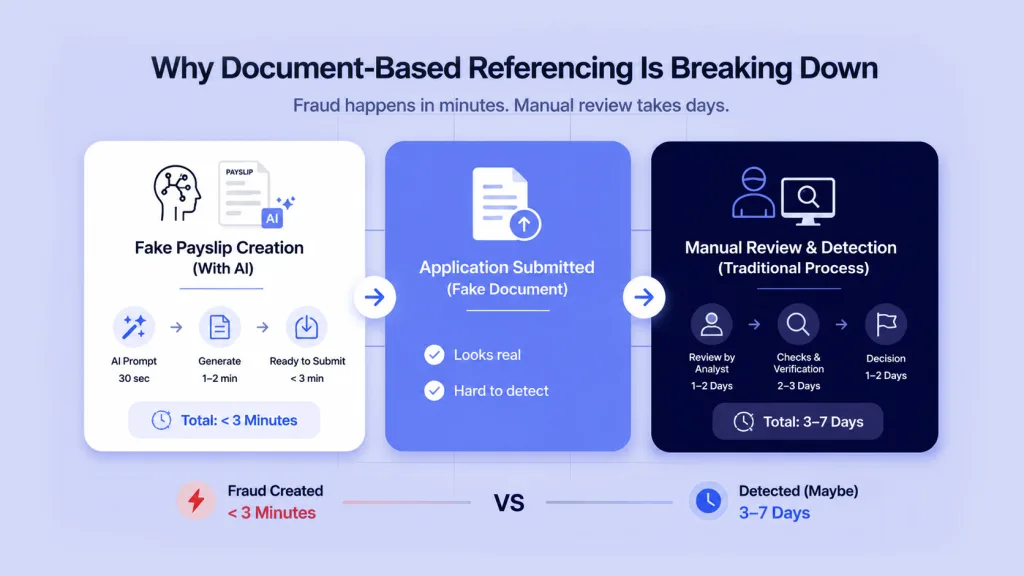
The problem it solves is straightforward. Payslip fraud now accounts for over half of all tenancy fraud (Vouch, 2025). Fraudulent rental applications surged by 140% in 2024. With generative AI tools making convincing fake payslips and bank statements possible in minutes (Vorensys, February 2026), traditional document submission is no longer a reliable verification method.
Open banking for referencing addresses this at the data source – not at the document review stage. The financial data comes from the bank, not from the applicant. It cannot be edited between the bank and the platform.
TL;DR
Open banking referencing uses FCA-authorised AIS to retrieve bank transaction data directly from a tenant’s bank with their consent. Income patterns, rent payment history, and affordability signals are extracted from real transactions – not from submitted documents. Payslip fraud makes up over 50% of tenancy fraud in the UK. PDF statements and payslips are increasingly AI-fabricated. Open banking for referencing eliminates the document layer entirely, replacing it with bank-sourced data under Payment Services Regulations 2017 and UK GDPR. PropTech platforms building referencing workflows need AIS infrastructure that delivers structured, enriched transaction data with income categorisation and consent logs per retrieval.
Key Takeaways
What is open banking referencing?
Open banking referencing is the process of using Open Banking AIS to retrieve a tenant’s bank transaction data directly from their bank, with explicit consent, for income verification, affordability assessment, and rental payment history checks. The data comes from the bank at the moment of consent – not from the applicant. It is read-only and cannot be altered between the bank and the referencing platform.
How does open banking for referencing differ from traditional document checks?
Traditional referencing relies on applicant-submitted payslips, bank statements, and employer letters. These can be:
- Edited before submission – PDF statements are alterable
- Fabricated entirely – AI tools now produce convincing fake payslips in minutes
- Incomplete – applicants select which months to share
Open banking for referencing removes the applicant from the data supply chain. The platform requests data directly from the bank. The tenant authenticates in their own banking app. The data flows from bank to platform – unaltered, timestamped, and complete for the requested period.
What data does open banking referencing provide?
Structured bank transaction data including:
- Income transactions – salary credits, self-employed income, benefit payments
- Regular outgoings – rent, utilities, loan repayments, subscriptions
- Rent payment history – confirmation of regular payments to current landlord or agent
- Affordability signals – monthly disposable income after committed expenditure
- Transaction history depth – up to 12 months standard, up to 7 years available via some providers
Why Document-Based Referencing Is Breaking Down
What Is the Problem With Traditional Tenant Referencing Documents?
The referencing industry is facing an accelerating fraud problem that document-based verification cannot solve.
Fake payslips now make up over 50% of all tenancy fraud. Fraudulent rental applications increased by 140% in a single year. A single fraudulent tenancy costs a letting agent up to £10,000.
With generative AI widely available, a convincing fake payslip – correct formatting, company letterhead, plausible salary figures – takes minutes to produce. The same applies to PDF bank statements. Even experienced agents struggle to identify modern forgeries.
The Renters’ Rights Act, commencing 1 May 2026, increases landlord obligations around tenant due diligence. This regulatory shift makes reliable income verification more important – and reliance on alterable documents more risky.
Open banking for referencing addresses this by removing documents from the process entirely. There is no payslip to fake if the income verification goes directly to the bank.
“Open banking referencing solves the document fraud problem at the source – not at the review stage. When the data comes directly from the bank, there is no document to alter, no statement to fabricate, and no gap between what the applicant claims and what their bank shows.” – Ravi, Finexer
The PropTech platforms building referencing workflows can see how Open Banking AIS integrates with letting agent systems in the Finexer Open Banking product overview, which covers AIS capability and integration approach.
How Does Open Banking Referencing Work at Platform Level?
How Do PropTech Platforms Implement Open Banking for Referencing?
| Referencing Step | Document-Based | Open Banking Referencing |
|---|---|---|
| Data source | Applicant-submitted PDFs and payslips | Direct from bank via AIS at consent |
| Fraud risk | High – documents are alterable | Low – data comes from bank, unalterable |
| Income verification | Manual review of stated figures | Automated from real transaction history |
| Processing time | Days – chasing documents from applicant | Minutes – consent granted, data retrieved |
| Audit trail | Document copies – no provenance | Consent log per retrieval – timestamped |
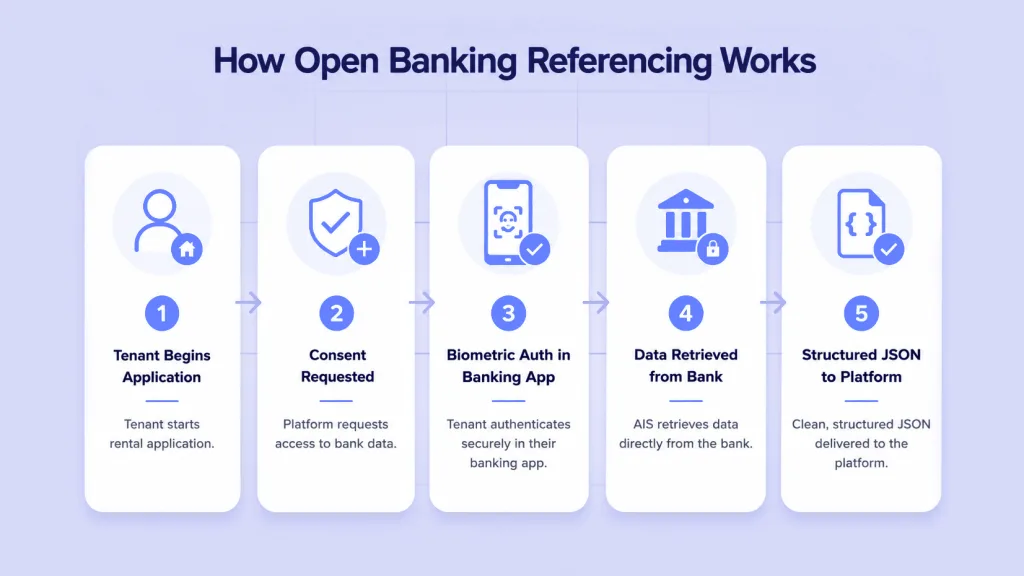
The platform implementation flow:
- Tenant begins referencing application on the platform
- Platform requests consent via Open Banking AIS consent flow
- Tenant authenticates in their own banking app using biometric SCA
- AIS retrieves transaction data directly from the bank – read-only
- Data is returned to the platform in structured JSON with income categories, transaction history, and regular payment identification
- Platform’s referencing logic processes the structured data to produce an affordability and income assessment
The tenant never shares login credentials. The platform never sees raw banking passwords. Data access is governed by the Payment Services Regulations 2017 and UK GDPR – consent-based, purpose-limited, and revocable.
Building this infrastructure is covered in the banking API integration guide, which explains how Open Banking AIS connects to bank systems and what the data structure looks like for income and transaction analysis.
What Do PropTech Platforms Need From Open Banking Referencing Infrastructure?
What Data and Features Does a Referencing Platform Actually Require?
The platforms building open banking referencing workflows need more than raw transaction data. The data must arrive structured, enriched, and with clear income classification – otherwise the platform’s referencing logic has to build its own categorisation layer.
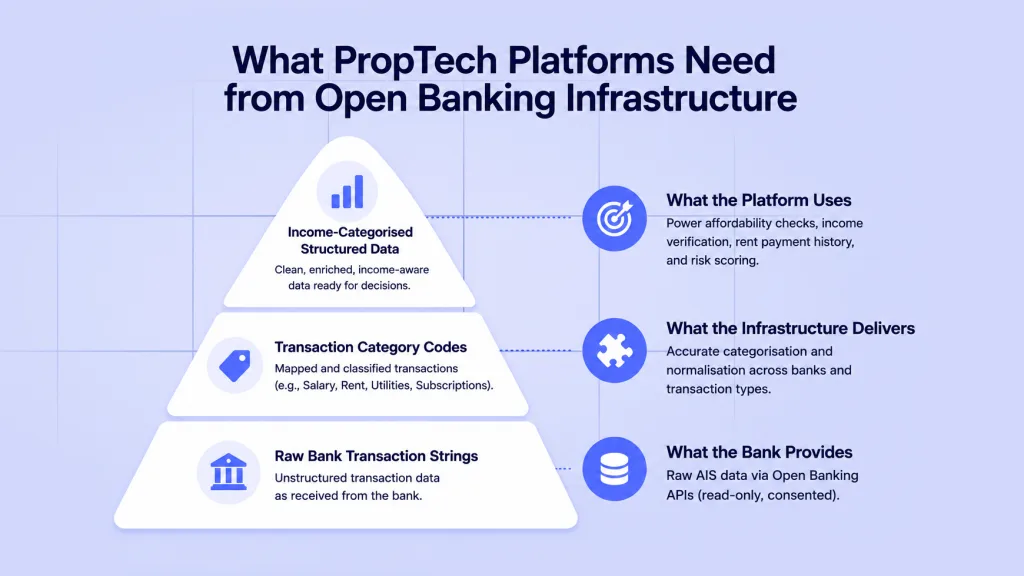
What structured AIS data provides for referencing platforms:
- Income categorisation at source – salary, self-employed credits, benefits, and rental income identified and labelled before reaching the platform
- Merchant IDs per transaction – consistent counterparty identification enabling reliable regular payment identification (rent, utilities, loan repayments)
- Category codes – spending categories applied at source with 95%+ accuracy at under 100ms
- Consent logs per retrieval – timestamped access record per applicant, demonstrating when data was accessed and under what consent scope
- Structured JSON – consistent schema across almost all major UK banks – one format regardless of which bank the tenant uses
- Transaction history depth – up to 7 years available, configurable per referencing requirement
Without income categorisation at source, the referencing platform must build and maintain its own classification rules on top of raw bank description strings – a significant engineering overhead that compounds as transaction volume grows.
“The data quality question is as important as the data access question for open banking referencing. Structured income categorisation and consistent merchant identification – applied before the data reaches the platform – are what allow referencing logic to work reliably from day one, not after months of categorisation edge case handling.” – Ravi, Finexer
How Does Finexer Support Open Banking Referencing Workflows?
What Does Finexer’s AIS Provide for Referencing and Income Verification Platforms?
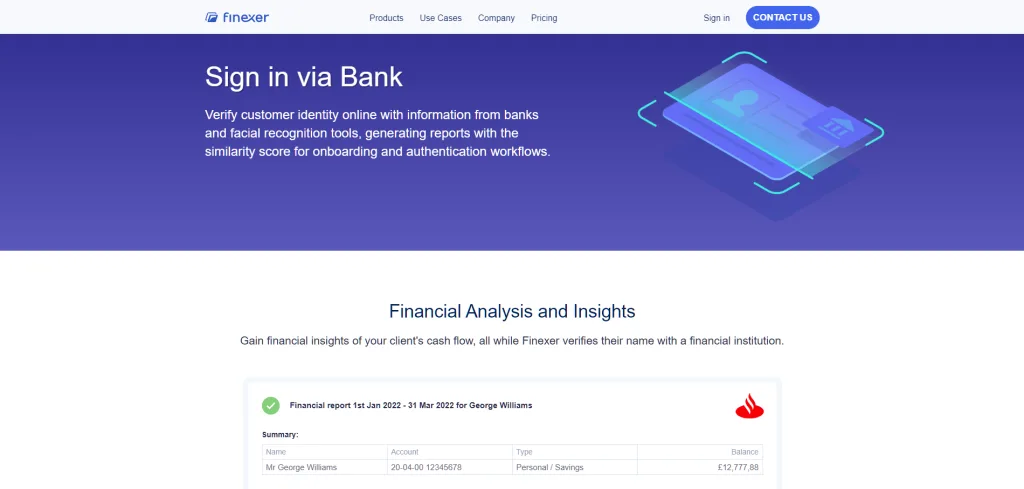
Finexer is not a referencing agency. It does not produce landlord reports, make tenancy decisions, or assess tenant suitability. Finexer provides FCA-authorised Open Banking AIS – the bank data infrastructure that PropTech platforms, referencing SaaS, and letting agent systems build their referencing workflows on top of.
AIS for open banking referencing:
- Direct bank data retrieval – transaction data retrieved from the bank at consent, not from the applicant
- Income categorisation at source – salary, self-employed credits, benefits identified before data reaches the platform
- Merchant IDs per transaction – consistent counterparty identification for regular payment verification (rent, utilities, subscriptions)
- Category codes at source – 100M+ merchant database, 95%+ accuracy, under 100ms
- Consent logs per retrieval – per-applicant timestamped access record
- Structured JSON – consistent schema across virtually every major UK bank
- Up to 7 years of transaction history – configurable per referencing workflow requirement
- 99% UK bank coverage – high street, challenger, and business accounts
- Usage-based pricing, no setup fees, 3-5 weeks to production
PropTech and letting agent platforms can see how Finexer integrates with rental workflows in the open banking for letting agents guide, covering how AIS data applies to tenant onboarding, income verification, and affordability checking.
What I Feel
Document-based referencing has a fundamental problem that more thorough document review does not solve.
A convincing fake payslip passes review. A convincing fake bank statement passes review. The question is not whether the reviewer is diligent enough – it is whether the data source can be trusted.
Open banking referencing moves the trust question from the document to the bank. The bank authenticated the tenant. The bank provided the data. The platform received it directly. That chain of provenance is what makes the verification reliable – not the quality of the PDF review.
Common Use Cases
PropTech Referencing Platforms
Open banking referencing replaces PDF statement collection with direct bank data retrieval. Income categorisation at source enables automated affordability assessment. Consent logs per applicant provide the audit trail for FCA and GDPR compliance without manual record-keeping overhead.
Letting Agent SaaS
Structured AIS data with income categorisation and regular payment identification enables letting agent platforms to produce referencing assessments in hours rather than days. Consistent JSON schema across almost all major UK banks means the integration works for applicants regardless of which bank they use.
Affordability and Lending Platforms
Income pattern analysis from 12 months of categorised transaction data provides a more accurate affordability picture than stated income on a payslip. Regular committed expenditure – rent, loan repayments, subscriptions – is visible and categorised from real transaction history.
Compliance and Verification SaaS
Consent logs per retrieval provide a timestamped audit trail showing when bank data was accessed, under what consent scope, and what was retrieved – supporting GDPR compliance and regulator review of income verification procedures.
Why is open banking referencing more reliable than document-based checks?
Open banking referencing retrieves financial data directly from the bank at consent – unaltered, timestamped, and complete. Document-based referencing relies on applicant-submitted PDFs and payslips that can be altered or fabricated using AI tools in minutes. With payslip fraud making up over 50% of tenancy fraud in the UK, removing the document layer removes the primary fraud vector.
Is open banking for referencing GDPR compliant?
Yes. Under the Payment Services Regulations 2017 and UK GDPR, tenants must give explicit, informed consent before any Open Banking AIS provider can access their financial data. Access is read-only, purpose-limited, and revocable at any time. Tenants can withdraw consent and request data deletion once the referencing process is complete. FCA-authorised AIS providers are regulated under UK Open Banking standards.
What are the limitations of open banking referencing?
Open banking referencing verifies income and financial behaviour from transaction data. It does not provide landlord references from previous tenancies, confirm employment terms with employers, or access credit history databases. For a complete referencing picture, open banking income verification is typically used alongside credit checks and tenancy history verification – not as a standalone replacement for all referencing checks.
See how Finexer’s AIS provides structured bank data for open banking referencing workflows.
About the Author

Ravi Ranjan
Ravi Ranjan is Co founder & CEO of Finexer