API-First Payout Infrastructure for UK Platforms
Faster Payments for domestic. IBAN-based international payouts. Per-payout reconciliation built in
A global payments API gives UK platform teams one integration point for domestic payout rails, international recipient disbursements, per-payee reconciliation, and webhook-confirmed status – without building and maintaining separate infrastructure for each.
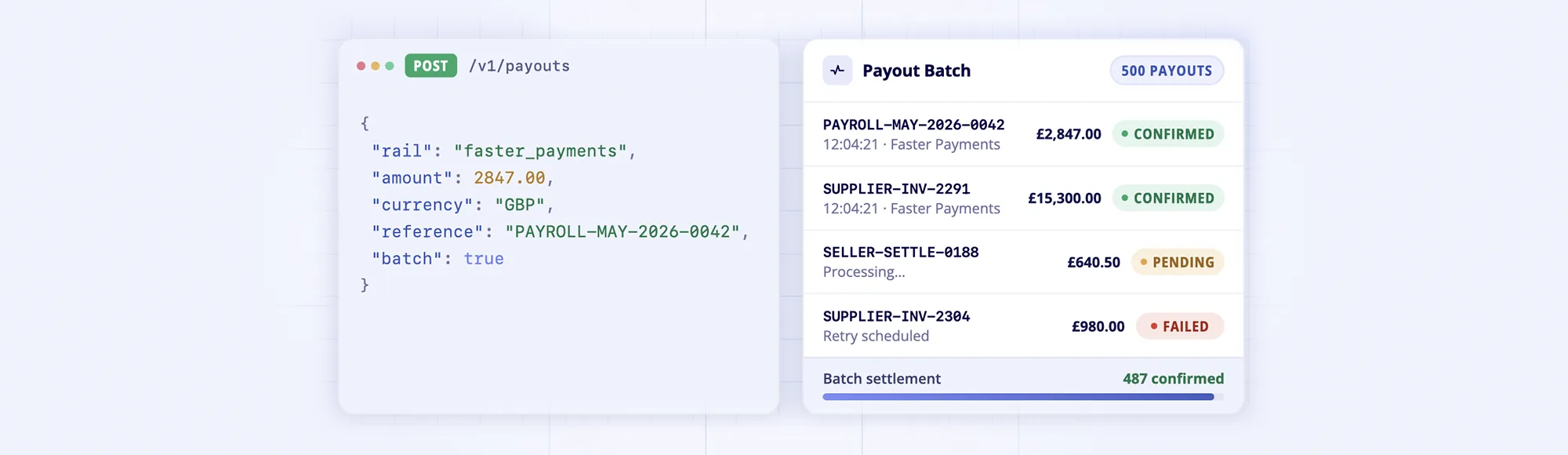
Here is what that looks like in practice: a B2B marketplace initiates 800 payouts in a single batch. UK suppliers settle via Faster Payments in seconds. International recipients receive disbursements to their IBAN or supported local account details.
Every payout carries a stable reference. Finance ops sees initiated, confirmed, and settled status per payee – without cross-referencing a bank statement import.
The infrastructure question behind that is not one most platforms think about at the start. Acceptance is solved early – Stripe, Adyen, Braintree are mature and well-documented. The payout side of a global payments API is where the architecture gaps show up twelve months in.
“The platforms that evaluate us well are the ones that separate the acceptance question from the payout question early. Outbound at scale is a different infrastructure problem – different rails, different reconciliation, different failure modes. Getting that right from the start is what removes the manual work later.” – Ravi, Finexer
TL;DR
A global payments API for UK platforms needs to handle domestic GBP disbursements via Faster Payments, international payouts to recipients via IBAN or supported account details, per-payout reconciliation with stable references, and webhook reliability on failures – not just a checkout flow. For UK-first platforms, Open Banking PIS handles the domestic GBP layer. Finexer’s International Payouts product handles UK-origin outbound disbursements to international recipients via supported payout routes, with Open Banking supporting the UK-side funding, consent and reconciliation layer.
What Does a Global Payments API Actually Need to Handle?
Most general-purpose payments APIs are built around acceptance. Inbound card processing is a single flow – customer initiates, platform captures, funds settle. Routing complexity sits upstream at the processor level.
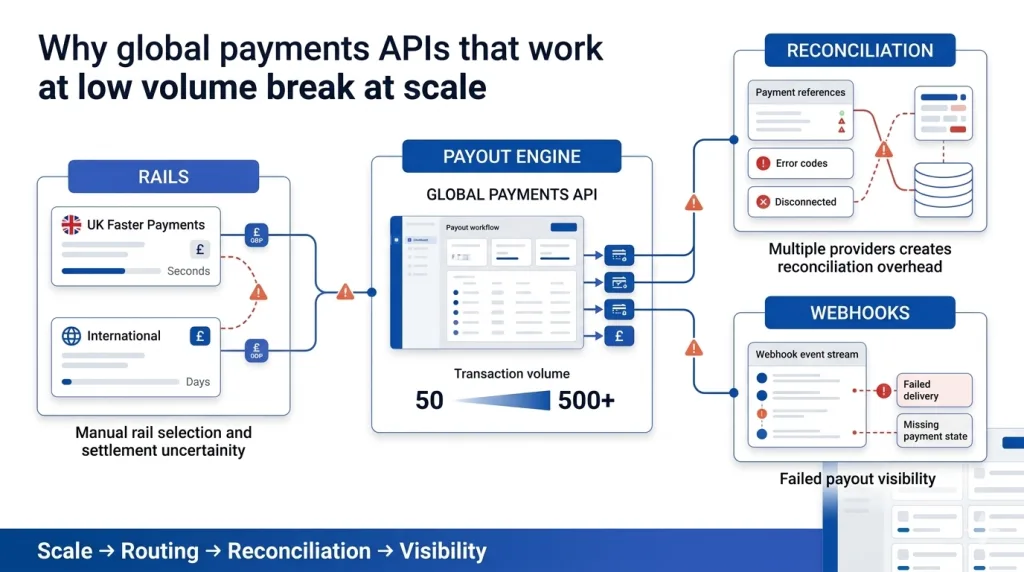
Outbound payout operations reverse that. The platform becomes the initiator. It owns rail selection, timing, reconciliation, and failure handling. What works at 50 payouts per cycle becomes operationally expensive at 500.
Three gaps appear consistently:
Rail mismatch. UK domestic payouts routed through the same integration as international disbursements produce unpredictable settlement timing. Faster Payments settle in seconds. International routes settle on timelines that vary by corridor, currency, and recipient bank. Without rail-aware routing at the API layer, the platform manages this distinction manually.
Reconciliation fragmentation. Each rail produces different reference formats and failure codes. A platform using multiple providers across geographies ends up with reconciliation logic split across several integrations. Finance teams build manual bridges. Those bridges break under volume.
Webhook unreliability. A failed checkout webhook prompts a customer retry. A failed salary disbursement webhook leaves the platform unaware of the payment status until a payee reports non-receipt.
What Payment Rails Does a Global Payments API Need to Support?
Rail choice is where most of the operational cost and complexity in a global payments API actually lives – not the integration layer itself.
What rails cover UK and international payout operations for platform teams?
Rail selection determines settlement speed, cost, and failure handling – not the API layer above it.
For UK domestic api payouts, Faster Payments is the correct rail. Account-to-account, settles in seconds, 24/7 including weekends, no card network fee, no card-style chargeback mechanism.
For international payouts to recipients outside the UK, the correct approach depends on the recipient country, currency, and supported payout route. Recipients are paid using IBAN or supported local account details depending on geography. Settlement timelines are estimated and vary by route – not guaranteed.
For payouts beyond the corridors covered by primary rails, SWIFT handles the transfer but adds cost and latency.
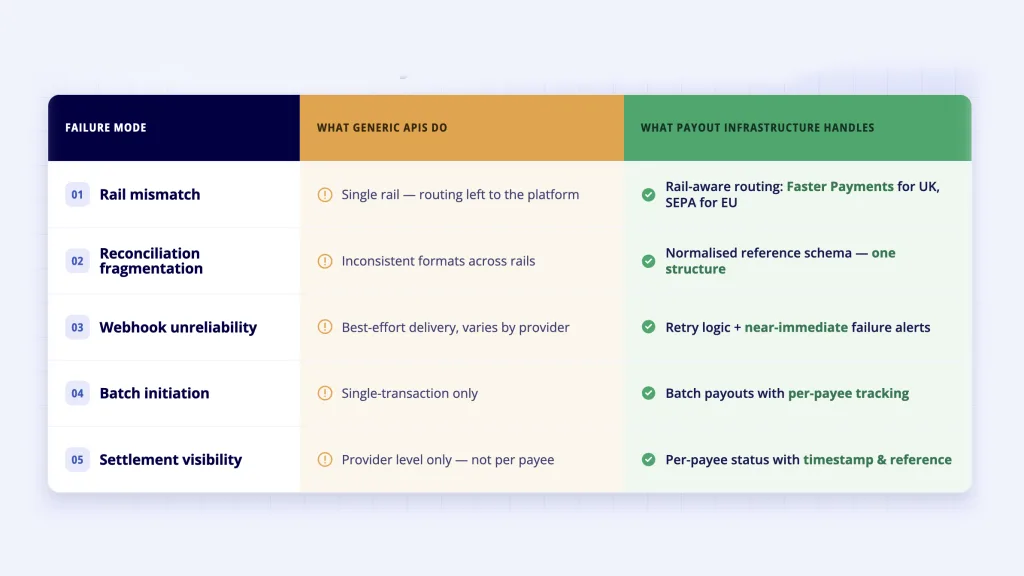
| Failure mode | Generic API | Purpose-built payout infrastructure |
|---|---|---|
| Rail mismatch | Platform manages routing externally | Rail-aware routing at API layer |
| Reconciliation fragmentation | Inconsistent formats across rails | Normalised reference structure per payout |
| Webhook unreliability | Best-effort delivery | Retry logic with near-immediate failure notification |
| Batch initiation | Single-transaction only | Batch initiation with per-payee status tracking |
| Settlement visibility | Provider-level only | Per-payee settlement status with timestamp and reference |
What mistakes do platforms commonly make when building on a global payments API?
Treating payouts as an acceptance afterthought is the most consistent one. Outbound initiation, rail routing, batch handling, and per-payee reconciliation require different architecture decisions from acceptance. Discovering this after the integration is built is expensive to unpick.
Using a single rail logic for all geographies creates downstream reconciliation mismatches. UK domestic Faster Payments and international IBAN-based routes operate on different timelines and confirmation formats – treating them identically means the reconciliation layer has to absorb the difference manually.
Assuming webhook delivery is reliable by default. Retry logic with near-immediate failure notification is operational infrastructure, not a nice-to-have.
Conflating initiation with settlement. An API confirming that a payout was initiated is not the same as confirming it settled. Platforms using initiation as their reconciliation checkpoint carry exceptions that only surface during bank statement matching.
What Does Platform-Scale Payout Operations Look Like?
The specific pain point shifts by platform type, but the underlying infrastructure gap is the same one every time.
How do payroll, marketplace, and supplier payment platforms use payout API infrastructure?
The infrastructure requirement differs by platform type. The underlying gaps are consistent.
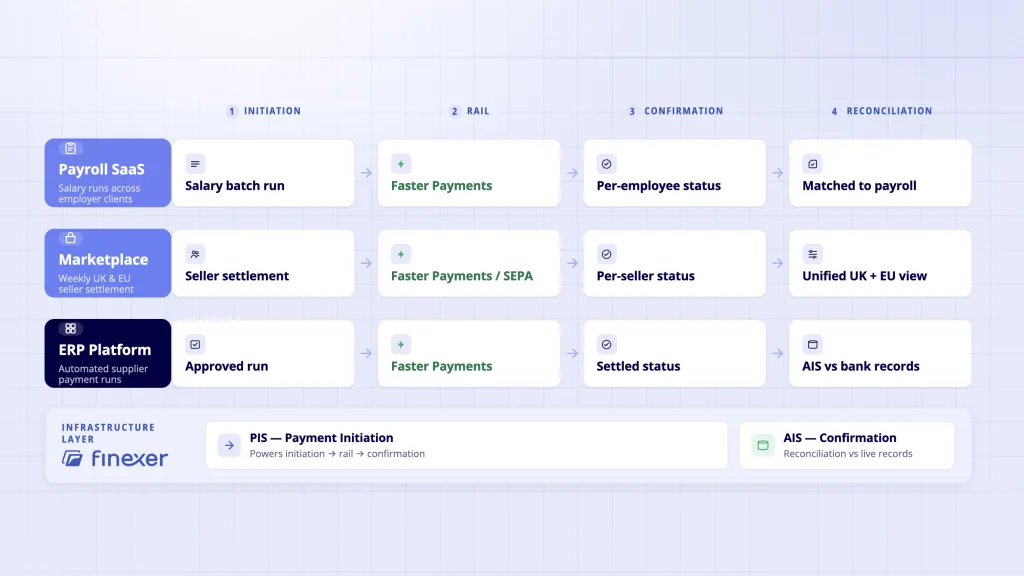
Payroll disbursement. A payroll SaaS processing salary run for 200 employer clients needs every salary confirmed and reconcilable against the payroll record in the same working day. The failure mode is almost never the payment itself – it is webhook latency or silent failures. The payment initiates. The confirmation does not arrive. Finance teams spend the morning after payroll day checking statuses manually rather than managing flagged exceptions automatically.
Marketplace seller settlement. A B2B marketplace settling weekly with UK and international suppliers hits a reconciliation problem that compounds with volume. UK suppliers on Faster Payments confirm in seconds. International suppliers on IBAN-based routes confirm estimated timelines that vary by corridor. Two settlement formats, one finance team that needs a single view.
Without a unified payout layer, the platform builds separate reconciliation workflows and manually normalises the differences. This works at 50 suppliers. At 600, the manual steps outweigh the automation.
Supplier payment automation. An ERP platform running supplier payment workflows needs staged initiation: approve first, then trigger. Where this breaks is status visibility. The API confirms initiation. Per-payment settled status does not surface in a format the ERP can consume directly. Finance ops cross-references API output with bank statement imports – defeating the automation.
Platforms building on Open Banking API integration typically set up AIS for account data access alongside the PIS payout layer.
Where Does Open Banking Fit in a Global Payments API Stack?
This is the part most platforms get vague answers on – where exactly the Open Banking rail stops and the international leg starts.
How does Open Banking PIS fit alongside other global payment rails
Open Banking PIS instructs the payer’s bank directly. For UK domestic payouts, this means Faster Payments at source – no card network fee, no intermediary, no card-style chargeback mechanism.
For a payroll platform initiating 5,000 salary payments via Open Banking PIS, the cost difference versus card push payouts at scale is material. No per-transaction network fee. Confirmation within seconds.
For UK-origin international payouts, Open Banking handles the UK-side layer: account access, payment consent, funding initiation, and reconciliation. The international payout to the recipient uses supported payout routes and is not carried on the Open Banking rail itself. Recipients are paid via IBAN or supported local account details depending on the country, currency, and route.
What Open Banking does not replace:
- SWIFT for corridors outside primary supported routes
- Card networks where recipient account details are unavailable
- Multi-currency account holding across more than UK and supported payout currencies
UK platforms running B2B Open Banking payments at scale use PIS for outbound initiation and AIS for settlement confirmation against live account records.
How Does Finexer Support the UK Payout Infrastructure Layer?
Finexer delivers FCA-authorised Open Banking PIS and AIS infrastructure for UK platforms, alongside UK-origin international payout capability for recipients outside the UK.
On the UK domestic side: Open Banking PIS routes domestic GBP payouts via Faster Payments natively – instant settlement, no card network fee, no card-style chargeback mechanism, per-payout reference tied to the originating instruction.
On the international side: Finexer’s International Payouts product handles UK-origin outbound disbursements to international recipients using IBAN or supported account details, subject to supported countries, currencies, and payout routes. Open Banking supports the UK-side layer – account access, funding initiation, consent, and reconciliation. The international leg uses supported payout routes. Delivery timelines are estimated and vary by route and recipient bank.
On reconciliation: Every payout carries a stable per-payout reference tied to the originating instruction. AIS provides transaction-level confirmation against live bank account records – so the reconciliation output matches what actually settled, not just what was initiated.
On webhook reliability: Failure notifications arrive near-immediately with retry logic. A failed salary disbursement surfaces as a system alert, not an employee phone call.
What Finexer provides in practice:
- Faster Payments initiation for UK domestic payouts – instant settlement, per-payout reference, no card network overhead
- UK-origin outbound payouts to international recipients via IBAN or supported account details, subject to supported countries and routes
- Batch initiation for payroll runs and supplier payment cycles
- Per-payout status across initiated, confirmed, and settled stages
- AIS balance data for pre-payout funding checks before a batch run triggers
- Up to 7 years of account history across almost all major UK banks for reconciliation and audit
Open Banking Limited recorded 37.46 million payment transactions in March 2026. Platforms building outbound payout operations on the same infrastructure avoid the fragmentation that comes from managing a separate payout provider alongside an AIS connection.
“What we see consistently is platforms that built acceptance well and then tried to retrofit payout operations six months later. The infrastructure gaps show up in reconciliation and webhook reliability, not in the initiation itself. Purpose-built payout infrastructure resolves those gaps before they reach finance teams.” – Ravi, Finexer
Where this works well: payroll SaaS platforms running salary disbursements at scale, B2B marketplaces settling UK and international suppliers, ERP platforms automating supplier payment runs, and SaaS products adding payout capability without building payment infrastructure in-house.
Where Finexer does not fit: platforms where card acceptance is the primary requirement, consumer remittance products, workflows requiring multi-currency account holding, or payout corridors outside currently supported countries and routes.
FCA-authorised (FRN 925695). 3 to 5 weeks of onboarding support. Usage-based pricing.
What to Look for in API Payouts Infrastructure?
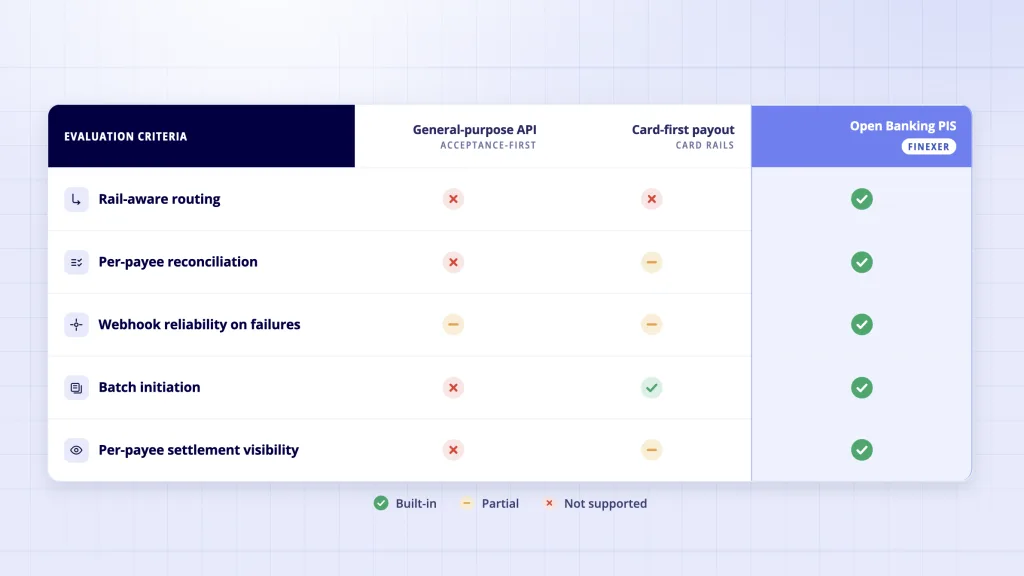
Feature pages look similar across providers. The differences in api payouts infrastructure show up in production.
Does the API separate payouts from acceptance architecturally? Some global payments APIs bolt payout capability onto an acceptance-first architecture. The reconciliation schema and error handling reflect checkout logic, not disbursement operations. Platforms find this after the integration is built.
How does rail selection work? Does the platform configure routing, or does the API route based on payee account details and geography? Rail-aware routing at the API layer removes significant engineering overhead.
What happens when a payout webhook fails? Failure reason, payee reference, and timestamp should arrive within seconds – not require polling to detect.
How is reconciliation structured? Each payout needs a stable reference matching the originating instruction. Different reference formats across rails means manual intervention at volume.
What does per-payee status look like? Finance teams need initiated, pending, confirmed, and failed status per individual payout. Batch-level confirmation only is an infrastructure gap.
What is the international payout model? For UK-origin international payouts, understand how the API handles the UK-side versus the international leg – the funding, consent, and reconciliation layer should be clearly separated from the payout route to the recipient.
Platforms shortlisting B2B payment APIs for UK operations will find payout support and reconciliation depth vary more than acceptance coverage across the provider set.
What is a global payments API and what does it need to handle for UK platforms?
A global payments API for UK platform teams needs domestic GBP payout rails via Faster Payments, international recipient disbursements via IBAN or supported account details, per-payout reconciliation with stable references, and webhook reliability on failures. The acceptance and disbursement layers have different architecture requirements.
How does api payouts infrastructure differ from payment acceptance infrastructure?
Acceptance is a single inbound flow the processor manages. Api payouts make the platform the initiator – it owns rail selection, timing, per-payee reconciliation, and failure handling. This requires different infrastructure logic: batch initiation, rail-aware routing, and webhook reliability on individual disbursements.
Where does Open Banking fit in a global payments API for UK platforms?
For UK domestic payouts, Open Banking PIS provides account-to-account Faster Payments initiation with no card network fee. For UK-origin international payouts, Open Banking handles the UK-side layer – account access, funding, consent, and reconciliation. The international disbursement to the recipient uses supported payout routes with settlement timelines that vary by corridor.
What makes reconciliation fragmentation the most common global payments API problem?
Each payout rail produces different reference formats and failure codes. A platform using multiple providers across geographies ends up normalising the differences manually in finance ops every settlement cycle. Purpose-built payout infrastructure provides a normalised reference structure across rails from a single schema.
UK payout operations need the domestic and international layers clearly separated. To see how Finexer’s International Payouts infrastructure fits your platform’s payout and reconciliation workflow.
Explore with AI
About the Author

Ravi Ranjan
Ravi Ranjan is Co founder & CEO of Finexer