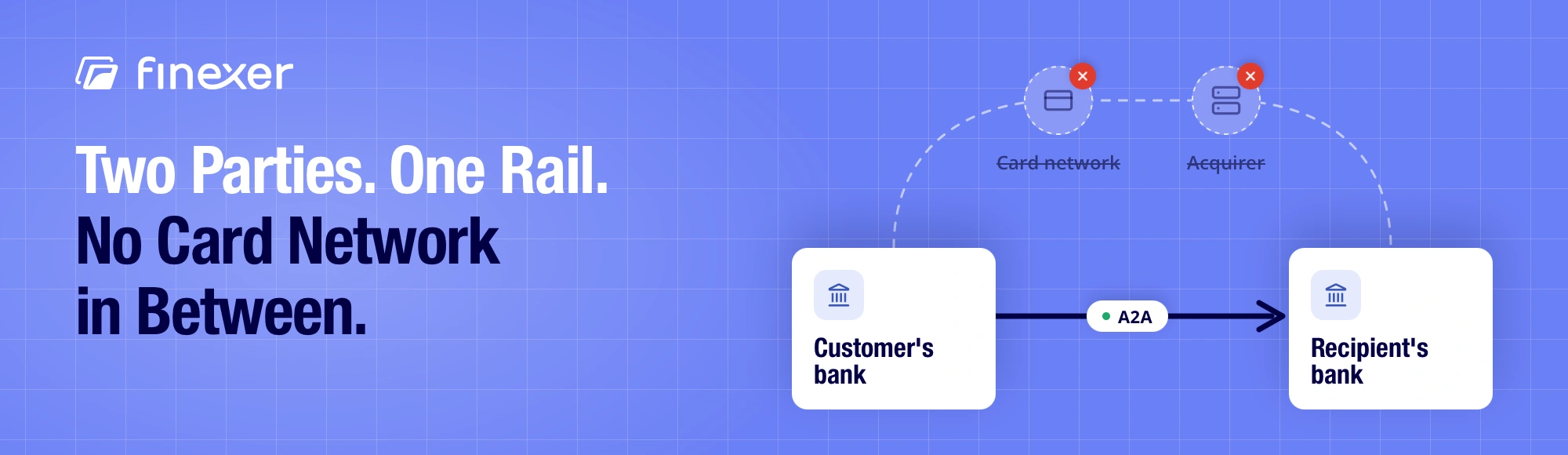
Direct Between Accounts.
Faster Payments settlement with SCA built in.
Every card payment a business accepts has three parties standing between the customer and the money: the network, the acquirer and the interchange fee that never quite disappears.
TL;DR: Account-to-account (A2A) payments strip that chain down to two parties and one rail. Money moves directly between the customer’s bank account and the recipient’s, authorised by the customer’s own bank, with no card scheme in the middle. This article covers how account-to-account (A2A) payments actually work in the UK, how they stack up against cards and Direct Debit and what checks to be performed before choosing a provider to run them.
Finexer initiates account-to-account (A2A) payments for UK platforms across payroll, EPOS, invoicing and utility billing, all settling via Faster Payments under FCA authorisation. Everything below reflects how that actually works in production, and none of it is a theoretical explanation.
What Are Account-to-Account (A2A) Payments?
Account-to-account (A2A) payments move money directly between two bank accounts without a card network sitting in the middle.
The customer authorises the payment through their own bank. No card number, no expiry date and no CVV. The money leaves one account and arrives in another, initiated by a regulated third party rather than being routed through Visa, Mastercard or an acquirer’s processing stack.
That difference is not cosmetic. Removing the card network from the transaction changes who gets paid and how quickly, and how much of the transaction value survives the journey intact.
For platforms weighing options on how to collect or send money, that structural difference is the entire reason account-to-account (A2A) payments have moved from a niche mention to a category buyers actively search for.
How Do A2A Payments Work in the UK?
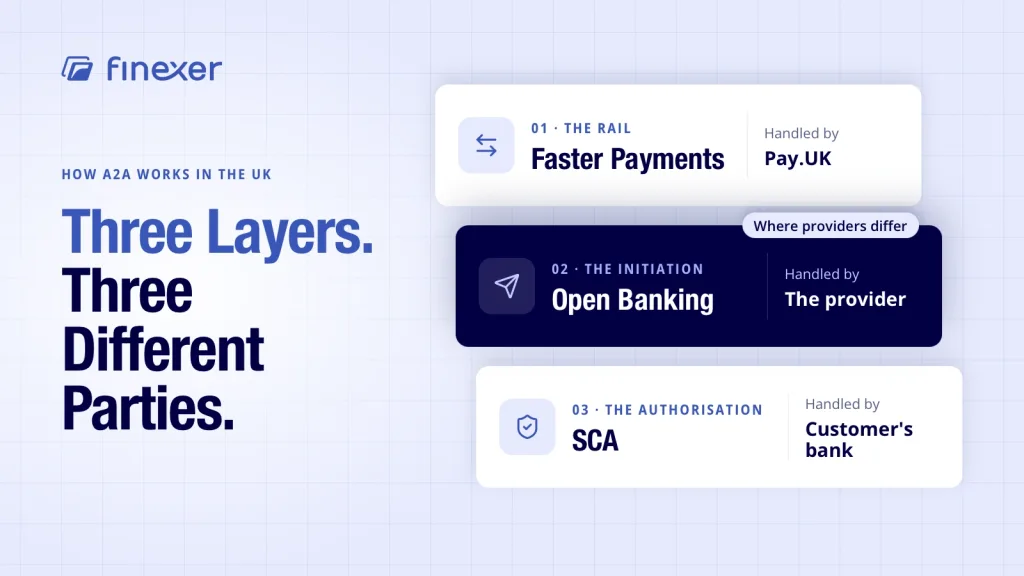
Account-to-account (A2A) payments in the UK run on three layers working together: the rail, the initiation method and the authorisation step. Each layer is handled by a different party, and confusing them is one of the most common mistakes platforms make when evaluating a provider.
- Faster Payments is the rail. It is the underlying UK payment scheme that actually moves the funds between banks. It is operated by Pay.UK and not by any single payment company.
- Open Banking is the regulated initiation method. A provider like Finexer uses open banking payment initiation to trigger the payment on the customer’s instruction, without ever holding the funds itself.
- Strong Customer Authentication (SCA) is the authorisation step. The customer approves the payment inside their own banking app, the same way they would log in normally, so the authorisation happens with the bank and not with the merchant or the provider.
Understanding these three layers matters more than most guides let you in on, as providers differ meaningfully in how they handle the middle one. The wider landscape of open banking payment methods covers this initiation layer in greater depth.
How Does A2A Compare to Cards and Direct Debit?
Account-to-account (A2A) payments differ from cards and Direct Debit in cost, settlement speed, authorisation and where failures tend to happen. None of these differences are minor once transaction volume climbs into the thousands per month.
| Factor | Cards | Direct Debit | A2A (Open Banking) |
|---|---|---|---|
| Cost structure | Interchange plus scheme fees | Bacs processing fee | No card interchange |
| Settlement | Same day to a few days, acquirer-dependent | Days, on a fixed collection schedule | Instant via Faster Payments |
| Authorisation | Card details plus 3D Secure | Standing mandate, no per-payment approval | SCA at the customer’s bank, per payment |
| Chargeback exposure | Chargebacks possible for a defined window | Indemnity claims possible under the Direct Debit Guarantee | No card-scheme chargeback mechanism |
| Common failure cause | Expired or declined cards | Insufficient funds on collection date | Insufficient funds at authorisation or bank connectivity issues |
None of this makes account-to account (A2A) payments a universal replacement. It sits alongside alternative payment methods as one option among several, chosen for the situations where its particular trade-offs make sense.
What Types of A2A Payments Exist?
There are two main types of account-to-account (A2A) payments: single immediate payments and recurring payments authorised in advance. Most platforms end up using both just for different parts of the same product.
A single immediate payment covers a one-off transaction, a rent payment, an invoice settlement, a checkout purchase, each authorised once and executed once. Variable recurring payments open banking covers the other type, where a customer authorises a series of payments within agreed limits, which is useful for subscriptions, bill collection or account sweeping, without requiring a fresh authorisation every time. Commercial VRP adoption is growing in the UK, extending this beyond personal account sweeping into business-to-business collection.
Where Is A2A Growing?
A2A payments volumes have grown consistently as Open Banking infrastructure matures across UK banks.
The UK ecosystem processed 2.81 billion API calls and 40.16 million Open Banking payments in June 2026 alone, with user connections reaching 18.81 million (Open Banking Limited). Growth has been driven partly by the rising adoption of Variable Recurring Payments alongside single domestic payments, a pattern that platforms evaluating A2A payments providers should expect to continue.
That scale did not appear overnight. Open Banking infrastructure has spent several years maturing behind the scenes, bank by bank, before payment volumes reached a level where account-to-account (A2A) payments became a genuine line item on a merchant’s payment stack rather than an experiment.
Platforms weighing whether to add account-to-account (A2A) payments now are arriving at a market that is already operating at production scale and not with a technology that is still finding its feet.
How Do UK A2A Providers Compare?
Not every UK Open Banking provider approaches account-to-account (A2A) payments the same way.
| Provider | Position | What to Know |
|---|---|---|
| TrueLayer | AIS + PIS, UK-founded | Large share of UK Pay by Bank transactions, skews enterprise |
| GoCardless | PIS-led, UK-founded | Strong in recurring collection and Direct Debit replacement |
| Yapily | AIS + PIS, developer-first | Covers 19+ European countries, broader than UK-specific |
| Tink | AIS + PIS, Visa-owned | Strong European coverage, enterprise-leaning pricing |
| Finexer | AIS + PIS, UK-focused | Single API for data and payments |
What Should You Check Before Choosing an A2A Provider?
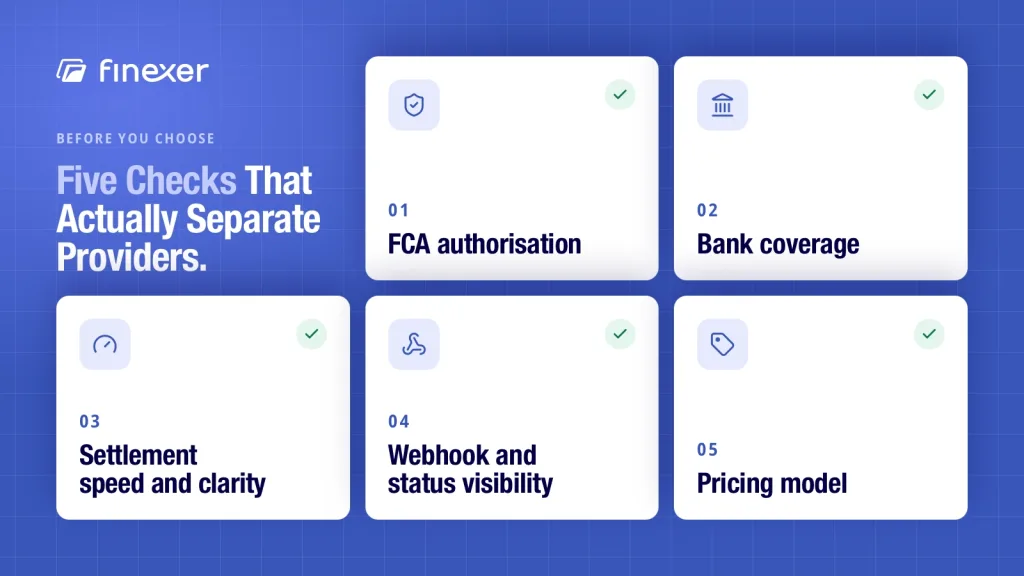
Choosing an account-to-account (A2A) payments provider boils down to five checks that matter more than a feature list. Most providers look similar on a sales page, and the differences that actually affect a platform only show up once these five questions get asked directly.
- FCA authorisation. Confirm that the provider not only claims Open Banking capability but also is authorised as a Payment Initiation Service Provider.
- Bank coverage. Ask for coverage not only of the largest few banks but also across high-street, challenger and business accounts.
- Settlement speed and clarity. Faster Payments settlement is typically near-instant, although occasional delays can occur, so ask how a provider communicates that.
- Webhook and status visibility. Confirm that you get real-time status updates per payment and not just a batch file you have to reconcile manually.
- Pricing model. Confirm that it is a direct one-to-one bank connection, with multiple data pulls/refreshes. Contact us for pricing details.
Where Does Finexer Fit In?
Platforms choosing between cards, Direct Debit and account-to-account (A2A) payments need a provider that handles the initiation layer without adding integration weight and without asking a product team to become experts in payment scheme rules first.
Finexer’s payments API initiates account-to-account (A2A) payments that settle via Faster Payments, authorised through SCA in the customer’s own banking app, with webhook status updates on every transaction so that a platform always knows what happened to the payment.
- FCA-authorised payment initiation and not a card gateway or acquirer
- Faster Payments settlement with SCA built into the authorisation step
- Real-time webhook status per payment and no polling required
- Single API covering both A2A payments and banking data
This fits EPOS platforms replacing card fees at checkout, payroll platforms running bulk payouts, invoicing platforms collecting from customers and utility billing platforms offering an alternative to Direct Debit.
Is A2A the same as Open Banking?
A2A is the payment category. Open Banking is the regulated framework that makes A2A payment initiation possible in the UK alongside data access.
Can A2A payments be used for international transfers?
No, not directly. The A2A payments covered here run over UK Faster Payments between UK bank accounts. Cross-border transfers use separate payout routes rather than the same Open Banking initiation.
Can A2A payments be reversed like a chargeback?
There is no card-scheme chargeback mechanism for A2A payments. Disputes are handled directly between the parties or through the bank and not through a chargeback process.
Does a customer need an app to make an A2A payment?
The customer authorises the payment inside their own banking app or online banking, which most UK banks support as standard for Open Banking authorisation.
See A2A Payments in Action
See how Finexer’s FCA-authorised A2A payment initiation settles instantly over Faster Payments with webhook status on every transaction.
Explore with AI
About the Author

Ravi Ranjan
Ravi Ranjan is Co founder & CEO of Finexer