
Card payments carry costs most merchants accept without question. Interchange fees, chargeback exposure, and 1-3 day settlement delays come bundled into what feels like the default option. But for UK businesses in 2026, alternative payment options are no longer niche.
Open Banking payments reached 37.46 million transactions in March 2026 alone. Direct Debit continues to power recurring billing across utilities, accountancy, and property. Digital wallets are standard at checkout for many buyers. The question is not whether to offer alternative payment options, but which ones suit your customers, your transaction size, and your margin.
This guide compares the most relevant UK payment methods on cost, settlement, authorisation, chargeback risk, and basket fit, so you can make an informed decision rather than default to cards.
For a broader overview of how payment methods online work in the UK, see online payment systems.
Key Takeaways
- Alternative payment options vary significantly on cost (interchange fees vs flat-rate vs zero-fee), settlement speed, and chargeback exposure
- Open Banking/A2A delivers instant settlement via Faster Payments with SCA built in -no stored card details, no card network overhead
- Direct Debit suits recurring billing; digital wallets suit high-frequency retail; A2A suits high-value one-off transactions
- UK businesses should evaluate alternative payment solutions by sector fit, not just headline fee
What Are the Most Popular Payment Methods UK Merchants Use?
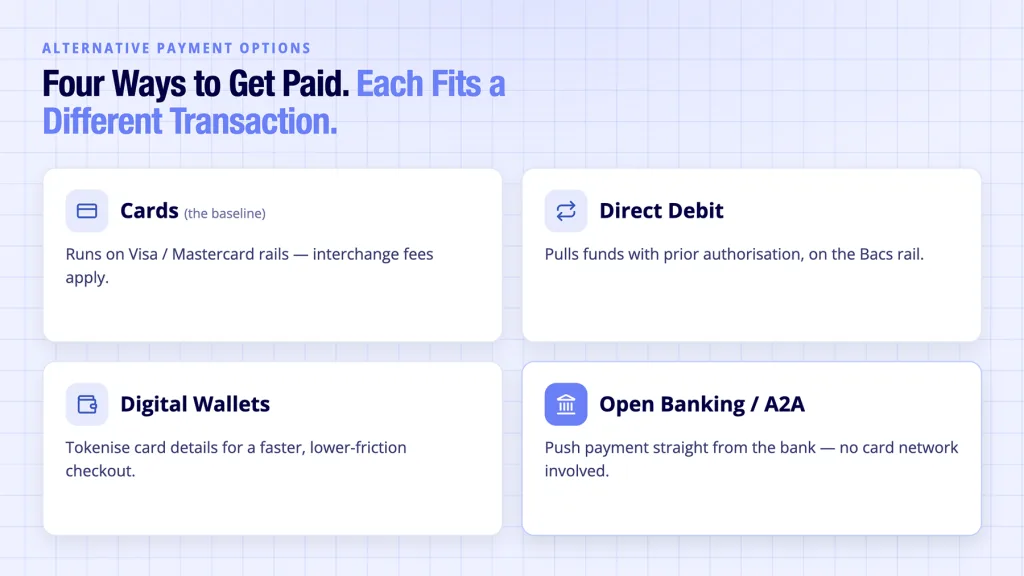
Most UK payment methods fall into four categories. Cards dominate by volume but not by suitability for every transaction type. Alternative payment methods are growing faster.
Here is how each UK payment method category works in practice:
Cards (the baseline)
Cards process transactions via global card networks (Visa, Mastercard). The merchant pays interchange fees to the card network and an acquirer fee on top. Settlement typically takes 1-3 business days. Chargebacks are a structural feature; customers can dispute and reverse card charges, and merchants bear the cost.
Direct Debit
Direct Debit pulls funds from a customer’s account with prior authorisation. It runs on the Bacs rail, which has a 3-working-day settlement cycle. It is the standard alternative payment solution for recurring billing: utilities, subscriptions, membership, and invoice collection. Chargeback risk is lower than cards, and fees are generally lower.
Digital Wallets
Wallets (Apple Pay, Google Pay, PayPal) tokenise card or bank details. Most consumer-facing wallets sit on card payment rails, meaning interchange fees still apply. The user experience is faster and reduces checkout abandonment. Wallets do not remove card network overhead -they add a convenience layer on top of it.
Open Banking / Account-to-Account (A2A)
Open Banking payments initiate push payments directly from the customer’s bank account to the merchant’s, with the customer authenticating via their bank app. No card network is involved. Settlement is instant via Faster Payments. SCA is handled natively by the bank. There are no stored card details and no card-style chargebacks, but customers also do not have the same chargeback protections available with card payments.
For a deeper breakdown of how A2A works, see a2a payments.
How Do Alternative Payment Methods Compare?
This table compares alternative payment methods on the criteria that matter most to UK merchants:
| Method | Cost | Settlement | SCA | Chargeback Risk | Best Basket Type |
|---|---|---|---|---|---|
| Card | Interchange fees + acquirer margin | 1-3 days | Optional | High | Low-value, high-frequency retail |
| Direct Debit | Low flat rate | 3 days (Bacs) | Not applicable | Low | Recurring, subscription, utility |
| Digital Wallet | Card interchange still applies | 1-3 days | Device-level | Moderate | Mobile checkout, high-frequency |
| BNPL | Merchant fee (higher) | Varies | Varies | Low (merchant) | Retail, discretionary spend |
| Open Banking / A2A | Low per-transaction | Instant (Faster Payments) | Bank-native SCA | Very low | High-value, one-off, B2B |
Why Are Merchants Moving Away From Card Payment Rails?
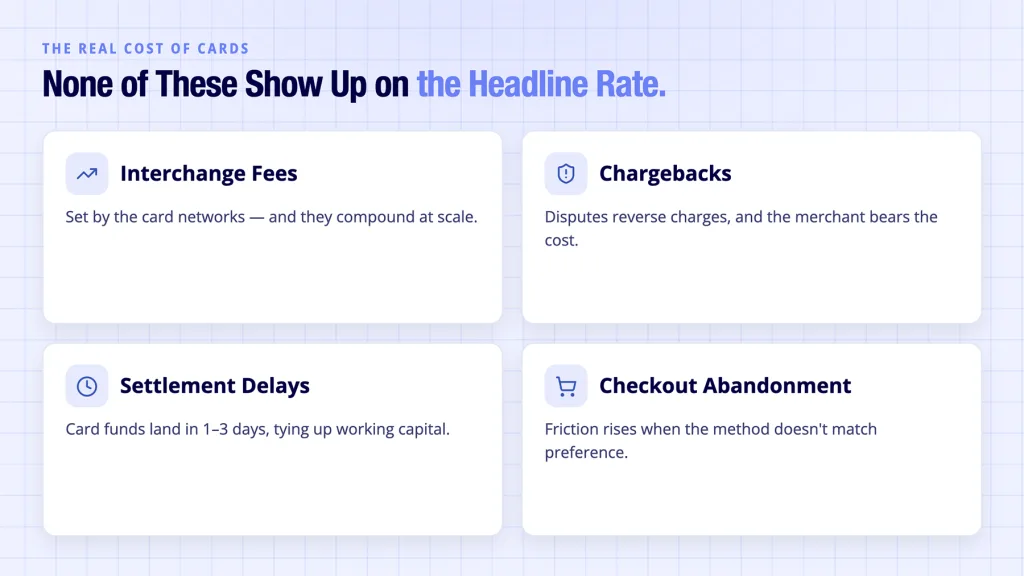
Cards work well for low-value consumer transactions. For many UK merchant categories, the cost-to-benefit calculation has shifted.
Interchange fees accumulate at scale
Card payments carry interchange fees set by card networks. For a merchant processing £1 million a month in card payments, even a modest fee percentage compounds into a significant cost line. For alternative payment solutions built on bank rails, this overhead does not exist.
Chargebacks expose merchants to fraud and disputes
Chargebacks -where a customer disputes a card charge and the card network reverses the transaction -sit disproportionately with merchants. Even resolved disputes carry administrative costs. Open Banking payments, which are push payments initiated by the customer with bank-level SCA, significantly reduce this exposure.
Settlement delays create cash flow pressure
Card settlement takes 1-3 business days. For businesses managing tight cash flow- utilities, property firms, or high-volume EPOS environments- waiting for funds already authorised is a structural inefficiency. Open Banking settles instantly via Faster Payments.
Checkout abandonment increases with friction
Research consistently shows that checkout abandonment rises when payment methods online do not match customer preference. Offering a broader set of alternative payment options reduces this friction -especially for mobile-first or repeat-purchase journeys.
How Does Open Banking Fit Into the Alternative Payment Options Landscape?
Open Banking is one of the most relevant alternative payment solutions for UK merchants in 2026, but it fits specific transaction profiles better than others.
The mechanism: A customer selects Pay by Bank at checkout, authenticates with their bank app (SCA handled natively), and the payment moves instantly via Faster Payments. The merchant receives funds directly, with no intermediary holding period. No card details are stored. No card network processes the transaction.
This makes Open Banking particularly suited to:
- High-value one-off payments: Property deposits, legal disbursements, utility lump sums
- Recurring collection with VRP: Variable Recurring Payments allow pre-authorised recurring bank payments -not yet universally live, but in commercial rollout
- B2B invoice settlement: Where Direct Debit is too slow and cards too expensive
For more on how payment initiation works under Open Banking, see payment initiation.
For how this applies to UK Open Banking payments specifically, see open banking payments UK.
Which Sectors Benefit Most From Alternative Payment Solutions?
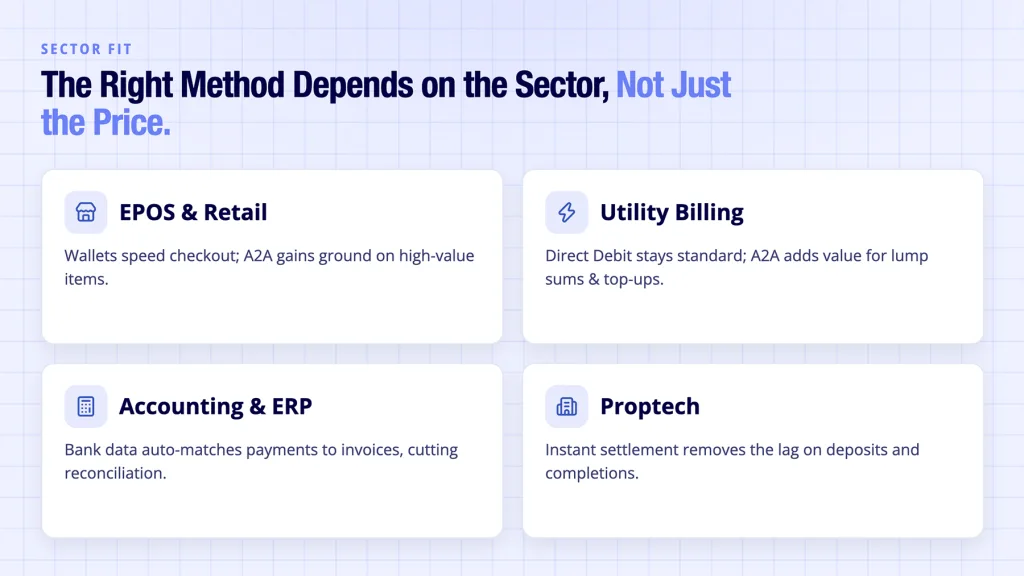
Different UK payment methods suit different verticals. Here is where the fit is strongest:
EPOS and Retail
At point of sale, digital wallets reduce checkout abandonment and speed up transaction time. Open Banking is gaining ground in high-value retail (electronics, furniture) where the per-transaction cost saving on a £500+ purchase is material. See how epos systems are evolving with Open Banking integration.
Utility Billing
Direct Debit remains the standard for recurring utility payments. Open Banking adds value for lump-sum payments, final settlement, and pre-payment top-ups where the settlement speed matters.
Accounting and ERP Platforms
Alternative payment solutions that connect directly to bank data- like Open Banking -reduce manual reconciliation. Payments are matched to invoices automatically through the reference and account data.
Proptech
Property transactions involve high-value payments under time pressure. Open Banking instant settlement removes the 3-day lag that creates risk in completions and deposits.
Where Does Finexer Fit in the Alternative Payment Options Landscape?
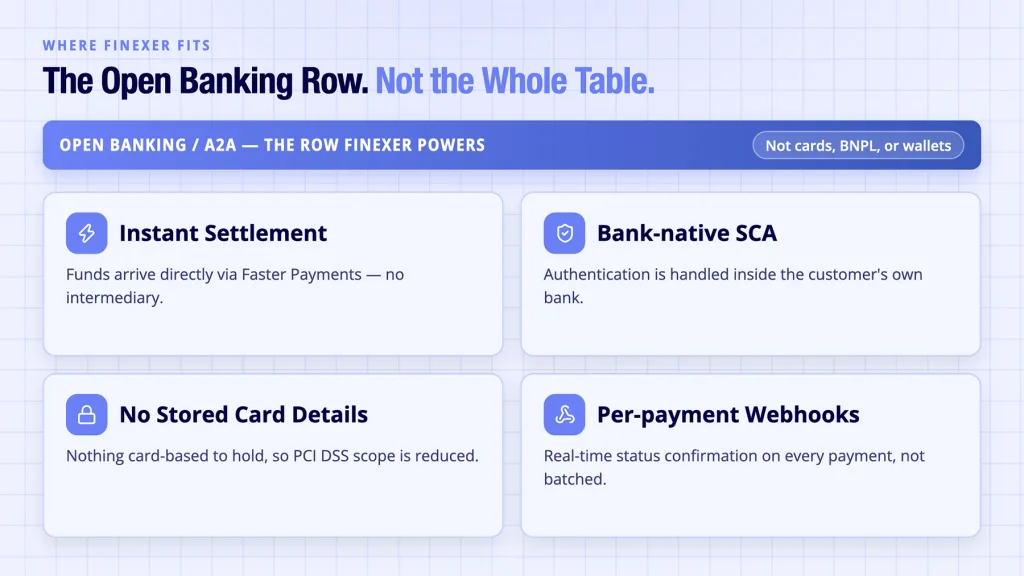
Finexer operates as an FCA-authorised PISP (FRN 925695) and AISP, providing Open Banking payment infrastructure for UK platforms. Within the alternative payment options landscape, Finexer covers the account-to-account and Open Banking segment specifically -not cards, BNPL, or wallets.
What this means for platforms evaluating alternative payment solutions:
- Instant Settlement Via Faster Payments– Funds arrive in your account directly, no intermediary
- SCA Handled Natively by the Customer’s Bank– No separate authentication layer to build
- No Stored Card Details– PCI DSS scope reduced
- Per-payment Webhooks– Real-time status confirmation, not batched
- 99% UK Bank Coverage across consumer, business, and challenger accounts
- Usage-based pricing- Pay based on your actual transaction usage, with flexible pricing that scales with your needs
Finexer does not offer card processing, BNPL, or digital wallet infrastructure. For platforms that need the Open Banking alternative payment solutions layer specifically, Finexer provides the regulated infrastructure underneath.
Bottom Line
Alternative payment options in the UK now cover a wide range of mechanisms, each with distinct trade-offs. Cards remain dominant by volume but carry interchange fees, chargeback exposure, and settlement delays that compound at scale. Direct Debit, digital wallets, and Open Banking each solve part of the problem. The most relevant UK payment methods for merchants depend on transaction size, sector, and customer profile. Evaluating alternative payment solutions by fit rather than by familiarity is how you reduce cost and improve cash flow in 2026.
What are the most popular payment methods UK merchants accept online?
Cards remain the most used UK payment method by volume. Among alternative payment methods, Direct Debit leads for recurring billing, digital wallets are growing at checkout, and Open Banking is the fastest-growing for one-off and high-value payments. Open Banking payments reached 37.46 million monthly transactions in March 2026
What are the main alternative payment options for UK businesses?
The main alternative payment options are Direct Debit (for recurring collection), digital wallets (for checkout convenience), Open Banking/A2A (for instant, low-cost, high-value payments), and BNPL (for retail where buyers want deferred payment). Each alternative payment solution has different cost structures, settlement timelines, and chargeback profiles.
Which alternative payment methods have the lowest fees for UK merchants?
Direct Debit and Open Banking/A2A typically carry the lowest per-transaction costs for UK merchants. Neither runs on card payment rails, which removes interchange fees. Open Banking adds instant settlement, which further reduces cash flow cost. The exact fee depends on your provider.
Are payment methods online becoming more important for UK businesses?
Yes. The shift to payment methods online -accelerated by mobile commerce and changing buyer expectations -has made checkout flexibility a competitive differentiator. Merchants offering only cards see higher checkout abandonment on mobile. UK payment methods that reduce friction at checkout, like wallets and Open Banking, are growing fastest.
See how Finexer’s UK-exclusive focus provides 99% bank coverage without multi-market complexity.
Explore with AI
About the Author

Ravi Ranjan
Ravi Ranjan is Co founder & CEO of Finexer