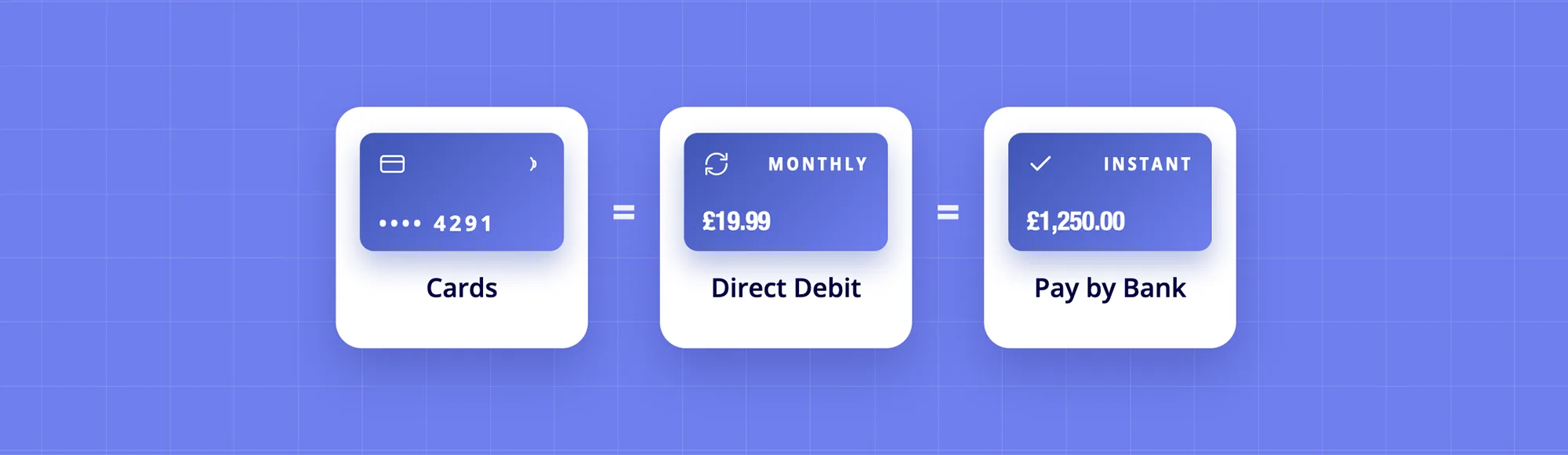
Online payment systems come in three main types: card payments (high adoption, higher fees), Direct Debit (reliable recurring payments), and Open Banking/Pay by Bank (fastest-growing, lowest fees). Each serves different business needs. Understanding the trade-offs between speed, cost, and customer preference helps you choose the right online payment method.
When you search for how customers pay online, you’ll find three competing systems fighting for dominance in the UK market. Cards have been the default for decades. Direct Debit handles recurring bills reliably. Open Banking, a newer entrant, is growing faster than both.
Online payment systems aren’t about picking one winner. In 2026, they will coexist. Your choice depends on what you’re selling, how much you’re charging, and whether customers trust the method. This guide compares the three main online payment rails so you understand which one to offer first.
What Are the Different Online Payment Systems?
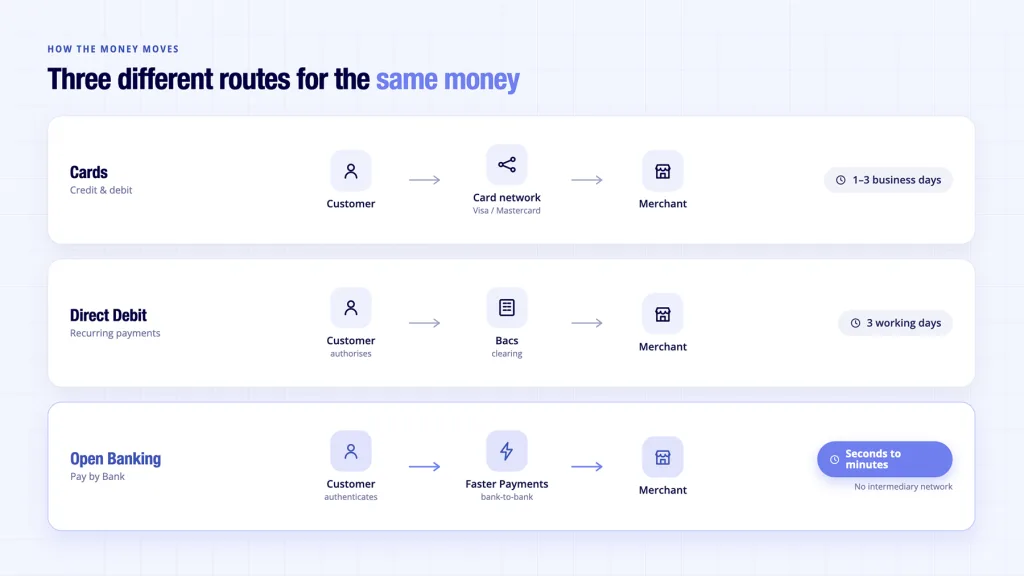
The UK offers three core online payment systems for moving money online. Each has different mechanics, costs, and uses.
1. Cards Remain the Default
Cards (credit and debit) are the oldest online payment method, still dominating. 97% of UK adults hold a payment card, and most online checkout flows default to cards first.
How they work:
- Customer enters card details
- Payment processes through Visa/Mastercard networks
- Money reaches your account (usually within 1-3 business days)
- Customer sees the charge on their statement
Costs: Card payments carry the highest merchant fees of the three main systems, but adoption is so high that many businesses accept the cost.
Best for: E-commerce stores, SaaS subscriptions, one-off purchases where speed matters more than cost.
2. Direct Debit: The Recurring Payment Standard
Direct Debit is the most common recurring payment method in the UK, amounting to a total volume of 5,029,499 shoppers for bills, subscriptions, and regular transfers, as of 2025.
How they work:
- Customer permits to debit their account
- Money moves via Bacs (Banker’s Automated Clearing Services)
- Typically settles within 3 working days
- The customer sees regular debits on their bank statement
Costs: Merchant fees are significantly lower than cards, making Direct Debit cost-effective for recurring billing.
Best for: Recurring subscriptions, utility bills, gym memberships, anything monthly or regular.
3. Open Banking/Pay by Bank: The Fastest-Growing System
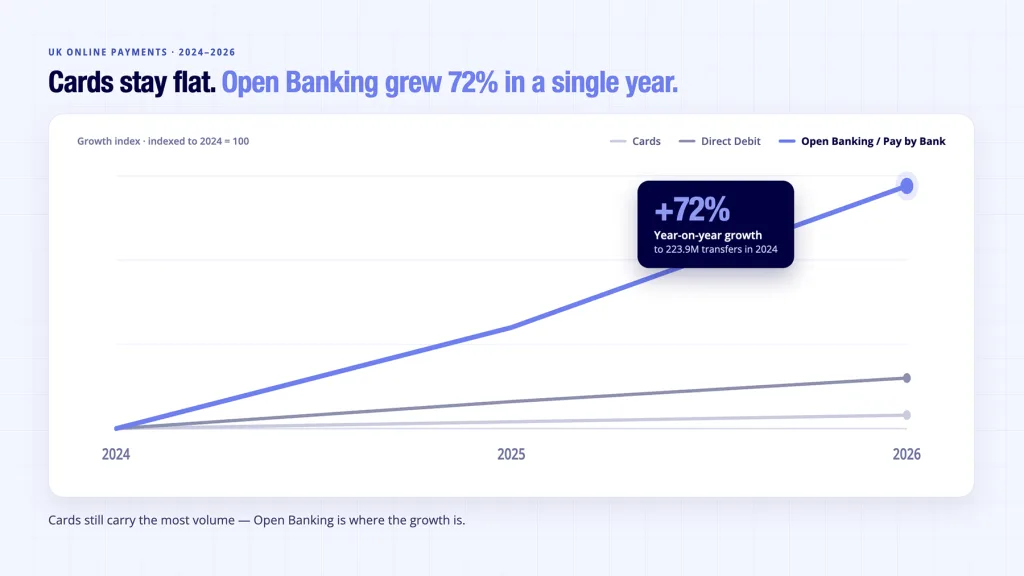
Open Banking (regulated under PSD2) is reshaping how online payment systems work. Pay by Bank, a specific Open Banking implementation, is the newest competitor, and it’s growing fastest.
How they work:
- Customer authenticates directly with their bank via Open Banking consent
- Money transfers instantly via Faster Payments
- Settlement is near-immediate (within seconds to minutes)
- No card network involved; bank-to-bank transfer
Costs: Merchant fees are the lowest of all three systems, and settlement is immediate.
Growth trajectory: Pay by Bank transfers grew 53% year-on-year through 2025, making it one of the fastest-growing online payment methods in the UK.
Best for: High-value transactions, businesses wanting to cut payment fees, platforms prioritizing settlement speed over card-first UX.
How Do These Online Payment Systems Compare?
This table shows the key trade-offs across the three main online payment systems:
| Factor | Cards | Direct Debit | Open Banking / Pay by Bank |
|---|---|---|---|
| Adoption | Highest (most established) | Common for recurring | Growing rapidly (72% YoY) |
| Settlement Speed | 1-3 business days | 3 working days | Near-instant (seconds) |
| Merchant Fees | Highest | Lower | Lowest |
| Customer Trust | Highest (established) | High (for recurring) | Growing (newer) |
| Best Use Case | One-off purchases | Recurring payments | High-value, instant transfers |
| Chargeback Risk | Moderate-high | Low | Very low |
Which Online Payment System Should You Use?
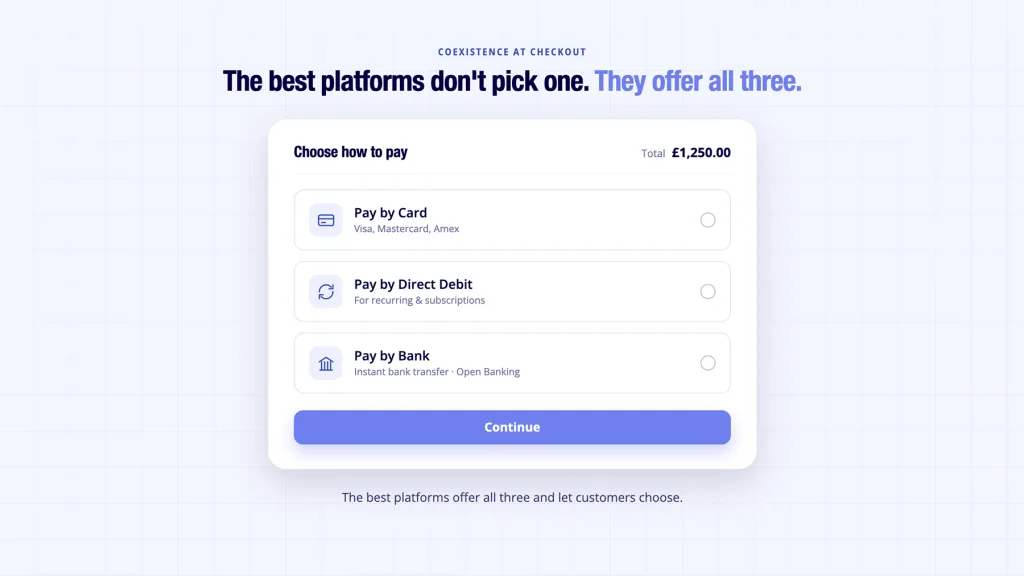
The answer depends on your business model. Most platforms now offer multiple online payment systems and let customers choose.
1. For E-Commerce Stores:
Start with cards-adoption is highest. Add Open Banking/Pay by Bank as a second option for cost-conscious customers. Direct Debit works only if you’re handling subscriptions.
2. For SaaS Platforms and Subscriptions
Cards remain standard for initial signup (customers expect it). Offer Direct Debit for recurring billing to lower your fees. Add Pay by Bank if you want to differentiate on cost.
3. For Marketplace and Settlement Payments
Open Banking/Pay by Bank is ideal here. Settlement is instant, fees are lowest, and you can offer it to seller payout networks without card infrastructure. This is where online payment growth is fastest.
Why Is Open Banking Growing So Fast?
Open Banking changes the mechanics of online payment systems fundamentally. Instead of routing through card networks (which take fees), money moves directly between banks.
This matters because:
- Lower merchant fees mean better margins for your business
- Instant settlement means faster access to cash
- Bank authentication is stronger than card data
- 17.94 million UK Open Banking user connections exist as of March 2026, providing real adoption data
For choosing a Pay by Bank provider, see what to look for in a Pay by Bank provider.
For a deeper comparison of payment initiation platforms, see PISP platforms compared.
How Do You Support Multiple Payment Methods?
As businesses expand beyond cards and Direct Debit, supporting newer payment methods like Pay by Bank doesn’t have to mean managing multiple bank connections or payment workflows. A unified infrastructure can help simplify implementation while reducing ongoing maintenance.
With Finexer’s Payments product, platforms can:
- Support Open Banking payment initiation and bank-transfer workflows through a single API.
- Receive real-time payment status updates through webhooks, helping applications stay in sync with payment events.
- Initiate bulk payments with per-payee status tracking for operational efficiency.
- Build on FCA-authorised Open Banking infrastructure supporting both AIS and PIS.
- Connect to almost all major UK banks, including business accounts, through a single integration.
To explore how Open Banking fits alongside other digital payment methods, see our guide to contactless and mobile payment options.
The Bottom Line
Businesses no longer have to rely on a single online payment system. Cards remain the highest-adoption method. Direct Debit handles recurring payments reliably. Open Banking/Pay by Bank is the fastest-growing system, offering the lowest fees and instant settlement.
The best platforms offer all three and let customers choose. If you’re building a product that needs online payment flexibility, modern infrastructure providers handle the complexity of supporting all three rails simultaneously.
Understanding which online payment method suits your use case-and when to introduce each one to your customers-is how you optimise both conversion and cost.
What are the types of online payment systems?
The three main types are cards (highest adoption), Direct Debit (recurring payments), and Open Banking/Pay by Bank (fastest-growing, near-instant). Cards dominate volume; Open Banking is one of the fastest-growing segments.
What’s the cheapest online payment system for UK businesses?
Direct Debit and Open Banking/Pay by Bank both offer lower merchant fees compared to cards. Open Banking is cheaper if you prioritise cost; Direct Debit is cheaper if you handle recurring billing. For one-off payments, cards remain standard despite higher fees.
Is a bank transfer safer than cards?
Both are safe, but in different ways. Cards offer consumer protection through chargeback rights. Bank transfers (including Open Banking) use bank-level authentication and are harder to reverse, which benefits merchants. For businesses, Open Banking transfers are safer because chargeback risk is lower.
See how a single API can simplify Open Banking payment initiation and bank-transfer workflows.
Explore with AI
About the Author

Ravi Ranjan
Ravi Ranjan is Co founder & CEO of Finexer