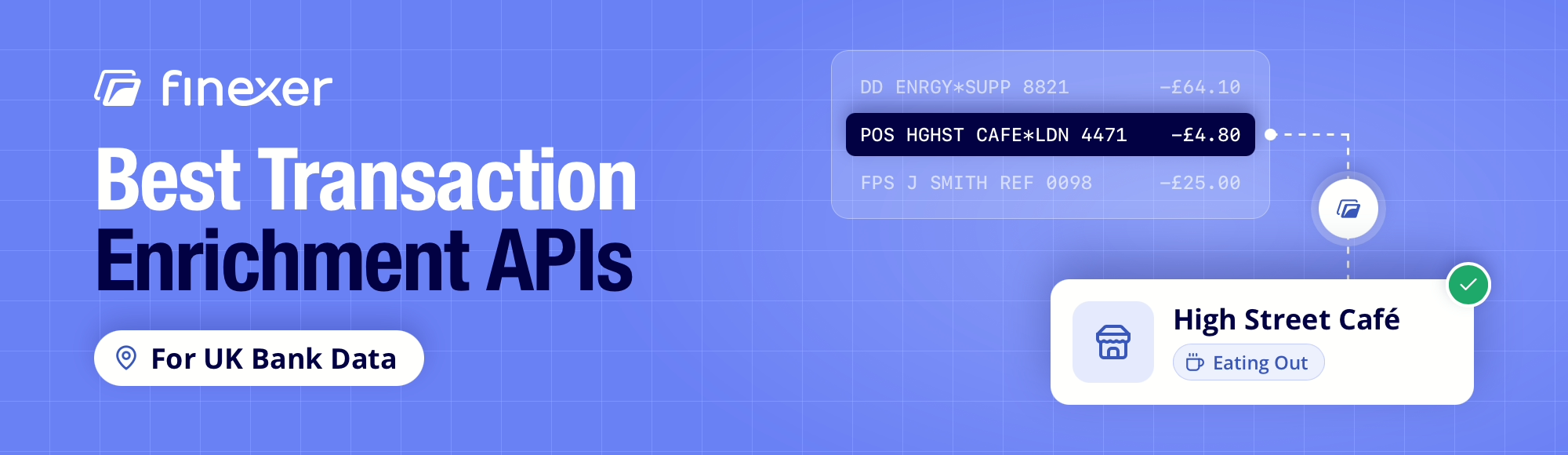
The best transaction enrichment APIs are those you can test against UK merchants in production. For any transaction enrichment API UK, compare merchant identification, category consistency and latency first, then check whether enrichment is bundled with the banking data feed or offered separately.
Open Banking Limited reported 2.81 billion API calls and 40.16 million payments in June 2026 (source: openbanking.org.uk). At that scale, small classification gaps in a transaction enrichment API UK that platforms rely on can become material product problems.
How should you evaluate a transaction enrichment API UK?
To assess a transaction enrichment API UK, use three tests: UK merchant coverage, category consistency and response time. Then check output fields, transaction types and integration models.
| Buyer test | What to test | Why it matters |
|---|---|---|
| UK merchant coverage | Retailers, utilities, subscriptions and local merchants | Global breadth does not prove UK recognition |
| Category consistency | Repeated transactions from the same merchant | Stable categories support reporting and rules |
| Latency | Response time under normal and peak loads | Slow enrichment can delay user-facing data |
| Output depth | Merchant, legal entity, category, location, recurrence and confidence | More context supports more features |
| Integration model | Enrichment in the feed or separate API | Determines architecture and processing |
Why does UK merchant coverage matter more than global coverage?
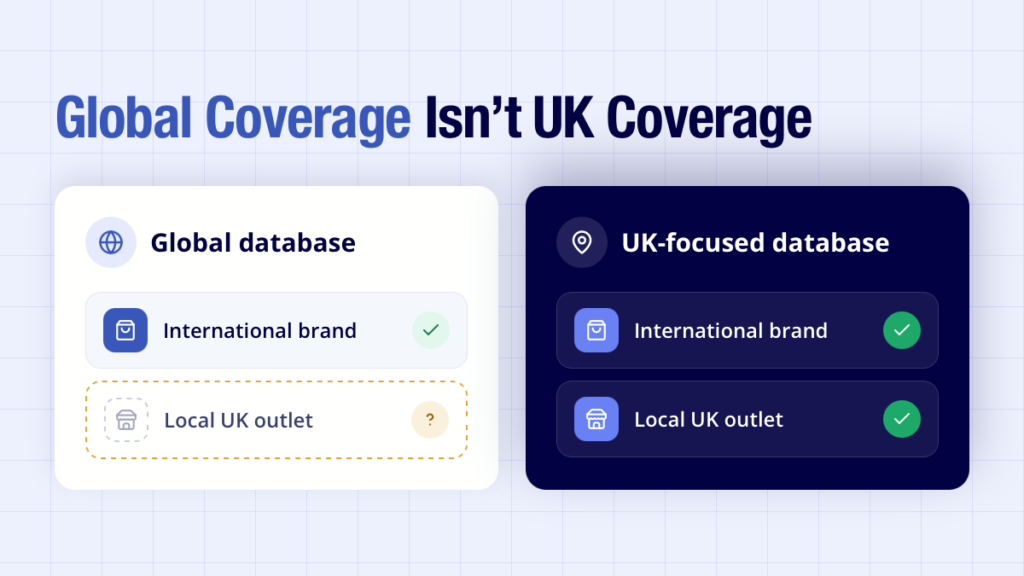
UK merchant coverage matters because the bank descriptors in standard Open Banking transaction data reflect local payment patterns, trading names and payment processors. A database built mainly around US transactions may recognise a global brand while missing a UK trading entity, outlet or familiar descriptor.
For a transaction enrichment API UK, that matters in reporting. Through transaction enrichment, a recognisable merchant name can feed categories, recurring-spend logic, search, dashboards and reconciliation rules. A generic descriptor leaves downstream systems to guess.
TrueLayer documents transaction categorisation across its supported countries, with classification and merchant names for the UK, Ireland and France. Tink offers categorisation and merchant information, including brand names, through its Data Enrichment product, while Yapily supports UK and EU categorisation and returns merchant, recurrence and payment-processor fields.
Which providers are strongest for different requirements?
There is no universal transaction enrichment API UK winner. TrueLayer, Tink and Yapily are relevant when enrichment sits alongside broader Open Banking capabilities, while Plaid’s Enrich is currently documented for US and Canadian use.
| Provider | Publicly described enrichment | UK fit to investigate | Best fit |
|---|---|---|---|
| Finexer | Merchant identification, categorisation and transaction context | UK-focused | UK platforms needing enrichment with banking data infrastructure |
| TrueLayer | Transaction categories and merchant names | UK, Ireland, France | Broader Open Banking data infrastructure |
| Tink | Categories, brands and merchant information | European and multi-market | Wider-market enrichment |
| Yapily | Categories, merchant, recurrence and processor data | UK and EU | Developer-led Open Banking workflows |
| Plaid | Merchant, category and location enrichment | Enrich documented for US/Canada | North American use cases |
Should enrichment be bundled with the banking data feed?
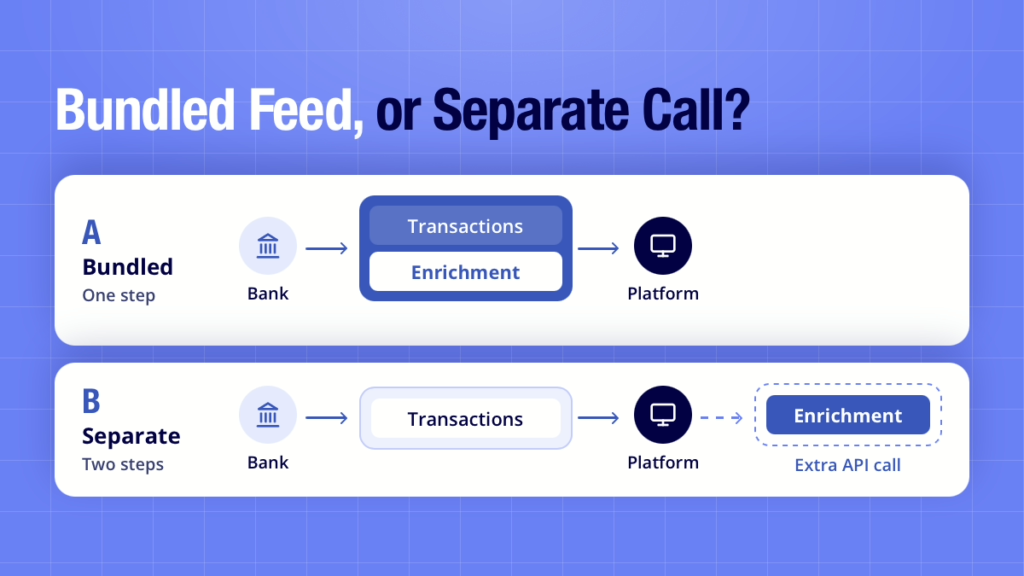
Bundling transaction enrichment with the feed can reduce architectural handoffs, while a separate enrichment API can give teams control over which transactions they process. The right transaction enrichment API UK model depends on whether enrichment is central to the product or an occasional processing step.
Yapily documents enrichment both for transactions sourced through its AIS service and for transaction data supplied directly. Tink offers its categorisation and merchant information as part of its Data Enrichment product.
Ask four questions of any transaction enrichment API UK:
- Can it process the transaction types you receive?
- Can you control when enrichment runs?
- Are enriched fields returned in a stable schema?
- Can your team handle unmatched merchant results?
What should a transaction enrichment API UK return?
A useful transaction enrichment API UK should return merchant identity and category context in a form your product can consume. Confidence matters because downstream workflows should know when identification is less certain.
Finexer’s enrichment product returns an identified merchant name, legal entity, spending category, billing pattern, location data, transaction type and confidence score. It covers card payments, Direct Debits, bank transfers and standing orders.
Finexer Enrichment delivers 95%+ categorisation accuracy, sub-100ms response time and a 100 million+ merchant database. These metrics apply specifically to its enrichment product.
How does Finexer compare for UK-focused platforms?
Finexer is worth considering when a buyer wants UK banking data and transaction enrichment from the same infrastructure relationship. The enrichment layer adds merchant intelligence to standard Open Banking transaction data rather than treating the underlying banking data as defective.
Finexer is infrastructure rather than software for end users. It is FCA-authorised, with FRN 925695, and its Data product provides account, balance and transaction data. It covers almost all major UK banks, including high-street, challenger and business accounts.
If your platform already receives transaction data through Open Banking, adding a transaction enrichment API gives it merchant context without your team building its own merchant database.
Reporting teams benefit from consistent merchant and category fields, because the logic behind their financial reporting tools becomes less dependent on individual bank descriptors.
Finexer’s banking data API provides the UK banking data connection, and Finexer Enrichment adds merchant and category context as an additional layer.
What should you test before choosing?
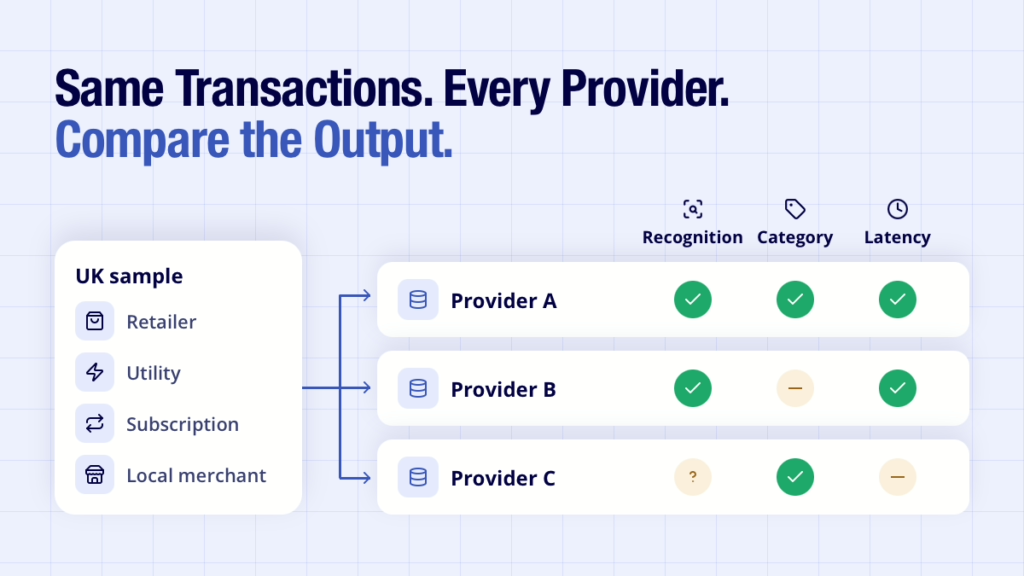
Run the same UK transaction sample through every shortlisted transaction enrichment API UK provider. Measure recognition, category, stability and latency rather than relying on published coverage alone.
Include major UK retailers, utilities, subscriptions, card payments, Direct Debits, bank transfers, local merchants and repeated transactions across different banks.
The best transaction enrichment API UK provider is the one whose output fits your product with the least additional processing, not necessarily the one with the largest stated merchant database.
Is transaction enrichment the same as transaction categorisation?
No. Categorisation assigns a spending or income class to a transaction. Enrichment goes further and can add merchant identity, legal entity, location, recurrence, transaction type and a confidence signal alongside the category, which gives reporting, search and rules engines more context to work with than a category alone.
Can a transaction enrichment API UK work without an Open Banking feed?
Yes. Some providers document standalone enrichment of transaction data supplied by the customer, so a platform can enrich transactions it already holds. Others integrate enrichment directly with their banking data services. Check which model a provider supports before you design how transactions move through your pipeline.
Why should UK platforms test local merchants?
Global coverage can hide gaps in UK trading names, descriptors and payment patterns. A provider may recognise an international brand yet miss a local outlet or a UK payment processor. A UK-specific test set, drawn from your own customers, gives a more useful view of production performance.
Should buyers compare accuracy alone?
No. Accuracy should sit alongside merchant coverage, category consistency, latency, output depth and integration model. A high headline figure means little if categories shift between repeated payments or responses slow down at peak load. Those factors determine how much engineering work remains after the API responds.
Finexer combines UK banking data infrastructure with transaction enrichment to turn inconsistent UK transaction descriptions into structured, transaction-level merchant context
Explore with AI
About the Author

Ravi Ranjan
Ravi Ranjan is Co founder & CEO of Finexer