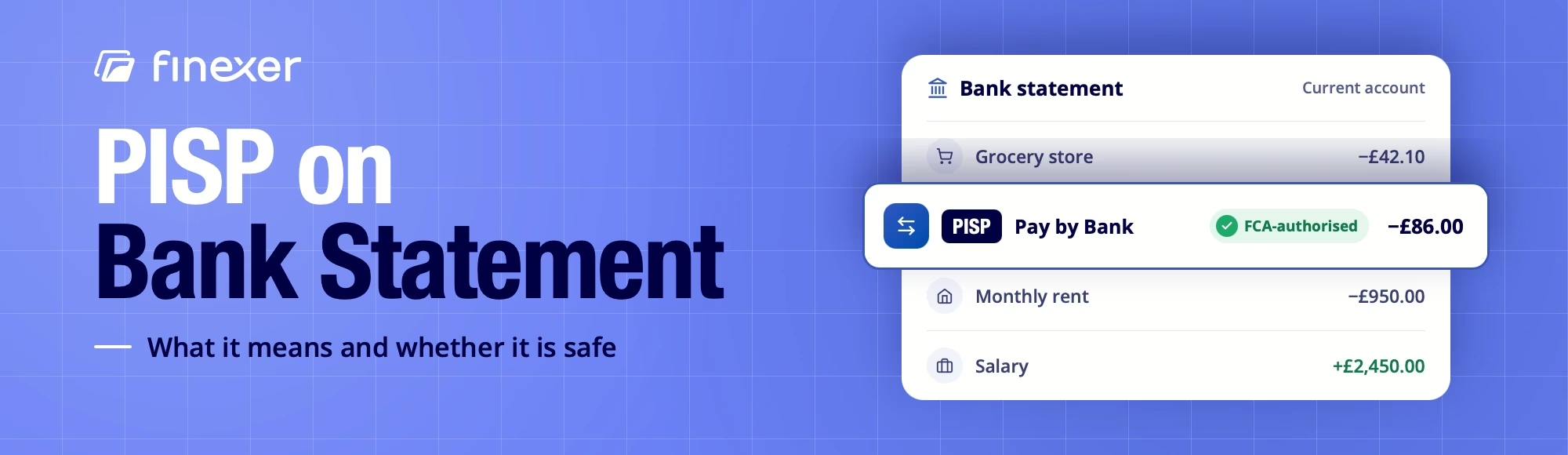
PISP on bank statement stands for Payment Initiation Service Provider – that is the PISP meaning in full. It means a regulated, FCA-authorised firm initiated a bank payment you approved, and there is nothing unusual about it.
According to the PSR Annual Report 2025/26 published on GOV.UK in August 2026, open banking payments in the UK grew by 53% in 2025, with more than 17 million users now benefiting from open banking services.
PISP open banking is a normal part of that growth.
This page covers the PISP meaning, why the reference appears, how to confirm the provider is legitimate, and what to do if the payment looks unfamiliar.
Key Takeaways
- PISP meaning: Payment Initiation Service Provider, a regulated category under the Payment Services Regulations 2017.
- Seeing PISP on bank statement means a regulated provider initiated a payment you authorised.
- A PISP can only move money with your explicit consent and Strong Customer Authentication.
- A PISP cannot access your funds, store your card details, or move money without your approval.
- Verify any provider on the FCA Financial Services Register before accepting it as legitimate.
- If you do not recognise the payment, contact your bank immediately.
What Does PISP on Bank Statement Mean?
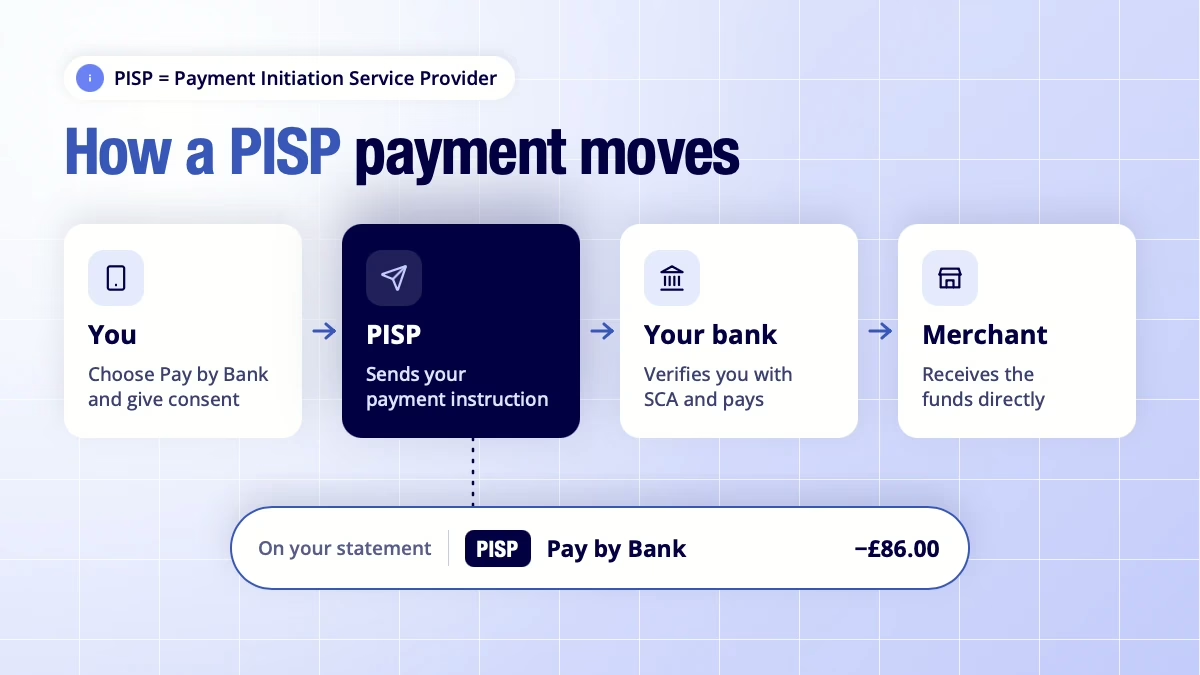
PISP on bank statement means an FCA-authorised payment initiation service provider processed a payment directly from your bank account, typically through a “Pay by Bank” option rather than a card.
The PISP meaning here is straightforward: the provider sends your payment instruction to your bank, the merchant receives the funds, and the PISP reference appears because it, not the merchant, is the regulated entity that carried the instruction.
Why Does the PISP Name Appear Instead of the Merchant Name?
Whether you see the PISP name or the merchant name depends on how your bank displays open banking payment references. Some banks show the PISP’s registered name in the transaction narration field; others show the merchant name alongside it.
This is a bank-level display decision, not a sign anything went wrong.
What Is PISP Open Banking?
PISP open banking means a regulated provider connects to your bank directly under FCA rules, rather than routing through a card network. Seeing PISP on a bank statement confirms three things:
- A regulated provider was involved in initiating the payment
- You gave explicit consent before the payment was processed
- The transaction went through your bank’s own authorisation flow, not a card network
If the reference is unfamiliar, check it against any recent “Pay by Bank” purchases before concluding.
Is PISP on Bank Statement Safe and Legitimate?
Yes, in almost all cases, provided the provider is properly authorised. The FCA must authorise payment initiation service providers under PSD2 regulation before initiating a single payment.
FCA rules on open banking security require mandatory Strong Customer Authentication, meaning your own bank verifies your identity before the payment is released.
Strong Customer Authentication is non-negotiable. No payment initiation service provider can complete a transaction without the customer first authenticating through their banking app using biometrics, a PIN, or a one-time passcode.
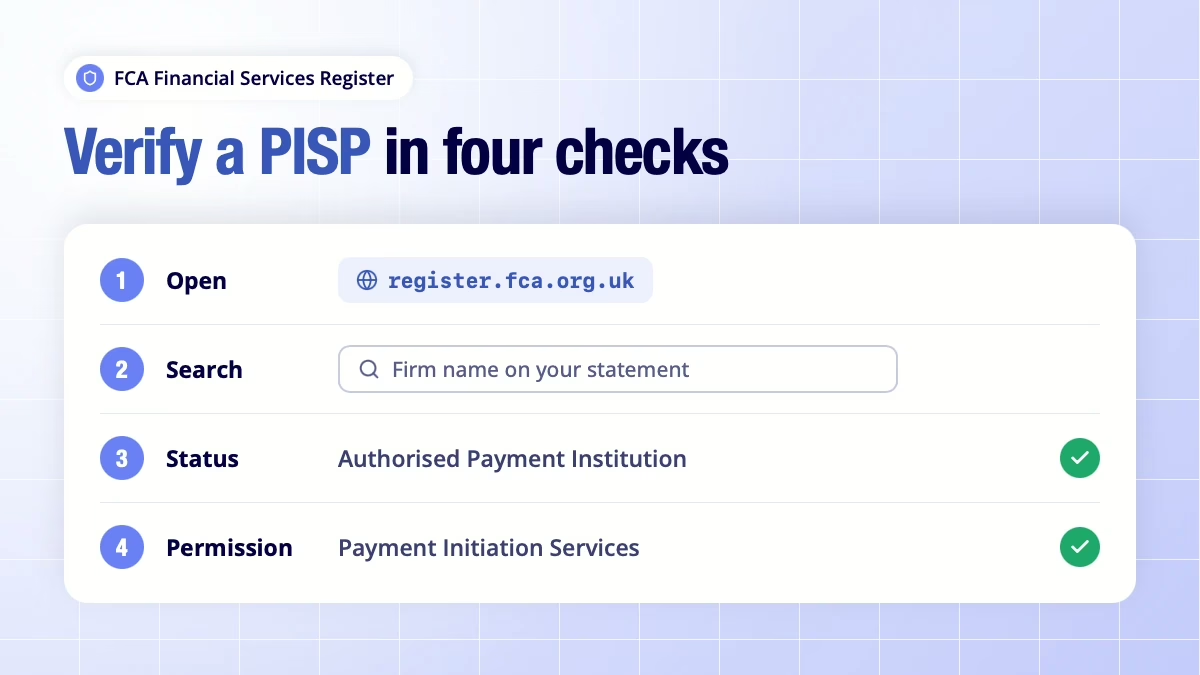
How to Check a Provider on the FCA Register?
To confirm a provider is legitimate, use the FCA Financial Services Register:
- Go to register.fca.org.uk
- Search the firm name shown on your statement
- Confirm the firm holds “Authorised Payment Institution” status
- Check that “Payment Initiation Services” is listed under its permitted activities
A firm that does not appear, or lacks that permission, should be treated as unverified. Contact your bank immediately if you cannot confirm the provider’s authorisation status.
What a PISP Can and Cannot Do?
The table below provides quick snapshots of what a PISP is eligible for and its limitations:
| What a PISP Can Do | What a PISP Cannot Do |
|---|---|
| Initiate a payment you explicitly authorise | Move money without your consent |
| Send your instruction to your bank | Hold or store your funds |
| Confirm a payment has been initiated | Access your balance or history (needs an AISP) |
| Operate under FCA authorisation | Store your card details or banking passwords |
For a full comparison of what a PISP does versus “what is an aisp“, the key distinction is that a PISP initiates payments whilst an AISP reads account data. Neither can access your funds independently.
What Should You Do If You Do Not Recognise the Payment?
Seeing an unfamiliar PISP on bank statement is worth checking, not panicking over. Follow these steps:
- Check recent “Pay by Bank” activity first: The PISP name may differ from the merchant name. Match the amount and date against any recent open banking payment you completed.
- Contact your bank directly using the number on the back of your card: Under the Payment Services Regulations 2017, your bank must investigate and, where applicable, refund an unauthorised payment.
- Verify the provider on the FCA register at register.fca.org.uk before taking any further action.
- Report suspected fraud through your bank: The FCA advises consumers to contact the bank as the first point of contact for any disputed payment.
- Never share your banking password, PIN, or one-time passcode with anyone claiming to investigate the payment on your behalf: Legitimate banks and FCA-authorised firms will never ask for this.
What Does PISP Mean for Businesses and Platforms?
For business readers, a payment initiation service is the regulated infrastructure behind account-to-account payments. PISP open banking enables customers to pay directly from their bank account, bypassing card networks entirely.
The PSR Annual Report 2025/26 already confirmed the growth of open banking in the UK which indeed is a clear signal that account-to-account payment volumes are reaching commercial scale.
Why Platforms Use Payment Initiation Service Providers?
UK platforms adopt payment initiation service providers for three practical reasons:
- Lower transaction costs: Account-to-account payments carry no interchange fee, unlike card payments where merchant fees typically run 0.3–1.5% per transaction.
- Faster settlement: Open banking payments route through Faster Payments, with 95% settling in under 15 seconds.
- Reduced compliance burden: Strong Customer Authentication is enforced by the customer’s own bank, and the regulatory obligations sit with the payment initiation service providers, not the integrating platform.
Finexer: An FCA-Authorised PISP
Finexer is not a bank or a consumer app, which is exactly why the name may look unfamiliar. Finexer is UK infrastructure that platforms build on: one of the payment initiation service providers authorised directly by the FCA.
If Finexer appears as PISP on a bank statement, a platform you use chose Finexer to move that specific payment, initiated only with your explicit authorisation through SCA.
- FCA-authorised for both AIS and PIS under FRN 925695
- Settles bank-to-bank via Faster Payments, no card network involved
- Customers authenticate directly with their bank, while Finexer securely handles consented banking data through its FCA-authorised AIS infrastructure.
- Coverage across most of the UK banks with transparent pricing (no hidden charges)
UK platforms use Finexer’s payments API to collect and disburse funds this way instead of routing through cards.
Bottom Line
Seeing PISP on bank statement is not a cause for alarm. It confirms a regulated, FCA-authorised payment initiation service provider carried out a payment you approved through your banking app.
A PISP cannot move money without your consent, cannot hold your funds, and cannot access your account data. If the payment is familiar, no action is needed. If it is not, contact your bank directly and verify the provider on the FCA register.
What does PISP stand for on a bank statement?
PISP on bank statement stands for Payment Initiation Service Provider. The PISP meaning is that an FCA-authorised firm initiated a bank payment you approved, usually through a ‘Pay by Bank’ option at checkout or in a billing portal.
What is PISP open banking?
PISP open banking refers to a regulated provider initiating a payment directly from your bank account via the Open Banking framework, under FCA authorisation. It is the mechanism behind ‘Pay by Bank’ options you see at checkout. If PISP open banking appears on your statement, it confirms a regulated, consent-based payment was made.
Is a PISP on my bank statement a sign of fraud?
Not in itself. Payment initiation service providers are regulated by the FCA under the Payment Services Regulations 2017 and can only initiate payments with your explicit consent and Strong Customer Authentication. If you authorised a ‘Pay by Bank’ payment, seeing PISP on a bank statement is expected. If you do not recognise it, contact your bank immediately.
Can a PISP take money from my account without permission?
No. Payment initiation service providers cannot move funds without your explicit authorisation and Strong Customer Authentication. Under FCA rules, a PISP cannot store your credentials, hold your funds, or initiate any transaction without your active approval through your banking app.
Building a platform that needs FCA-authorised payment initiation? Finexer initiates payments inside the customer’s own banking app, with SCA built in and no card data to store.
Explore with AI
About the Author

Ravi Ranjan
Ravi Ranjan is Co founder & CEO of Finexer