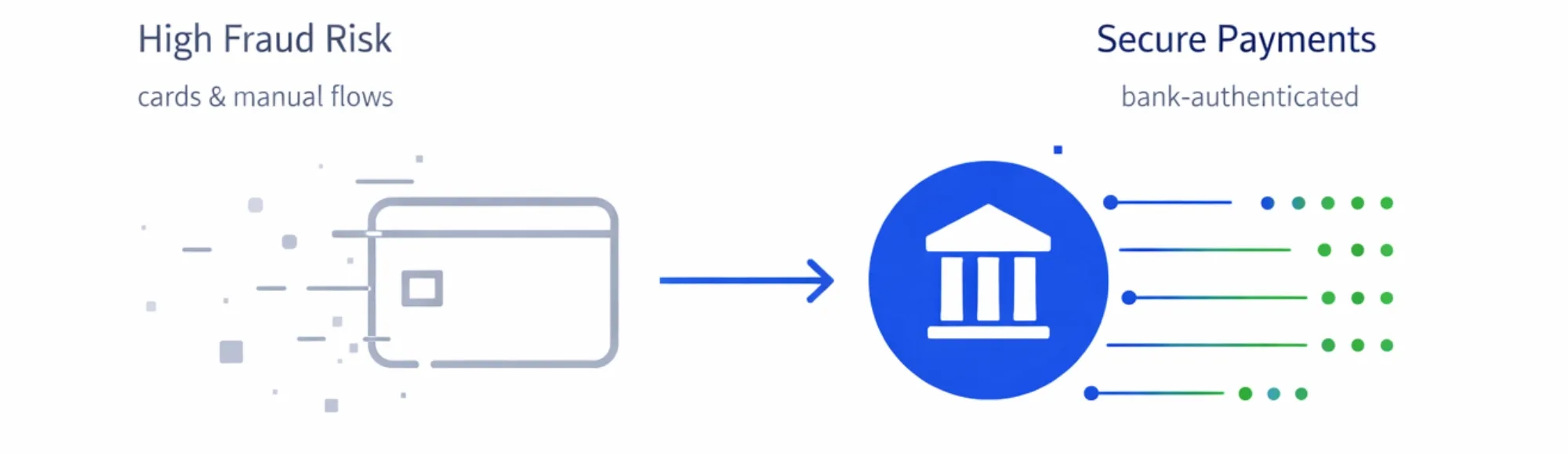
Manual audit trails creating compliance gaps?
Access verified bank transaction data for audit-ready regulatory reporting.
Alternative payment methods are not just a cost decision. They are a fraud and reliability decision.
Card payments expose platforms to chargebacks. Manual bank transfers expose users to APP scams. BACS creates 3 working day settlement gaps where fraud can complete before detection. BNPL carries credit risk that sits outside the platform’s control.
The alternative payment methods a platform chooses determine where fraud can enter. Platforms that evaluate methods only on transaction fees discover the real cost later – in chargeback disputes, failed collections, and manual fraud review overhead.
At Finexer, I work with EPOS, utility billing, and payment platforms evaluating payment infrastructure. The fraud and reliability trade-offs between methods are almost never discussed until they are a live problem.
TL;DR
Alternative payment methods in the UK range from card payments and digital wallets to Pay by Bank (A2A), Direct Debit, and Variable Recurring Payments. Each carries a different fraud profile. Cards are vulnerable to stolen credential fraud and chargebacks. Manual transfers are the primary vector for APP scams. Pay by Bank via Open Banking uses SCA at the bank level, has no chargeback mechanism, and records a fraud rate of 0.013% by volume – compared to 0.045% across all payment types. For platforms, the method determines the fraud exposure before any fraud prevention logic runs.
Key Takeaways
What are the main alternative payment methods in the UK?
The main alternative payment methods in the UK are:
- Pay by Bank (A2A via Open Banking) – bank-to-bank payment with SCA, instant Faster Payments settlement
- Direct Debit (BACS) – recurring collection with 3 working day settlement, Bacs Direct Debit guarantee
- Digital wallets (Apple Pay, Google Pay) – card-backed pass-through with tokenisation
- BNPL (Buy Now, Pay Later) – deferred payment with credit risk transfer
- Card payments (debit/credit) – ubiquitous but highest chargeback exposure
Which payment methods carry the highest fraud risk for platforms?
Card payments carry the highest chargeback exposure – stolen card details can generate fraudulent transactions that platforms must dispute. Manual bank transfers are the primary APP fraud vector. BACS creates a 3 working day window where fraud can complete before detection. Pay by Bank via Open Banking has the lowest fraud rate – 0.013% by transaction volume.
Why does Pay by Bank reduce payment processing fraud risk?
Pay by Bank uses Strong Customer Authentication (SCA) directly within the user’s bank app. No card details are shared. There is no chargeback mechanism – the bank processes a valid authorised payment. The fraud rate recorded by Open Banking Limited in 2025 was 0.013% by volume, versus 0.045% across all payment types.
What makes a payment method reliable for platform collections?
Reliability requires instant settlement confirmation, no chargeback reversal risk, and consistent payment completion rates. Pay by Bank via Faster Payments settles in seconds with webhook confirmation. Direct Debit via BACS settles in 3 working days with cancellation exposure. Cards settle in 2-5 days with chargeback reversal risk.
What Are the Alternative Payment Methods Available in the UK?
Which Payment Methods Should UK Platforms Evaluate?
Every payment method in use across UK platforms carries a distinct fraud profile. The choice is not just about which methods to accept – it is about which fraud exposures to accept alongside them.
| Payment Method | Settlement | Fraud Exposure | Chargeback Risk |
|---|---|---|---|
| Card (debit/credit) | 2-5 days | Stolen credentials, CNP fraud | High |
| Digital wallet | 2-5 days (card-backed) | Lower than card, tokenised | Medium |
| Direct Debit (BACS) | 3 working days | APP scams, cancellation | Low-medium |
| BNPL | Variable | Credit default, identity fraud | Provider-level |
| Pay by Bank (A2A) | Seconds | Lowest – SCA at bank, no card data | None |
Complete guide to Open Banking payments for UK platforms covers how A2A payment initiation works technically and where it fits in a platform payment stack.
“When I ask platform teams about their fraud exposure, the conversation almost always starts with their fraud detection logic. It rarely starts with their payment method. The method determines what fraud is even possible before any detection layer runs.” – Ravi, Finexer
Where Does Fraud Enter Each Payment Method?
What Are the Fraud Vulnerabilities by Payment Type?
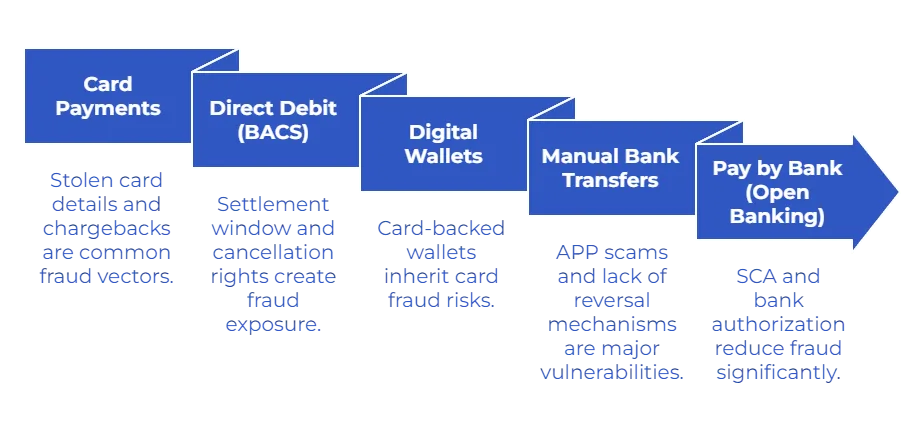
Understanding payment processing fraud prevention starts with understanding where fraud enters each alternative payment method.
Card payments:
- Stolen card details used for card-not-present (CNP) fraud
- Chargebacks used as a fraud vector – goods received, payment disputed
- No bank-level authentication in standard card flows
- Platform absorbs chargeback cost and processing overhead
Direct Debit (BACS):
- 3 working day settlement window allows payment to complete before fraud is detected
- Cancellation and refund rights create exposure for subscription platforms
- No SCA requirement in standard BACS flows
Digital wallets:
- Card-backed – inherits card fraud exposure unless linked directly to bank
- Tokenisation reduces stolen card data risk at checkout
- Does not eliminate chargeback exposure
Manual bank transfers:
- Primary vector for APP (Authorised Push Payment) scams
- According to Open Banking Limited’s 2025 financial crime update, UK businesses and consumers lost over £600 million to APP fraud in H1 2025
- User is manipulated into authorising a legitimate-looking payment
- No reversal mechanism once payment clears via Faster Payments
Pay by Bank (Open Banking):
- The most fraud-resistant alternative payment method available to UK platforms
- SCA required at the bank level – user authenticates directly in their bank app
- No card data shared – eliminates CNP fraud vector entirely
- No chargeback mechanism – payment is bank-authorised
- Fraud rate = 0.013% by transaction volume (OBL 2025)
The truth about Open Banking security for UK platforms covers how Open Banking’s security architecture compares to card-based payment fraud profiles.
What Is the Business Impact of High-Fraud Payment Methods?
How Does Payment Method Choice Affect Platform Operations?

Choosing a payment method with high fraud exposure creates three compounding operational problems:
- Chargeback overhead – each disputed card transaction requires investigation, documentation, and dispute filing. At scale, this creates significant operational overhead that no fraud detection tool fully eliminates
- Manual review cost – high-fraud payment methods require monitoring, flagging, and review workflows. This cost grows with transaction volume
- Settlement delay exposure – 2-5 day card settlement and 3 working day BACS settlement windows give fraud time to complete before platforms can act. By settlement, funds have already moved
According to the PSR’s APP reimbursement rules introduced in 2024, platforms with payment processing fraud exposure must also consider regulatory liability for fraud losses that reach consumers through their infrastructure.
TrueLayer alternatives for Open Banking payment infrastructure covers how Open Banking PIS providers compare on fraud exposure, reliability, and payment feature completeness for UK platforms.
| Platform Type | Primary Fraud Risk | Recommended Method | Why |
|---|---|---|---|
| EPOS platforms | CNP fraud, chargebacks at scale | Pay by Bank (QR / Payment Link) | SCA at bank, no chargeback exposure, instant confirmation |
| Utility billing | BACS cancellation, late detection | VRP (Variable Recurring Payments) | Merchant-controlled, pre-authorised, no per-payment re-auth |
| Payment SaaS | Card fraud, settlement gaps | Pay by Bank + webhook confirmation | Instant settlement, real-time confirmation, zero chargebacks |
| Accounting SaaS (collections) | Manual transfer APP fraud | Payment Links via Open Banking | Replaces manual transfer instruction with authenticated payment |
How Does Finexer Provide Secure Alternative Payment Infrastructure?
What Does Finexer’s PIS Offer for Payment Processing Fraud Prevention?
The problem: card payments create chargeback exposure, manual transfers enable APP fraud, and BACS creates settlement gaps that allow fraud to complete. For platforms evaluating alternative payment methods for fraud prevention, Finexer’s FCA-authorised PIS eliminates these exposures by enabling bank-authenticated payments with instant settlement and webhook confirmation.
Finexer PIS features:
- Pay by Bank via Faster Payments – SCA at bank level, instant settlement, zero chargebacks, no card data
- Payment Links – shareable payment initiation that replaces manual bank transfer instructions, removing APP fraud vector
- QR code payments – point-of-sale initiation without redirect, no card data exposure
- VRP (Variable Recurring Payments) – pre-authorised merchant-controlled recurring collection, no per-payment re-authentication
- Bulk Payout – outbound disbursements via single API call, webhook confirmed
- Webhook confirmation per payment – real-time settlement status, no batch reconciliation gaps
- Covers almost all major UK banks – high street, challenger, and business providers
- Usage-based pricing, 3-5 weeks to production deployment
Top alternative to Stripe Connect for UK platforms covers how Finexer’s PIS compares to card-based payment infrastructure on fraud exposure and operational cost.
“The payment method is the first fraud prevention decision. Pay by Bank removes the card data fraud vector, eliminates chargeback exposure, and authenticates at the bank. Everything else – monitoring, detection, review – operates on what gets through the method itself.” – Ravi, Finexer
What I Feel
Fraud prevention conversations focus on detection – AI models, transaction monitoring, risk scoring.
Very few start with which alternative payment methods the platform is using.
But the method determines what fraud is structurally possible. A platform that removes card data from the flow cannot suffer CNP fraud from that flow. A platform that replaces manual transfer instructions with Payment Links removes the social engineering vector those instructions create.
Detection fixes fraud after it enters. Method selection prevents it from entering.
Common Use Cases

EPOS Platforms
Card fraud and chargebacks at scale create significant operational overhead for EPOS platforms. Finexer’s QR and Payment Link initiation:
- Authenticates via the user’s bank app – no card data in the flow
- Settles instantly via Faster Payments
- Delivers webhook confirmation per transaction
- Carries zero chargeback exposure
Utility Billing Platforms
BACS Direct Debit creates a 3 working day settlement window and cancellation exposure every billing cycle. Finexer’s VRP:
- Pre-authorises collection within agreed parameters
- Initiates on the billing date without re-authentication
- Eliminates the per-cycle authentication failure that creates arrears
- Settles via Faster Payments with instant webhook confirmation
Accounting SaaS (Collections)
Manual bank transfer instructions in invoices are the primary APP fraud vector for accounting clients. Finexer’s Payment Links:
- Replace manual sort code and account number in invoice
- Initiate a bank-authenticated payment directly
- Remove the social engineering opportunity that manual instructions create
- Deliver real-time settlement confirmation back to the platform
What are alternative payment methods in the UK?
Alternative payment methods in the UK include Pay by Bank (A2A via Open Banking), Direct Debit via BACS, digital wallets, BNPL, and card payments. Each carries a different fraud profile. Pay by Bank uses SCA at the bank level and has no chargeback mechanism, recording a fraud rate of 0.013% by volume in 2025.
How do alternative payment methods reduce fraud?
Pay by Bank via Open Banking removes card data from the payment flow, eliminating CNP fraud exposure. SCA is authenticated directly in the user’s bank app. There is no chargeback mechanism – the payment is bank-authorised. Payment Links replace manual transfer instructions, removing the social engineering vector that enables APP scams.
What is the most secure payment method for UK platforms in 2026?
Pay by Bank via FCA-authorised Open Banking PIS is the most fraud-resistant alternative payment method for UK platforms. It uses bank-level SCA, shares no card data, carries no chargeback exposure, and records a 0.013% fraud rate by volume – compared to 0.045% across all UK payment types.
Build secure payment workflows on FCA-authorised Pay by Bank and VRP infrastructure.
About the Author

Ravi Ranjan
Ravi Ranjan is Co founder & CEO of Finexer