Developers choosing an API for bank transactions often compare feature matrices: “Does it support this bank? Does it return merchant data?” These questions matter.
But they miss what actually breaks implementations: coverage gaps during peak transactions, webhooks that don’t fire when payment status changes, inconsistent data formats across bank types, and licensing limits on how much historical data you can retrieve.
This guide covers what to ask providers before integrating an API for bank transactions into production. It’s built on failure modes, not marketing claims.
What Is an API for Bank Transactions?
An API for bank transactions connects your application to customer bank accounts, allowing you to retrieve transaction history, balance data, and payment events via open banking standards. In the UK, this operates under PSD2 (Payment Services Directive 2) via Account Information Services (AIS) licensing.
Open Banking has become mainstream UK infrastructure rather than an emerging technology. Open Banking Limited reported more than 24 billion successful API calls in 2025, a 27% increase year on year, highlighting the growing use of API-based financial data sharing.
How does the API for Bank Transactions Work?
Think of it as a direct data pipeline: instead of customers uploading bank statements manually, the API fetches live transaction data from their bank. But “live” has nuances. Some providers deliver webhooks the moment a transaction clears. Other batch events. Some return raw bank data. Others enrich it with merchant categorisation. These differences compound when you’re processing thousands of transactions per day.
If your primary use case is importing bank transaction data into accounting or finance platforms, our guide to choosing a bank feed API explains the integration options and key evaluation criteria.
The core challenge: Open banking standards (AIS) are consistent. Implementation is not. Coverage gaps, webhook reliability, and data format inconsistencies are where most integrations fail.
Failure Mode 1: Coverage Gaps Across UK Banks
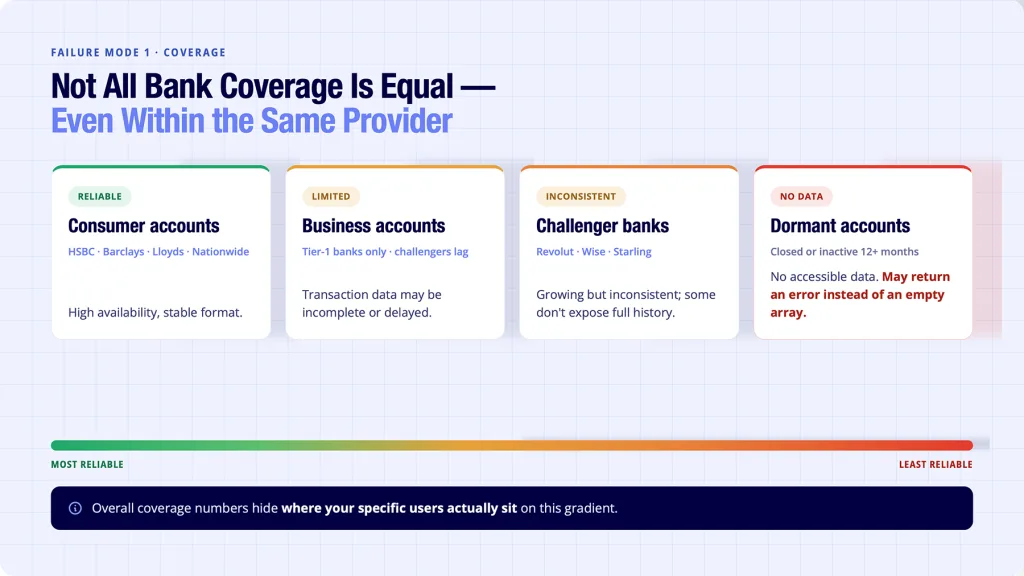
Not all API to get bank transactions providers support all UK banks equally. Coverage varies most on the business banking side, where most fintech platforms need it most.
| Coverage Category | What Does This Mean? | Risk |
|---|---|---|
| Consumer accounts | HSBC, Barclays, Lloyds, Nationwide | High availability, stable format |
| Business accounts | Limited to tier-1 banks; challenger banks lag | Transaction data may be incomplete or delayed |
| Challenger banks | Revolut, Wise, Starling | Growing but inconsistent; some don’t expose full transaction history |
| Dormant accounts | Closed or inactive for 12+ months | No accessible data; the provider may return an error instead of an empty array |
Evaluating an API to get bank transactions means checking: Does it support your users’ exact bank type, account tier, and account status? Overall bank coverage is only one part of the evaluation. Make sure the provider supports the specific banks, account types, and customer segments your platform serves.
So, it is recommended to test with your actual user base in the sandbox before committing.
Failure Mode 2: Webhook Inconsistency and Event Delays
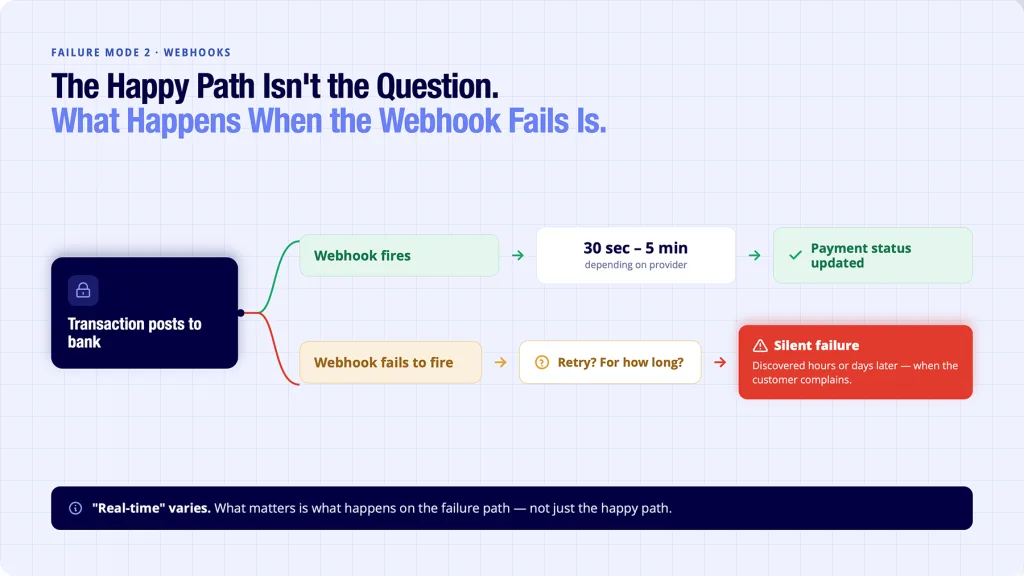
Real-time webhooks are non-negotiable for payment-critical workflows. But “real-time” varies.
Some API to get bank transactions providers fire webhooks the moment a transaction posts to the bank. Others batch events and deliver once per hour. Some don’t support webhooks at all, forcing you to poll (constant API calls, higher costs, stale data).
What to ask:
- Does the provider support webhooks per transaction?
- What’s the typical latency from bank posting to webhook delivery? (Expect 30 seconds to 5 minutes, depending on the bank.)
- What happens if a webhook fails? (Does it retry? For how long?)
- Can you configure which transaction events trigger webhooks? (e.g., only high-value or flagged transactions)
Missing webhooks = you discover payment delays hours or days later when customers complain. This is the most common failure point in production integrations.
Failure Mode 3: Raw vs Enriched Data and Format Inconsistency
Banks return transaction data in different formats. Some provide merchant names. Some return codes. Some omit category data entirely. An API for bank transactions provider can either pass raw bank data through or enrich it with standardised merchant categorisation, reference parsing, and transaction type inference.
- Raw data is fast and low-latency. You get exactly what the bank sends.
- Enriched data is more usable but adds processing latency and vendor dependency.
| Data Type | Delivery | Characteristics | Best For |
|---|---|---|---|
| Raw bank data | Direct from the bank | Unprocessed transaction information | Payments, reconciliation, compliance |
| Enriched data | After enrichment | Merchant names, categories, insights | Analytics, expense management |
| Hybrid | Combined delivery | Raw bank data plus enrichment | Financial platforms need both operational data and insights |
Ensure your chosen provider’s data format matches your database schema before integration. Mismatches require transformation layers- extra code, extra latency, extra failure points.
AIS vs PIS: Licensing and Data Access Limits
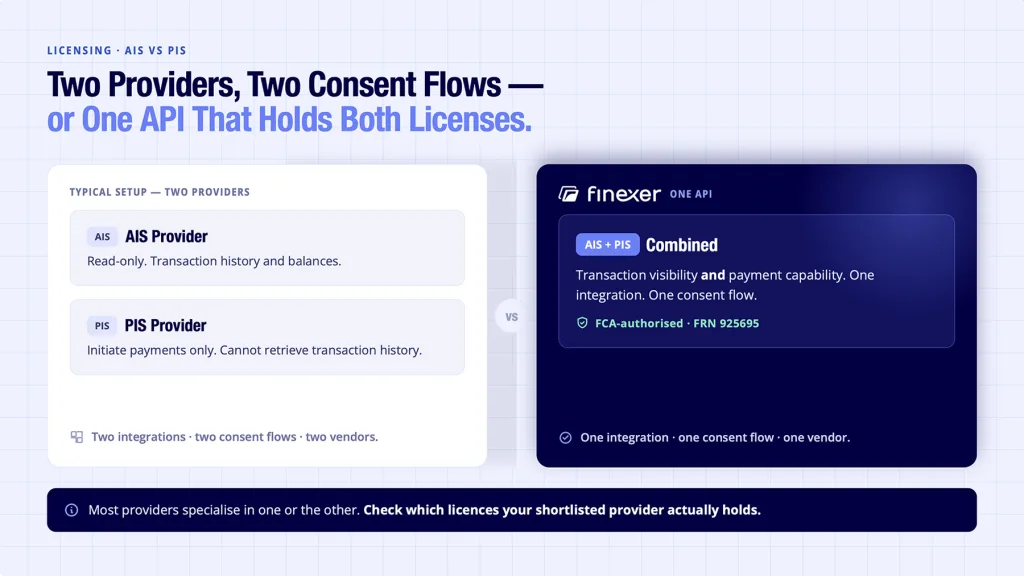
Understanding the regulatory split is critical. UK open banking distinguishes between:
- AIS (Account Information Services): Read-only access to transaction history and balances. Governed by the account holder’s consent. No payment initiation. 90-day lookback standard; some providers offer a 7-year history.
- PIS (Payment Initiation Services): Initiate payments on behalf of the account holder. Different regulatory requirements and stricter liability rules.
An API for bank transactions that only needs transaction history requires AIS licensing. If you’re building payment features alongside transaction access, you need both AIS and PIS, which adds compliance overhead.
Key Question to Consider
Does your chosen provider hold both licenses, or just AIS? PIS-only providers can’t retrieve transaction history. AIS-only providers can’t initiate payments. Hybrid providers (AIS + PIS) offer unified APIs but typically cost more.
Where Does Finexer Fit?
For developers building platforms that need both transaction visibility and payment capability, Finexer offers unified infrastructure through Finexer’s Data API. The per-bank variance this guide describes is handled below your integration, so you build against one consistent API. The specifics:
- Real-time transaction data with webhook delivery as transactions post, across consumer, business, and challenger accounts
- Up to 7 years of historical transaction data, with the account holder’s consent
- Structured JSON per transaction, consistent across banks
- Connection monitoring and maintenance handled by Finexer, not your team
- FCA-authorised (FRN925695) as both AISP and PISP
- 99% UK bank coverage
- Usage-based pricing, so the cost tracks your call volume
- White-label deployment: your users see your product, not Finexer’s
- 3-5 weeks of onboarding support from integration start to go-live
If richer transaction intelligence matters to your build, Finexer’s separate Transaction Enrichment API adds verified merchant names and spending categories on top of the raw data.
Why does this matter?
Most API for bank transactions providers specialise in either data retrieval OR payment initiation. Finexer combines both in a single API, so you don’t integrate two providers and manage two consent flows.
The technical advantage
Built on open banking standards (PSD2-compliant, FCA-authorised as both AISP and PISP), so your compliance obligations are clear. PCI DSS-compliant infrastructure means transaction data is encrypted in transit and at rest. Coverage across 99% of UK banks means you’re not managing coverage exceptions for each user.
Explore Finexer’s AIS API for bank data to understand implementation, testing, and integration requirements.
How to Choose an API for Bank Transactions?
Choosing the right API to get bank transactions means looking beyond features to assess coverage, data quality, webhook reliability, and regulatory compliance
Score providers on these five criteria:
- Coverage – Does it support your users’ exact banks and account types? Test in sandbox.
- Webhook reliability – Real-time delivery, retry logic, configurable events?
- Data format – Raw, enriched, or hybrid? Does it match your schema?
- Regulatory licensing – AIS only, or AIS + PIS? Check the FCA Register independently.
- Latency & uptime – Does the provider offer low-latency responses and a clearly defined uptime SLA?
Testing in a sandbox is non-negotiable. Most failures emerge during edge cases: dormant accounts, closed accounts, high-transaction-volume days, or delayed bank feeds.
Once you’ve shortlisted providers, it’s worth understanding the technical steps involved in a successful banking API integration before moving to production.
Conclusion
Choosing an API for bank transactions requires moving beyond feature lists. Coverage gaps, webhook inconsistencies, and data format mismatches are where integrations fail in production. Score providers on reliability- real-time webhooks, consistent data formats, and broad coverage.
The right API to get bank transactions should do more than connect to banks. It should provide reliable coverage, consistent data, and real-time visibility when payment volumes increase. The real test of a bank API isn’t a successful demo- it’s how reliably it performs in production.
What is a bank transaction API?
An API for bank transactions allows your application to fetch transaction history and real-time payment events from customer bank accounts via open banking standards (PSD2 in the UK). Instead of manual uploads, the API retrieves live data, pending transactions, cleared payments, and balance updates- with user consent.
How do you choose an API to get bank transactions?
Evaluate based on coverage (does it support your users’ banks?), webhook reliability (real-time event delivery?), data quality (raw or enriched?), and licensing (AIS, PIS, or both?). Test with real user accounts in the provider’s sandbox before integrating to production.
What data does an API for bank transactions return?
Transaction date, amount, merchant name (raw or enriched), transaction reference, account balance, and transaction status. Historical depth varies- most offer 90 days; some (like Finexer) offer up to 7 years. Webhook events deliver payment status changes in real-time.
What happens when an API for bank transactions fails?
Coverage gaps mean some users can’t connect. Webhook failures mean you don’t know when payments arrive. Data inconsistencies mean your reconciliation logic breaks. Mitigation: test extensively, implement retry logic, log all failures, and alert on missing webhooks.
Explore how Finexer’s unified Open Banking infrastructure is designed to support real-world payment and data workflows at scale.
To see how Finexer can support your bank data and payment integration.
Explore with AI
About the Author

Ravi Ranjan
Ravi Ranjan is Co founder & CEO of Finexer