Manual audit trails creating compliance gaps?
Access verified bank transaction data for audit-ready regulatory reporting.
UK regulated platforms cannot maintain audit trail compliance when financial records depend on manual bank statement uploads. LawTech platforms, accounting SaaS, and fintech products need verified transaction data providing structured financial records without operational overhead.
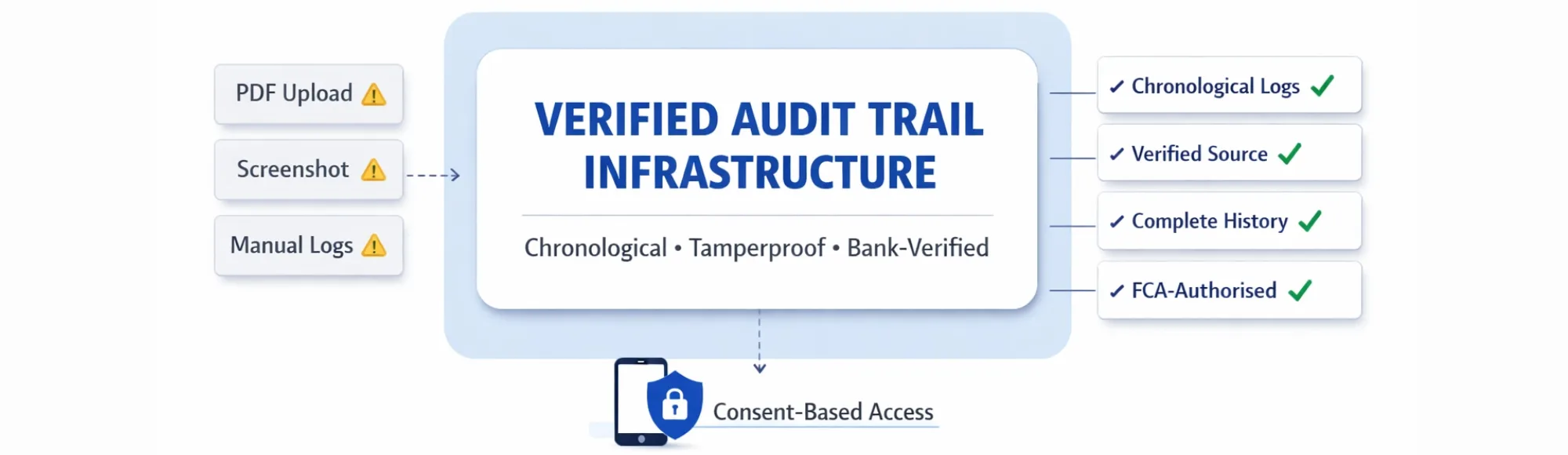
Audit trail compliance in the UK requires automated, tamperproof, and chronological logs of financial transactions. Key requirements include recording user identification, timestamps, and data alterations. Manual processes create gaps when records lack structure and verification.
This explains how UK platforms achieve audit trail compliance using verified bank transaction data and why consent-based access supports full audit trail requirements.
Key Takeaways
What is audit trail compliance?
Audit trail compliance requires automated, tamperproof, chronological logs of financial transactions. UK platforms need verified bank transaction data providing structured records meeting regulatory requirements for GDPR, FCA, and HMRC audits.
What is a full audit trail?
A full audit trail includes complete transaction history, user identification, timestamps, counterparty details, payment amounts, and data modifications. Platforms access structured bank data through Open Banking providing audit-ready records.
Why does verified transaction data matter?
Manual screenshots lack verification. Platforms need consent-based bank data access providing transaction-level visibility and audit-ready records supporting compliance requirements.
What should platforms evaluate?
Verified data sources, transaction completeness, chronological logging, historical depth, structured format, and FCA-authorised infrastructure.
Where does Finexer fit?
Finexer provides verified bank transaction infrastructure. Platforms access financial data through FCA-authorised Open Banking APIs. Platforms build audit trail compliance features on top.
Why platforms need audit trail compliance infrastructure
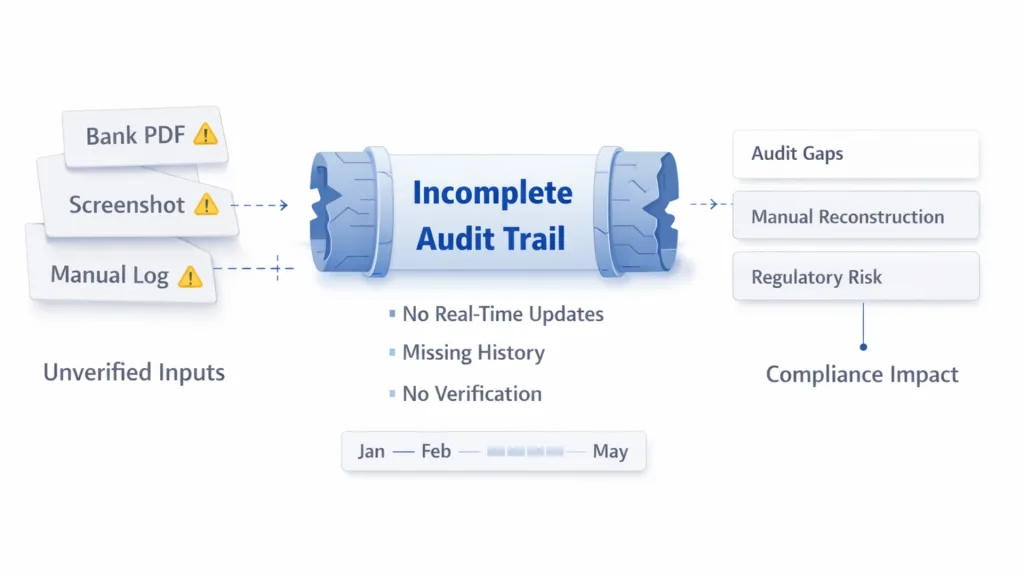
LawTech platforms managing client accounts cannot demonstrate proper oversight when financial records consist of unverified PDFs. Solicitors handling client money face strict audit requirements under SRA Account Rules and Money Laundering Regulations 2017.
LawTech platforms require:
- Verified transaction records for client account audits
- Complete chronological financial history
- Counterparty visibility for compliance verification
- Immutable logs demonstrating proper oversight
Accounting SaaS platforms need:
- Structured transaction records for client reporting
- Complete financial history supporting tax audits
- Verified bank data for MTD ITSA compliance
- Audit-ready logs eliminating manual reconstruction
Fintech platforms depend on:
- Transaction-level audit trails for FCA compliance
- Verified financial records for regulatory reporting
- Complete historical data for supervisory reviews
- Structured logs supporting accountability
Manual bank statement collection prevents proper audit trail compliance. Users upload PDFs without verification. Screenshots lack authentication. Financial records remain incomplete when transaction visibility depends on periodic manual uploads.
What breaks manual audit trail workflows
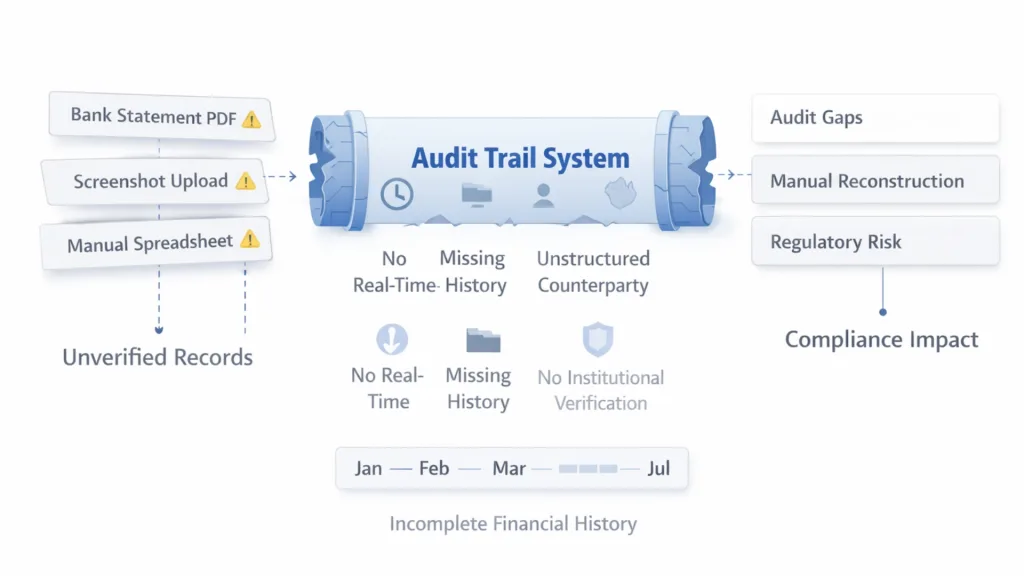
Manual bank statement uploads create verification problems. Platforms receive unverified documents that auditors cannot authenticate. Screenshot-based financial evidence lacks chain of custody.
Infrastructure gaps:
- No real-time transaction updates
- Missing historical visibility beyond uploaded periods
- Unstructured counterparty information
- Lack of institutional verification
- Manual reconstruction required for regulatory reviews
Financial data completeness matters critically. Platforms need complete transaction history showing all financial activity. Manual collection creates gaps when users provide incomplete information.
How verified bank transaction data enables compliance
An effective audit trail must be verifiable, structured, immutable, historical, and continuously updated. Manual processes cannot deliver these characteristics.
Open Banking provides regulatory-grade access:
- Consent-based transaction data direct from banks
- Verified financial records with institutional authentication
- Structured transaction logs in consistent format
- Historical access supporting complete audit trails
- Ongoing updates maintaining current records
UK Government audit trail guidance emphasises maintaining automated, chronological financial records for accountability.
Platforms accessing verified bank transaction data through FCA-authorised infrastructure receive financial records that auditors can authenticate. Direct-from-bank data provides a chain of custody that manual uploads cannot demonstrate.
How Finexer enables audit trail compliance
Finexer provides FCA-authorised infrastructure enabling platforms to access verified bank transaction data supporting audit trail compliance.
Key capabilities:
- 99% UK bank coverage
- FCA-authorised infrastructure
- Real-time webhooks
- Up to 7 years historical data
- Usage-based pricing
- White-label ready
- 2-3x faster integration
- 3-5 weeks onboarding support
- Saves up to 90% on transaction costs
Platforms integrate audit data APIs through REST endpoints. Users authenticate accounts via secure Open Banking flows. Platforms receive verified transaction information building audit-ready financial records automatically.
Real-time webhooks notify platforms when transactions occur. Chronological logging happens automatically. Audit trail compliance continues without manual data collection.
Historical transaction access extends up to seven years depending on bank support. Platforms retrieve complete financial history meeting regulatory retention requirements.
Critical compliance clarity:
Finexer does not conduct audits, issue compliance certifications, or manage regulatory filings. Platforms control reporting formats, compliance frameworks, and audit documentation.
Finexer provides the verified bank transaction data layer enabling audit trail compliance infrastructure.
For platforms requiring audit trail infrastructure, verified data access removes compliance bottlenecks.
Infrastructure evaluation checklist
| Criteria | Why It Matters | What to Look For |
|---|---|---|
| Verified sources | Unverified uploads fail authentication | FCA-authorised Open Banking connectivity |
| Transaction completeness | Gaps prevent full compliance | Complete history with counterparty details |
| Chronological logging | Audit trails require time-ordered records | Automated timestamping with real-time updates |
| Historical depth | Retention periods require multi-year access | 7-year transaction retrieval |
| Structured format | Unstructured records prevent reporting | Consistent JSON with merchant enrichment |
What we see in practice
Most platforms underestimate compliance risk of manual audit trail compliance. Manual record keeping appears sufficient initially but fails during regulatory reviews.
LawTech platforms face serious exposure when client account audits reveal incomplete transaction records. SRA Account Rules require proper oversight. Manual processes cannot provide required verification.
Accounting platforms discover gaps when supporting client tax audits. HMRC reviews require complete financial records. Manual uploads create problems when history lacks verification.
Fintech platforms under FCA supervision need audit-ready records demonstrating proper financial oversight. Manual processes fail when platforms cannot demonstrate complete financial visibility.
For platforms using Open Banking for auditing, verified transaction data transforms compliance quality.
Common use cases

LawTech platforms:
- Maintain verified records for client account audits
- Demonstrate proper oversight of trust accounts
- Support source-of-funds verification
- Build audit-ready logs meeting SRA Account Rules
Accounting SaaS:
- Provide verified financial records for tax audits
- Support MTD ITSA compliance
- Maintain complete history for HMRC reviews
- Enable audit-ready reporting
Fintech platforms:
- Demonstrate financial oversight for FCA reviews
- Maintain transaction-level audit trails
- Support regulatory reporting
- Build accountability systems
Compliance SaaS:
- Embed verified financial data layer
- Enable full audit trail compliance
- Provide structured transaction records
- Support regulatory requirements
What I Feel About Audit Trail Compliance
Most platforms think audit trails are just “keeping records.” They store PDFs in folders. Call it compliance.
Then regulators ask “how do you verify this transaction actually happened?” and the answer is “user uploaded a screenshot” – audit fails.
The real problem:
- Storage isn’t verification
- Unverified records have zero compliance value
- Chain of custody matters more than data volume
I’ve watched LawTech platforms scramble during SRA audits. Thousands of PDFs but can’t prove authenticity. Manual audit trails work for 10 clients. At 1,000 clients it’s impossible to defend.
What actually matters:
- Institutional verification from source
- Complete chronological history
- Automated updates without manual work
Open Banking solves this at protocol level. Banks authenticate every transaction. Platforms get audit-ready records automatically.
Yet platforms stick with manual uploads because “migration is expensive.” Then spend more defending incomplete audit trails during reviews.
Audit trail compliance isn’t a record-keeping problem. It’s a verification infrastructure problem.
What are the requirements for an audit in the UK?
UK audit requirements include maintaining complete financial transaction records with user identification, timestamps, and data alterations. Platforms must retain records for regulatory periods-typically 3-8 years depending on sector and specific regulations including GDPR, FCA requirements, and HMRC rules.
What is an audit trail in ISO 9001?
ISO 9001 audit trails document quality management system activities demonstrating compliance with standards. For financial platforms, this includes maintaining records of transactions, system changes, and user actions supporting accountability and continuous improvement.
How does Open Banking support audit trail compliance?
Open Banking provides FCA-authorised access to verified bank transaction data. Platforms retrieve structured financial records directly from banks enabling audit trail compliance with verifiable, complete, and chronological transaction logs meeting regulatory requirements.
Enable audit trail compliance with verified bank transaction data and regulatory-grade financial records.
About the Author

Ravi Ranjan
Ravi Ranjan is Co founder & CEO of Finexer