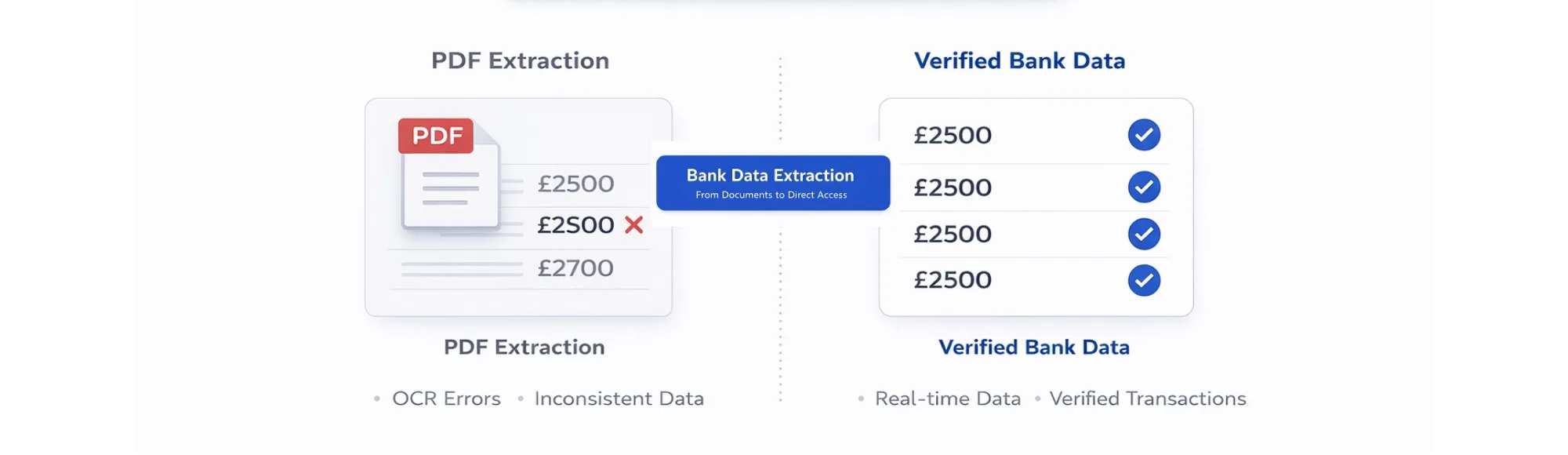
Document parsing creates data gaps that break financial workflows.
Access verified bank transaction data directly – no PDF parsing required.
Bank statement extraction software is used by platforms to pull financial data from uploaded bank statement documents – transactions, balances, and account details – using document parsing technologies. For accounting SaaS, LawTech platforms, and fintech products handling financial documents, these tools became the default approach to digitising client financial records.
The problem is not the concept. It is the execution at scale. When platforms rely on bank statement extraction software to power reconciliation, income verification, and compliance workflows, the limitations of document parsing become operational problems – inconsistent output, manual correction overhead, and financial data that cannot be independently verified.
This blog explains why bank statement extraction software creates reliability problems for platforms, what those problems mean for financial workflows, and why the shift toward direct bank data access removes the document parsing layer entirely.
TL;DR
Bank statement extraction software extracts financial data from PDF documents using parsing technologies. The core problem is that statement formats vary across banks, parsed data requires manual correction, and extracted records cannot be verified against actual bank activity. Platforms that need to extract data from bank statements reliably are moving toward direct bank data access through Open Banking AIS infrastructure – retrieving verified transaction data at source rather than parsing documents that may be incomplete or inconsistent.
Key Takeaways
What is bank statement extraction software?
Bank statement extraction software is used to extract financial data – transactions, balances, and account details – from uploaded bank statement documents using parsing technologies. It converts document-based financial records into structured digital data.
Why does bank statement extraction software struggle at scale?
Statement formats vary across UK banks, parsed data contains errors that require manual correction, documents can be incomplete or outdated, and extracted records cannot be verified against actual bank activity. These problems compound as client volume grows.
What is the alternative to using extraction tools to extract data from bank statements?
Direct bank data access through FCA-authorised Open Banking AIS infrastructure retrieves verified transaction data directly from the bank – eliminating document uploads, parsing errors, and manual corrections entirely.
Which platforms are most affected by bank statement extraction problems?
Accounting SaaS platforms, LawTech platforms running source-of-funds checks, and fintech products building income verification workflows are most affected – as their core workflows depend on accurate, verifiable financial data.
How does Open Banking AIS replace bank statement extraction software?
FCA-authorised AIS infrastructure gives platforms consent-based access to verified bank transaction data directly from client accounts – providing the same financial information as a bank statement, structured and accurate, without document handling.
What Is Bank Statement Extraction Software?
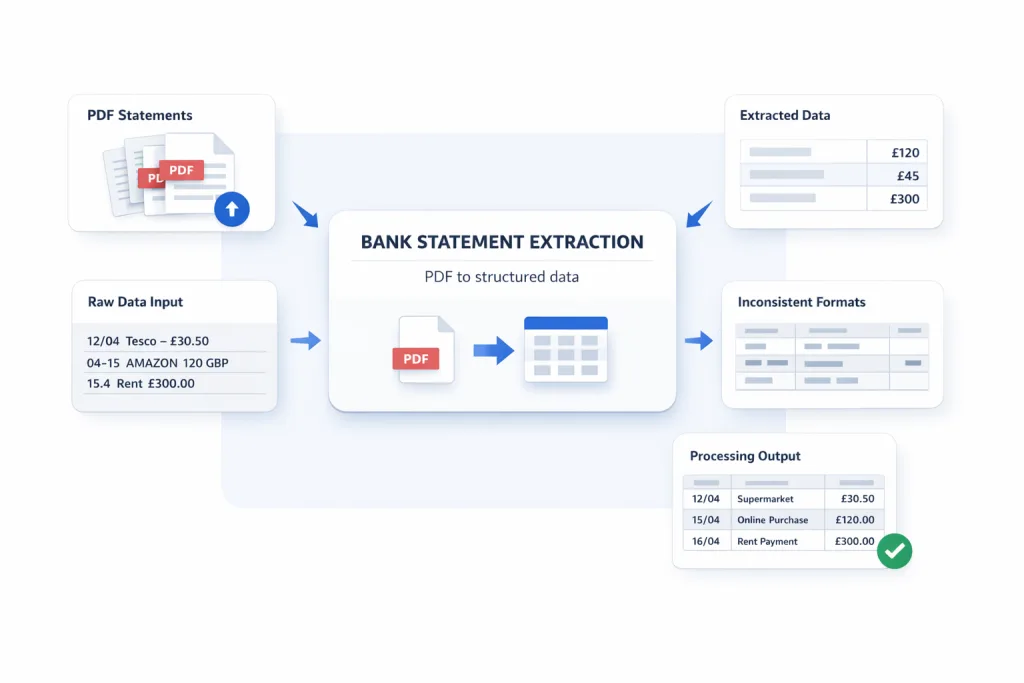
How Extraction Tools Work
Bank statement extraction software converts uploaded bank statement documents into structured digital data. Platforms use these tools to digitise client financial records, extract transaction histories, and feed financial data into reconciliation, reporting, and verification workflows.
For platforms managing client financial data at scale, the appeal is clear. Rather than manually processing uploaded documents, extraction software automates the conversion process – pulling transaction amounts, dates, descriptions, and balances from PDF statements into a usable format.
Where Extraction Tools Fit Today
Bank statement automation workflows that depend on document parsing are widely used across accounting platforms, LawTech firms, and fintech SaaS tools. The tooling exists, the integrations are built, and the workflows are live.
The problem is not that these tools do not work. It is that they do not work reliably enough for the financial workflows platforms need to run on top of them.
“At Finexer, the platforms I work with that have built on bank statement extraction software share the same pattern – it works in controlled testing, then breaks in production when real client documents arrive in fifteen different formats with inconsistent layouts.” – Ravi, Finexer
Why Does Bank Statement Extraction Software Fail at Scale?

The Core Data Reliability Problem
When platforms rely on bank statement extraction software to extract data from bank statements, they inherit a set of structural limitations that cannot be solved by better parsing logic.
Every UK bank produces statements in a different format. Column layouts, date formats, transaction description styles, and balance presentation vary across institutions – and change when banks update their statement templates. Extraction tools trained on one format produce errors on another.
The result for platforms is financial data that requires manual review, correction, and verification before it can be used in any downstream workflow.
- Statement formats differ across every UK bank and change without notice
- OCR parsing introduces transcription errors on amounts, dates, and references
- Multi-page statements are frequently misaligned or incompletely parsed
- Client-uploaded documents are often incomplete – missing periods, wrong date ranges
- Extracted data cannot be cross-referenced against actual bank activity to confirm accuracy
“The manual correction overhead that comes with bank statement extraction software is the part platforms underestimate. Every error caught in review is time spent on data correction rather than product delivery. At volume, that overhead becomes a significant operational cost.” – Ravi, Finexer
Why This Breaks Financial Workflows
Platforms depend on accurate financial data for reconciliation, compliance checks, and income verification. When the underlying data produced by bank statement extraction software is unreliable, every workflow built on top of it inherits that unreliability.
A reconciliation workflow matching extracted transactions against internal records will produce mismatches that are not real discrepancies – they are parsing errors. An income verification workflow relying on extracted salary data will miss payments that were not captured correctly. A source-of-funds check built on incomplete extracted records cannot support regulatory review.
The problem is not the workflow logic. It is the data foundation beneath it.
Why Are Platforms Shifting Away From Document Parsing?
The Infrastructure Shift
Bank data import through document uploads creates a dependency on client behaviour – clients must upload the right documents, in the right format, covering the right period. Direct bank data access removes that dependency entirely.
Platforms moving beyond bank statement extraction software are not finding better extraction tools. They are removing the extraction layer altogether by accessing bank transaction data directly through Open Banking AIS infrastructure.
Instead of asking clients to upload documents and then extracting data from those documents, the platform retrieves verified transaction data directly from the client’s bank account through a consent-based API connection.
The data arrives structured, standardised, and bank-authenticated – without parsing, without manual correction, and without the format inconsistencies that make bank statement extraction software unreliable at scale.
| Approach | Bank Statement Extraction Software | Direct Bank Data Access (AIS) |
|---|---|---|
| Data source | Client-uploaded PDF documents | Verified bank transaction data at source |
| Format consistency | Varies across banks and statement versions | Standardised output across 99% of UK banks |
| Data accuracy | Parsing errors require manual review and correction | Bank-authenticated data with no parsing layer |
| Completeness | Dependent on what the client uploads – gaps are common | Complete transaction history per consent scope |
| Verification | Cannot be verified against actual bank activity | Retrieved directly from the bank – source verified |
| Operational overhead | Manual correction, re-upload requests, format handling | Automated retrieval with no document handling |
How Does Finexer Replace Bank Statement Extraction Software?
Finexer is an FCA-authorised Open Banking infrastructure provider. For platforms that need to extract data from bank statements reliably, Finexer’s AIS infrastructure provides consent-based access to verified bank transaction data directly from client accounts – removing the document parsing layer entirely.
What Finexer’s Infrastructure Provides
- FCA-authorised AIS access – verifiable on the FCA register
- Verified transaction data directly from client bank accounts
- Standardised, structured output across 99% of UK banks
- Up to 7 years transaction history per account
- Categorised transaction data with merchant names, timestamps, and payment references
- Consent logs and access timestamps per data retrieval
- Usage-based pricing with 3-5 weeks onboarding support
“The platforms that move from bank statement extraction software to direct bank data access do not go back. The data quality difference is significant – and the operational overhead of managing document uploads, parsing errors, and manual corrections disappears.” – Ravi, Finexer
What I Feel
Bank statement extraction software solved a real problem when direct bank data access was not available. That option now exists.
Platforms still running document-based workflows are carrying operational overhead that is invisible in testing but compounds in production. Every parsing error, every manual correction, every incomplete upload is time and resource spent on data quality rather than product development.
The shift from extraction tools to direct bank data access is not a technical upgrade. It is a data reliability decision. Platforms that make it earlier spend less time managing data problems and more time building on top of verified financial records.
Common Use Cases
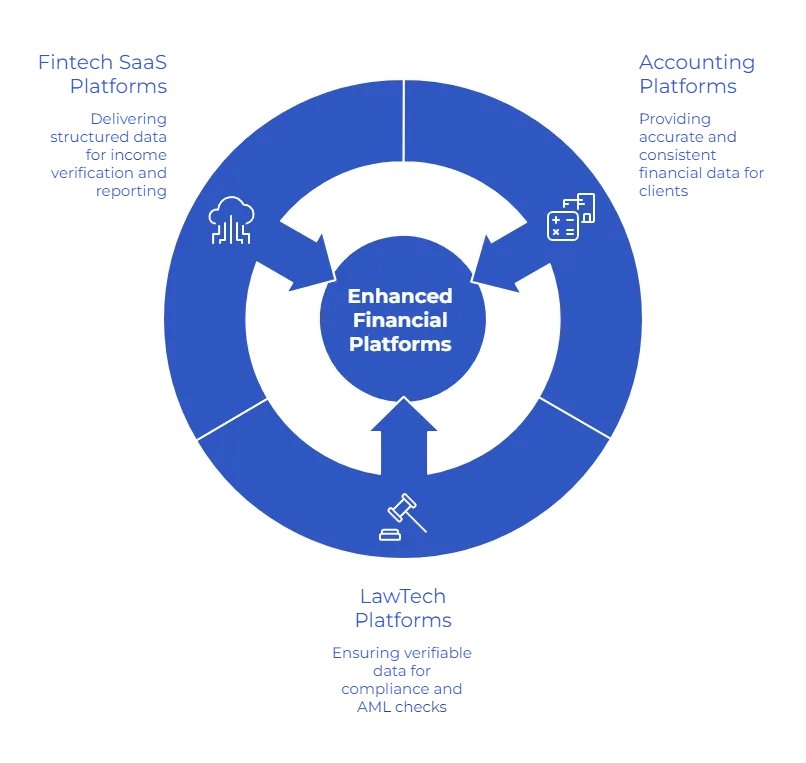
Accounting and Bookkeeping Platforms
Accounting platforms managing client financial data need transaction records that are complete, accurate, and consistent across all UK banks. Finexer’s FCA-authorised AIS eliminates the need for bank statement extraction software by providing verified bank transaction data directly – supporting reconciliation and bookkeeping workflows without document handling or parsing errors.
LawTech Platforms
LawTech platforms running source-of-funds checks and AML reviews cannot rely on extracted document data that cannot be independently verified. Finexer’s AIS provides bank-authenticated transaction history with full consent logs – giving compliance workflows a verifiable data foundation that extracted records cannot provide.
Fintech SaaS Platforms
Fintech platforms building income verification and financial reporting features need to extract data from bank statements accurately at scale. Finexer’s AIS provides structured, categorised transaction data with consistent output across UK banks – replacing document-based extraction with verified bank data that scales without manual correction overhead.
What is bank statement extraction software used for?
Bank statement extraction software is used to extract financial data – transactions, balances, and account details – from uploaded bank statement documents. Platforms use it to digitise client financial records for reconciliation, income verification, and compliance workflows.
Why is it difficult to extract data from bank statements using parsing tools?
Statement formats vary across UK banks and change without notice. Parsing errors introduce inaccuracies in amounts, dates, and references. Uploaded documents are frequently incomplete. Extracted data cannot be verified against actual bank activity – requiring manual review and correction that creates operational overhead at scale.
How does Open Banking AIS replace bank statement extraction software?
FCA-authorised AIS infrastructure gives platforms consent-based access to verified bank transaction data directly from client accounts. This provides the same financial information as a bank statement – structured, accurate, and bank-authenticated – without document uploads, parsing errors, or manual corrections.
Replace document parsing with verified bank transaction data.
About the Author

Ravi Ranjan
Ravi Ranjan is a fintech entrepreneur and growth leader with experience in building and scaling Open Banking ventures in the UK. As Co-founder and CEO of Finexer, he focuses on expanding adoption of Pay-by-Bank payments and real-time financial data infrastructure through secure API solutions. With a background in computer science engineering and an MBA from Aston Business School, Ravi combines technical insight with commercial strategy to help businesses modernise financial operations and accelerate digital payment innovation