Fix categorisation at the data layer, not the rules engine.
Structured bank transaction data with merchant IDs and category codes for accounting platforms.
Bank transaction categorisation fails most often not because the categorisation engine is wrong. It fails because the data it runs on is inconsistent.
The same merchant appears with three different descriptions across three transactions. A supplier payment hits the account with a reference that matches nothing in the rules engine. A refund lands as a credit with no context. The engine guesses. The guess is wrong. A human corrects it manually.
In my work building data infrastructure for accounting and ERP platforms at Finexer, this is where bank transaction categorisation breaks. Not in the algorithm. In the raw transaction data that feeds it.
TL;DR
Bank transaction categorisation accuracy depends on the quality of the input data – not just the rules or models applied to it. Raw bank descriptions are inconsistent, truncated, and unreliable for automated classification. Transaction categories built on unstructured data require constant manual correction. Finexer’s Data Enrichment API provides merchant identifiers, category codes, and structured transaction data with 95%+ accuracy across 100M+ merchants – giving accounting and ERP platforms a reliable categorisation input layer.
Key Takeaways
What is bank transaction categorisation for accounting platforms?
Bank transaction categorisation is the automated process of classifying each transaction into a structured category – expenses, revenue, supplier payments, tax liabilities – for bookkeeping and reporting. Accuracy depends entirely on the quality of the underlying transaction data the classification runs on.
Why does categorisation fail with raw bank data?
Raw bank transaction descriptions are generated by bank systems, not designed for accounting readability. They contain truncated merchant names, internal reference codes, and format inconsistencies that change across banks and payment types. Rules engines built on this data break constantly.
What causes the same merchant to appear across different transaction categories?
The same merchant processes payments through different acquirers, payment types, and regional systems. Each route produces a different transaction description. Without a merchant identifier that normalises these variations, the categorisation engine treats them as separate entities.
How does structured enrichment data improve transaction category accuracy?
Merchant identifiers and category codes applied at the data layer give the categorisation engine consistent, normalised inputs regardless of how the raw description arrived. Accuracy improves because the input is standardised – not because the rules engine is more sophisticated.
Why Does Bank Transaction Categorisation Fail in Real Accounting Workflows?
What Does Raw Bank Transaction Data Actually Look Like?
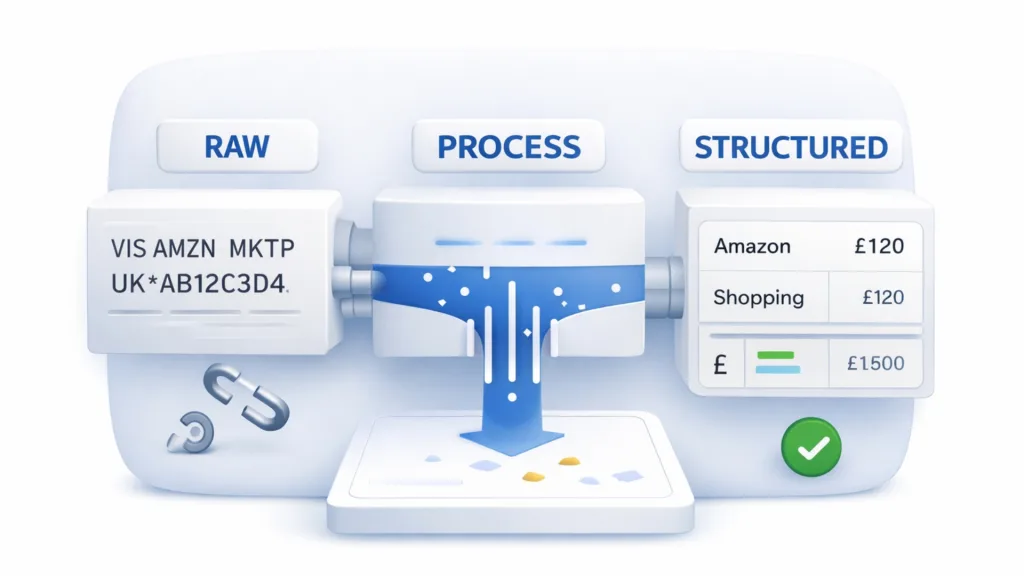
Raw bank transaction data is not accounting-ready. It is a system output from the bank’s internal processing – designed for settlement, not classification.
A typical raw description might read: “VIS AMZN MKTP UK*AB12C3D4 LONDON GB” – a valid Faster Payments entry, completely opaque to a categorisation rule that expects “Amazon.” The same merchant generates different strings depending on whether the purchase used a debit card, credit card, direct debit, or online payment link.
According to transaction data enrichment via structured bank APIs, the gap between raw bank output and accounting-ready data is where most categorisation accuracy problems originate.
“The platforms I work with that struggle most with bank transaction categorisation are not using bad rules engines. They are running good engines on bad input data. That is the real problem – and it is a data layer problem, not a categorisation logic problem.” – Yuri, Finexer
Why Do Transaction Categories Break When Merchants Change Payment Methods?
A single supplier may pay via BACS one month and Faster Payments the next. The bank description changes. The reference format changes. The categorisation rule that correctly identified last month’s payment fails on this month’s.
At volume, these failures compound. Each miscategorised transaction requires manual review. Manual review introduces human error. Corrections applied to one transaction do not automatically fix the same merchant’s future payments.
Bank statement extraction and categorisation for accounting platforms covers how structured data extraction compares to raw statement processing for bookkeeping accuracy.
| Categorisation Failure Type | Root Cause | Accounting Impact | Enrichment Fix |
|---|---|---|---|
| Same merchant, different descriptions | Different payment rails produce different strings | Merchant split across multiple wrong categories | Merchant ID normalises all descriptions to one entity |
| Truncated bank references | Bank systems apply character limits on descriptions | Rules engine cannot match truncated string | Merchant name and category resolved from ID lookup |
| Mixed transaction types | Refunds, fees, and reversals share description formats | Credit and debit miscategorised as same type | Category codes distinguish transaction type at source |
| New or infrequent merchants | Rules engine has no prior match for unfamiliar string | Uncategorised or miscategorised as miscellaneous | 100M+ merchant database resolves unknown entities |
How Does Finexer Solve Bank Transaction Categorisation at the Data Layer?
The categorisation accuracy problem starts with inconsistent raw data. Finexer’s Data Enrichment API solves this by applying merchant identifiers and category codes to each transaction before it reaches the platform’s categorisation logic.
Transaction categorisation API for UK VAT and bookkeeping covers how structured category codes per transaction reduce VAT classification errors in accounting workflows.
What Does Finexer’s Data Enrichment API Provide?
The problem: raw bank descriptions are inconsistent and unreadable by categorisation engines. Finexer’s Data Enrichment API solves this by resolving each transaction against a 100M+ merchant database, returning a clean merchant ID and category code alongside the raw data.
- Merchant identifiers per transaction – normalises all description variants to a single entity
- Category codes per transaction – structured transaction categories applied at source
- 95%+ categorisation accuracy across 100M+ merchants
- Under 100ms response time – no latency added to the data pipeline
- Works with AIS transaction feeds or existing bank data imports
- Consistent output schema – same structure regardless of originating bank
How Finexer’s AI-powered transaction categorisation works covers the full categorisation capability including how merchant recognition improves over time.
“Bank transaction categorisation accuracy is a solved problem when the input data is structured. The merchant ID is the key – once you can normalise description variants to a single entity, the category follows reliably. That is what the enrichment layer does.” – Yuri, Finexer
What I Feel
Most accounting platforms I work with treat bank transaction categorisation accuracy as a rules engine problem. They build more rules. They add exceptions. They train models.
The rules keep breaking because the input keeps changing.
Fixing categorisation at the data layer – before the rules engine sees it – is a fundamentally more reliable approach. Structured input produces consistent output. That is not a feature. That is an architectural decision.
Common Use Cases
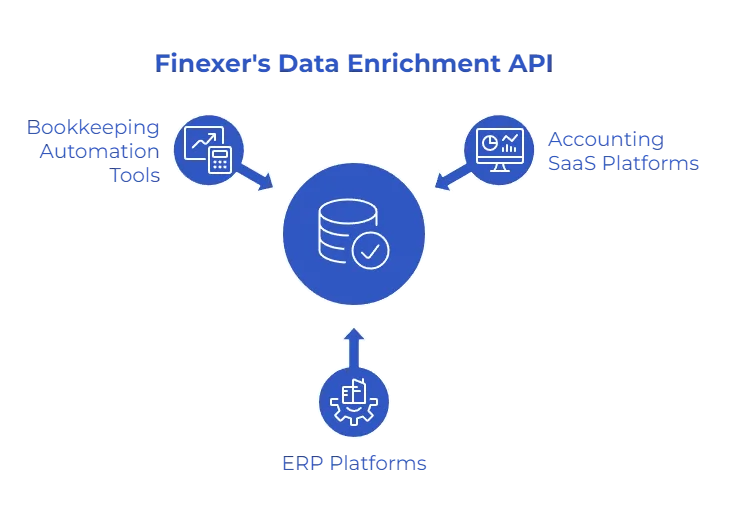
Accounting SaaS Platforms
Client bank feeds arrive with inconsistent merchant descriptions that break categorisation rules across accounts. Finexer’s Data Enrichment API applies merchant IDs and category codes per transaction – giving the categorisation engine normalised inputs that produce consistent transaction categories without manual correction.
ERP Platforms
ERP financial modules processing high supplier payment volumes cannot manually resolve miscategorised transactions at scale. Finexer’s enrichment layer resolves merchant identity and category code per payment – enabling automated categorisation that holds across payment method changes.
Bookkeeping Automation Tools
Bookkeeping tools that auto-categorise bank transactions for clients need reliable transaction categories to reduce manual review time. Finexer’s 95%+ categorisation accuracy across 100M+ merchants means fewer uncategorised transactions and less client-facing correction overhead.
What are transaction categories in banking?
Transaction categories are structured labels applied to each bank transaction – such as payroll, utilities, supplier payments, or tax liabilities – that classify financial activity for accounting and reporting. Accurate categories depend on reliable merchant identification, not just raw bank description matching.
How accurate is automated bank transaction categorisation?
Accuracy varies significantly by data quality. Raw bank descriptions produce inconsistent results that require constant manual correction. Enriched transaction data with merchant identifiers and category codes consistently achieves 95%+ accuracy – as Finexer’s Data Enrichment API demonstrates across 100M+ merchants.
How does structured bank data improve transaction categorisation for accounting tools?
Structured enrichment data applies a merchant identifier and category code to each transaction before it reaches categorisation logic. This normalises description variants from the same merchant and resolves unknown entities against a large merchant database – producing consistent transaction categories without rule-by-rule maintenance.
Build reliable transaction categories on enriched, structured bank data.