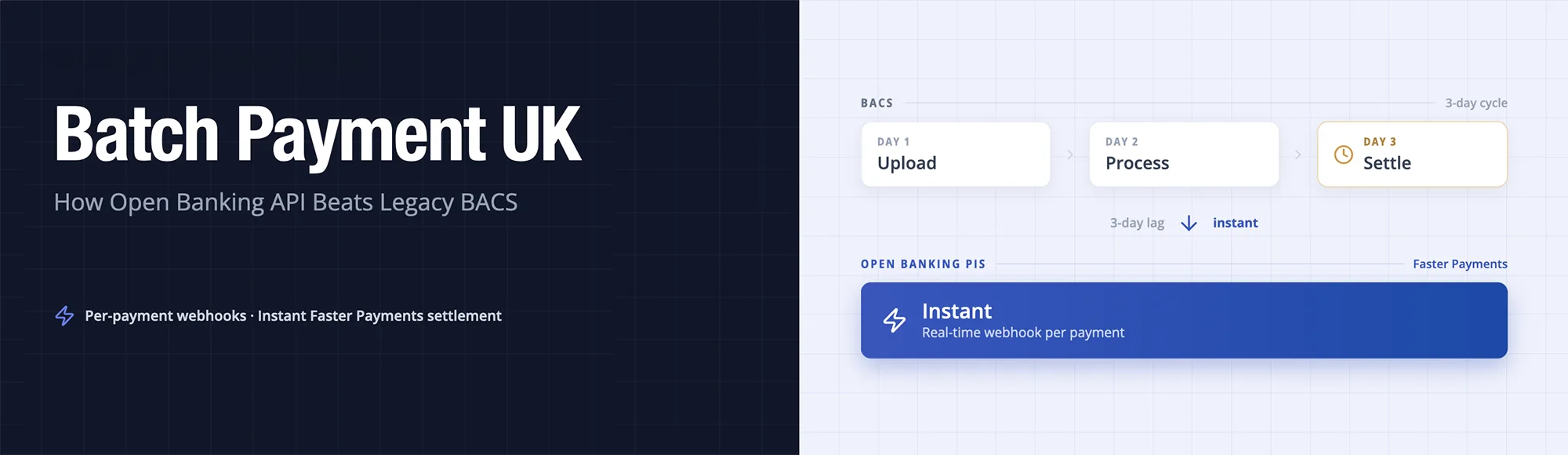
When you submit a batch payment via BACS on Monday, the 3-day processing cycle means settlement happens on Wednesday. But what happens when Thursday arrives, and you still haven’t received confirmation? Or when a payment fails mid-cycle and you don’t discover it until Day 3? Without real-time visibility into individual payment statuses, your finance team has to manually check the bank portal, cross-reference spreadsheets, and contact employees to apologize for delays they didn’t anticipate.
This is BACS. Finance teams dealing with payroll, suppliers, and contractors across the UK all endure this problem, as a batch payment system built for the 1970s can’t really deliver real-time updates in 2026.
This is the point where Open Banking PIS can make an impact. Here, instead of CSV uploads, you can simply initiate batch payment via API and get instant webhooks for every single transaction. The consequence: Smart, faster transactions with real-time updates. This guide explains how BACS works, why it’s slow, and how modern Open Banking APIs offer a faster alternative.
What is a Batch Payment?
A batch payment is a financial process that groups several individual transactions into a single file/submission. So, instead of authorising 150 individual payments, you need to create a CSV file that contains all transactions and submit it once. In the UK, batch payments are mainly processed via BACS. To further simplify this, think of batch payments as processing payments for all your employees together by submitting a single file on a set schedule.
The BACS Model: How Batch Payments Actually Work
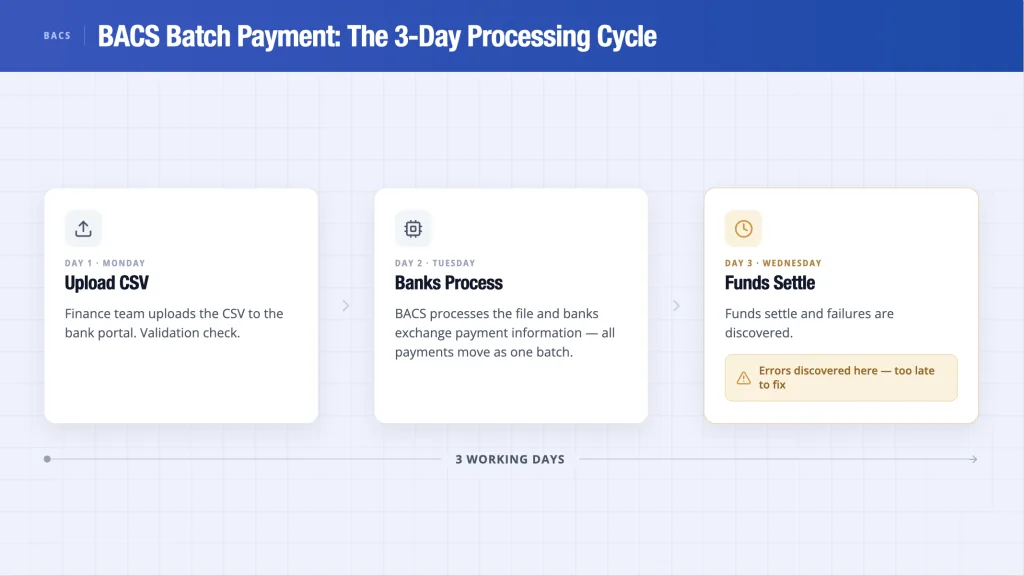
When you submit a batch payment through BACS, these are the things that happen (unlike modern batch payment workflow automation):
Day 1 (Monday)
Your finance team uploads a CSV file to your bank portal. This file contains all the payment details, such as recipients’ account numbers, amounts, and sort codes. Your bank validates the file format, and only if it passes this does it enter the clearing cycle.
Day 2 (Tuesday)
BACS processes the file for clearance, and banks exchange payment information. All of the transactions in your batch payment process together, irrespective of individual status.
Day 3 (Wednesday)
Funds settle down, and recipients receive their respective amounts. But the biggest problem is that if an invoice fails due to insufficient funds, wrong sort code, or account closed issues, you can’t do anything until Day 3, and guess what? By then, it’s too late to ‘fix’ before payday.
Why BACS Is Slow: The Root Cause?
BACS was not designed for real-time updates. Built in the 1970s, this was specifically meant for bulk and scheduled file uploads with a three-day cycle, as clearing houses take time to process several batch payment files from every UK bank simultaneously.
Every individual batch of payments takes the same route of-
validation → clearing → settlement
So, until the entire batch settles down, there is no scope to know the individual transaction status. Earlier, this made sense, but today, finance teams have to sit for hours to manually check everything, including the apology to employees for delayed payments.
How Does Open Banking PIS Process Batch Payments?
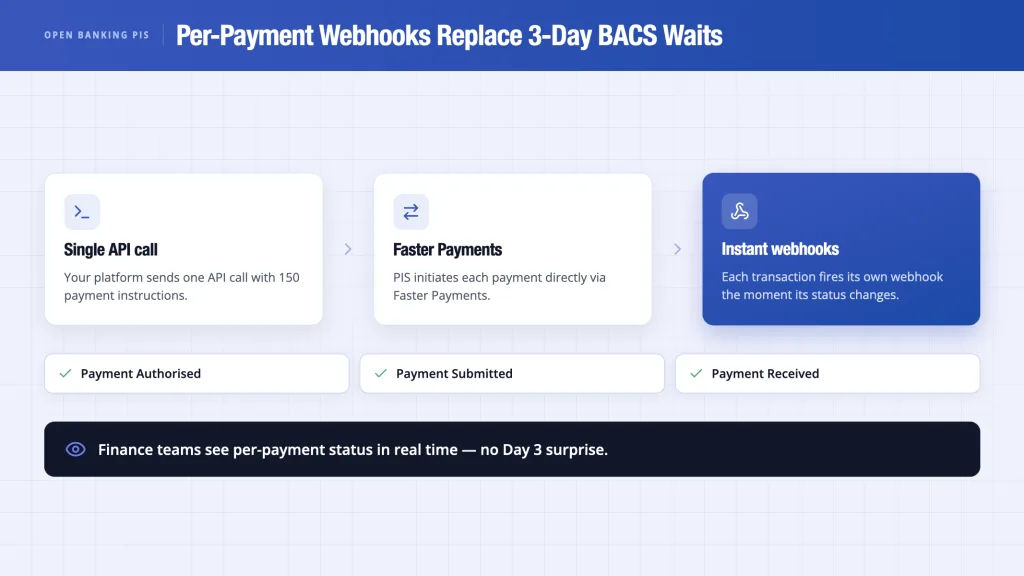
Open Banking Payment Initiation Service (PIS) changes the processing pattern of a batch payment. Instead of uploading files, followed by a relentless waiting period of 3-days, you initiate payments via API. The result? Get instant webhook updates about errors from the moment you facilitate the bulk payment API.
Suppose you send one API call with over 150 payment instructions. The system initiates each payment directly from your bank account via Faster Payments. Just within seconds, each transaction fires a webhook: “Payment authorised,” “Payment submitted,” “Payment received.”
This is real-time payment status-tracking, which saves the time and effort of your finance team with no sudden surprise on Day 3. Plus, the operational efficiency is largely enhanced with the bulk payment API.
BACS vs Open Banking PIS: How Batch Payments Compare?
The differences between batch payment and bulk payment API can provide quicker insights into the topic. For deeper context, see our guide on bulk payouts explained:
| Aspect | BACS Batch Payment | Open Banking PIS |
|---|---|---|
| Submission | CSV file upload to the bank portal | Single API call |
| Settlement Time | 3 days (Day 1, 2, 3 cycle) | Instant via Faster Payments |
| Per-Payment Status | None until Day 3 | Real-time webhooks at each stage |
| Error Detection | Day 3 — too late to fix before payday | Immediate — time to correct before impact |
| Operational Overhead | High (manual file management and tracking) | Low (automated, API-driven) |
| Cost per Transaction | BACS fees plus manual correction costs | Per-transaction PIS fee (no interchange) |
| User Experience | Outside your platform | Embedded in your platform |
When to Use BACS vs Open Banking: An Honest Guide
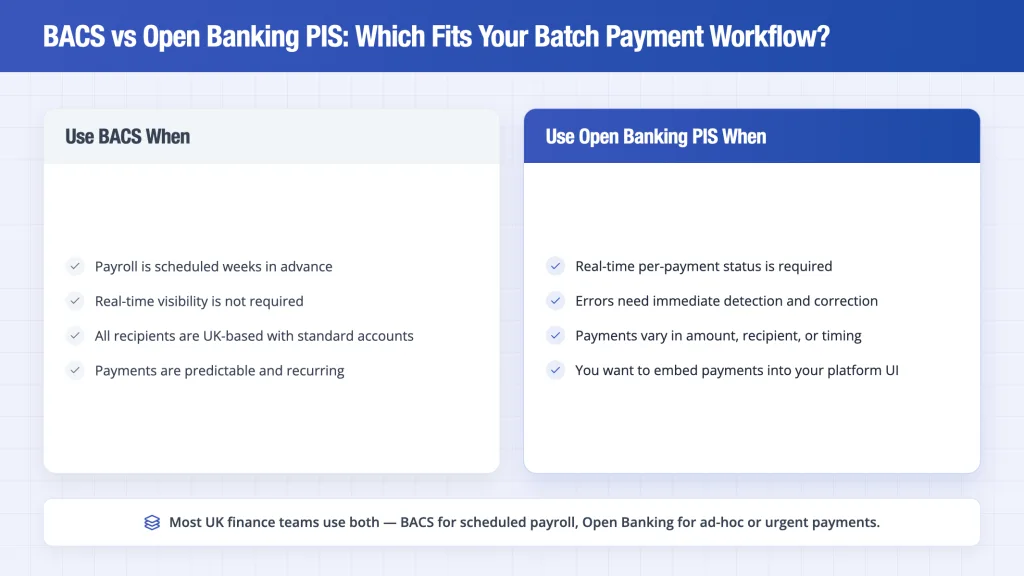
Use BACS when:
- Your payroll is scheduled not to keep just 3 days in hand, but weeks in advance
- Real-time visibility is not the priority
- All recipients are UK-based with standard accounts
Use Open Banking PIS when:
- Real-time visibility and per payment status are your priorities
- Errors need to be instantly detected and corrected
- Payments are varied (different amounts, recipients, timing)
- You want to embed batch payment into your existing product UI
- You serve contractors or suppliers with irregular payment schedules
In the UK, for the majority of finance teams, both of the options are equally important- scheduled payroll via BACS, and ad-hoc or urgent payments via Open Banking.
The Real Cost of BACS Delays
You discover one Friday morning that a 150-person payroll has failed on 3 invoices, and you find out this after three days of submission. You then ask your finance team to track manually the payments that succeeded, and three failed payments, followed by notifying the affected employees. Your team can take as long as 4 hours to manually track this information.
An example: If 4 hours of your finance team equates to £40/hour, that’s £160 per incident. If this happens twice a month, you’re literally spending £3,840 annually on error correction alone. This is a hypothetical example to provide you with clarity about how BACS delay can result in cost-inefficiency.
Also, take into account the cost of employee complaints, manual reconciliation errors, and audit trail gaps. Hence, the real cost of BACS delays is not just the time, but the cumulative inefficiencies resulting from operational friction, compliance risk, and team frustration.
How Open Banking PIS Helps Finance Teams?
In case you are managing several batch payment runs monthly, real-time payment status tracking is obvious. This helps you fix the issue right at the start, before your employee asks you, “Where’s my salary?”
Open Banking platforms like Finexer (FCA-authorised infrastructure) let you initiate batch payment via API, embed Pay by Bank into your platform, and receive instant webhooks for each transaction. You stay in control. Your users get faster, embedded payments. Finance teams get the visibility they need.
The future of batch payment processing is not CSV files with three-day waits. It’s APIs and real-time certainty.
What’s the difference between batch and bulk payment?
A batch payment traditionally means a group of similar payments submitted on a fixed schedule (BACS). A bulk payment API allows you to send multiple varied payments in one request with real-time status tracking. Bulk is modern; batch is legacy terminology, though both are used interchangeably today.
How long does a batch payment take in the UK?
BACS takes 3 days (Day 1-3 cycle). Open Banking via Faster Payments settles instantly.
Can I track individual payments in a BACS batch?
Not until Day 3. Open Banking gives you real-time payment status tracking via webhooks—you know the status of each payment as it happens.
Is Open Banking PIS secure for bulk payments?
Yes. PIS uses Strong Customer Authentication (SCA), tokenised payments, and bank-to-bank encryption. It’s more secure than traditional methods.
What’s the cost difference between BACS and Open Banking batch payments?
BACS charges per file submission. Open Banking charges per transaction. For high-volume payments, Open Banking is typically cheaper (no card interchange fees). Batch payments via BACS take 3 days with no per-transaction visibility. Open Banking PIS offers instant settlement and real-time webhooks for each transaction.
Curious how this works for your platform?
Explore with AI
About the Author

Ravi Ranjan
Ravi Ranjan is Co founder & CEO of Finexer