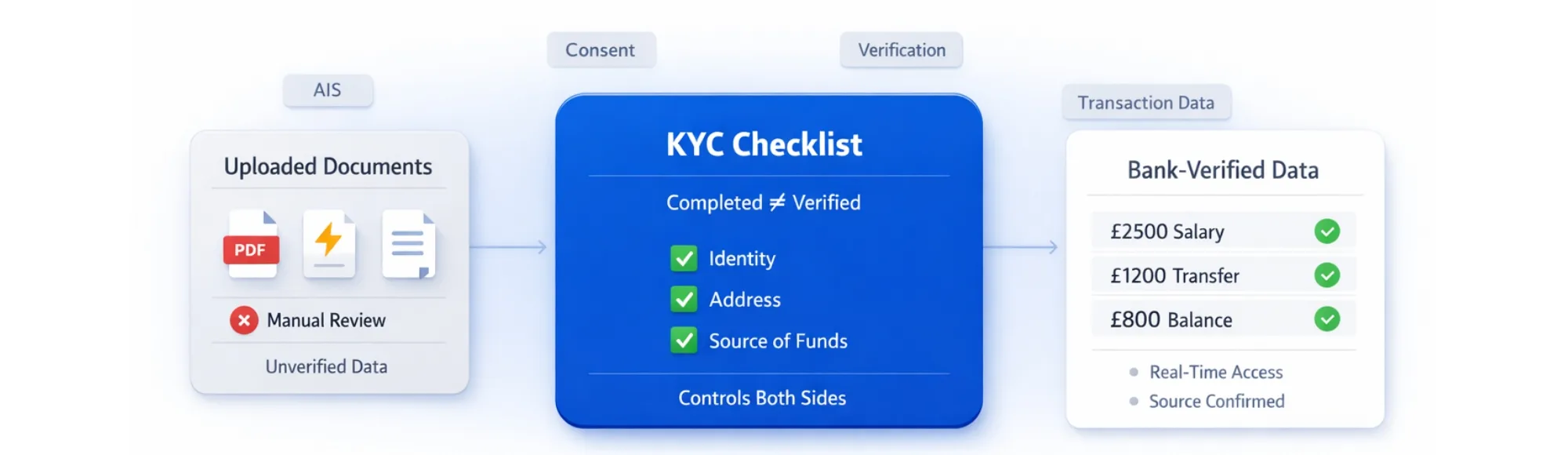
KYC verification fails at the data layer, not the checklist.
Finexer provides bank transaction data infrastructure for reliable KYC and onboarding workflows.
KYC onboarding breaks most often not because platforms are missing checklist steps. It breaks because the data behind those steps cannot be independently verified.
A passport is submitted. A bank statement is uploaded. An address is confirmed via a utility bill. Each item is ticked. The checklist is complete.
Then the source of funds turns out to be unverifiable. The uploaded statement does not match actual account activity. The address verification came from a document the client supplied. The platform has completed the checklist – but has not verified anything at source.
In my work with Lawtech and compliance SaaS platforms at Finexer, this is where client onboarding KYC checklist failures occur. Not in the design of the checklist. In the reliability of the data layer beneath it.
This blog covers the full client onboarding KYC checklist required under UK Money Laundering Regulations 2017, where each item typically fails with document-based approaches, and how bank transaction data accessed via FCA-authorised AIS resolves the verification gap.
TL;DR
The client onboarding KYC checklist for UK platforms covers individual CDD (identity, address, source of funds), corporate KYB (registration, UBOs, PSCs, directors), AML screening (sanctions, PEPs, risk scoring), and ongoing monitoring. Under the Money Laundering Regulations 2017, KYC financial services platforms must complete Customer Due Diligence before services are rendered and maintain records for five years. The most common failure point is source of funds and income verification – where document-based checks cannot confirm what bank transaction data accessed via FCA-authorised AIS can verify directly at source.
Key Takeaways
What is a client onboarding KYC checklist for UK platforms?
A client onboarding KYC checklist is the structured set of identity, address, source of funds, and AML screening checks a platform must complete before onboarding a client. Under MLR 2017, Customer Due Diligence is mandatory before any services are rendered.
What is KYC in financial services and what does it require?
KYC financial services obligations require platforms to verify client identity, confirm address, assess source of funds, screen against sanctions and PEP lists, and apply risk-based due diligence. Enhanced Due Diligence is required for high-risk clients including PEPs and complex ownership structures.
Why does a completed KYC checklist still produce verification failures?
Because each checklist item depends on a data source – and document-based data sources are inherently unverifiable at origin. A client-submitted bank statement can be altered. A utility bill can be outdated. The checklist is complete but the underlying data is not verified at source.
How does bank transaction data improve KYC verification reliability?
FCA-authorised AIS retrieves transaction data directly from the client’s bank with consent. Source of funds, account ownership, income patterns, and financial behaviour are confirmed from the bank rather than from documents the client supplied – providing a verifiable data layer that document-based KYC cannot.
What is the Full Client Onboarding KYC Checklist Under MLR 2017?
What Does Individual Client Due Diligence Require?

Under the Money Laundering Regulations 2017, Customer Due Diligence for individual clients must cover:
Identity verification:
- Full legal name – verified against government-issued ID (passport, driving licence, or national ID)
- Date of birth – to confirm legal age and identity match
- Biometric or liveness check – photo or video comparison against ID document
Address verification:
- Current residential address – verified via digital address checks, bank statements, or utility bills
- Address data must be current – documents older than three months create verification gaps
Source of funds and wealth:
- Declared source of funds – how the client’s money was generated
- Verification against actual financial activity – this is where document-based checks most commonly fail
According to the FCA’s regulatory framework for KYC financial services, platforms must complete CDD before establishing a business relationship – not during or after.
What Does Corporate KYB (Know Your Business) Require?

Corporate client onboarding requires an additional layer of verification beyond individual CDD:
- Company name and registration number – verified against Companies House
- Registered office address – confirmed as the principal place of business
- Certificate of Incorporation or Articles of Association
- Ultimate Beneficial Owners (UBOs) – individuals holding 25% or more in shares or voting rights
- People with Significant Control (PSCs) – name, date of birth, nationality, and address for each
- Directors and authorised signatories – individual KYC checks on each
The UBO and PSC layer is where complex ownership structures create the most verification complexity. Nominee arrangements, multi-layer holding companies, and offshore structures can obscure beneficial ownership in ways that document-based checks cannot reliably detect.
What AML Screening Must the Checklist Include?
AML screening is a mandatory component of every client onboarding KYC checklist under MLR 2017:
- Sanctions screening – immediate check against the UK His Majesty’s Treasury sanctions list and OFAC
- PEPs screening – identification of Politically Exposed Persons and their associates
- Adverse media screening – checks for negative press coverage indicating financial crime risk
- Risk scoring – categorising each client as Low, Medium, or High Risk
- Enhanced Due Diligence (EDD) – mandatory for High Risk clients, PEPs, and complex ownership structures
KYC onboarding process and compliance framework for UK platforms covers the regulatory obligations in detail across each of these screening requirements.
| KYC Checklist Item | Document-Based Approach | Common Failure Point | Bank Data Fix |
|---|---|---|---|
| Identity verification | Passport or driving licence upload | Documents can be forged or outdated | Account ownership confirmation via AIS – bank-authenticated at source |
| Address verification | Utility bill or bank statement (client-supplied) | Client supplies outdated or incorrect document | Address on bank account record – retrieved directly from bank |
| Source of funds | Bank statement PDF uploaded by client | Document can be altered – cannot be verified at origin | Transaction history via AIS – retrieved directly from bank with consent |
| Income verification | Payslips or tax returns submitted by client | Payslips can be manipulated – do not reflect actual deposits | Salary transaction patterns from bank transaction history |
| Ongoing monitoring | Periodic document re-submission or client questionnaire | Monitoring is periodic – not continuous | Real-time transaction monitoring via AIS webhooks |
Where Does the Client Onboarding KYC Checklist Most Often Fail?
Why Does Source of Funds Verification Break With Documents?
Source of funds is the checklist item that causes the most regulatory exposure for platforms.
The problem is structural. A client submits a PDF bank statement. The platform reviews it. The source of funds box is ticked.
But the PDF was generated by the client. It reflects what the client chose to include. It cannot be verified against actual account activity. It can be altered. It may cover only a partial period or exclude accounts the client did not wish to disclose.
According to the Money Laundering Regulations 2017, platforms must conduct Customer Due Diligence adequate to the risk the client presents. A document the client supplied does not meet that standard for high-risk clients where source of funds is material.
“In my experience working with Lawtech and compliance platforms, source of funds is where the document-based client onboarding KYC checklist most consistently fails. The checklist is complete. The underlying verification is not. That distinction matters when HMRC or the FCA reviews the onboarding file.” – Clare, Finexer
Risk management during client onboarding for UK platforms covers how platforms design onboarding workflows that hold up under regulatory scrutiny.
Why Does Address Verification Via Documents Create Gaps?
Address verification relies on the client supplying a document containing their address – a utility bill, council tax letter, or bank statement. The platform reviews it. The address is confirmed.
The failure mode is straightforward. The document was supplied by the client. It may be outdated. It may cover a previous address. It may relate to a different person at the same address.
For KYC financial services platforms conducting onboarding at scale, the manual review of address documents creates both a reliability gap and an operational overhead. Each document requires assessment. Inconsistencies require follow-up. Re-submission requests delay onboarding completion.
Bank transaction data accessed via AIS retrieves account details including registered address directly from the bank. The address is not client-supplied. It is bank-confirmed – retrieved at the point of consent, from the source.
Why Does Ongoing Monitoring Fail With Periodic Document Collection?
Post-onboarding monitoring obligations under MLR 2017 require platforms to monitor client financial activity for unusual or high-risk patterns – including transactions exceeding £10,000 that may indicate suspicious activity.
Periodic document collection cannot meet this requirement reliably. By the time a platform requests and receives updated bank statements, the relevant transactions have already occurred without platform visibility.
Open banking onboarding workflows for UK platforms covers how real-time bank data access changes the ongoing monitoring architecture from periodic to continuous.
AIS webhooks deliver transaction events as they occur. A transaction exceeding the monitoring threshold triggers an alert at the point it happens – not weeks later when a re-submission is reviewed.
How Does Finexer Support KYC Financial Services Verification Workflows?
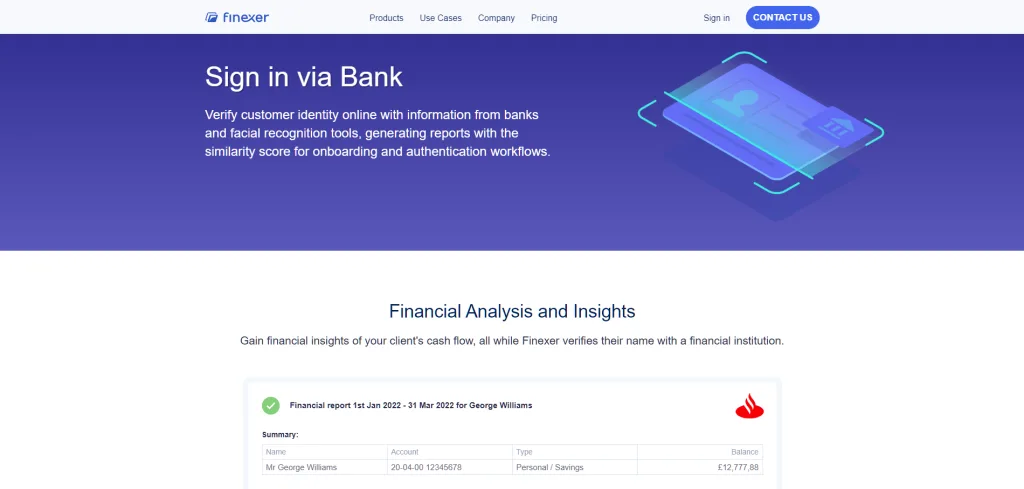
For Lawtech platforms, compliance SaaS providers, and accounting platforms running client onboarding KYC checklist workflows – Finexer’s FCA-authorised AIS provides the bank data layer that makes each checklist item verifiable at source rather than dependent on client-supplied documents.
Accounting firm client onboarding with verified bank data covers the specific onboarding workflow improvements for accounting platforms using bank transaction data for KYC verification.
What Does Finexer’s Infrastructure Provide for KYC Workflows?
- FCA-authorised AIS – read-only bank data access, verifiable on the FCA register
- Account ownership verification – bank-authenticated.
- Source of funds verification via transaction history – retrieved directly from the client’s bank
- Up to 7 years of transaction history for EDD and source of wealth checks
- Income pattern identification from recurring bank deposits
- Consent logs and access timestamps per retrieval – full audit trail for regulatory review
- Real-time webhooks for ongoing transaction monitoring
- Covers virtually every major UK bank – high street, challenger, and business banking providers
- Structured JSON output – consistent schema across all connected institutions
- White-label consent flows under the platform’s own brand
- Usage-based pricing with 3-5 weeks onboarding support
What I Feel
The client onboarding KYC checklist is not the problem. Most platforms have well-designed checklists that cover every MLR 2017 requirement.
The problem is the data layer. Each checklist item is only as reliable as the source it draws from. A checklist built on client-supplied documents is a checklist built on unverifiable foundations.
“The platforms I work with that face regulatory scrutiny on their onboarding files are rarely missing a checklist item. They are missing evidence that the data behind each item was independently verified rather than client-supplied. That is the distinction MLR 2017 is testing for.” – Clare, Finexer
KYC financial services workflows that move to bank-verified data do not bypass the checklist. They make each item on it genuinely verifiable – which is what the regulation requires and what regulatory review tests.
Common Use Cases

Lawtech Platforms
Source of funds and UBO verification for property transactions and legal matters require evidence that survives regulatory scrutiny. Finexer’s FCA-authorised AIS provides bank-authenticated transaction history with consent logs and timestamps – supporting each KYC checklist item with independently verifiable financial data.
Accounting & ERP Platforms
Accounting platforms onboarding clients for tax and advisory services face the same CDD obligations as regulated firms. Finexer’s AIS delivers verified income patterns, account ownership confirmation, and transaction history – replacing client-submitted documents with bank-sourced financial records.
Compliance SaaS Platforms
Compliance platforms automating KYC financial services workflows need a data source that can confirm source of funds and income at scale without manual document review. Finexer’s AIS provides structured transaction data across all connected accounts – enabling automated verification without human document handling.
What is a client onboarding KYC checklist?
A client onboarding KYC checklist is the structured set of verification steps a platform must complete before onboarding a client – covering identity, address, source of funds, AML screening, and risk scoring. Under MLR 2017, Customer Due Diligence must be completed before services are rendered.
What is KYC in financial services and who must comply?
KYC financial services obligations apply to regulated firms including Lawtech platforms, accountants, financial advisers, and payment service providers. They require identity verification, source of funds assessment, sanctions and PEP screening, and ongoing transaction monitoring. Records must be maintained for five years after the business relationship ends.
How does Open Banking improve client onboarding KYC verification?
FCA-authorised AIS retrieves bank transaction data directly from the client’s bank with their consent – providing bank-verified source of funds, account ownership confirmation, and income patterns. This replaces client-supplied documents with independently verifiable bank data that holds up under regulatory review.
Build a verifiable KYC data layer with Finexer.
About the Author

Clare Pearson
Clare Pearson is a senior payments professional with extensive experience across the global financial services and payments industry. She specialises in Open Banking, payment infrastructure, and financial technology transformation, with expertise spanning product delivery, operational strategy, regulatory compliance, and large-scale payments programmes. Clare currently serves as a Non-Executive Director at Finexer and a panel member for the Payment Systems Regulator (PSR), advising on the development of payment systems policy and innovation