
Choose your provider with confidence.
Stop comparing marketing claims. Use a practical scorecard to evaluate Open Banking providers on the criteria that determine deployment speed, product fit and long-term operational success.
TL;DR: Most comparison articles simply rank open banking providers by popularity. That isn’t how serious buyers make purchasing decisions. This guide gives Product Managers, CTOs and Finance Leads a weighted evaluation framework covering bank coverage, pricing, AIS and PIS capability, onboarding, white-label deployment and developer experience, helping you compare providers against your own requirements rather than someone else’s shortlist.
Choosing the wrong Open Banking provider rarely becomes obvious during procurement.
It becomes obvious six months later, when integration takes longer than expected, your roadmap changes, pricing no longer fits your growth, or you discover the product you actually need requires a second provider.
“The best Open Banking provider isn’t the one with the longest feature list. It’s the one whose capabilities, commercial model and deployment approach align with the product you’re trying to build–not just the project you’re delivering this quarter.” – Ravi Ranjan, Finexer
At Finexer, we work with UK SaaS platforms across accounting, ERP, payroll, lawtech and payments. One lesson appears repeatedly: successful implementations begin with the right evaluation framework, not the biggest brand name. This guide is written for buyers who already understand Open Banking and now need a practical way to compare providers before making a decision.
Why Comparing Open Banking Providers Is Harder Than It Looks
Choosing between open banking providers is difficult because many offer similar headline capabilities while differing significantly in implementation, pricing and operational fit.
Almost every provider mentions APIs, bank connectivity and security. Many support Account Information Services (AIS), Payment Initiation Services (PIS), or both. Several operate across multiple European markets.
Those similarities make comparison surprisingly difficult.
The real differences usually appear beneath the marketing pages:
- How many UK banks can they access?
- Do they combine AIS and PIS?
- Is pricing suitable for growing platforms?
- How quickly can your engineering team deploy?
- Can the product be offered entirely under your own brand?
- Does the provider specialise in your market?
Those questions, not feature checklists, determine whether a provider supports your roadmap over the next three years.
What Should You Evaluate Before Choosing an Open Banking Provider?
The best way to compare open banking providers is to score each one against consistent business and technical criteria rather than relying on rankings.
Here’s a practical framework used by many product and engineering teams.
1. Bank coverage
Coverage determines how many customer bank accounts your application can connect to.
For UK-first platforms, UK coverage usually matters more than the number of countries listed on a provider’s website.
2. AIS and PIS capability
Some providers specialise in financial data.
Others specialise in payments.
If your roadmap includes both bank connectivity and Pay by Bank, choosing separate providers may increase integration complexity.
3. Pricing model
Pricing affects more than procurement.
Commercial structures influence forecasting, scaling decisions and long-term operating costs.
Ask whether pricing aligns with your expected transaction volumes rather than your current usage.
4. Onboarding and implementation
Technical capability only creates value after deployment.
Documentation quality, SDKs, developer support and implementation timelines often influence project success as much as API functionality.
5. White-label capability
Many SaaS platforms want customers to remain entirely within their own product experience.
White-label deployment becomes particularly valuable where brand consistency is part of the product strategy.
6. Regulatory credentials
Every provider should clearly explain its regulatory permissions.
Where payments or financial data are involved, confirm the provider’s FCA authorisation and whether it operates as an AISP, PISP or both.
A Practical Evaluation Scorecard
Rather than assigning equal importance to every feature, weight the criteria according to operational impact.
| Evaluation Criterion | Suggested Weight |
|---|---|
| UK bank coverage | 25% |
| AIS + PIS capability | 20% |
| Pricing flexibility | 15% |
| Developer experience | 15% |
| Onboarding time | 10% |
| White-label capability | 10% |
| Regulatory credentials | 5% |
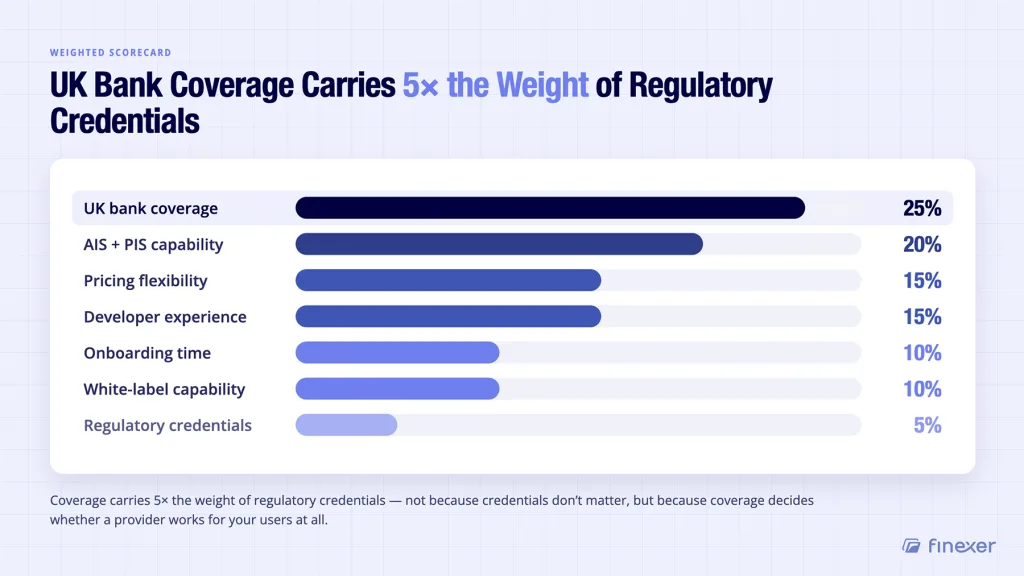
Every organisation will adjust these weightings differently: an accounting platform may prioritise AIS, whereas a payroll platform may place greater emphasis on PIS. A fintech building consumer who is budgeting tools may care more about developer tooling than white-label deployment. The framework stays the same; only the weighting changes.
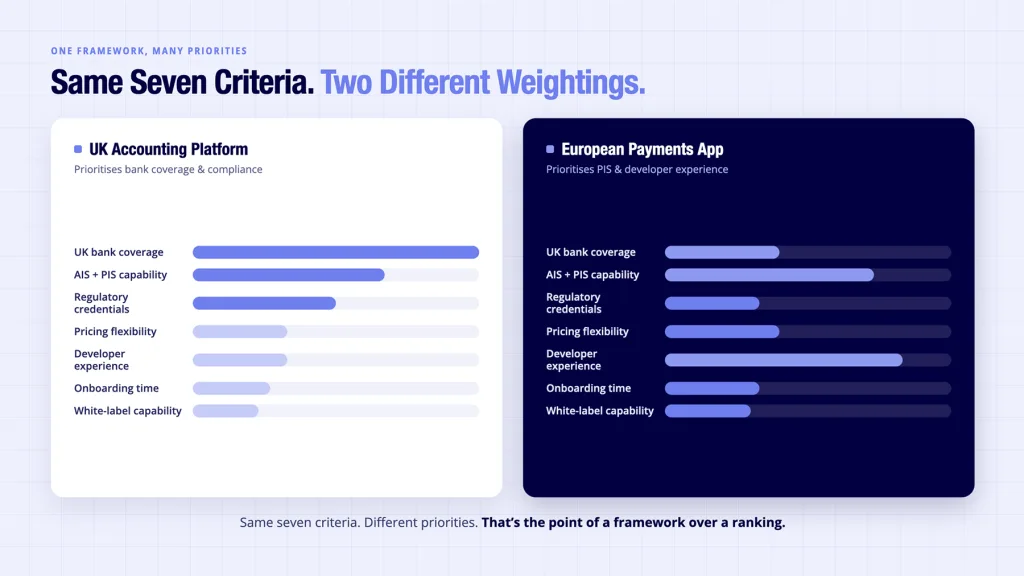
Applying the Framework: Illustrative Examples
The purpose of this article isn’t to rank providers.
Instead, let’s see how different providers naturally perform against different criteria.
| Provider | AIS | PIS | White-label | Typical Focus | Good For |
|---|---|---|---|---|---|
| TrueLayer | ✓ | ✓ | Yes | Enterprise Open Banking | Large fintech platforms |
| Yapily | ✓ | ✓ | Yes | Developer-first APIs | European fintech builders |
| Plaid | ✓ | Limited UK payments | Yes | Global connectivity | International products |
| Tink | ✓ | ✓ | Yes | European financial data | Multi-country deployments |
| Finexer | ✓ | ✓ | Yes | UK Open Banking infrastructure | UK SaaS platforms |
Notice that no provider is objectively “best.”
Each is optimised for different commercial priorities.
If you’re looking for a broader vendor overview rather than an evaluation framework, our guide to the top Open Banking providers explores the market from a different perspective.
The Gap: Why Most Provider Comparisons Don’t Help Buyers
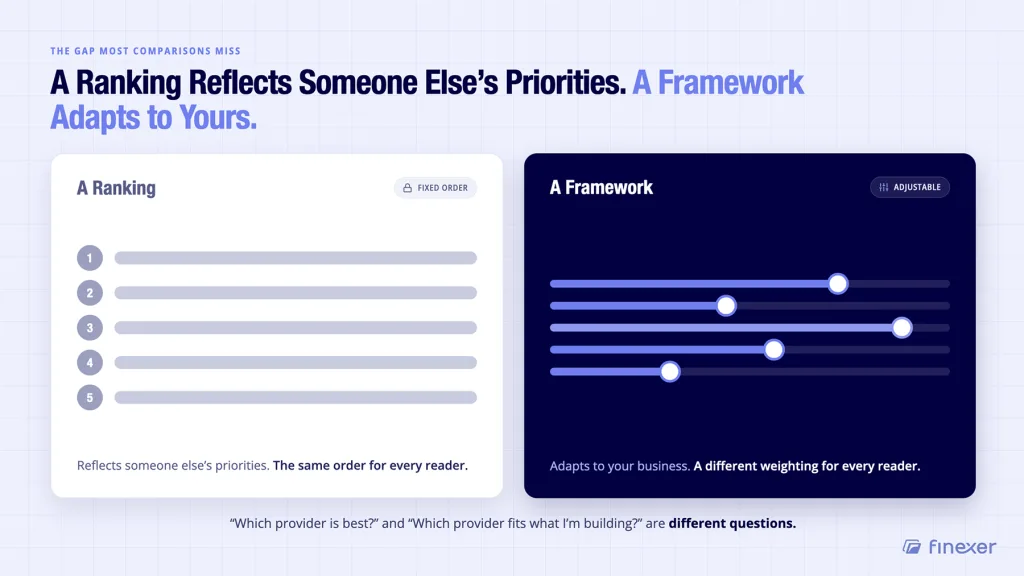
Most comparison articles answer the wrong question.
They ask, “Who are the biggest providers?”
Buyers usually ask something entirely different.
They want to know:
“Which provider best fits the product we’re building?”
Imagine two engineering teams.
One is building a UK accounting platform that needs bank feeds and reconciliation.
The other is launching a European payments application.
Both require Open Banking.
Neither should necessarily choose the same provider.
The decision depends on regulatory scope, implementation effort, commercial model and product direction, not brand recognition.
That’s why scorecards consistently outperform listicles.
A framework adapts to your business.
A ranking reflects somebody else’s priorities.
Finexer: Open Banking Infrastructure That Fits the Framework
The challenge isn’t finding open banking providers. It’s finding one that continues to meet your requirements after launch.
A successful evaluation should reveal whether a provider supports today’s implementation and tomorrow’s roadmap. That’s where understanding the underlying mechanism matters more than comparing feature lists.
Finexer’s infrastructure combines Account Information Services (AIS) and Payment Initiation Services (PIS) while allowing SaaS platforms to deploy Open Banking capabilities under their own brand.
Here’s how the two services work together:
- AIS retrieves bank account information after the customer provides explicit consent. It enables applications to access balances, account details and transaction data for reconciliation, affordability checks and financial insights. AIS never initiates payments.
- PIS enables customers to authorise account-to-account payments directly from their banking application. Once Strong Customer Authentication (SCA) is completed, the bank initiates payment through Faster Payments. PIS never retrieves transaction history.
Although these services can operate independently, many SaaS products eventually require both. An accounting platform may begin with bank feeds before introducing Pay by Bank. Likewise, a payments platform may later require transaction data for reconciliation or reporting.
If you’re evaluating AISP infrastructure, this guide explains the architectural considerations in more detail.
For organisations comparing commercial models, our guide to budget-friendly Open Banking solutions explores pricing approaches across different provider types.
If your roadmap depends on consolidating financial data from multiple institutions, our article on scalable banking data aggregation examines the technical considerations behind large-scale bank connectivity.
Why Finexer Scores Well Against This Framework
Using the evaluation criteria discussed earlier, Finexer’s infrastructure is designed for UK SaaS platforms that need flexibility rather than unnecessary complexity.
Relevant capabilities include:
- FCA-authorised AISP and PISP (FRN925695)
- Transparent pricing
- White-label deployment
- 3–5 weeks onboarding support
- AIS and PIS available through the same infrastructure
- Developer-friendly APIs and webhook architecture
- 99% UK bank coverage
For buyers assessing product fit, explore Finexer’s Data product:
If your primary objective is account-to-account payments, see the Payments product:
What Are Open Banking Solution Providers?
Open banking solution providers supply the regulated infrastructure that allows businesses to access banking data, initiate payments, or both, through Open Banking APIs.
Unlike banks themselves, these providers build and maintain the connectivity layer between financial institutions and business applications. Depending on their permissions, they may operate as AISPs, PISPs or offer both services under the UK’s Open Banking framework.
For buyers, the distinction is important because two providers can appear similar while serving very different use cases. One may specialise in data aggregation for accounting software, while another focuses on payment initiation for commerce platforms. Others combine both capabilities, reducing the need for multiple integrations as product requirements expand.
The strongest evaluation doesn’t begin with provider names. It begins by defining the problem you’re solving. Once those requirements are clear, comparing open banking solution providers becomes considerably more objective, because each criterion, coverage, pricing, deployment, regulatory permissions and white-label capability, can be assessed against measurable business outcomes rather than marketing claims.
What are the best Open Banking providers in the UK?
There isn’t a single “best” provider for every organisation. The right choice depends on your requirements, including whether you need AIS, PIS, white-label deployment, pricing flexibility, UK bank coverage or rapid implementation. A weighted evaluation framework generally produces a better decision than relying on popularity rankings.
How should I compare Open Banking providers?
Compare providers using consistent business and technical criteria rather than feature lists. Bank coverage, AIS and PIS capability, pricing model, onboarding time, developer experience and regulatory permissions should all form part of the evaluation.
What’s the difference between an AISP and a PISP?
An Account Information Service Provider (AISP) accesses financial data with customer consent but cannot initiate payments. A Payment Initiation Service Provider (PISP) initiates bank payments after customer authorisation but does not retrieve account transaction data.
Should I choose one provider for both AIS and PIS?
Not always, but using a single provider can reduce integration complexity if your product requires both banking data and Pay by Bank functionality. The decision should depend on your roadmap, commercial requirements and technical architecture.
Can I switch Open Banking providers later?
Yes, but migration effort depends on how tightly your application is integrated with provider-specific APIs and workflows. Evaluating documentation quality, implementation approach and long-term product fit early can reduce switching costs later.
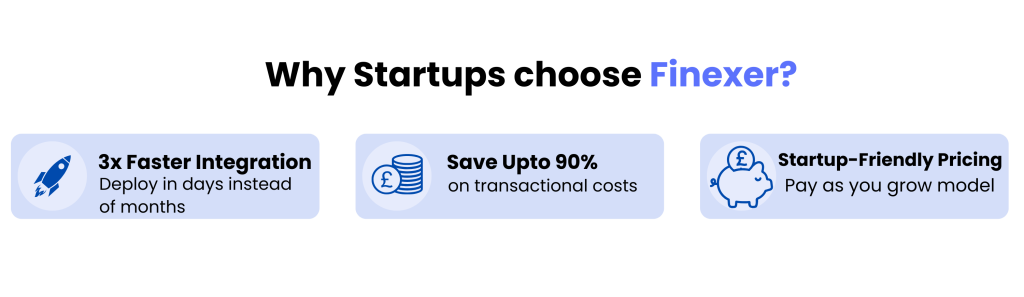
Choose infrastructure that supports your roadmap, not just today’s project.
See how Finexer’s Data and Payments infrastructure help UK SaaS platforms evaluate, integrate and scale Open Banking with confidence.
Explore with AI
About the Author

Ravi Ranjan
Ravi Ranjan is Co founder & CEO of Finexer