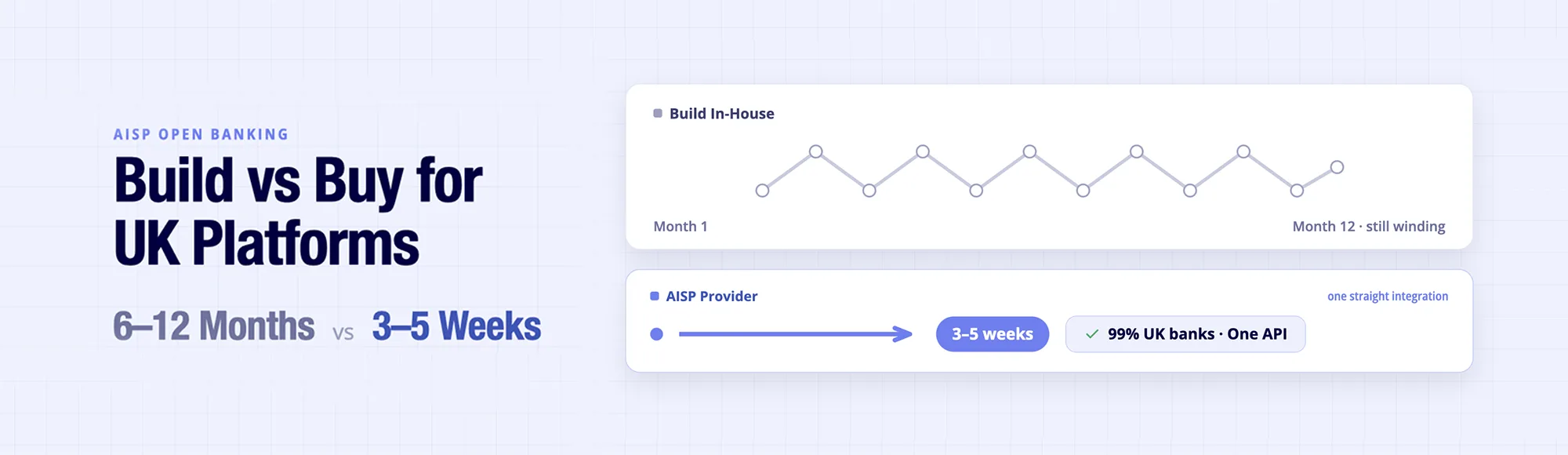
Build vs buy, decided in one API call
See what 6–12 months of in-house bank integration work looks like against 3–5 weeks with an AIS provider.
For UK platform teams, the decision to build direct bank connections or integrate with an AISP Open Banking is rarely about writing the first API call. It is a long-term engineering and operational decision that affects regulatory compliance, bank coverage, consent management and ongoing maintenance.
This guide compares both approaches, examining the real cost of building Open Banking infrastructure in-house versus integrating with an FCA-authorised AISP, so engineering leaders and product teams can evaluate which path delivers the fastest and most sustainable route to production.
TL;DR: A platform team estimates six weeks to connect to UK banks and ends up spending six months chasing API differences, token refreshes and FCA paperwork. Open Banking AISPs exist to remove that build entirely, offering read-only bank data access through a single integration instead of dozens of direct bank connections. In my work with engineering teams evaluating this build-vs-buy decision, the cost that gets missed isn’t the initial connection, it’s the maintenance burden that starts the day it ships.
By Yuri, Technical Lead at Finexer
“When I work with engineering teams integrating Open Banking, the first question is always about webhook latency. The second question, usually asked three months later, is why nobody budgeted for the ongoing maintenance of fifty separate bank connections.”
The Real Cost of Building AISP Open Banking In-House
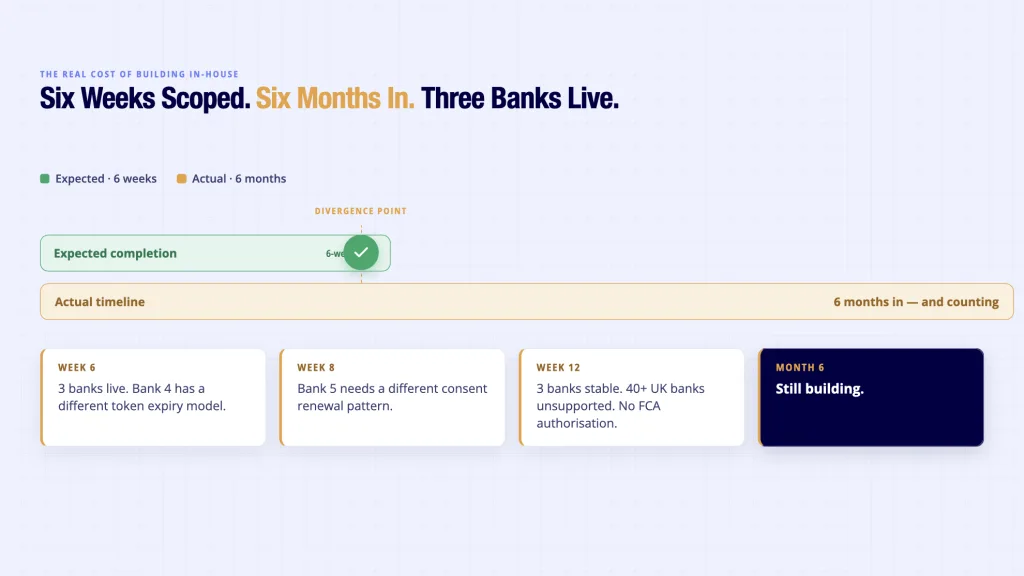
A platform team scopes bank data access as a six-week project. They pick three major UK banks, get sandbox access, and build the OAuth flow.
Then a fourth bank uses a different token expiry model. A fifth requires a different consent renewal pattern. By week twelve, the team has three banks live, forty-plus UK banks unsupported, and no FCA authorisation to legally operate as an AISP.
This is not a rare outcome. It’s the default outcome, because each UK bank implements Open Banking APIs slightly differently, and maintaining that difference at scale requires a dedicated team, not a sprint.
What a Build-vs-Buy Decision Actually Needs to Weigh
Five factors determine whether building direct bank connections or using an Open Banking AISP is the right call for a platform.
- FCA authorisation timeline – Operating as an AISP requires FCA authorisation, which typically takes several months and ongoing compliance obligations. Using an already-authorised provider removes this from the platform’s roadmap entirely.
- Bank coverage breadth – Supporting a handful of major banks is achievable in-house. Supporting the full range of UK banks, including challengers and business accounts, multiplies the maintenance surface.
- Consent lifecycle management – Open Banking consent typically runs on a 90-day cycle, and each bank handles renewal and revocation slightly differently. This logic needs to be built and maintained per bank connection.
- Engineering maintenance load – Bank APIs change without much notice. A five-engineer integration team maintaining direct connections spends a recurring share of its time on breakage, not new features.
- Data normalisation – Raw AIS data returns in inconsistent formats across banks. Without a normalisation layer, categorisation and reconciliation logic breaks per bank, not once.
FCA Authorisation and the 90-Day Consent Cycle
Operating as an Account Information Service Provider under UK Open Banking rules requires FCA authorisation, and the FCA regulates every AISP and PISP operating in the UK. A platform building direct bank connections either pursues its own authorisation or partners with an already-authorised AISP.
The read-only access model is fixed by regulation: an AISP can retrieve transaction history, balances and account details with the customer’s consent, but it cannot move money. That consent typically renews on a 90-day cycle, and the customer can revoke it at any point, at which point access stops immediately.
This applies identically whether a platform builds the connection itself or integrates through a provider; the regulation doesn’t change – it is only who carries the compliance burden that changes.
Build vs Buy: What Each Path Actually Costs
| Factor | Build In-House | AIS Open Banking Provider |
|---|---|---|
| Time to first bank connection | Weeks | Days |
| Time to 99% UK bank coverage | 6–12 months (if achievable) | 3–5 weeks onboarding support |
| FCA authorisation | Platform must obtain its own | Already FCA-authorised |
| Ongoing bank API maintenance | Dedicated engineering team | Handled by provider |
| Consent renewal logic | Built and maintained per bank | Handled centrally |
| Data format | Inconsistent per bank | Normalised, structured |
For platforms evaluating named vendors in this category, Bud Financial alternatives and the broader list of Open Banking providers are useful starting points for comparing coverage and positioning before deciding whether to build or buy.
The Gap: Why In-House Bank Integrations Break Down at Scale
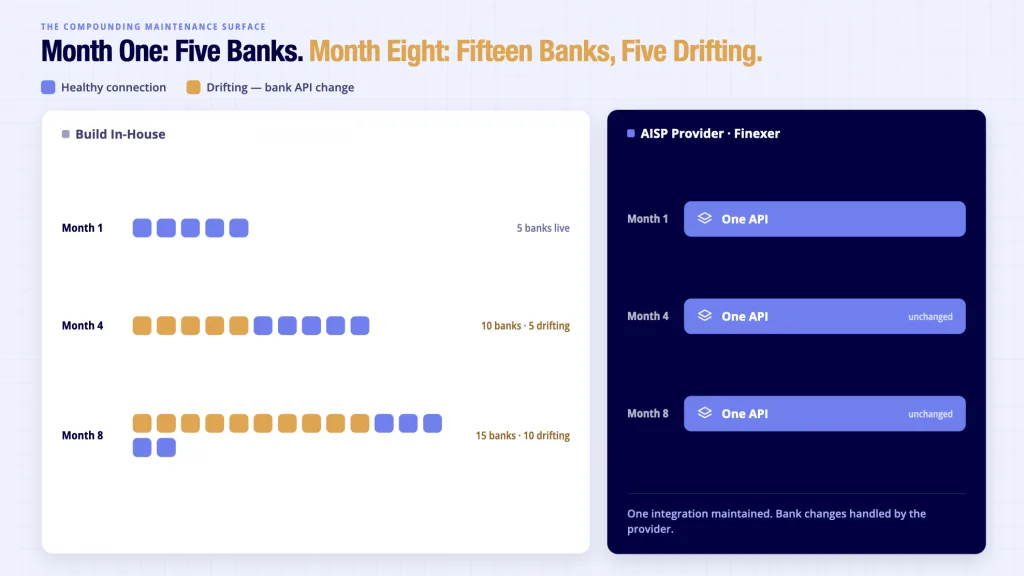
Every direct integration effort shares the same limitation: each UK bank is a separate, ongoing engineering commitment, not a one-time build. A team that connects five banks in month one is often still connecting bank fifteen by month eight, while the first five connections have already started drifting from bank-side API changes.
The right Open Banking AIS infrastructure removes this drift by centralising bank connectivity, consent handling and data normalisation behind a single API, so the platform team maintains one integration instead of dozens.
Finexer’s AIS: The Infrastructure Layer for AISP Open Banking
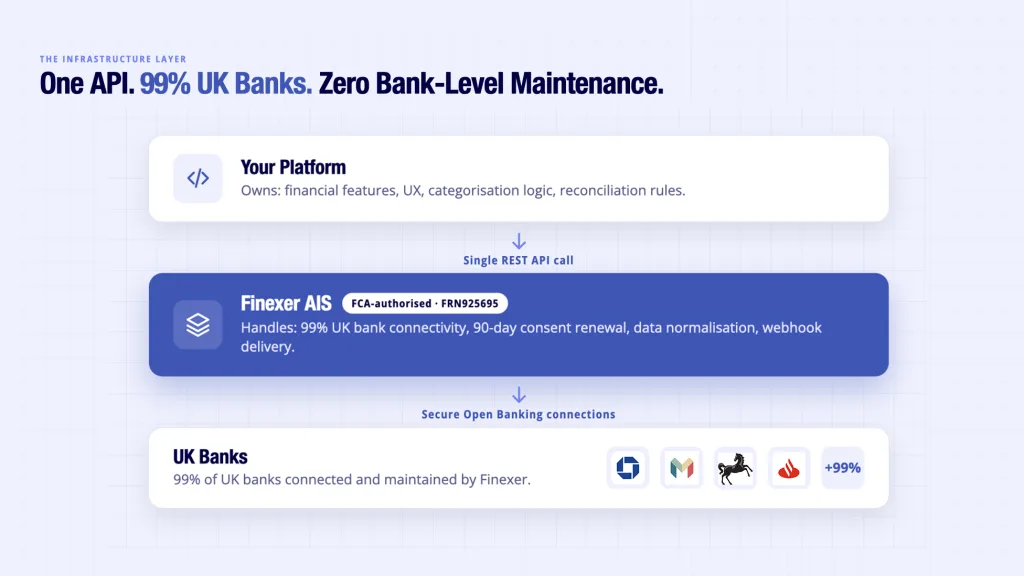
Platform teams evaluating AISP Open Banking are really deciding whether to spend engineering time on bank connectivity or on their own product.
Finexer’s Data (AIS) product provides read-only access to UK bank transaction data through a single API: the platform requests consent, the customer authenticates directly with their bank, and Finexer returns structured, normalised transaction data via webhook as new activity occurs, without the platform building or maintaining individual bank connections.
This is the same infrastructure documented in Finexer’s AIS API for teams wanting the technical integration detail.
- Single API instead of per-bank integration work
- Consent management handled across the 90-day renewal cycle
- Structured, normalised transaction data per bank
- Up to 7 years of transaction history (bank-dependent)
- Real-time webhooks for new transaction events
- Almost all UK banks covered
- FCA-authorised AISP and PISP (FRN925695)
- 3–5 weeks onboarding support
- Usage-based pricing
What Is Open Banking AISP?
Open Banking AISP refers to an Account Information Service Provider authorised to access bank account data with customer consent, under UK Open Banking regulation.
An AISP can retrieve transaction history, balances and account details, but it never moves money; that’s the role of a PISP. The distinction matters for platform teams building financial features: verification, reconciliation and aggregation all sit on the AISP side, while payment initiation sits on the PISP side. Finexer is authorised as both, so platforms can use one provider across both access models without separate integrations.
What is the difference between AISP and PISP?
An AISP retrieves bank account data and never moves money, while a PISP initiates payments directly from a bank account after customer authorisation. The two are regulated separately under UK Open Banking rules, though a single provider like Finexer can hold both authorisations.
Is AISP access read-only?
Yes, an AISP’s access to bank data is strictly read-only under FCA regulation, covering transaction history, account balances and account details with the customer’s explicit consent. An AISP cannot initiate or move funds under any circumstances.
How long does AISP Open Banking integration take?
Building direct bank connections in-house typically takes 6-12 months to reach meaningful UK bank coverage, while integrating with an Open Banking AISP like Finexer typically takes 3-5 weeks with onboarding support. The difference is largely the ongoing maintenance burden of individual bank APIs, not the initial connection.
Do platforms need their own FCA authorisation to use AISP data?
No, a platform can integrate with an already-authorised AISP like Finexer without obtaining its own FCA authorisation, since the provider carries the regulatory permission. Platforms pursuing their own authorisation typically do so only if AIS access is core to their regulated business model.
See how Finexer’s AIS API replaces months of direct bank integration work with a single, FCA-authorised connection
Explore with AI
About the Author

Yuri
Yuriy Yakushko is a fintech founder and software engineer with over 20 years of experience building financial technology. He’s passionate about creating scalable, secure infrastructure that helps businesses modernise how they access financial data and manage payments.