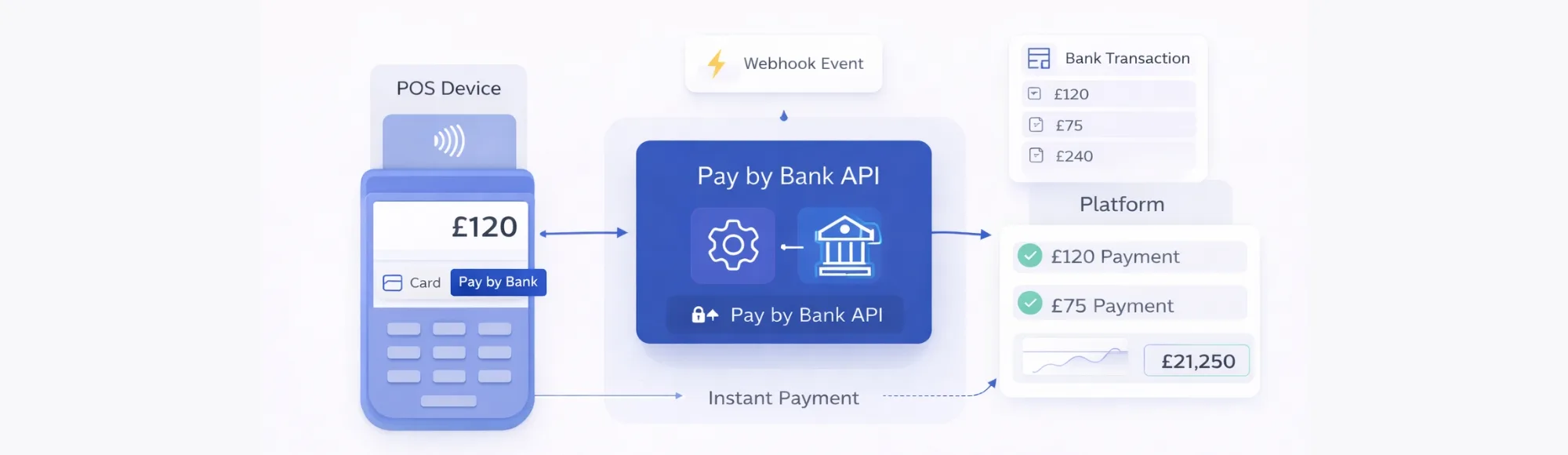
Building Pay by Bank into your EPOS platform?
Finexer gives EPOS platforms FCA-authorised PIS and AIS infrastructure – payment initiation and bank transaction verification in one integration.
Most EPOS platforms handle payment acceptance well. The problems appear downstream – in settlement confirmation, reconciliation, and financial reporting workflows that depend on data arriving from card processors hours after the transaction occurred.
EPOS integration with bank payment infrastructure changes this architecture entirely. Payment confirmation arrives at the point of transaction. Settlement data comes directly from the bank. Reconciliation runs automatically against verified records rather than processor batch reports.
At Finexer, we work with UK EPOS software providers and retail payment platforms integrating Pay by Bank and bank transaction data APIs into their payment workflows. The operational difference becomes clear within the first weeks of transaction volume – end-of-day reconciliation processes that previously took hours run automatically against real-time bank data.
This blog explains how EPOS integration works with Pay by Bank and financial data APIs, what the POS integration API flow looks like, and where Finexer fits as the infrastructure layer.
TL;DR
EPOS integration with Pay by Bank and financial data APIs allows POS platforms to accept bank payments, receive real-time confirmation, and automate reconciliation against verified bank transaction data. Finexer provides FCA-authorised PIS for Pay by Bank payment initiation and AIS for bank transaction verification – giving EPOS platforms a complete pos integration api layer covering 99% of UK banks.
Key Takeaways
What is EPOS integration in the context of Open Banking?
EPOS integration refers to connecting POS software with external payment infrastructure and bank data APIs. In an Open Banking context, this means integrating PIS for Pay by Bank payment initiation and AIS for bank transaction verification – replacing card network dependencies with direct bank connectivity.
What does a POS integration API do?
A pos integration api allows POS software to communicate with payment infrastructure programmatically. It triggers payment initiation, receives real-time confirmation via webhook, and retrieves bank transaction data for reconciliation – all without the POS platform building or maintaining direct bank connections.
How does Pay by Bank work in an EPOS integration?
The customer selects Pay by Bank at checkout. They authenticate via their banking app using Strong Customer Authentication. The payment is initiated directly from their bank account via PIS. The EPOS platform receives real-time confirmation via webhook – no card network, no processor delay.
Why does EPOS integration with bank data improve reconciliation?
Card payment reconciliation depends on processor settlement reports that arrive in batches – often end-of-day or later. Bank transaction data retrieved via AIS arrives as transactions settle – allowing EPOS platforms to match POS records against bank-confirmed data in real time rather than retrospectively.
What does Finexer provide for EPOS integration?
Finexer provides FCA-authorised PIS for Pay by Bank payment initiation and AIS for bank transaction data retrieval – covering 99% of UK banks through a single pos integration api with real-time webhooks and structured transaction outputs.
What Is EPOS Integration?
EPOS integration is the process of connecting POS software to external financial infrastructure – payment systems, bank data APIs, and transaction verification services – so that payment workflows run automatically within the POS system.
Traditional EPOS integration focused on card terminal connectivity. Modern EPOS integration extends this to include:
- Pay by Bank payment initiation via PIS
- Bank transaction data retrieval via AIS for settlement verification
- Automated reconciliation against bank-confirmed records
- Real-time payment confirmation via webhook rather than batch reports
The shift from card-only to bank-inclusive EPOS integration is not just about adding a payment method. It changes the data architecture behind reconciliation, reporting, and financial operations.
“EPOS integration with bank APIs removes the data gap between payment initiation and settlement confirmation. That gap is where most reconciliation errors originate.” – Yuri, Finexer
How Does a POS Integration API Work?
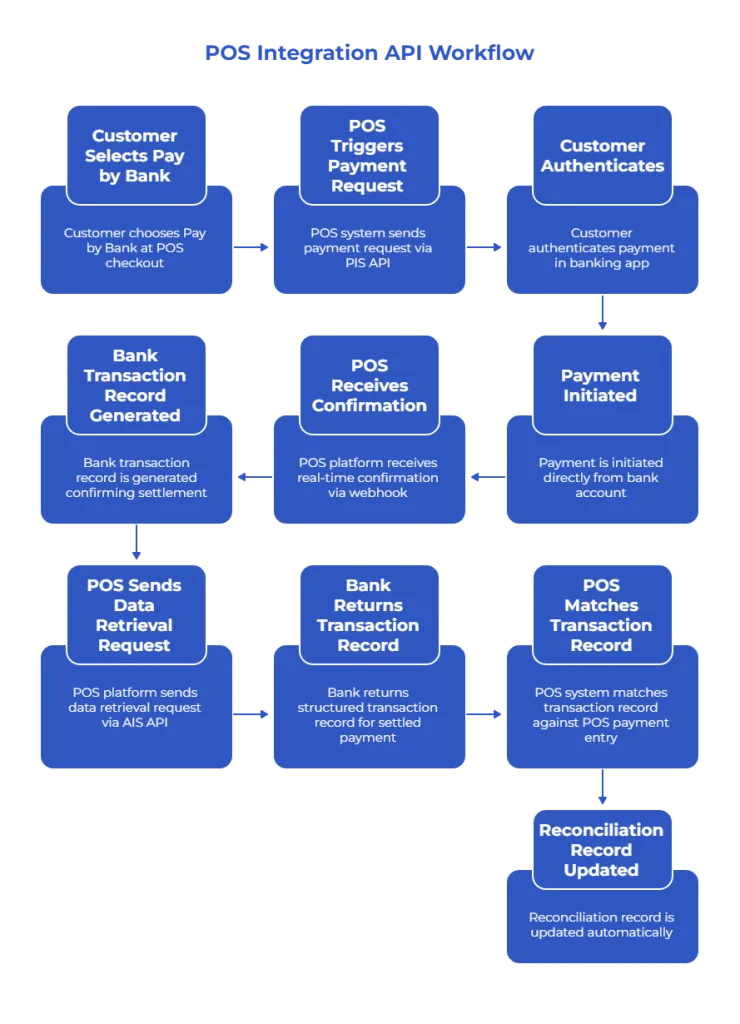
A pos integration api is the programmatic interface that connects POS software to payment and bank data infrastructure. Understanding the flow helps engineering teams evaluate what integration involves.
Pay by Bank payment flow via POS integration API:
- Customer selects Pay by Bank at POS checkout
- POS system triggers payment request via PIS API
- Customer is redirected to their banking app for SCA authentication
- Payment is initiated directly from customer’s bank account
- POS platform receives real-time confirmation via webhook
- Bank transaction record is generated confirming settlement
Bank transaction verification flow via AIS:
- POS platform sends transaction data retrieval request via AIS API
- Bank returns structured transaction record for the settled payment
- POS system matches transaction record against POS payment entry
- Reconciliation record is updated automatically
No manual steps. No end-of-day batch dependency. No processor intermediary between payment and confirmation.
Open Banking for EPOS retail payments covers the payment layer in detail.
How Should EPOS Platforms Evaluate Integration Infrastructure?
| Integration Requirement | Why It Matters | What to Look For |
|---|---|---|
| Real-Time Payment Confirmation | POS environments require instant confirmation – not end-of-day settlement reports | Webhook-driven PIS confirmation; instant payment events; live settlement signals |
| Bank Transaction Verification | Reconciliation requires bank-confirmed settlement data, not just initiation confirmation | AIS connectivity; structured transaction outputs; real-time bank data feeds |
| UK Bank Coverage | Pay by Bank only works if the customer’s bank is supported by the pos integration api | 99% UK bank coverage; CMA9 and challenger banks; consistent across institutions |
| Failed Payment Detection | EPOS platforms need instant visibility into failed payments to resolve at point of sale | Webhook failure notifications; real-time payment status; instant retry capability |
| Structured Data Output | Automated reconciliation requires consistently formatted transaction records | Structured JSON outputs; merchant identifiers; transaction references; amount data |
| White-Label Capability | EPOS platforms serving merchants need branded payment journeys within their product | White-label consent flows; customisable payment UI; branded bank connection journey |
How Does Finexer Enable EPOS Integration?
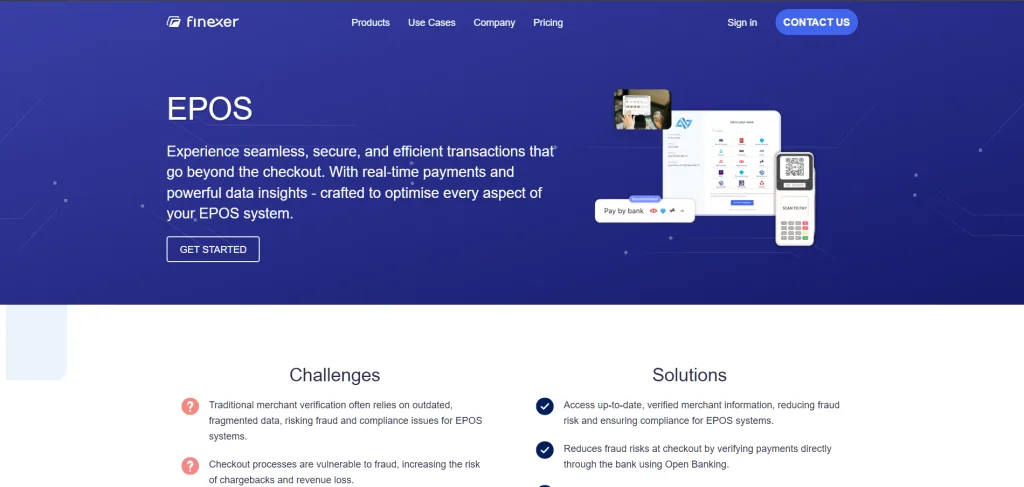
Finexer provides FCA-authorised Open Banking infrastructure combining PIS for Pay by Bank payments and AIS for bank transaction verification – giving EPOS platforms both sides of the payment and reconciliation workflow through a single pos integration api.
What Finexer provides for EPOS integration:
- PIS infrastructure for Pay by Bank payment initiation at POS checkout
- Real-time payment confirmation via webhooks at point of transaction
- AIS connectivity for bank transaction verification across 99% of UK banks
- Structured JSON transaction outputs with merchant identifiers and settlement data
- Instant failed payment detection via webhook-driven transaction events
- White-label capability for branded payment journeys within EPOS products
- Usage-based pricing with no minimum volume commitments
EPOS platforms integrate once and get both payment initiation and transaction verification from the same infrastructure layer. Engineering teams maintain one pos integration api rather than separate providers for PIS payments and AIS reconciliation data.
How EPOS systems evolve with Open Banking covers the broader infrastructure evolution in detail.
Finexer EPOS use cases cover the full product capabilities available for EPOS platform integration.
What I Feel
The EPOS integration question engineering teams ask most often is not about payment acceptance – it is about what happens after the payment. How does settlement get confirmed? How does reconciliation run without a manual step?
The pos integration api answer is straightforward. PIS handles initiation. AIS handles verification. Both arrive through the same integration. The reconciliation problem disappears when bank transaction data flows into the POS system automatically rather than arriving in a processor batch report the next morning.
Common Use Cases

EPOS & Retail Payment Platforms
EPOS platforms use Finexer’s PIS pos integration api to accept Pay by Bank at checkout – removing card processing fees and delivering real-time payment confirmation via webhook. AIS connectivity retrieves bank transaction records automatically, replacing end-of-day reconciliation runs with continuous automated matching against live bank data.
POS Software Providers
POS software providers embed Finexer’s epos integration layer to offer Pay by Bank alongside existing card acceptance. Structured bank transaction data from AIS powers reconciliation reporting directly within the POS software – merchants receive settlement confirmation without downloading separate processor reports.
Payroll & Invoicing Platforms
Payroll platforms using POS-adjacent disbursement workflows integrate Finexer’s PIS for payment initiation and AIS for settlement verification. Bank-confirmed transaction records support accurate payroll reconciliation and audit trails without manual payment matching.
Accounting & ERP Platforms
Accounting platforms supporting retail merchants use AIS to retrieve bank transaction data from POS payment settlements automatically. Verified transaction records map directly to accounting entries – removing the manual bank statement upload step from retail merchant reconciliation workflows.
Utility Billing Platforms
Utility platforms using POS-style payment collection integrate Finexer’s PIS for Pay by Bank bill payments and AIS to verify customer payment receipt. Epos integration of bank transaction verification eliminates manual payment matching from high-volume billing reconciliation workflows.
What is EPOS integration with Open Banking?
EPOS integration with Open Banking refers to connecting POS software to bank payment infrastructure via PIS for Pay by Bank payments and AIS for bank transaction verification. This allows EPOS platforms to accept bank payments at checkout, receive real-time confirmation, and automate reconciliation against bank-verified settlement data.
What is a POS integration API?
A pos integration api is the programmatic interface connecting POS software to payment and bank data infrastructure. It triggers Pay by Bank payment initiation, delivers real-time confirmation via webhook, and retrieves structured bank transaction data for automated reconciliation – without the POS platform maintaining direct bank connections.
Is Finexer suitable for EPOS platforms building Pay by Bank integration?
Yes. Finexer is FCA-authorised and provides PIS for Pay by Bank payment initiation and AIS for bank transaction verification – covering 99% of UK banks through a single pos integration api. EPOS platforms integrate once to access both payment and reconciliation infrastructure with real-time webhooks and structured data outputs.
Build complete EPOS integration with Pay by Bank and bank transaction verification.
About the Author

Yuri
Yuriy Yakushko is the Founder of Finexer, an FCA-authorised Open Banking platform that enables businesses to access real-time bank data and Pay-by-Bank payments through secure API infrastructure. With more than 20 years of experience in fintech and software engineering, he focuses on building scalable financial technology that helps businesses modernise payments and financial data workflows.