
Wrong infra choice costs months.
FCA-authorised payments and bank data infrastructure for UK platforms.
API-driven fintech infrastructure allows platforms to build payments, onboarding, and financial data workflows using modular APIs instead of legacy banking integrations.
For UK startups and scale-ups, this infrastructure decision determines everything downstream: how fast you go live, how clean your data is, and whether compliance workflows hold under regulatory scrutiny.
The wrong choice does not announce itself in the demo. It surfaces three weeks after go-live – when reconciliation gaps appear, bank connections drop without a retry path, or data arrives in a format the system cannot parse.
At Finexer, I work with UK product leads and CTOs at exactly this decision point. The questions that matter are rarely the ones in the marketing materials.
TL;DR
API-driven fintech infrastructure for UK platforms requires four things working together: reliable UK bank connectivity, clean and enriched transaction data, payment initiation capability, and production-ready onboarding support. Most providers deliver some of these well. The platforms that struggle post-launch are those that optimise for the demo experience rather than the production environment. This blog covers what to actually evaluate – and where the gaps most commonly appear.
Key Takeaways
What is API-driven fintech infrastructure?
API-driven fintech infrastructure is the technical layer that connects platforms to banking systems – enabling access to account data, transaction history, and payment initiation without direct bank integrations. In the UK, it is built on FCA-regulated Open Banking standards, allowing FCA-authorised third-party providers to access bank data and initiate payments with user consent.
What do UK fintech platforms actually need from infrastructure?
UK platforms need reliable connectivity to UK banks specifically, enriched transaction data that arrives in a usable format, payment initiation that works at scale, and an onboarding timeline measured in weeks rather than months. Global coverage is often irrelevant for UK-first builds. UK-specific reliability is not.
Why do infrastructure integrations that work in testing fail in production?
Testing uses controlled sandbox environments with predictable data. Production exposes the integration to real bank API variation – different data formats across institutions, connection instability during bank maintenance windows, and webhook delivery failures under volume. The integration quality that matters is production quality, not sandbox quality.
How should platforms evaluate API fintech infrastructure providers?
Evaluate on time to production (not time to first API call), data quality (not just data availability), UK bank coverage depth (not headline connection count), payment feature completeness (not feature presence), and onboarding support (not documentation quality). The gap between these pairs is where most integration failures originate.
What UK Fintech Platforms Actually Need From Infrastructure
What Are the Real Requirements for Payments and Data Infra?
Most API fintech infrastructure comparisons focus on feature lists. The decision that matters is whether the infrastructure works reliably in production for UK-specific use cases.

Four requirements define whether infrastructure is genuinely fit for purpose:
- UK bank connectivity at depth – connecting to a bank is not the same as receiving reliable, consistent data from it. UK platforms need infrastructure that handles bank API variation across institutions, manages connection failures without data loss, and delivers data in a consistent schema regardless of which bank originated the transaction.
- Enriched, structured data from the point of delivery – raw bank transaction data is not workable in accounting, ERP, or compliance workflows. Infrastructure that delivers merchant-identified, categorised, and normalised transaction data removes the enrichment layer that platforms would otherwise need to build and maintain themselves.
- Payment initiation that covers the use case set – Pay by Bank for one-off collections, Payment Links for invoice-triggered payments, Bulk Payout for payroll and supplier disbursements, and Variable Recurring Payments for subscription and billing use cases. Coverage of the full payment flow – not just single payment initiation – determines whether the infrastructure is genuinely sufficient.
- Production onboarding measured in weeks – the gap between a successful sandbox integration and a production-ready deployment is where most infrastructure projects slow down. Onboarding support that covers consent flow design, webhook configuration, and data schema validation shortens this gap from months to weeks.
Open Banking infrastructure for financial platforms – what actually matters covers how UK Open Banking infrastructure differs from global API platforms and where the production-readiness gap most commonly appears.
“The infrastructure decision for UK platforms is almost never about which provider has the most banks. It is about which provider’s data arrives clean enough to use, which provider’s payments actually clear reliably, and which provider will still be actively supporting the integration six months after go-live.” – Ravi, Finexer
Where Most API Fintech Infrastructure Platforms Fall Short
What Are the Real Gaps in API Fintech Platform Performance?
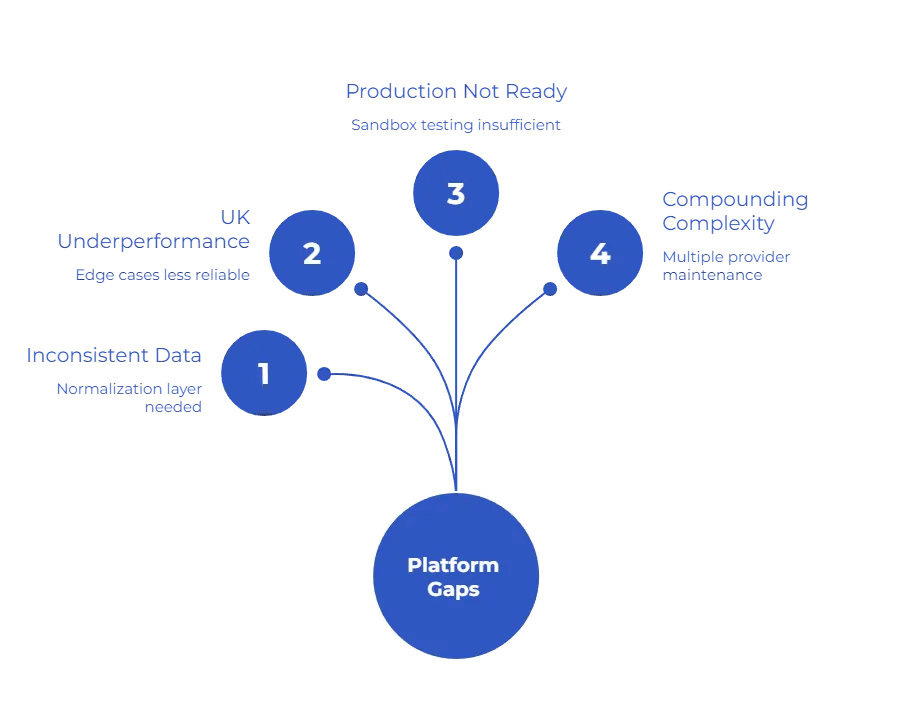
The gap between what API fintech infrastructure platforms promise and what they deliver in production follows a consistent pattern.
- Good APIs, inconsistent data – most providers have functional APIs. Fewer deliver data in a format that is immediately usable. Transaction descriptions that vary across banks, inconsistent merchant identification, and missing category codes mean the platform still needs to build a normalisation layer on top of the infrastructure. This adds engineering overhead and introduces categorisation errors that downstream workflows inherit.
- Global coverage, UK underperformance – platforms built for multi-country coverage optimise across geographies. UK-specific bank connections may work, but edge cases – challenger banks, business accounts, joint accounts – are often less reliable than the headline coverage figure suggests. For UK-only builds, a UK-first provider outperforms a globally optimised one on the metrics that matter.
- Integration complete, production not ready – a successful API integration and a production-ready deployment are different milestones. Webhook delivery under volume, connection recovery after bank maintenance, consent flow UX, and error handling at scale are all production concerns that sandbox testing does not expose. Infrastructure providers that treat go-live as the end of the engagement leave platforms to solve these problems themselves.
- Multiple providers, compounding complexity – platforms that need data from one provider and payments from another create a two-integration maintenance burden. Data and payment flows that run through separate infrastructure layers require reconciliation logic that neither provider owns.
Banking API integration guide for UK fintech platforms covers the architecture decisions that determine whether production issues are absorbed at the infrastructure layer or escalate into platform-level problems.
Audit trail infrastructure for UK fintech platforms covers how compliance and audit requirements interact with infrastructure provider selection – and why the consent and access logging layer is as important as the data layer.
How to Evaluate API-Driven Fintech Infrastructure
What Criteria Actually Predict Production Performance?

Most evaluations test the wrong things. Documentation quality, sandbox cleanliness, and feature count predict demo quality. These three criteria predict production quality:
Data quality over data availability – does merchant identification normalise across payment methods? Are category codes applied at source? Is the transaction schema consistent across all connected UK banks? Data that arrives clean eliminates the normalisation layer platforms would otherwise build themselves.
Time to production over time to first API call – what is the realistic timeline from API access to first live transaction? Who provides active support during that window? Sandbox speed and production onboarding speed are different metrics. The gap between them is where integration timelines slip.
Payment completeness over payment presence – which features are fully in production today? Single payment initiation, Payment Links, Bulk Payout, VRP – feature presence on a roadmap is not feature availability for go-live.
| What Providers Claim | What to Actually Test | Why It Matters |
|---|---|---|
| Structured transaction data | Merchant ID consistency across payment methods | Inconsistent data breaks downstream categorisation |
| Fast setup / quick integration | Time from API access to first live transaction | Sandbox speed does not predict production speed |
| Feature list (PIS, VRP, Bulk) | Which features are production-ready today | Roadmap features cannot be relied on for go-live |
Most popular banking API use cases for UK fintech platforms covers how the most common API use cases – onboarding, reconciliation, payment initiation – interact with infrastructure provider selection.
“When I ask platform teams what went wrong with their first infrastructure choice, the answer is almost always the same. It worked in the demo. It worked in the sandbox. The problems started when they went live and hit a bank that behaves differently at 2am than it does at 2pm.” – Ravi, Finexer
How Finexer Fits Into This Picture
What Does Finexer’s Infrastructure Provide for UK Platforms?
For UK platforms that need both financial data and payment infrastructure without managing multiple providers, Finexer provides a unified API layer combining FCA-authorised AIS and PIS – designed for UK-first builds with a production onboarding timeline of 3-5 weeks.
AIS – Account Information Services:
- Real-time webhooks per transaction – no polling, no batch delays
- Merchant IDs and category codes applied at source – pre-enriched data before it reaches the platform
- Up to 7 years of transaction history per connected account
- Multi-account access in a single consent flow
- Structured JSON output – consistent schema across 99% of UK banks
- Consent logs and access timestamps per retrieval – full audit trail
PIS – Payment Initiation Services:
- Pay by Bank via Faster Payments – instant settlement, zero chargebacks
- Payment Links – shareable payment initiation for invoice and billing use cases
- QR code payments – point-of-sale initiation without redirect friction
- Bulk Payout – multiple disbursements via single API call
- Payout – single outbound payment initiation
- VRP (Variable Recurring Payments) – merchant-controlled recurring collection
- Webhook confirmation per payment – real-time settlement status
Infrastructure terms:
- FCA-authorised FRN925695
- White-label consent flows under platform branding
- Usage-based pricing
- 3-5 weeks to production deployment with active onboarding support
What I Feel
Most infrastructure decisions are made on the wrong criteria – headline coverage, documentation quality, and how clean the sandbox data looks.
The right criteria are different. How does the data arrive when a business account at a challenger bank processes a transaction via direct debit? What happens to the webhook when the bank runs maintenance at 3am? Who picks up the support ticket when something breaks in production on a Friday?
Those are the questions that determine whether the infrastructure works for the platform or creates work for the platform.
Common Use Cases
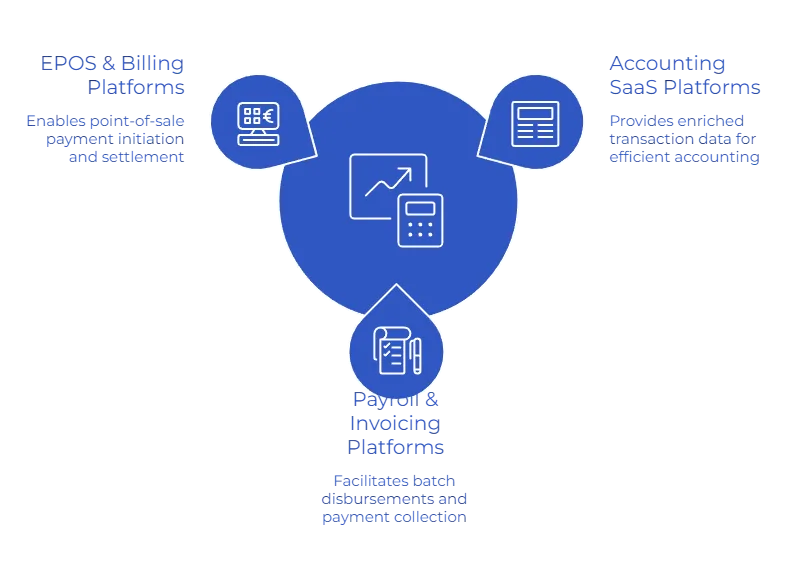
Accounting SaaS Platforms
Accounting platforms need enriched transaction data that arrives ready to categorise – not raw bank descriptions that require a normalisation layer. Finexer’s AIS delivers merchant-identified, category-coded transactions with a consistent JSON schema across virtually every UK bank, alongside Bulk Payout for client disbursement workflows.
Payroll & Invoicing Platforms
Payroll and invoicing platforms need Bulk Payout for batch disbursements, Payment Links for invoice-triggered collection, and AIS transaction confirmation to verify when payments clear. Finexer provides all three through a single API integration without requiring separate provider relationships.
EPOS & Billing Platforms
EPOS and billing platforms need point-of-sale payment initiation and real-time settlement confirmation. Finexer’s QR and Payment Link initiation with webhook confirmation per payment gives EPOS platforms instant settlement status without polling or batch reconciliation.
What does API-driven fintech infrastructure include for UK platforms?
API-driven fintech infrastructure for UK platforms typically includes Account Information Services (AIS) for bank data access and Payment Initiation Services (PIS) for payment execution. Under UK Open Banking, only FCA-authorised providers can deliver these services. A complete infrastructure layer covers data retrieval, enrichment, payment initiation, and consent management through a single integration.
What should UK platforms prioritise when choosing API fintech infrastructure?
UK platforms should prioritise production readiness over sandbox performance, data quality over data availability, and UK bank coverage depth over headline connection count. Time to production, active onboarding support, and unified data and payment capability from a single provider reduce integration complexity and post-launch failure risk.
How does FCA authorisation affect fintech infrastructure provider selection in the UK?
FCA authorisation determines which providers can legally access UK bank data and initiate payments under Open Banking. Only FCA-authorised AISPs and PISPs can operate compliantly. Platforms building on non-authorised infrastructure carry regulatory exposure. Verifying FCA registration before provider selection is a compliance requirement, not a preference.
Build UK fintech infrastructure on FCA-authorised payments and data APIs.
About the Author

Ravi Ranjan
Ravi Ranjan is Co founder & CEO of Finexer