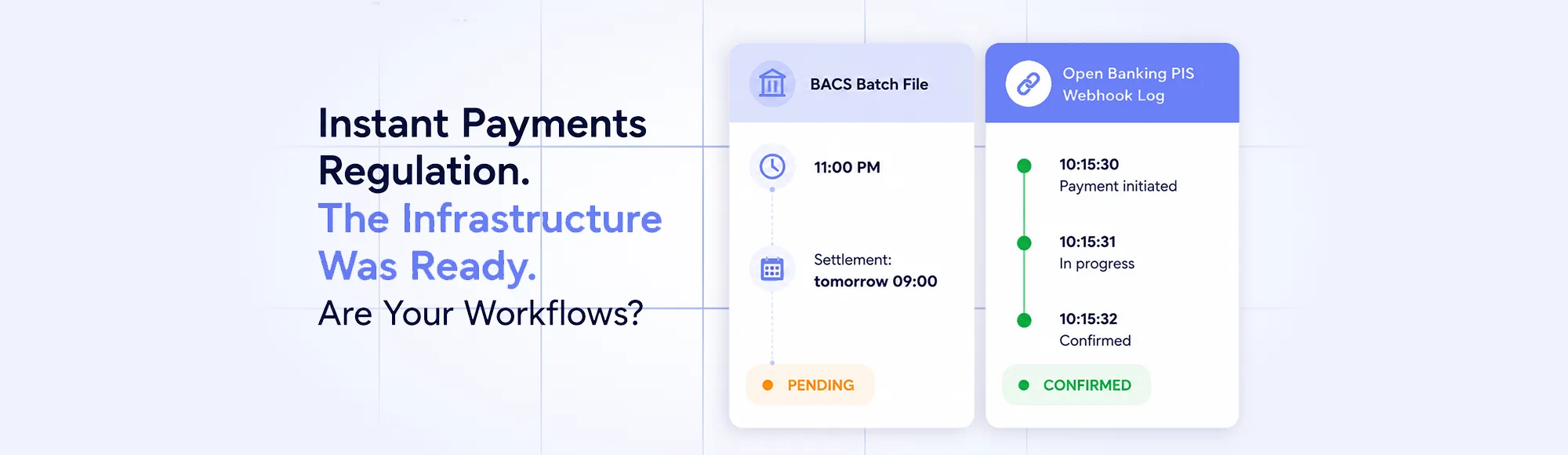
Instant payment infrastructure for platforms.
FCA-authorised Open Banking PIS and AIS with per-payment webhook confirmation.
The assumption that payments take a day has been embedded in business infrastructure for decades.
Payroll systems built before instant payments regulation run on T+1 logic. Reconciliation workflows expect overnight settlement. Supplier payment terms are written around clearing windows that no longer reflect the technical reality of modern payment rails.
Faster Payments has been processing transfers in seconds since 2008 in the UK. The infrastructure has been there. The workflows built on top of it often have not caught up.
Instant payments regulation – both the EU Instant Payments Regulation (IPR) that entered into force in April 2024, and the UK’s own Faster Payments trajectory – is now formalising what the infrastructure already supports.
The question for payment platforms and finance teams is not whether instant payments regulation is creating change. It is whether their confirmation, reconciliation, and settlement workflows are built to operate at that speed.
“The platforms that struggle most with instant payment adoption are not struggling with the payment itself. They are struggling with everything that needs to happen the moment a payment confirms. Status webhooks, reconciliation triggers, downstream workflow signals – those systems were built for a world where payments took a day.” – Clare, Finexer
TL;DR
Instant payments regulation is not a speed upgrade – it is a workflow infrastructure shift. EU IPR mandates what instant payments UK already delivers via Faster Payments since 2008. Eurozone banks: receive from January 2025, send from October 2025. For platforms: confirmation, reconciliation, and workflow triggers must fire at point of payment – not the following morning.
Key Takeaways
What is the instant payments regulation?
The EU IPR, adopted March 2024, requires eurozone banks to offer instant credit transfers at no premium. January 2025: must receive. October 2025: must send. April 2026: first PSP reporting to regulators.
What is the instant payment system in the UK?
FPS has processed UK bank transfers in seconds, 24/7, since 2008 – already the default rail. Open Banking PIS routes through FPS, adding API access and per-payment webhook confirmation on top.
How fast are Faster Payments in the UK?
Most Faster Payments complete in seconds, settlement near-instant bank-to-bank. Open Banking PIS adds per-payment webhook: initiated, confirmed, or failed – the trigger signal platforms need for downstream workflows.
The Regulation Gap: EU Mandate vs UK Infrastructure Reality
The EU and UK are at different points on the same trajectory.
The EU Instant Payments Regulation is a mandate. Eurozone banks did not have a universal instant payment obligation before 2024. The IPR creates one – requiring all banks offering credit transfer services to also offer instant credit transfers, at the same price, 24/7.
The UK is different. Faster Payments has been live since 2008. It is the UK’s default instant payment rail. Instant payment infrastructure is not new here – it is already the default for bank transfers. What the UK lacks is the EU’s regulatory standardisation around pricing, availability, and PSP reporting obligations.
That is the gap instant payments regulation fills for eurozone banks.
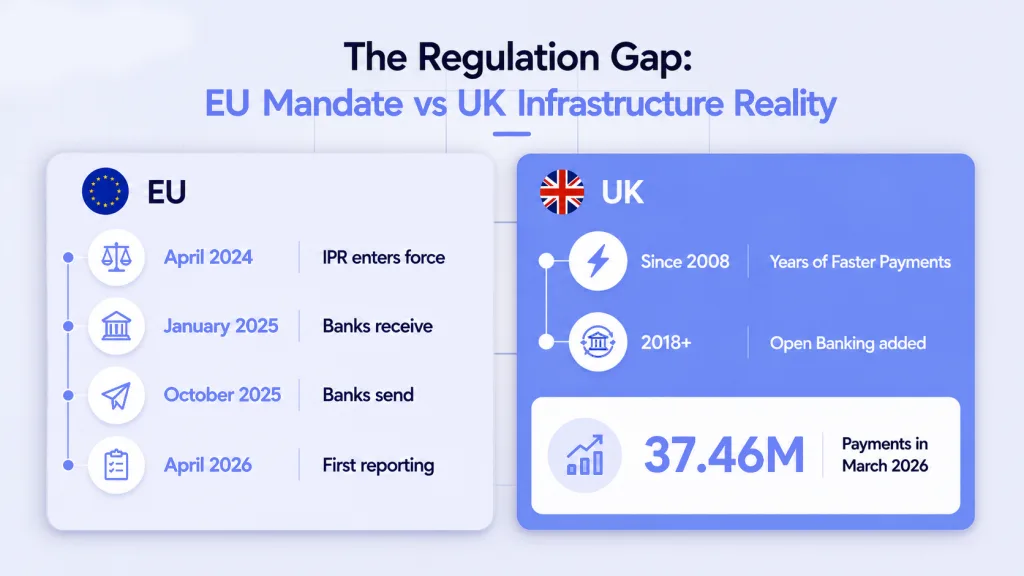
EU IPR timeline (verified):
- April 2024 – Regulation enters into force
- January 2025 – Eurozone banks must be able to receive instant payments
- October 2025 – Eurozone banks must be able to send instant payments
- April 2026 – First mandatory PSP reporting period to regulators
UK Faster Payments trajectory:
- FPS operating since 2008 – transfers in seconds, 24/7
- 4.9 billion FPS payments processed in the 12 months to September 2024, up 14% year-on-year (Payment Systems Regulator)
- Q4 2024 alone: over 1.3 billion FPS payments, up 12.3% on Q4 2023 (Pay.UK)
- Open Banking adding API-driven A2A payment initiation on top of FPS rails
- PSR fraud rules (since late 2024): banks can delay transfers up to 4 days for fraud review – a separate consideration from instant payment speed
Payment infrastructure teams building on faster payments need to understand how settlement timing, scheme participation, and Open Banking initiation interact within the same rails.
What Instant Payments Actually Change for Platforms
Speed is the least important part of the instant payments UK shift.
A payment that takes seconds instead of a day creates a different operational problem: every workflow that was designed around T+1 settlement now needs to operate in real time.
Reconciliation that ran overnight has to run on confirmation. Status polling logic built for batch windows needs to handle webhooks. Downstream triggers built around the assumption of next-day clearing need to fire immediately.
This is where most payment platforms encounter friction – not in the payment itself, but in what they have built around it.
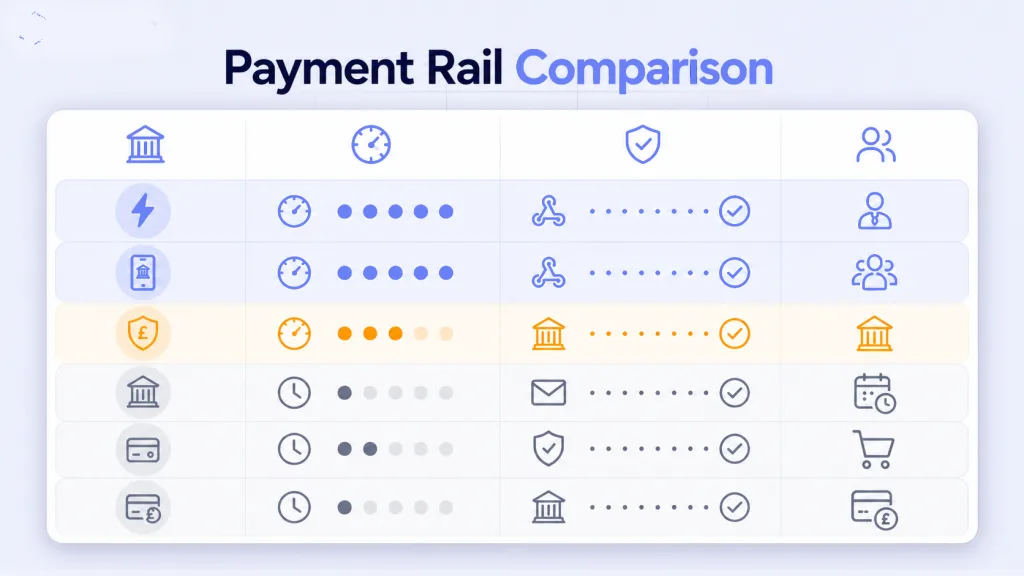
| Payment Rail | Settlement Speed | Confirmation Method | Typical Use |
|---|---|---|---|
| Faster Payments (FPS) | Seconds (24/7) | Near-immediate bank confirmation | Personal and business transfers, Open Banking A2A |
| CHAPS | Same day (within processing hours) | RTGS – irrevocable settlement | High-value, time-critical payments (avg £1.8M in 2025) |
| Bacs Direct Credit | 3 working days | Batch notification | Payroll, bulk supplier payments |
| Bacs Direct Debit | 3 working days | Batch notification | Recurring collections, utility billing |
| Open Banking PIS via FPS | Near-instant | Per-payment webhook (initiated / confirmed / failed) | Pay by Bank, A2A checkout, invoice payment |
| Card payments (Visa/MC) | Authorisation immediate; settlement T+1 to T+3 | Authorisation code at point of sale | Consumer and business card transactions |
The table above shows the settlement speed. The column that matters operationally is confirmation method.
Faster Payments and Open Banking PIS are the only rails that provide per-payment confirmation at the point of transfer. Every other method either settles in batches (Bacs) or separates authorisation from settlement (cards).
For platforms that need to trigger a workflow – releasing a product, updating a ledger, sending a receipt, initiating a disbursement – the confirmation signal is the operational primitive, not the speed.
The operational pattern where bank payment delays break downstream workflows – reconciliation, ledger updates, customer notifications – is the same pattern that instant payment confirmation resolves at the platform level.
How Open Banking Sits Within Instant Payment Infrastructure
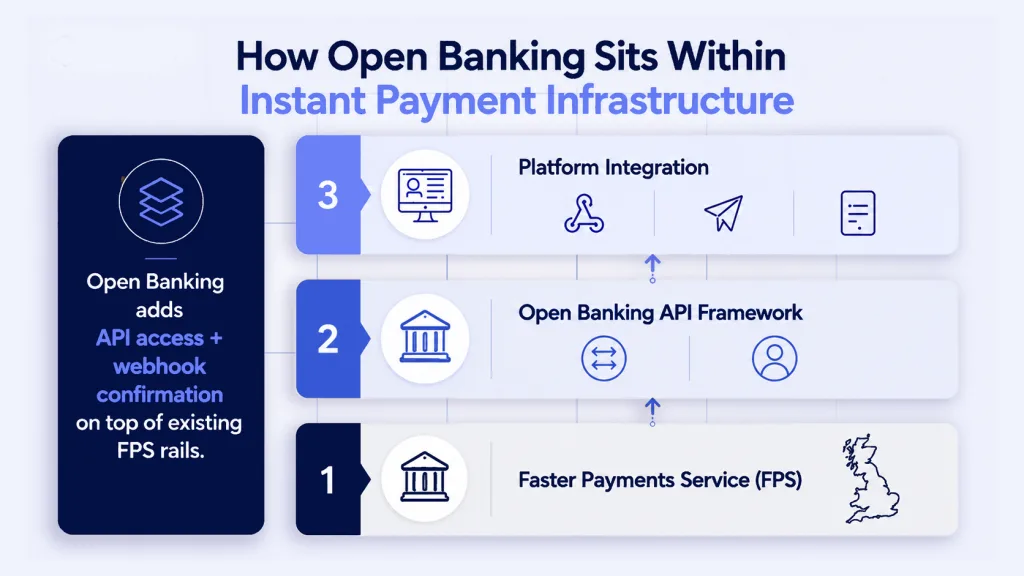
Open Banking does not operate a separate payment rail.
Open Banking Payment Initiation Services (PIS) initiates payments through the existing Faster Payments infrastructure. The Open Banking layer adds:
- API-based initiation – the platform triggers the payment through a structured API call rather than a manual bank transfer
- Consent-based authentication – the customer authorises the payment directly through their bank
- Per-payment webhook confirmation – the platform receives a status event at each lifecycle stage: initiated, in progress, confirmed, or failed
- Structured payment reference – embedded at initiation and returned at confirmation
What Open Banking changes is not the rails. It is the programmatic access to those rails, and the confirmation signal that allows platforms to build payment-event-driven workflows.
Instant payments regulation accelerates this shift – making API-based payment access the expected standard, not the exception.
37.46 million Open Banking payments were processed in March 2026 (Open Banking Limited) – all running on Faster Payments rails, initiated through Open Banking APIs.
B2B payment APIs handle the same instant payment infrastructure across payroll, supplier payments, and invoice settlement – with per-payment confirmation at each workflow stage.
How Does Finexer Support Instant Payment Workflows?
Finexer isn’t a payment scheme. It doesn’t operate Faster Payments or the Open Banking framework.
Finexer provides FCA-authorised Open Banking PIS and AIS – the infrastructure layer that payment platforms, billing systems, and finance teams use to initiate instant payments via Faster Payments and receive per-payment confirmation signals.
The instant payments regulation shift – and the instant payments UK infrastructure that already supports it – creates one specific requirement for platforms: confirmation at the point of payment, not in the next day’s batch. Finexer addresses this at the infrastructure layer.
PIS – payment initiation and confirmation:
- Payment initiation via Open Banking on Faster Payments rails
- Per-payment webhook: initiated, confirmed, or failed at each lifecycle stage
- Failure notification near-immediately with reason code
- Payment reference embedded at initiation and returned at bank confirmation
- Bulk initiation with per-recipient status for high-volume payment flows
AIS – transaction visibility:
- Bank transaction data near settlement – not T+1 batch
- Balance data across connected accounts in consistent format
- Up to 7 years of transaction history for reconciliation and audit
- Merchant IDs and category codes at source
When PIS confirmation and AIS transaction data connect, platforms receive both the outgoing payment status and the incoming bank confirmation in the same data layer. The T+1 workflow assumption breaks down. The platform operates on payment events, not overnight files.
- FCA-authorised (FRN 925695)
- Usage-based pricing, no setup fees, deployment measured in weeks
- Almost all major UK banks via single integration
Platforms running instant fund transfers at volume need per-recipient status and confirmation at initiation – not a single batch notification for the whole run.
What I Feel
The framing around instant payments regulation tends to focus on compliance obligations and regulatory timelines.
That is the wrong frame for most of the platforms I work with.
The question is not whether their bank supports instant payments regulation infrastructure – it does, through Faster Payments. The question is whether their platform is built to receive and act on instant payment confirmation. Most are not.
Their reconciliation logic runs at midnight. Their payment status is polled rather than pushed. Their downstream workflows assume a clearing window that the payment infrastructure long since abandoned.
Instant payments regulation forces the EU’s banking infrastructure to catch up to what the UK already has. With instant payments regulation less of an issue in the UK, the operational challenge is different: the infrastructure is there, but the platforms and workflows built on top of it have not been redesigned to use it.
“The infrastructure question and the workflow question are not the same question. UK banks have supported instant payments for over 15 years. The gap is in the platforms sitting on top – reconciliation engines, ledger updates, confirmation triggers – that were designed for a batch world and have not been rebuilt for a real-time one.” – Clare, Finexer
Common Use Cases
Billing and Subscription Platforms
Billing platforms that initiate payments on a fixed schedule via Bacs Direct Credit operate on a 3-day settlement window by design. When the payment fails – wrong account, insufficient funds, account closed – the platform finds out three days later. Open Banking PIS – the instant payments UK infrastructure layer – provides failure notification near-immediately, This is what instant payments regulation enables operationally – not just faster transfers, but faster failure recovery. allowing the billing workflow to trigger retry logic, customer notification, or account review within the same session rather than at the next processing window.
Payroll and Contractor Platforms
Payroll platforms running on Bacs Direct Credit process on a 3-day settlement cycle. For platforms moving to on-demand payroll – paying earned wages daily rather than monthly – Bacs is structurally incompatible. Open Banking PIS via Faster Payments allows per-payment initiation and confirmation, enabling payroll workflows that settle when initiated rather than on a fixed clearing schedule.
EPOS and Retail Checkout
EPOS platforms embedding instant payment checkout need confirmation at the point of sale – not a polling interval. Open Banking PIS webhooks provide the confirmation signal that allows the checkout flow to complete: payment initiated, confirmation received, transaction complete. The customer experience matches the speed expectation that instant payments create.
Finance Operations and Treasury Teams
Treasury teams managing intraday liquidity need transaction visibility that reflects current balance, not yesterday’s closing position. AIS near-settlement data across connected accounts gives treasury operations the balance and transaction view they need to manage intraday cash positions without waiting for overnight batch files.
What is the difference between Faster Payments and the EU IPR?
Faster Payments is the UK’s instant payment infrastructure since 2008. The EU IPR mandates the same for eurozone banks – instant transfers at no premium. The UK is not subject to the EU IPR, but the direction aligns: instant payments as the default, not a premium.
Which UK banks use Faster Payments?
All major UK retail banks participate in the instant payments UK network via FPS – Barclays, HSBC, Lloyds, NatWest, Santander, Monzo, Starling. Payments complete in seconds. FPS processed 4.9 billion payments in the 12 months to September 2024 (PSR). Smaller building societies access FPS indirectly.
What are instant Open Banking payments?
Instant payments regulation has accelerated bank-to-bank transfers via Open Banking PIS on Faster Payments rails. The customer authenticates with their bank, authorises the payment, and funds transfer near-instantly. The platform receives a webhook confirmation. No card network, no interchange fee, no T+1 delay.
See how Finexer’s Open Banking PIS gives payment platforms per-payment webhook confirmation instead of overnight batch settlement.
About the Author

Clare Pearson
Clare Pearson is a senior payments professional with extensive experience across the global financial services and payments industry. She specialises in Open Banking, payment infrastructure, and financial technology transformation, with expertise spanning product delivery, operational strategy, regulatory compliance, and large-scale payments programmes. Clare currently serves as a Non-Executive Director at Finexer and a panel member for the Payment Systems Regulator (PSR), advising on the development of payment systems policy and innovation