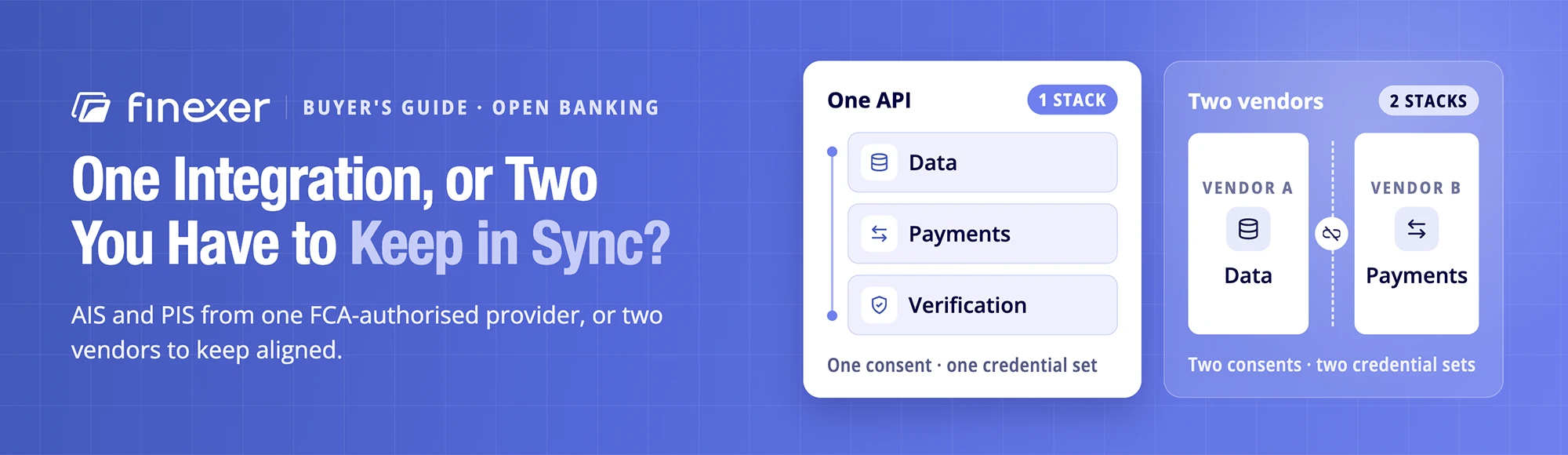
Some UK providers deliver AIS and PIS through a single integration; others require separate products or contracts for each. An open banking data and payments API from one provider reduces engineering effort, but the difference matters less for cost than for the time your team spends building and maintaining two separate integrations.
Do any UK providers offer data and payments in one API?
Yes. A number of UK Open Banking providers offer both account information and payment initiation under one FCA-authorised integration. Others treat AIS and PIS as distinct products, sometimes with separate onboarding, separate documentation, and separate support teams, even when both sit under the same regulatory umbrella.
Single-API stack versus a split stack
| Point of Distinction | Single-API Stack | Split Stack |
|---|---|---|
| Integration effort | One SDK, one set of documentation | Two integrations to build and maintain |
| Consent handling | One consent flow for the customer | Separate consent flows for data and payments |
| Support relationships | One support queue, one point of escalation | Two vendors, two escalation paths |
| Contract count | One commercial agreement | Two commercial agreements to negotiate and renew |
What actually doubles when AIS and PIS sit with different vendors?
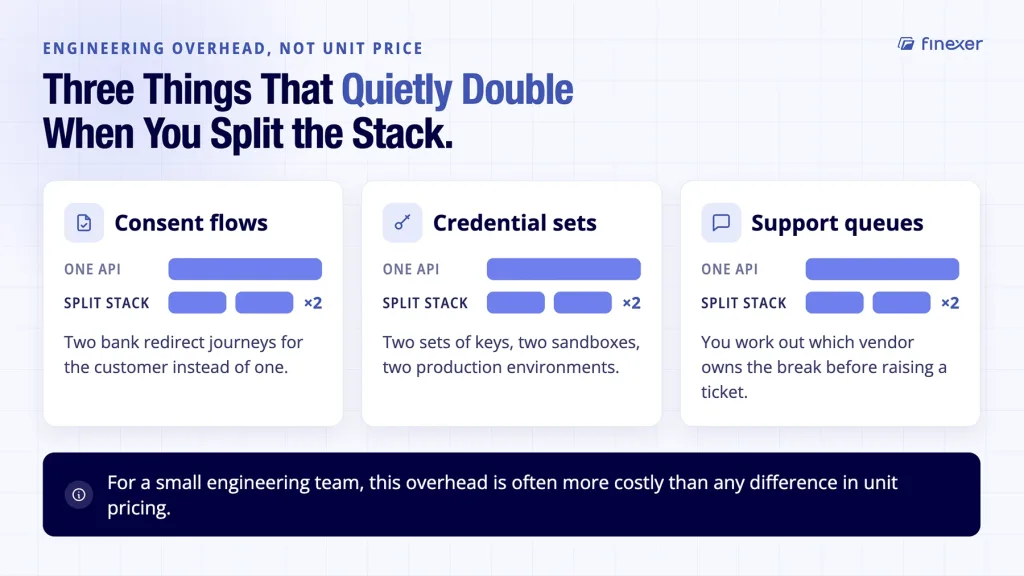
Splitting AIS and PIS across two vendors doesn’t just double the number of API calls your team writes. It typically doubles:
- Consent flows. Your customer authorises data access with one provider and payment initiation with another, which usually means two separate bank redirect journeys instead of one.
- Credential sets. Two sets of API keys, two sandbox environments, and two production environments to secure and monitor.
- Support queues. When something breaks, you first have to work out which vendor is responsible before you can even raise a ticket.
For a small engineering team, this overhead is often more costly than any difference in unit pricing between providers.
When a split stack is genuinely fine
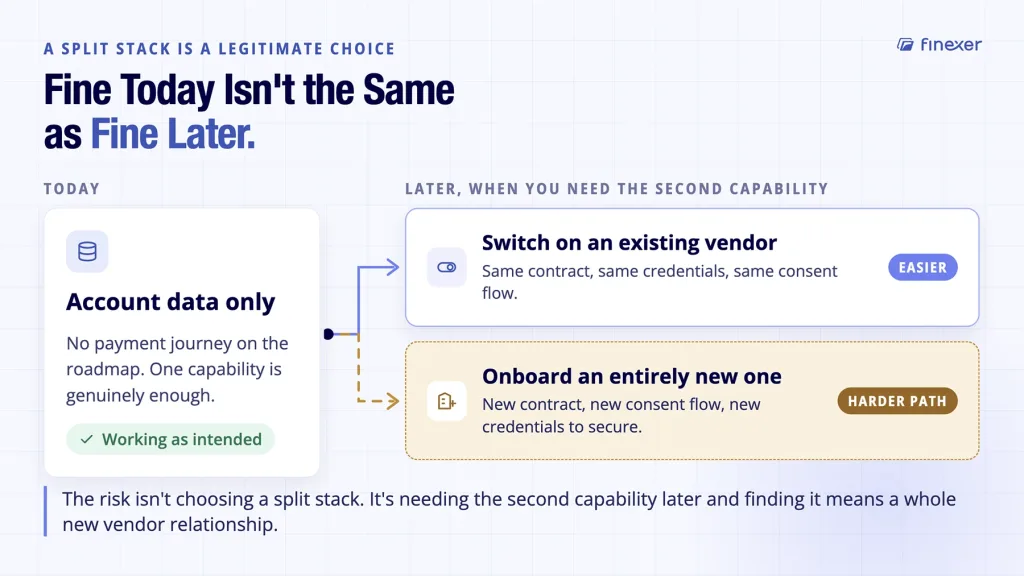
A split stack isn’t automatically the wrong choice. It makes sense when you only need one capability today, with no clear roadmap for the other. A platform that only needs account verification data, for example, gains little from paying for payment initiation it won’t use for the foreseeable future. The problem arises when a business adds the second capability later and discovers it means onboarding an entirely new vendor rather than switching on an existing one.
Our separate guide to AISP vs PISP covers what each role means individually, if you need that grounding before evaluating providers on this basis.
How Finexer brings data, payments and verification together?
Finexer provides AIS, PIS and identity verification behind one FCA-authorised integration, rather than as separate products requiring separate contracts. For a platform building both a data-driven onboarding flow and a payment journey, this removes the need to manage two vendor relationships for one connected workflow.
In practical terms, this means:
- One integration covering account data, payment initiation and verification
- One consent and credential setup instead of two
- One support relationship if something needs resolving
- Coverage across most of the UK banks, including business accounts and challenger banks
- Transparent pricing with no hidden charges
If you’re evaluating this alongside other providers, our guide to open banking solution providers sets out the wider selection criteria, and if Salt Edge is on your shortlist, our comparison of Salt Edge alternatives may be useful.
Bottom line
Buying data and payments from separate vendors is sometimes the right call, but it comes with real engineering overhead: two consent flows, two credential sets, and two support queues. An open banking data and payments API from a single provider removes that overhead when you know you’ll need both capabilities.
See how Finexer Connect brings data, payments and verification together in one integration.
Explore with AI
About the Author

Ravi Ranjan
Ravi Ranjan is Co founder & CEO of Finexer