
Get Paid with Finexer
Connect with 99% of UK Banks and Scale Your Business without Limits
All information in this article has been sourced from OpenPayd’s official website, announcements, and industry pricing benchmarks from Open Banking Tracker (2026). Pricing is custom and subject to change – figures cited reflect typical market ranges, not OpenPayd-confirmed rates.
OpenPayd is one of the more frequently mentioned names when UK platforms evaluate Open Banking infrastructure. But one question comes up every time: what does it actually cost?
OpenPayd does not publish pricing. Every proposal is custom. And the gap between what businesses expect to pay and what they eventually pay – once minimums, setup fees, and support tiers are included – is where most of the confusion lives.
At Finexer, we work directly with UK fintech platforms, billing SaaS, and ERP teams evaluating Open Banking providers. We speak to product and engineering leads who have already had the OpenPayd sales call and want a clearer picture before they sign.
This guide covers what OpenPayd pricing typically includes, what to ask before committing, and how it compares to simpler UK-focused alternatives.
TL;DR
OpenPayd is a London-based e-money institution – not a bank – processing $180B+ annually for over 1,000 businesses globally (openpayd.com, February 2026). It offers AISP, PISP, virtual IBANs, and FX through a single API. It does not publish pricing. All costs require a sales conversation and typically include per-API-call charges, a monthly platform fee, and a one-time onboarding charge. UK Open Banking PIS costs 5p-30p per transaction across providers – far lower than card fees of 1.5-3.5% (Open Banking Tracker, 2026). OpenPayd suits regulated businesses needing a full embedded finance stack. For UK platforms needing just Open Banking data and payments, usage-based alternatives without minimum commits are often more cost-effective.
Key Takeaways
What is OpenPayd?
A London-based e-money institution and BaaS platform – not a bank. Offers AISP, PISP, virtual IBANs, FX, and 70+ currencies through a single API. Serves enterprise-scale digital businesses globally.
Does OpenPayd publish its pricing?
No. There is no public rate card. Expect a proposal-based model with costs varying significantly by volume, contract length, and the services you need.
What does OpenPayd typically charge?
Per-API-call fees, a monthly platform access fee, and a one-time onboarding charge. FX markup applies to international flows.
Is OpenPayd right for early-stage businesses?
Not always. Minimum commitments and enterprise pricing suit platforms at scale. Usage-based alternatives suit early-stage businesses better.
If your business relies on Open Banking for account verification, payment initiation, or customer data access, knowing what you’re paying for matters. Transaction costs can add up quickly, especially if you’re operating at scale or serving multiple client use cases.
OpenPayd is one of the better-known names offering Open Banking APIs for UK-regulated businesses. While its platform is often associated with embedded finance and virtual IBANs, this guide focuses specifically on the Open Banking layer. We’ll look at what services are included, how the pricing is structured, and what to expect as you begin integrating.
What Is OpenPayd?
OpenPayd is a financial infrastructure provider – not a traditional bank. Founded in 2018 and headquartered in London, it operates as an e-money institution. As of February 2026, it processes over $180 billion annually for more than 1,000 businesses globally, including eToro, Kraken, OKX, and B2C2 (openpayd.com, February 2026). The platform covers 70+ currencies, FX, virtual IBANs, and multi-currency accounts. Its Open Banking layer is relevant for UK businesses regulated as AISPs or PISPs.
Here’s what’s included under OpenPayd’s Open Banking offering:
- Account Information (AISP)
Let your platform retrieve user-permissioned account balances and transaction history. - Payment Initiation (PISP)
Enables direct bank-to-bank payments from users without relying on cards. - Bank Account Verification
Confirms that account details like sort code and account number match the customer identity.
These tools are often used by platforms handling digital onboarding, account payouts, lending, and real-time data access for compliance or credit assessments. OpenPayd positions itself as a provider that handles both the infrastructure and regulatory complexity, allowing businesses to plug into Open Banking without taking on compliance risk directly.
UK businesses comparing Open Banking API providers can review the top 12 Open Banking API providers guide, which covers data, payments, and verification capabilities across the market.
Is OpenPayd a UK-based Open Banking provider?
Yes. OpenPayd operates in the UK market and supports FCA-compliant access to bank account data and payments through Open Banking APIs.
What UK services are covered under OpenPayd’s Open Banking APIs?
OpenPayd offers support for account information (AISP), payment initiation (PISP), and bank account verification for UK-regulated businesses.
How Does OpenPayd Pricing Work for Open Banking APIs?
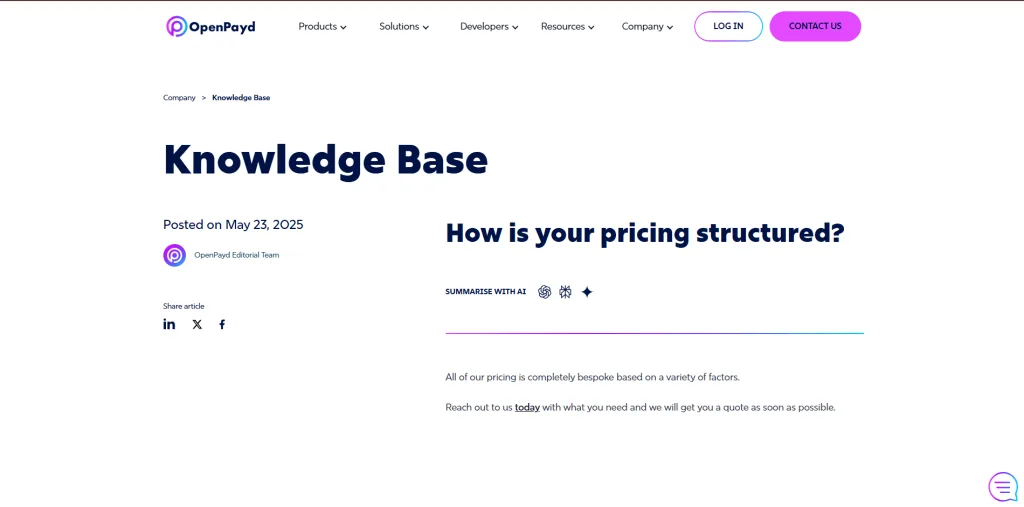
OpenPayd provides custom pricing based on usage volume, API requirements, and onboarding needs. UK Open Banking PIS typically costs 5p-30p per transaction across providers (Open Banking Tracker, 2026). It sits within enterprise brackets – costs scale with volume and contract length, not a published flat rate.
While rates are not listed on their public documentation, their model generally reflects industry-standard structures across similar platforms.
Below is a breakdown of the pricing components commonly included in proposals for Open Banking services:
API Access Charges
Businesses are typically charged for each successful API call related to account access, payment initiation, or account verification.
| API Service | Description |
|---|---|
| Account Information (AISP) | Per-request pricing for retrieving balances, account holder data, or transaction history |
| Payment Initiation (PISP) | Fee per payment successfully initiated using the PISP API |
| Account Verification | Per-lookup charge to confirm ownership of a UK bank account |
Monthly Platform Access
Some clients are quoted a fixed monthly cost that covers access to OpenPayd’s live environment, usage reporting, developer tools, and ongoing platform support.
| Service Area | Typical Coverage |
|---|---|
| Live API Usage | Access to production-grade Open Banking endpoints |
| Sandbox Testing | Non-live environment for development and QA |
| Platform Dashboard | Usage tracking, permissions, and account controls |
| Technical Support | Developer assistance based on support tier selection |
“OpenPayd is designed for regulated businesses that need a complete embedded finance stack – not just Open Banking. That completeness is its strength. It is also why the pricing model is enterprise-oriented by design.” – Ravi Ranjan, Co-Founder & CEO, Finexer
Onboarding & Configuration
There may be a one-time setup fee associated with onboarding, which can include issuing API credentials, verifying your regulatory status, and assisting with technical integration.
Do UK fintechs need to pay monthly fees for OpenPayd access?
In most cases, yes. OpenPayd often includes a monthly platform fee in UK proposals, covering production access, reporting tools, and support.
What Are OpenPayd API Fees by Transaction Type?
While OpenPayd’s pricing depends on the specific services you use, different types of transactions may carry different costs depending on volume, location, and processing method. For businesses planning to scale or manage multiple transaction types, this can have a meaningful impact on monthly costs.
UK businesses comparing Open Banking API costs can use the Open Banking pricing guide, which covers usage-based, flat-fee, and enterprise pricing models.
Here’s a breakdown of common transaction types you may encounter when using OpenPayd’s Open Banking APIs:
| Transaction Type | What It Involves | Potential Cost Factors |
|---|---|---|
| Domestic Payments | Bank-to-bank transfers within the UK using Open Banking rails | Volume tiering, success rate, response time |
| International Payments | Cross-border flows to or from non-UK banks (where supported) | Compliance checks, FX rates for currency handling |
| Recurring Payments | Pre-approved transfers at scheduled intervals | Frequency, user re-authentication, cancellation load |
| One-Time Payments | Single-use transfers with individual user consent | Per-transaction API call |
| Data-Only Sessions | Account information access without a payment | Read-only API pricing, bank polling frequency |
These categories are not charged equally. For example, retrieving account data every hour across 1,000 users may incur higher fees than initiating occasional payments. Similarly, international payment flows may include additional checks or FX markup when currency conversion is involved.
Is OpenPayd Cost-Efficient for Your Business?
Whether OpenPayd’s pricing model works for your business depends on what you’re building and how much control you want over banking infrastructure.
The platform is designed for regulated businesses that want Open Banking functionality delivered through a single provider. If you’re looking to combine account access, payment initiation, and bank account verification under one roof, OpenPayd offers a unified setup.
This can simplify integration and vendor management—especially for teams with limited engineering resources.
However, OpenPayd’s custom pricing approach means that affordability is tied to usage. For businesses with low transaction volumes or minimal API usage, the cost may feel front-loaded due to monthly access fees and onboarding requirements. On the other hand, platforms processing frequent payouts, account checks, or bulk payment runs are more likely to make full use of the pricing model.
Before signing on, it’s important to map out:
- How many transactions you expect to process monthly
- Whether you’ll use OpenPayd for both AISP and PISP services
- What level of technical or compliance support you’ll need
If Open Banking is a core part of your product offering, OpenPayd may fit well into your long-term infrastructure. For more occasional usage or data-only needs, it may be worth assessing how the pricing aligns with expected API traffic.
What Hidden Costs Should You Watch for With OpenPayd?
Most cost surprises with OpenPayd emerge after the sales call – not before. These are the five components to clarify before signing:
- Minimum monthly commitments – enterprise proposals often include a floor spend. Low-volume users may pay for capacity they do not use.
- Onboarding and setup fees – a one-time charge for API credentials, regulatory verification, and integration support is standard.
- FX markup on international flows – cross-border and multi-currency transactions may carry a conversion spread on top of the base rate.
- Volume tier lock-in – pricing tiers negotiated at signing may not flex if usage drops below the committed level.
- Support tier charges – dedicated account management and higher SLA response times are typically priced separately.
Getting a full cost breakdown before signing will avoid surprises at invoice stage.
UK businesses comparing payment initiation providers on cost can see a breakdown in the third-party providers for payment initiation guide, which covers FCA-authorised PISPs and their fee structures.
Not Ready for Complex Commitments? Try Finexer Instead
If OpenPayd’s custom pricing, minimum commitments, or enterprise onboarding requirements do not fit your stage, Finexer is built for UK businesses that need Open Banking without the overhead.
Finexer supports regulated UK businesses with secure, developer-friendly APIs for both data and payments. Whether you’re just starting out or managing high-volume flows, pricing remains straightforward across every plan:
- Startup plan with discounted rates and full product access
- Standard plan for established businesses with consistent volume
- Enterprise plan built on usage-based pricing
Every plan includes:
- Unlimited sandbox access for testing and integration
- 2–3x faster deployment compared to traditional providers
- No setup fees, no hidden fees, and no cancellation fees
- White-label options, fully managed compliance, and dashboard access
- 99% UK bank coverage – high street, challenger, and business accounts
- Consent management, webhook alerts, reporting tools, and user controls
- AIS + PIS in a single integration – bank data and payments together.
For a direct comparison of how OpenPayd and Finexer differ on embedded payments, IBANs, and pricing, see the embedded payments API guide, which covers both providers side by side.
From first integration to scaling live usage, Finexer gives you full access without forcing a large upfront commitment. Setup is quick, support is always included, and costs are built to grow with your needs.
“Most UK platforms we speak to need reliable Open Banking – not a full embedded finance stack. For those platforms, usage-based pricing without minimum commits changes the economics significantly.” – Ravi Ranjan, Co-Founder & CEO, Finexer
Get Started
Connect today and see why businesses trust Finexer for secure, compliant, and tailored open banking solutions.
What makes Finexer more affordable for UK Businesses?
Finexer offers usage-based pricing with no setup or cancellation fees. All plans include unlimited sandbox access and fast deployment with full UK bank coverage.
What are the main OpenPayd API fees?
OpenPayd API fees typically include per-call charges for AISP, per-transaction charges for PISP, per-lookup charges for bank account verification, a monthly platform access fee, and a one-time onboarding charge. Exact amounts are not published – they are negotiated per client.
Is OpenPayd well reviewed?
OpenPayd is reviewed positively for enterprise infrastructure and multi-currency capabilities. It won the ‘Best Early-Stage or Future Payments Initiative’ at the 2026 Cards and Payments Awards. Industry forums note the lack of transparent pricing as a friction point – particularly for businesses at an early stage.
Still Deciding? Try Our Sandbox, No Commitment Required
Access Finexer’s full Open Banking API suite with unlimited sandbox testing and developer support
About the Author

Ravi Ranjan
Ravi Ranjan is Co founder & CEO of Finexer