To pay employees and contractors outside the UK, a payroll team or a finance manager has to cross multiple layers of cost and complexity. Post-Brexit, with the increasing skill shortage in the UK, several UK employers are relying on global talent. One of the most critical challenges in maintaining a virtual global workforce is payroll requirements.
These include currency conversion, banking infrastructure, regulatory reporting, and per-recipient payment tracking, hence making overseas payroll services challenging. For UK payroll platforms and businesses, choosing the wrong route can result in slow settlements, opaque FX fees, and a lack of visibility into individual payment status.
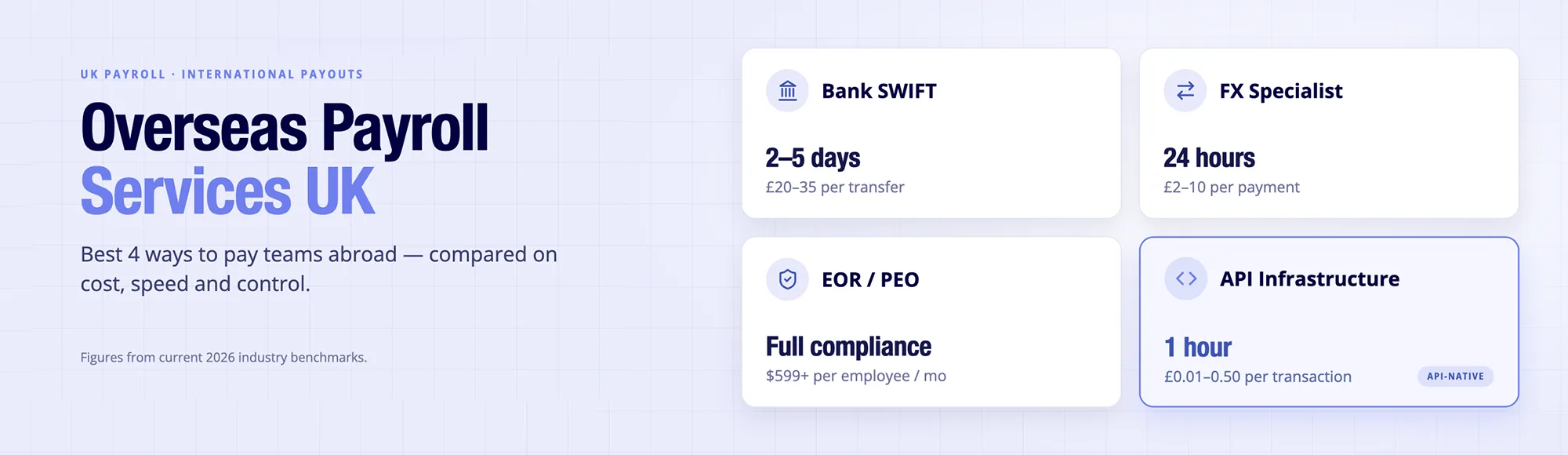
This guide compares four proven approaches of overseas payroll services in the UK, helping you understand which method suits your business structure and scale. We’ve sourced all figures from the current 2026 industry data.
What Are Overseas Payroll Services?
Overseas payroll services enable UK organisations to pay employees and contractors outside the UK via structured payment routes. Unlike domestic UK payroll (which uses Faster Payments or BACS), international payments need to navigate multiple currencies, banking networks, and regulatory frameworks.
The choice of route determines:
- Settlement speed: 1 hour (API) versus 2 to 5 days (SWIFT)
- Cost per payment: £2 to £50+ depending on route and FX
- Payment visibility: Real-time webhooks versus manual tracking
- API-first capability: Embedded in your platform versus a manual portal
For payroll SaaS platforms, the decision is especially critical because your end users depend on reliable, transparent payouts.
UK Regulatory Context for International Payroll Payments
UK businesses must meet HMRC obligations for employment tax reporting for having provisions of overseas payroll services. Compliance requirements vary by worker classification and country of residence. Consult your accountant on specific tax implications for your setup.
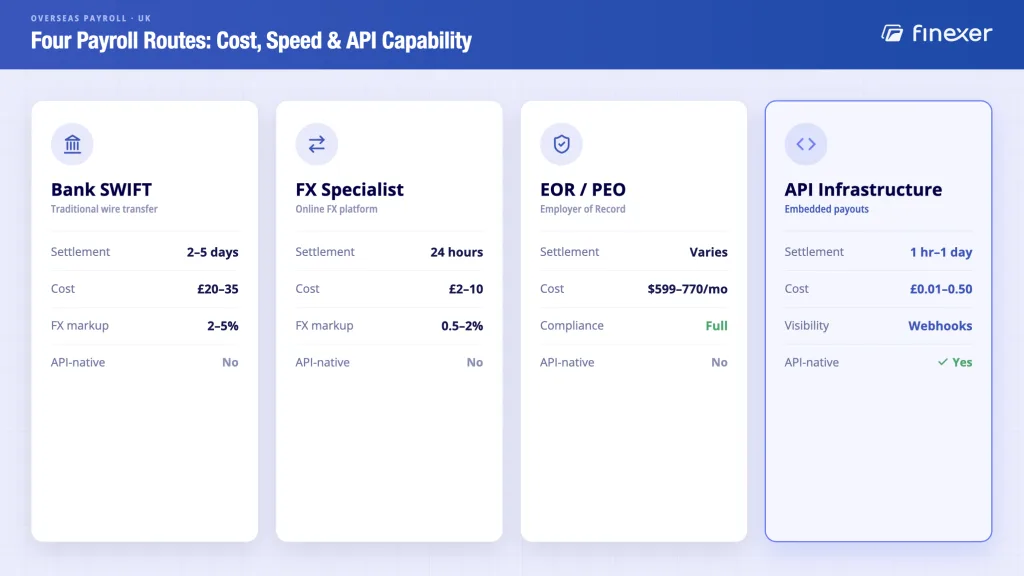
Four Overseas Payroll Routes Compared
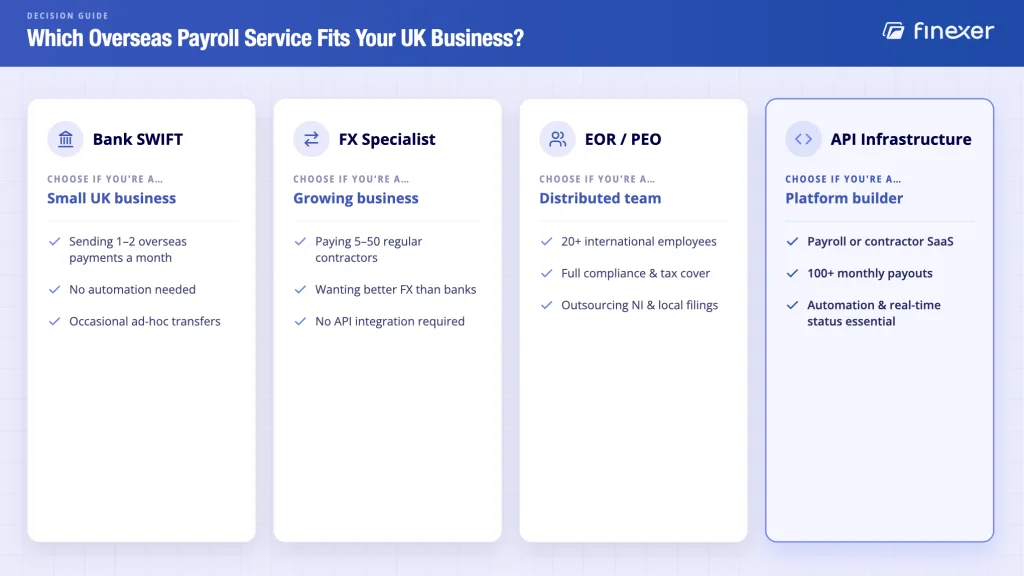
Here are the four types of overseas payroll routes that one can consider based on your business structure, transaction volume, settlement speed requirements, and technical integration needs.
Route 1: High-Street Bank SWIFT Transfers
How it works: You log into your UK bank and initiate a SWIFT wire transfer to the recipient’s international bank account.
Best for: Small UK businesses sending fewer than 5 monthly international payments with no automation requirements.
Costs:
- Transfer fee: £20 to £35 per transfer, sometimes up to £40
- FX markup: 2 to 5% on top of the mid-market exchange rate
- For 100 monthly payouts at £200 average: £2,000 to £5,000 annually in visible fees alone, plus hidden FX costs
Pros:
- Familiar interface (most UK businesses have a bank account)
- Direct route to the recipient’s bank
- No intermediary platform
Cons:
- Slow: 2 to 5 days settlement via SWIFT network
- Hidden correspondent bank fees deducted along the chain make the final cost unpredictable
- No per-payment status tracking (manual bank statement monitoring only)
- Not API-native (unsuitable for automation)
Best for: Occasional ad-hoc payments to one or two recipients.
Route 2: FX Specialists (Wise, Airwallex, WorldFirst)
How it works: You open an online account with an FX specialist, fund it from your UK bank, then send payments to recipients in their local currency.
Best for: Growing UK businesses with 5–50 regular international contractors needing better FX rates than banks but without API automation needs.
Costs:
- FX margin: 0.5 to 2% versus traditional banks’ 2 to 5%
- Transfer fee: £2 to £10 per payment (significantly lower than SWIFT)
- Settlement typically within 24 hours
Pros:
- Better FX rates than traditional banks
- Online dashboard with real-time tracking per payment
- Cost-effective for mid-scale operations
Cons:
- Not API-native (built for manual portal use, not platform integrations)
- Requires separate onboarding (additional vendor to manage)
- You manage recipient verification individually
- Not suitable for platforms embedding payment infrastructure
Best for: Small UK businesses paying 5 to 50 international contractors. Suitable for businesses needing better rates than traditional banks, but not requiring API automation.
Route 3: Employer of Record / PEO (Deel, Papaya Global)
How it works: You outsource the entire payroll operation to an EOR. They become the legal employer, handle tax compliance, and manage payouts in each country.
Costs:
- Deel and Remote: $599 per employee per month
- Papaya Global: $650 to $770 per employee per month
- This is the service fee only. Actual cost includes salary, employer taxes (13 to 40% above gross), and statutory benefits by country.
Pros:
- Compliance-first: EOR handles employment law, tax filings, and NI in each country
- Simplified operations (EOR manages everything)
- No internal compliance burden
- Full audit trail and documentation
Cons:
- Premium cost: $599 to $770 per employee monthly (significant for variable teams)
- Not API-native (dashboard-based, not suitable for platform builders)
- Loss of direct payout control
- Over-engineered for small contractor networks
Best for: Companies with 20+ international employees requiring full compliance coverage. Not suitable for SaaS platforms or variable contractor networks.
Route 4: API Payout Infrastructure
How it works: Platforms integrate a payroll disbursement API UK directly into their product. The platform controls when, to whom, and in what currency payments are sent.
Costs:
- Most API payout providers charge £0.01 to £0.50 per transaction, depending on volume
- No platform subscription fees
- FX spreads vary by corridor (typically 0.5 to 2% for specialist providers)
Pros:
- API-native: Embeds directly in your platform; no manual portal
- Per-payment control with full transparency
- Real-time webhooks provide instant status updates
- Scales efficiently to 100s or 1000s of payouts monthly
- Cost-efficient (charge per transaction, not per employee)
Cons:
- Requires platform engineering (typically 3 to 5 weeks of integration)
- Scope defined by provider (some routes supported, others not)
- Recipient banking infrastructure varies by country
Best for: Payroll SaaS platforms, contractor management platforms, and marketplace payment automation.
Check our international payments UK guide for better clarity.
Comparison Table: Which Route Fits Your Business?
| Factor | Bank SWIFT | FX Specialist | EOR / PEO | API Infrastructure |
|---|---|---|---|---|
| Settlement Speed | 2 to 5 days | 24 hours | Varies (1 to 3 days) | 1 hour to 1 day |
| Cost per Payment | £20–£35 + 2–5% FX | £2–£10 + 0.5–2% FX | $599–$770 per employee/month | £0.01–£0.50 + FX |
| Per-Payment Visibility | Manual tracking | Online dashboard | EOR dashboard | Real-time webhooks |
| API-First? | No | No | No | Yes |
| Compliance Included? | No | Basic (KYC only) | Full coverage | No (you manage) |
| Best Suited For | Occasional transfers | SMBs, 5–50 contractors | Large teams, 20+ headcount | Platforms, 100+ monthly payouts |
International Payroll Payments: How Finexer Fits?
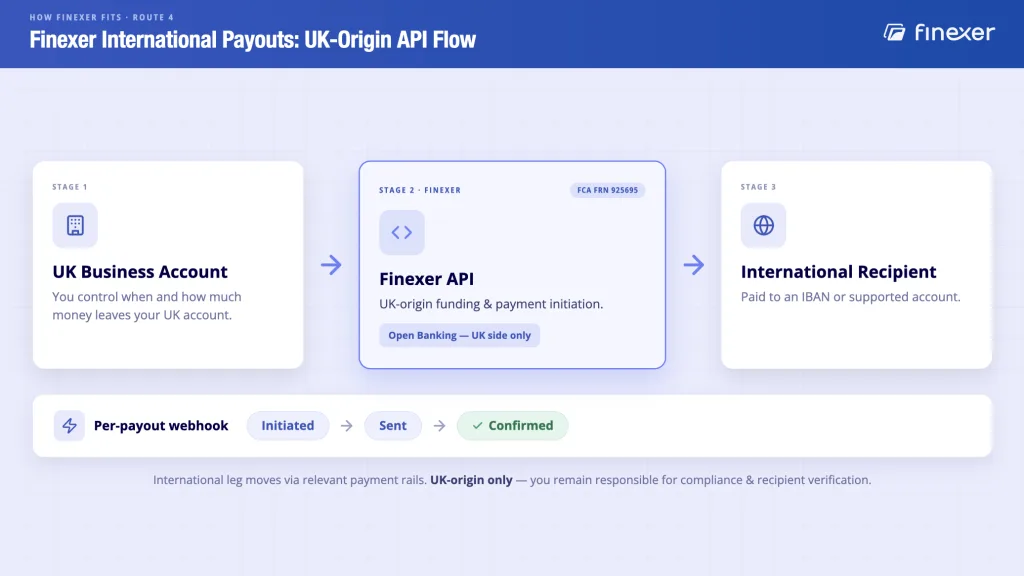
For payroll platforms and marketplace builders, UK payout infrastructure enables international payroll payments without building direct bank integrations.
Finexer’s international payouts product allows platforms to initiate payments from a UK business account to recipients using IBAN or supported account details. Key capabilities:
- UK-origin funding: You control when and how much money leaves your UK business account
- Per-payout webhooks: Your platform receives real-time status for every payment (Initiated, Sent, Confirmed)
- API-native: One integration covers domestic (via Faster Payments) and international payouts
- Supported routes: IBAN transfers to supported countries via Finexer’s international payout infrastructure – settlement speeds vary by corridor and recipient country
Finexer’s international payouts are UK-origin only, meaning your platform holds the funds in the UK and initiates the outbound transfer. You remain responsible for compliance and recipient verification. For full compliance outsourcing, EOR services are more appropriate.
View our international payments API infrastructure for detailed product documentation.
For payroll platforms managing 100+ monthly payouts, this approach offers cost advantages. Based on industry benchmarks, SWIFT costs £20 to £35 per transfer plus 2 to 5% FX markup, while API infrastructure typically charges £0.01 to £0.50 per transaction, representing a 60 to 70% cost reduction at scale. Actual savings depend on your transaction volume, recipient countries, and FX rates.
Check our mass payouts UK guide for better clarity and understanding.
Who Needs Each Route?
Choose Bank SWIFT if: You’re a small UK business sending 1 to 2 overseas payments per month. Setup is minimal, and costs are acceptable at low volume.
Choose FX Specialist if: You’re a growing UK business with 5 to 50 regular international contractors. You need better FX rates than banks, but don’t require automation.
Choose EOR if: You’re building a distributed team of 20+ international employees and need full compliance, tax, and NI management outsourced.
Choose API Infrastructure if: You’re a payroll or contractor platform builder embedding payment capabilities into your product. You need automation, per-payment transparency, and cost efficiency at scale.
Ready to Automate International Payouts?
If you’re a payroll platform or contractor management SaaS, embedding international payout capabilities can differentiate your product and improve user retention.
What’s the actual cost difference between SWIFT and an API?
Based on 2026 industry data: SWIFT via a UK bank costs £20 to £35 per transfer plus 2 to 5% FX markup. For 100 monthly payouts, that’s £2,000 to £5,000 annually in visible fees alone, plus hidden FX costs. API infrastructure at £0.01 to £0.50 per transaction costs £1 to £50 annually for the same volume. The gap widens significantly once FX spreads are included. Actual costs vary by recipient country, payment method, and FX rates.
Can I use Open Banking for international payments?
No. Open Banking in the UK (Faster Payments, BACS) is UK-domestic only. For international payouts, you need separate infrastructure like bank SWIFT, FX specialist APIs, or international-focused payment APIs. Finexer’s international product is a separate offering from its Open Banking (Faster Payments) capability.
Do I need compliance for international contractors?
Yes. You must verify contractor identity (KYC), confirm tax residency, and meet HMRC reporting requirements. EOR services handle this; API infrastructure does not. Consult your accountant on specific obligations.
How long does it take to integrate an API payout solution?
Typically, 3 to 5 weeks from integration start to production payouts, depending on complexity and your platform’s architecture. This includes API documentation, webhook configuration, recipient account verification, and testing.
Which international corridors does Finexer support?
Finexer supports international payments in the UK to IBAN accounts in supported countries. Check the documentation for the current list of supported routes. Not all countries or currencies are covered, recipient banking infrastructure determines availability.
To discuss how API infrastructure fits your platform’s roadmap. We’ll walk through supported routes, integration timeline, and cost structure in 20 minutes.
Explore with AI
About the Author

Ravi Ranjan
Ravi Ranjan is Co founder & CEO of Finexer