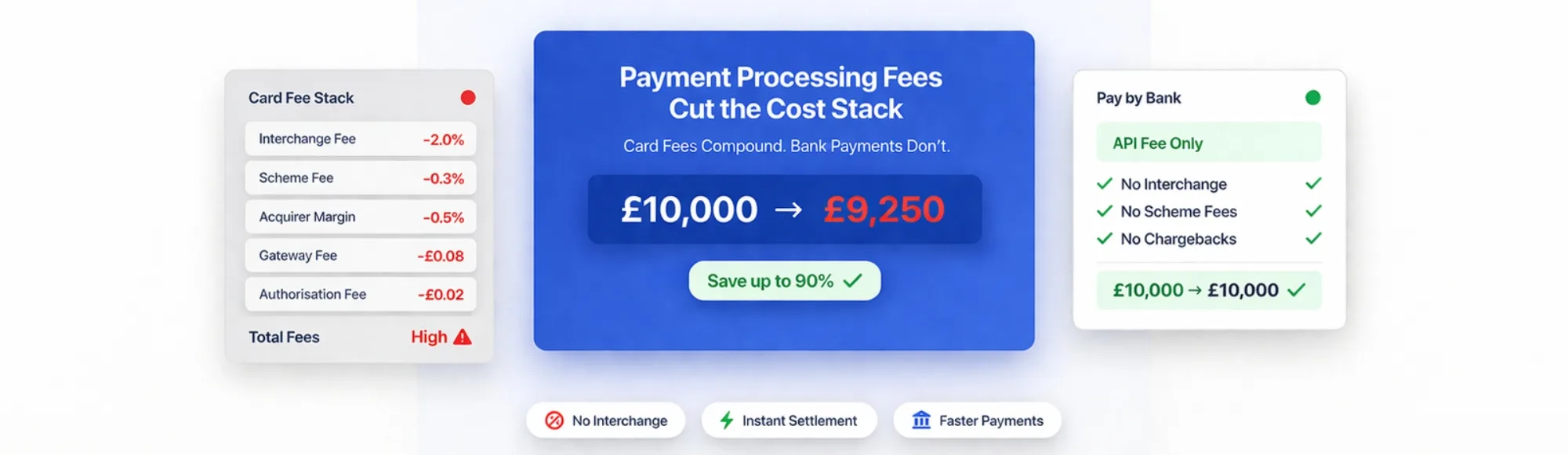
Still absorbing card fees on every transaction your platform processes?
Move to Pay by Bank infrastructure and cut online payment processing fees by up to 90%.
Payment processing fees are not a fixed cost of doing business. For UK platforms processing thousands of transactions monthly, they are a structural margin problem – one that compounds at every layer of the card network before a single pound reaches the platform’s account. Managing payment processing fees at scale requires more than negotiating with an acquirer.
Most platforms accept card fees as an unavoidable overhead. What they do not always account for is how many separate fee layers sit inside a single card transaction, and how that stack changes as volume scales.
This blog breaks down where payment processing fees originate, how online payment processing fees compare across card rails and Pay by Bank, and what replacing the card network actually delivers. why they compound on card rails in ways that are difficult to control, and how Pay by Bank infrastructure removes the fee layers that card networks require.
TL;DR
Payment processing fees on card rails consist of multiple layers – interchange, scheme fees, acquirer margins, and gateway charges – that compound per transaction and scale with volume. Online payment processing fees via Pay by Bank remove card network layers entirely, replacing them with a single usage-based fee and near-instant Faster Payments settlement. Finexer’s FCA-authorised PIS infrastructure enables UK platforms to embed Pay by Bank with 99% UK bank coverage and real-time webhook confirmation.
Key Takeaways
What are payment processing fees made up of for UK platforms?
Card-based payment processing fees typically include interchange fees paid to the card issuer, scheme fees charged by Visa or Mastercard, acquirer margins, and gateway charges – all applied per transaction on top of each other.
Why do online payment processing fees compound at platform scale?
Each fee layer is a percentage of transaction value. At low volumes the absolute cost appears small. At tens of thousands of transactions monthly, the combined fee stack becomes one of the largest operational costs on the platform’s P&L.
How do Pay by Bank payment processing fees compare to card fees?
Pay by Bank removes interchange, scheme fees, and acquirer margins entirely. The platform pays a single usage-based API fee per transaction – no percentage-of-value charges, no chargeback liability, no settlement delay fees.
Which UK card types carry the highest processing fees for platforms?
Commercial credit cards carry the highest interchange rates – typically 1.5% to 2.5% per transaction. Consumer debit cards are lower at 0.2% to 0.6%, but gateway and acquirer charges still apply on top regardless of card type.
What Do Payment Processing Fees Actually Consist Of for UK Platforms?
Breaking Down the Card Fee Stack
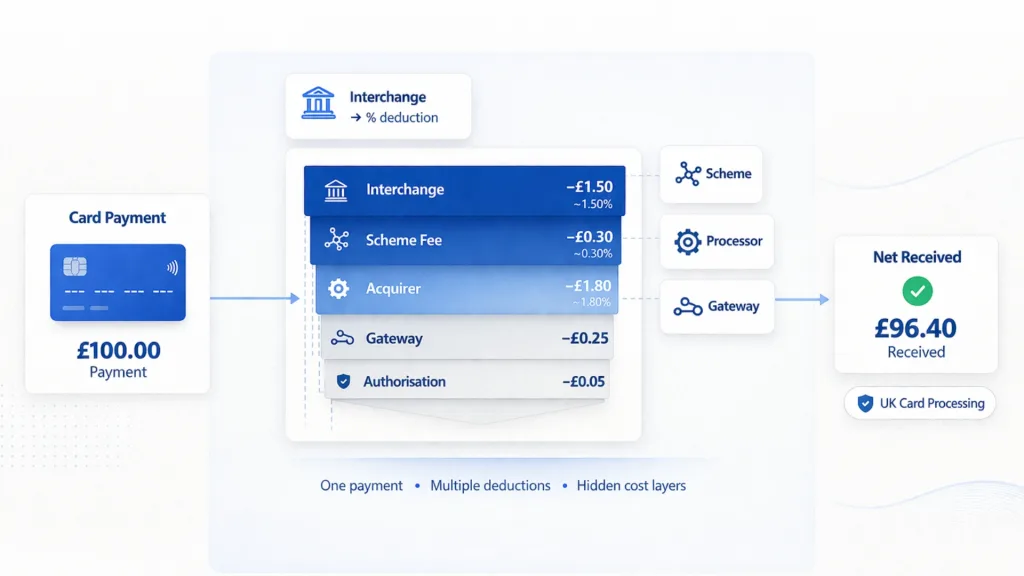
Every card transaction a UK platform accepts passes through multiple intermediaries – and each one charges a fee. Understanding the full stack matters because platforms often see only a blended rate from their acquirer, which obscures how much each layer costs individually.
The fee structure for a standard UK card transaction includes:
- Interchange fee – paid to the card-issuing bank, set by the card scheme. UK consumer debit cards: 0.2% to 0.6%. Consumer credit cards: 0.3% to 0.9%. Commercial credit cards: 1.5% to 2.5%.
- Scheme fee – charged by Visa or Mastercard for use of the card network. Typically 0.1% to 0.3% per transaction.
- Acquirer margin – the payment processor’s margin on top of interchange and scheme fees.
- Gateway fee – charged by the payment gateway for routing the transaction. Typically 6p to 10p per transaction or a fixed monthly fee.
- Authorisation fee – charged per authorisation attempt, typically 1p to 6p per transaction.
| Fee Layer | Who Charges It | Typical Rate (UK) | Applies to Pay by Bank? |
|---|---|---|---|
| Interchange fee | Card-issuing bank | 0.2% – 2.5% depending on card type | No – removed entirely |
| Scheme fee | Visa / Mastercard | 0.1% – 0.3% per transaction | No – no card scheme involved |
| Acquirer margin | Payment processor | Variable – bundled into blended rate | No – no acquirer in A2A flow |
| Gateway fee | Payment gateway | 6p – 10p per transaction | No – replaced by API fee |
| Authorisation fee | Payment processor | 1p – 6p per transaction | No – not applicable |
| Pay by Bank API fee | Open Banking infrastructure provider | Single usage-based fee | Yes – this is the only fee |
Why the Blended Rate Hides the Real Cost
Most acquirers present platforms with a blended rate – a single percentage that bundles interchange, scheme fees, and their own margin together. This makes it difficult for platform finance teams to identify which fee layer is growing and why.
When commercial cards increase as a share of transaction volume, payment processing fees rise without any visible explanation in the blended rate – common for B2B EPOS and payment SaaS platforms – the blended rate rises without any visible explanation. The interchange component alone on commercial cards runs at 1.5% to 2.5%, significantly above consumer card rates.
“At Finexer, I work with UK platform finance teams that only discover the true composition of their payment processing fees when they begin modelling Pay by Bank. The comparison makes the card fee stack visible for the first time.” – Ravi, Finexer
Why Do Online Payment Processing Fees Compound at Platform Scale?
The Volume Problem
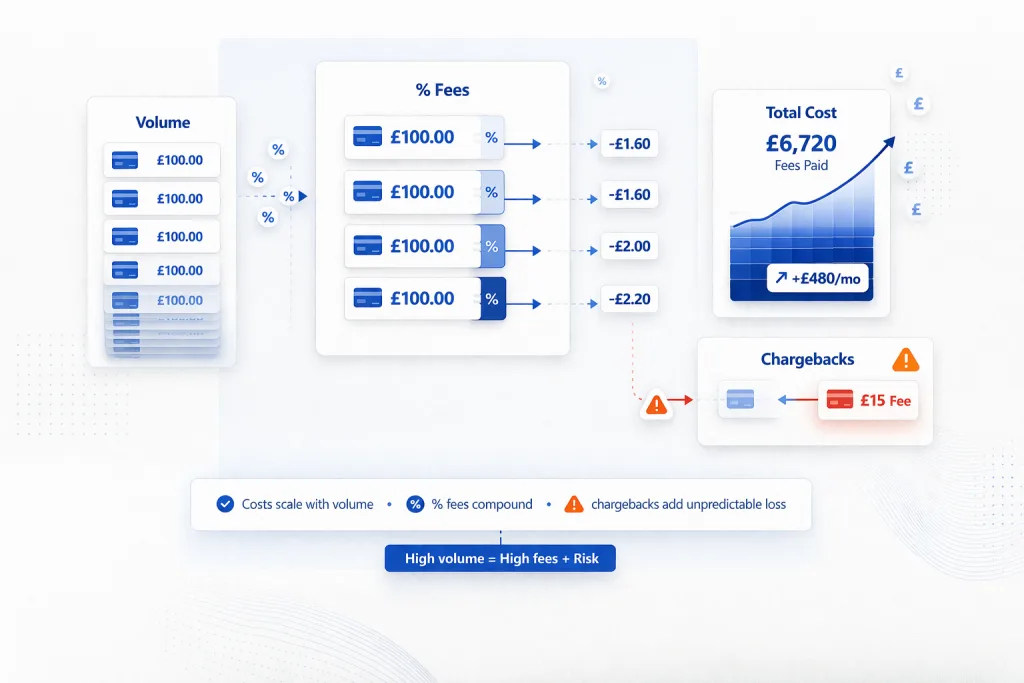
Online payment processing fees on card rails are percentage-based at almost every layer. That means the absolute cost grows in direct proportion to transaction value – and at volume, the compounding becomes significant.
Interchange alone on commercial credit cards runs at 1.5% to 2.5% per transaction. Add scheme fees, acquirer margin, and gateway charges, and the combined fee per transaction is materially higher than what most platform finance teams budget against. These are not costs a platform can negotiate away – interchange is set by the card scheme, not the acquirer.
How open banking payment flows work covers the A2A payment architecture that removes these percentage-based fee layers from the transaction entirely.
Chargeback Exposure Adds Unpredictable Cost
Card payment processing fees include a hidden variable cost that does not appear in the standard blended rate – chargebacks. When a cardholder disputes a transaction, the card scheme reverses the funds from the platform and applies a chargeback fee of typically £10 to £20 per incident.
For EPOS platforms and payment SaaS providers operating at volume, chargeback exposure is an ongoing liability that sits outside the standard fee model. Pay by Bank transactions via Open Banking PIS are irrevocable push payments – there is no chargeback mechanism, and therefore no chargeback fee exposure.
Alternative payment methods UK covers how platforms are replacing card rails with Pay by Bank infrastructure.
What Do Online Payment Processing Fees Look Like via Pay by Bank?
Removing the Card Network Entirely
Pay by Bank via FCA-authorised Open Banking PIS routes payments directly between bank accounts over the UK Faster Payments network. There is no card issuer, no card scheme, no acquirer, and no gateway in the transaction flow – which means none of the fee layers associated with those intermediaries apply.
The platform pays a single usage-based API fee per transaction. Settlement is near-instant via Faster Payments. There are no percentage-of-value charges, no authorisation fees, no scheme fees, and no chargeback liability.
Finexer’s Open Banking pricing covers the usage-based fee structure for UK platforms evaluating the cost comparison directly.
Settlement Speed and Working Capital
Card transactions typically take two to five business days to clear into the platform’s account. For platforms paying out to merchants or service providers, this delay creates a float gap – funds collected from payers that have not yet cleared to the payee. Pay by Bank via Faster Payments eliminates this gap, with funds settling in seconds rather than days.
How Does Finexer Support Platforms Cutting Card-Based Costs?
Finexer is an FCA-authorised Open Banking infrastructure provider. For EPOS platforms, payment SaaS providers, and fintech founders looking to reduce payment processing fees, Finexer’s PIS provides the bank-to-bank payment layer that removes card network fee dependencies from the transaction flow.
What Finexer’s Infrastructure Provides
- FCA-authorised PIS – verifiable on the FCA register
- 99% UK bank coverage across retail and challenger banks
- Near-instant Faster Payments settlement per transaction
- Real-time payment confirmation via webhooks
- White-label payment flows under the platform’s own brand
- Payment Links and QR code payment initiation for EPOS use cases
- Bulk Payout for platforms managing high-volume disbursements
- Usage-based pricing – no fixed monthly fees, scales with transaction volume
- Saves platforms up to 90% on transaction costs versus card-based processing
- 3-5 weeks onboarding support to reach production deployment
“The platforms that move fastest on reducing payment processing fees are those that treat it as an infrastructure replacement decision rather than a negotiation with their existing acquirer. The fee stack on card rails is structural – it cannot be negotiated out.” – Ravi, Finexer
What I Feel
The cost of card-based payments is consistently framed as something to manage rather than a structure to replace. The card network fee stack – interchange, scheme fees, acquirer margin, gateway charges – exists because every intermediary in the card flow needs to be compensated. That is not a negotiation problem. It is an infrastructure problem.
Pay by Bank removes the intermediaries. The online payment processing fees that remain are a single usage-based charge from the infrastructure provider. For platforms at volume, this is not a marginal saving – it is a fundamental change to the cost structure of every payment they process.
Common Use Cases
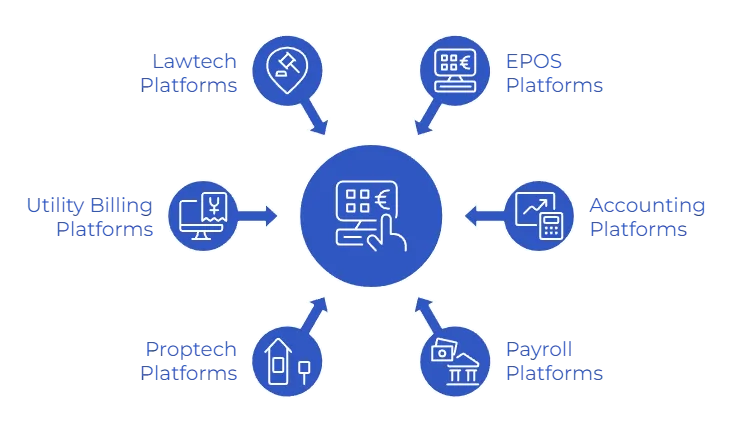
EPOS Platforms
EPOS platforms absorbing card fees across high transaction volumes face compounding interchange costs – particularly where commercial cards are common among business customers. Finexer’s PIS enables Pay by Bank at point of sale via QR code or Payment Link, replacing the card fee stack with a single usage-based API fee and near-instant Faster Payments settlement.
Accounting & ERP Platforms
Accounting platforms collecting client invoice payments on card rails lose a percentage of every payment to processing fees before it reaches the client’s account. Finexer’s Pay by Bank infrastructure enables direct bank-to-bank invoice collection with real-time confirmation and no percentage-based fee layers on the payment value.
Payroll & Invoicing Platforms
Payroll and invoicing platforms initiating bulk outbound payments via card-linked methods face per-transaction fees at scale. Finexer’s Bulk Payout capability delivers account-to-account disbursements via Faster Payments at usage-based pricing – removing card network fees from every outbound payment in the batch.
Proptech & Real Estate Platforms
Proptech platforms collecting rental payments or purchase stage payments via card face both processing fees and chargeback exposure on high-value transactions. Pay by Bank via Finexer’s PIS removes both – irrevocable push payments with no card scheme involvement and no chargeback liability per transaction.
Utility Billing Platforms
Utility billing platforms processing recurring customer payments on card rails pay processing fees on every billing cycle. Finexer’s PIS supports Pay by Bank payment initiation per billing record, with structured payment references and real-time confirmation – replacing card fees with a single API cost per payment event.
Lawtech Platforms
Lawtech platforms collect client matter payments or disbursements via card face processing fees and potential chargeback disputes on legally sensitive transactions. Finexer’s FCA-authorised PIS provides bank-authenticated, irrevocable payment confirmation with consent logs – removing both card fees and chargeback exposure from the payment flow.
What are processing fees in the UK for card payments?
UK card processing fees include interchange (0.2% to 2.5% depending on card type), scheme fees charged by Visa or Mastercard, acquirer margins, and gateway charges – all applied per transaction on top of each other.
Who pays the card processing fee on a transaction?
The merchant or platform accepting the payment absorbs the processing fees. These are deducted from the transaction value before the net amount is settled to the platform’s account.
Is it legal to charge a fee for card payments in the UK?
Under UK Consumer Rights regulations, surcharging consumers for using standard debit or credit cards is prohibited. Platforms absorb the processing cost rather than passing it to the payer – making the fee reduction case for Pay by Bank infrastructure directly relevant to platform margin.
Cut card-based payment processing fees with FCA-authorised Pay by Bank infrastructure.
About the Author

Ravi Ranjan
Ravi Ranjan is Co founder & CEO of Finexer