
Payout sent – but is it confirmed, recorded, reconciled?
Finexer gives platforms verified bank transaction data to close the loop.
Sending a payout is the easy part.
Confirming it landed. Matching it to the right record. Updating financial reports accurately. Detecting failures before they become disputes. These are the operational problems that platforms discover after go-live – and they compound at scale.
At Finexer, we work with UK payroll platforms, accounting and ERP systems, LawTech tools, and utility billing infrastructure that process high volumes of disbursements. The consistent issue is not payout execution. It is payout reconciliation – the gap between a payment leaving the platform and a verified, matched, reportable record existing in the system.
This blog is written for Product Managers, Finance and Ops Leads, and Engineering teams at platforms that manage payouts UK-wide and need verified bank transaction data to automate reconciliation workflows.
TL;DR
Platforms managing payouts face reconciliation mismatches, confirmation delays, and reporting gaps that manual processes cannot solve at scale. Finexer provides FCA-authorised Open Banking infrastructure – PIS for payout execution and AIS for transaction verification – enabling platforms to automate payout reconciliation and maintain accurate financial records.
Key Takeaways
Why is payout reconciliation harder than payout execution?
Execution confirms a payment was initiated. Reconciliation confirms it settled, matched the correct record, updated financial reports, and flagged any failures – a separate operational problem entirely.
What causes payout reconciliation mismatches for UK platforms?
Bank settlement timing differences, failed payout detection delays, inconsistent transaction references, and manual matching processes that cannot scale with disbursement volume.
How does verified bank transaction data improve payout reconciliation?
Bank-verified transaction records confirm payout settlement directly from source. Platforms can match disbursements to structured transaction data automatically, removing manual reconciliation steps.
Which platforms have the highest payout reconciliation risk?
Payroll platforms, accounting and ERP systems, LawTech platforms managing client funds, utility billing platforms processing refunds, and EPOS platforms handling merchant settlements.
How does Finexer support payout reconciliation workflows?
Finexer provides PIS infrastructure for account-to-account payout execution and AIS connectivity for bank transaction verification – giving platforms both initiation and reconciliation data in one infrastructure layer.
Why Are Payouts Operationally Complex for UK Platforms?

Most platforms underestimate payout complexity at the point of product design. The assumption is that once a payment is initiated, the workflow is complete. In practice, payout UK operations involve several distinct steps after execution.
A payroll platform sending contractor payments must confirm each payout completed. An accounting platform reconciling vendor disbursements must match each transaction to the correct record. A LawTech platform managing client funds must maintain compliant financial records for every outgoing payment.
Execution is step one. Confirmation, matching, reporting, and failure detection are steps two through five – and they all require verified financial data that initiation alone does not provide.
“Payout execution tells a platform what was sent. Verified bank transaction data tells a platform what actually settled.” – Finexer, working with UK platform operations teams
How bulk payouts work for UK platforms covers the execution layer in detail – this blog focuses on what comes after.
What Makes Payout Reconciliation Difficult at Scale?
Confirmation Delays Create Reporting Gaps
Bank settlement does not always happen instantly. Platforms initiating payouts UK-wide across multiple banks face variable settlement windows. Without bank transaction visibility, finance teams cannot confirm settlement until statements arrive – creating reporting gaps that affect accounting accuracy and client-facing records.
Failed Payout Detection Is Slow Without Bank Data
Failed payouts do not always generate immediate notifications. Without direct bank transaction visibility, platforms discover failures through client complaints or periodic statement reviews. At volume, undetected failures create financial discrepancies that are time-consuming to investigate and reconcile.
Manual Matching Cannot Scale
Matching disbursements to financial records manually works for low volumes. For platforms processing hundreds or thousands of payouts UK-wide, manual reconciliation introduces errors, consumes significant ops resource, and creates audit risk when records do not balance.
How real-time withdrawals work for payout-heavy platforms explains the infrastructure requirements for platforms operating at this scale.
How Should Platforms Evaluate Payout Reconciliation Infrastructure?
| Criteria | Why It Matters | What to Look For |
|---|---|---|
| Payout Execution Infrastructure | Account-to-account payouts reduce costs and settlement complexity versus card rails | PIS-enabled A2A payments; Pay by Bank support; 99% UK bank coverage |
| Transaction Verification | Platforms need bank-confirmed settlement data, not just initiation confirmation | AIS connectivity; real-time transaction feeds; structured settlement records |
| Real-Time Webhooks | Reconciliation workflows need immediate transaction events, not batch updates | Event-driven webhooks; instant failure notifications; live transaction status |
| Structured Data Output | Automated reconciliation requires machine-readable, consistently formatted records | Structured JSON outputs; transaction references; merchant and counterparty data |
| Historical Data Access | Audit and reporting workflows require access to historical payout records | Up to 7 years of transaction history; consistent data across periods |
| Regulatory Alignment | UK platforms must operate within FCA and payment regulation requirements | FCA-authorised PIS and AIS; GDPR-compliant data handling; consent management |
How Does Finexer Enable Payout Reconciliation for UK Platforms?
Finexer provides both sides of the payout workflow through a single FCA-authorised Open Banking infrastructure layer.
- Payout Execution via PIS
Finexer’s Payment Initiation Services enable platforms to send account-to-account payouts directly from bank accounts. This covers contractor disbursements, vendor payments, client fund transfers, refunds, and settlements – without card network costs or intermediary delays.
- Transaction Verification via AIS
After payouts are initiated, Finexer’s Account Information Services provide bank transaction visibility to confirm settlement. Platforms receive structured transaction data confirming payout completion, enabling automated matching against disbursement records.
What This Enables for Reconciliation Workflows
- Real-time payout settlement confirmation via bank transaction feeds
- Automated matching of disbursements to verified transaction records
- Instant failed payout detection through webhook-driven transaction events
- Structured financial records for accounting and audit reporting
- Up to 7 years of transaction history for compliance and reporting workflows
- 99% UK bank coverage ensuring consistent data across all payout recipients
Finexer does not provide accounting software, payroll systems, or reconciliation engines. Platforms build those workflows on top of Finexer’s verified payout and transaction infrastructure.
What We See in Practice
Platforms integrating Finexer’s payout infrastructure follow a consistent pattern. Initial deployment focuses on execution – replacing slower payment methods with account-to-account payouts UK-wide.
The reconciliation problem becomes visible within the first month of volume. Finance teams realise that confirmed initiation is not the same as confirmed settlement. Manual matching consumes ops resources that scales poorly with disbursement growth.
A pattern we observe consistently: a UK payroll platform moves contractor payments to Finexer’s PIS infrastructure. Within two months, the same platform integrates AIS transaction feeds to automate settlement confirmation. Manual reconciliation steps are removed entirely from the post-payout workflow.
“The platforms that get payout operations right treat execution and reconciliation as one connected workflow – not two separate problems.” – Finexer, working with UK payroll and accounting platforms
Platforms combining Finexer’s PIS and AIS infrastructure for payout workflows report:
- Faster settlement confirmation without manual statement review
- Fewer reconciliation mismatches from automated transaction matching
- Earlier failed payout detection through real-time webhook events
- Cleaner financial records for audit and regulatory reporting
Common Use Cases
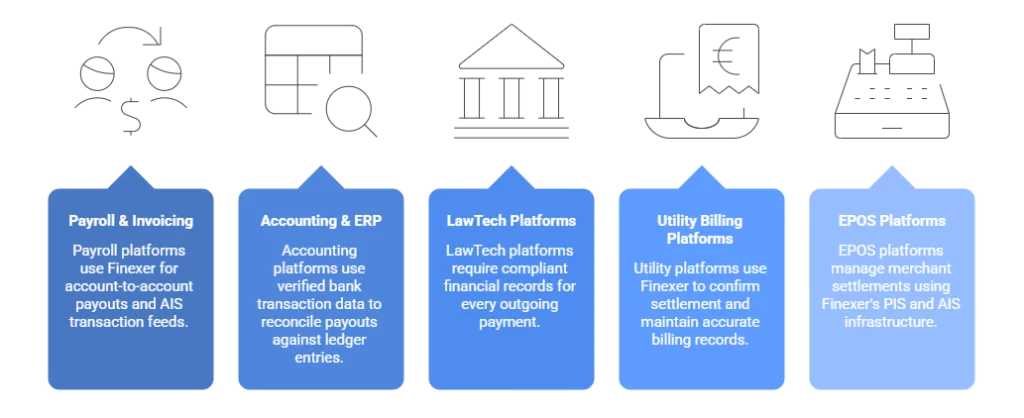
- Payroll & Invoicing Platforms
Payroll platforms sending contractor and employee disbursements use Finexer’s PIS infrastructure to initiate account-to-account payouts and AIS transaction feeds to confirm settlement. Each payment is matched to the corresponding payroll record automatically – removing manual reconciliation from end-of-period processing.
- Accounting & ERP Platforms
Accounting platforms managing vendor disbursements and client payments use verified bank transaction data to reconcile payouts against ledger entries. Structured transaction outputs map directly to charts of accounts fields, supporting automated journal entry generation and reducing month-end reconciliation workload.
- LawTech Platforms
LawTech platforms handling client fund disbursements require compliant financial records for every outgoing payment. Finexer’s AIS connectivity provides bank-verified transaction confirmation for each payout UK-wide, supporting the audit trail requirements that regulated legal workflows demand.
- Utility Billing Platforms
Utility platforms processing customer refunds and credit disbursements use Finexer’s payout infrastructure to confirm settlement and maintain accurate billing records. Real-time webhook events enable immediate detection of failed refunds before they generate customer complaints.
- EPOS Platforms
EPOS platforms managing merchant settlements use Finexer’s PIS and AIS infrastructure to initiate end-of-day settlements and verify transaction completion. Structured payout records support merchant-facing reporting and reduce disputes from unconfirmed settlement data.
What is payout reconciliation for UK platforms?
Payout reconciliation is the process of confirming that disbursements have settled, matching them to the correct financial records, and maintaining accurate reporting. It is distinct from payout execution – which only confirms a payment was initiated, not that it completed and matched correctly.
How does Open Banking improve payout reconciliation?
Open Banking AIS connectivity provides bank-verified transaction data confirming payout settlement directly from source. Platforms can automate matching of disbursements to transaction records, detect failures in real time, and maintain structured financial records without manual statement review.
Is Finexer suitable for platforms managing high-volume payouts UK-wide?
Yes. Finexer is FCA-authorised and provides both PIS for account-to-account payout execution and AIS for transaction verification, covering 99% of UK banks. Platforms managing high-volume disbursements use Finexer’s infrastructure to automate reconciliation workflows and maintain audit-ready financial records.
Stop reconciling payouts manually. Let verified bank data do it.
About the Author

Finexer
The Finexer Team is a collective of fintech engineers, payments specialists, and Open Banking experts working on financial infrastructure for UK businesses. Finexer builds API-driven solutions that allow companies to access real-time bank data, initiate Pay by Bank payments, and integrate financial services directly into their products.